
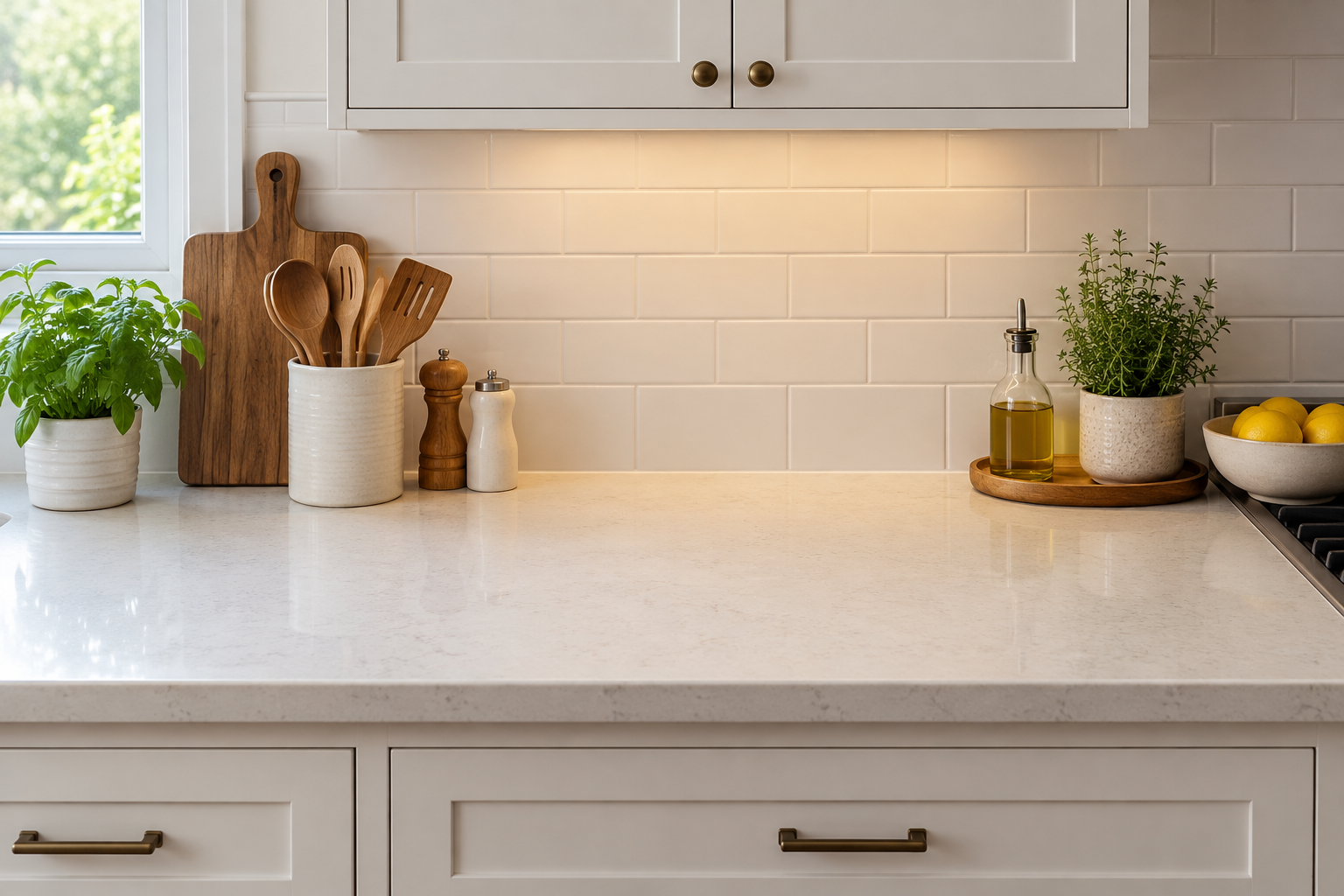
Kitchen counters have to do a lot of work. They are prep surfaces, appliance parking spots, serving areas, and sometimes an accidental home for everything that doesn’t have a place.
That is why simply clearing the counter often doesn’t solve the problem. If everything goes back to the same surface afterward, the clutter returns.
The goal isn’t to keep your kitchen counter completely empty. It is to make the space work well for the way you actually use your kitchen.
Start with the space you have, protect the working area you need most, and give the things that remain a clear reason for being there.
Clear the Counter Before You Organize It
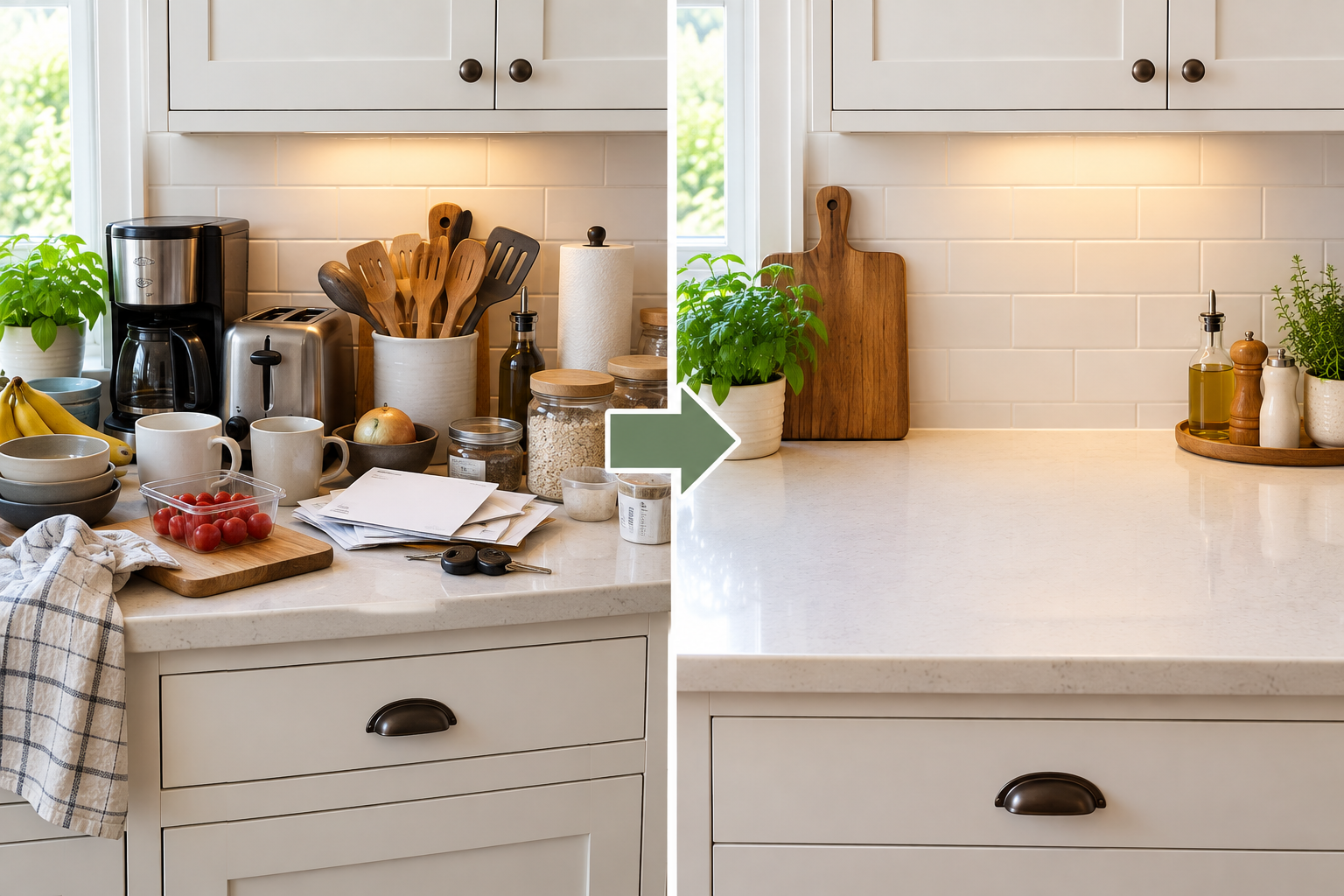
Start by removing everything from the countertop.
Don’t try to organize items while they are still sitting in their usual places. Clearing the surface gives you a better view of how much space you actually have and makes it easier to notice what has been using the counter simply because there was nowhere else to put it.
As you clear the counter:
- Put items that belong elsewhere in a temporary group.
- Set aside things you use regularly.
- Group similar kitchen items together.
- Separate items you rarely use.
- Remove obvious rubbish or empty containers.
- Clean the countertop before putting anything back.
At this stage, don’t worry about buying organizers.
First decide what deserves the space.
Decide What Deserves Counter Space
Not everything that is useful needs to live on the counter.
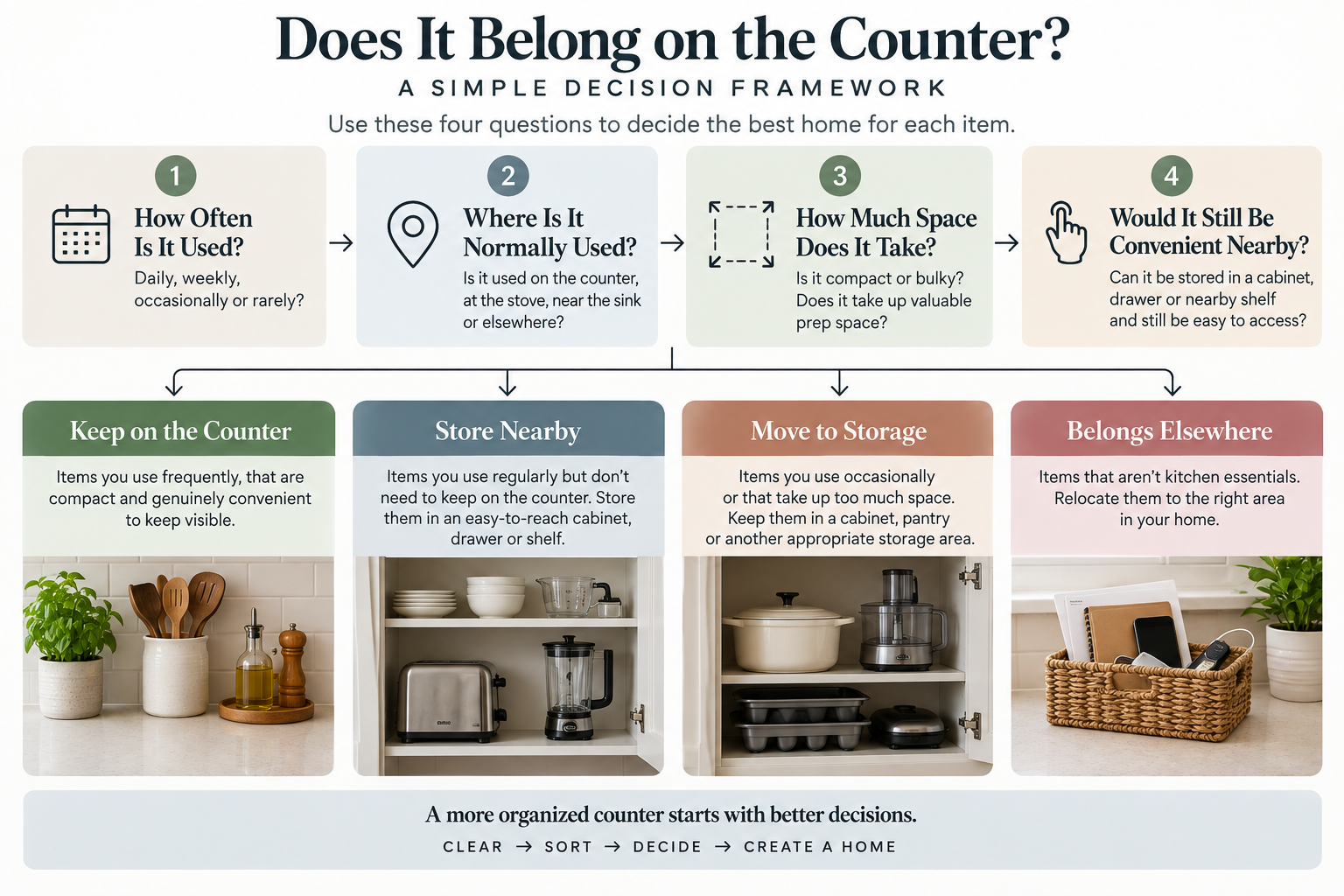
A better decision starts with four questions:
1. How often is it used?
Consider whether the item is used daily, regularly, occasionally, or rarely.
Frequency matters, but it shouldn’t be the only factor.
2. Where is it normally used?
An item may be convenient on the counter if that is where you actually use it.
For example, something used during food preparation may make more sense near the prep area than across the kitchen.
3. How much space does it take?
A small frequently used item and a large frequently used appliance create very different storage decisions.
Consider how much valuable working surface the item occupies.
4. Would it still be convenient nearby?
An item doesn’t necessarily need to sit on the counter to remain accessible.
A nearby cabinet, drawer, shelf, or other storage location may keep it just as convenient while giving you more working space.
Four Possible Outcomes
After considering those questions, most items can fall into one of four categories:
- Keep on the counter: For items that are frequently used, reasonably compact, and genuinely convenient where they are.
- Store nearby: For items you use regularly but don’t need sitting visibly on the counter.
- Move into storage: For occasional-use items or bulky items that take more workspace than they are worth.
- Move elsewhere: For things that aren’t really kitchen items or have simply ended up there because the counter became a default drop zone.
The important point is that there is no universal list of things that should or shouldn’t stay on a kitchen counter.
Your decision should reflect your kitchen, your available space, and your routine.
Protect Your Main Working Space
Once you’ve decided what deserves counter space, protect the area where you actually need to work.
For many kitchens, that means keeping a reasonably clear section for:
- chopping
- assembling meals
- preparing ingredients
- unloading groceries
- plating food
- other everyday tasks
Don’t fill every available corner simply because you can.
A counter can look organized while still being difficult to use.
Think of your main working surface as the space that everything else has to work around.
If an appliance, decorative item, or storage container regularly gets in the way, reconsider whether it deserves that location.
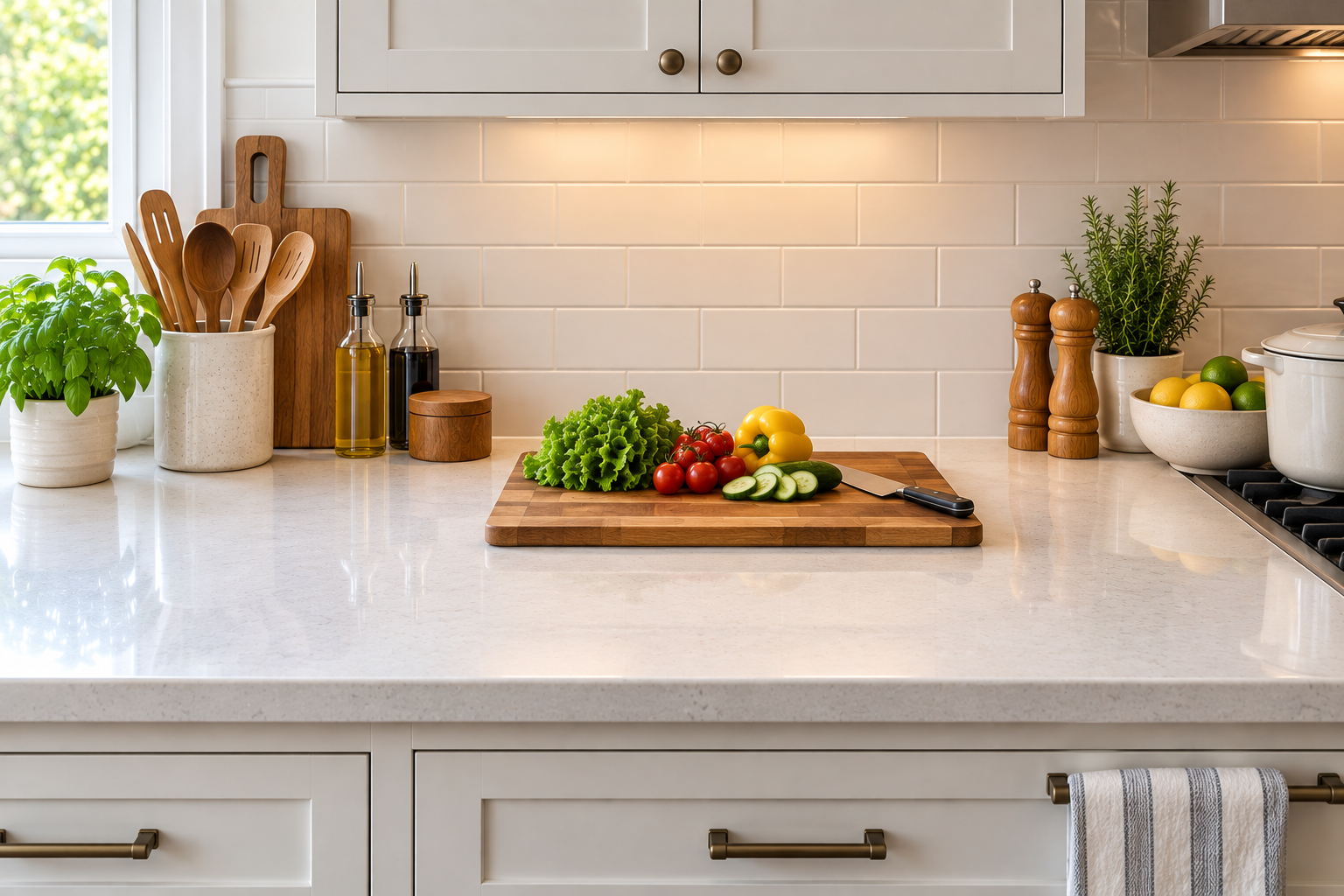
A useful counter doesn’t have to be empty from edge to edge. It simply needs enough open space for the work your kitchen requires.
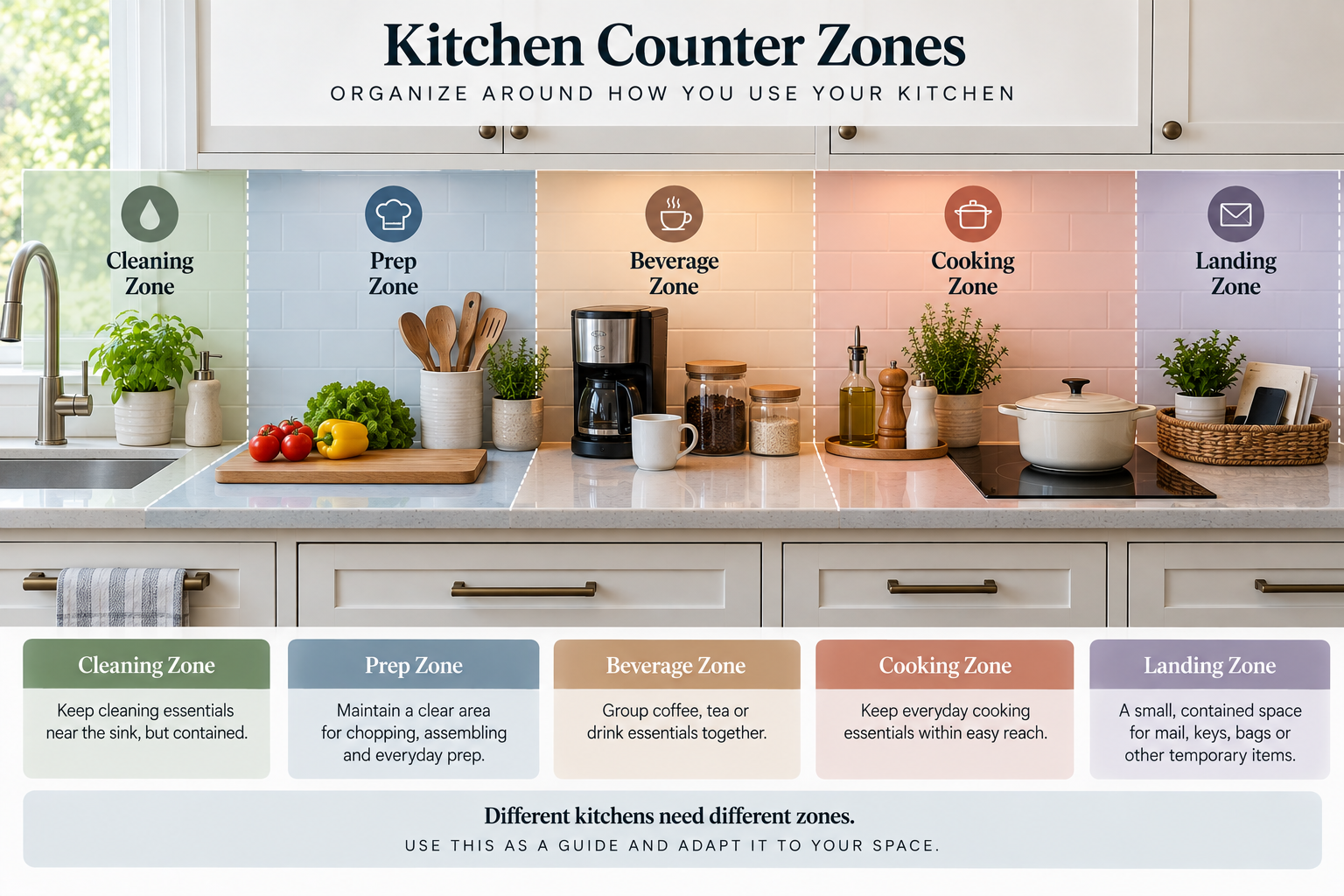
Create Simple Counter Zones
Instead of giving every individual item its own designated spot, group items according to the activities that happen in your kitchen.
Depending on your layout, you might have areas for:
- Prep: a clear surface for chopping and assembling.
- Cooking: frequently used cooking essentials near the stove.
- Beverages: coffee, tea, or other drink-making supplies grouped together.
- Cleaning: essentials kept near the sink but contained.
- Landing: a small, deliberate space for temporary items if your household genuinely needs one.
You don’t need all five.
You may only need two or three.
The point is to organize around how you use the kitchen, rather than creating zones simply because they sound organized.
Keep Related Items Together
Grouping related items can make a counter easier to use.
For example, if you regularly make coffee in one part of the kitchen, keeping the items involved in that routine together may be more practical than scattering them across several cabinets and sections of counter.
The same idea can work for cooking or food preparation.
The goal is not to create perfectly styled displays. It is to reduce unnecessary movement and make the things you actually use easier to find and return.
Give Frequently Used Items a Logical Home
Frequently used items are often the hardest to organize because there is a temptation to leave everything within arm’s reach.
Instead, ask whether the item needs to be visible or simply accessible.
Those are different things.
A utensil used throughout the day may need a convenient home, but that doesn’t automatically mean it needs to sit on the countertop.
If a smaller tool belongs in a drawer, our guide to organizing kitchen drawers can help you create a more useful home for it.
Larger or less frequently used items may be better suited to cabinet storage. See our guide to organizing kitchen cabinets for a broader storage system.
Look for the point where accessibility and workspace balance each other.
A good home should make it easy to:
Take it out → Use it → Put it back
If putting something away is difficult, it is more likely to migrate back onto the counter.
Handle Small Appliances Without Losing Your Workspace
Small appliances can quickly consume a large amount of countertop space.
Look at each appliance individually rather than deciding that all appliances should stay out or all should be stored away.
Consider:
- How often you use it
- How heavy or awkward it is to move
- Where you use it
- How much counter space it occupies
- Whether nearby storage is practical
- Whether leaving it out interferes with food preparation
A coffee maker that is used every morning may have a strong case for staying out.
A bulky appliance used occasionally may be better stored elsewhere.
The right answer depends on the appliance and your kitchen.
The goal is to avoid allowing convenience to slowly consume the entire work surface.
Use Vertical Space Only When It Solves a Problem
When countertop space is limited, look beyond the horizontal surface.
Depending on your kitchen, useful storage may come from:
- the wall
- the space underneath cabinets
- the inside of cabinet doors
- shelves
- vertical organizers
But don’t add storage simply because an empty wall or corner is available.
Every storage solution should solve a specific problem.
If a new shelf gives you storage but makes the counter feel visually crowded or interferes with your workspace, it may not actually improve the kitchen.
More storage isn’t always better storage.
Stop the Counter From Becoming a Drop Zone
Kitchen counters often attract things that don’t belong in the kitchen at all.
Mail, paperwork, bags, chargers, keys, and miscellaneous household items can gradually turn a useful work surface into general storage.
If this happens regularly, repeatedly clearing the counter won’t solve the underlying problem.
Give those items a better destination.
That might be:
- a small entryway basket
- a designated paperwork area
- a charging location
- a place for reusable bags
- a simple household drop zone somewhere else
If food and pantry items are repeatedly taking over the counter, our pantry organization guide can help you create better homes for everyday food storage.
If you genuinely need a temporary landing area in the kitchen, keep it small and intentional.
The goal is to prevent the entire countertop from becoming the landing zone.
Adapt the System to a Small Kitchen Counter
A small counter doesn’t necessarily need more organizers.
It usually needs more deliberate decisions.
- Protect the most useful working area first.
- Keep only the items that genuinely benefit from being accessible.
- Move occasional-use items into nearby storage.
- Combine related items into simple zones.
- Use vertical or hidden storage where it genuinely helps.
- Avoid filling every remaining corner.
The less counter space you have, the more important it becomes to distinguish between accessible and visible.
For a broader approach to organizing a compact kitchen, see our guide to how to organize a small kitchen.
Test the System Before Buying More Organizers
This step is easy to skip.
Once you’ve arranged the counter, use your kitchen normally for several days.
Pay attention to what happens.
- Does something keep moving to another location?
- Does an appliance constantly get in the way?
- Are you reaching across the kitchen for something you use frequently?
- Does one area become cluttered again and again?
These are useful signals.
If something repeatedly ends up in the same place, your original storage decision may not match your actual routine.
Change the system before buying another organizer.
Sometimes the best solution is simply moving an item closer to where it is used.
Common Kitchen Counter Organization Mistakes
Organizing Before Clearing
Trying to fit everything into its existing space makes it harder to see what you actually need.
Clear first. Decide second.
Keeping Every Appliance Out
Frequent use doesn’t automatically make an appliance a good countertop resident.
Consider its size and the workspace it consumes.
Sacrificing Your Prep Area
An organized counter isn’t useful if there isn’t enough room to prepare food.
Protect your main working surface.
Creating Too Many Zones
Zones should make the kitchen easier to use.
If every small group of items becomes its own zone, the system can become complicated rather than helpful.
Buying Organizers Too Early
An organizer cannot fix a poor storage decision.
Decide what belongs where first. Then determine whether an organizer is actually necessary.
Organizing for Appearance Instead of Workflow
A countertop can look beautiful and still be frustrating to use.
Prioritize accessibility, working space, and easy returns.
Using the Counter as General Storage
If everything without a home ends up on the counter, the problem is bigger than countertop organization.
Create destinations for those items.
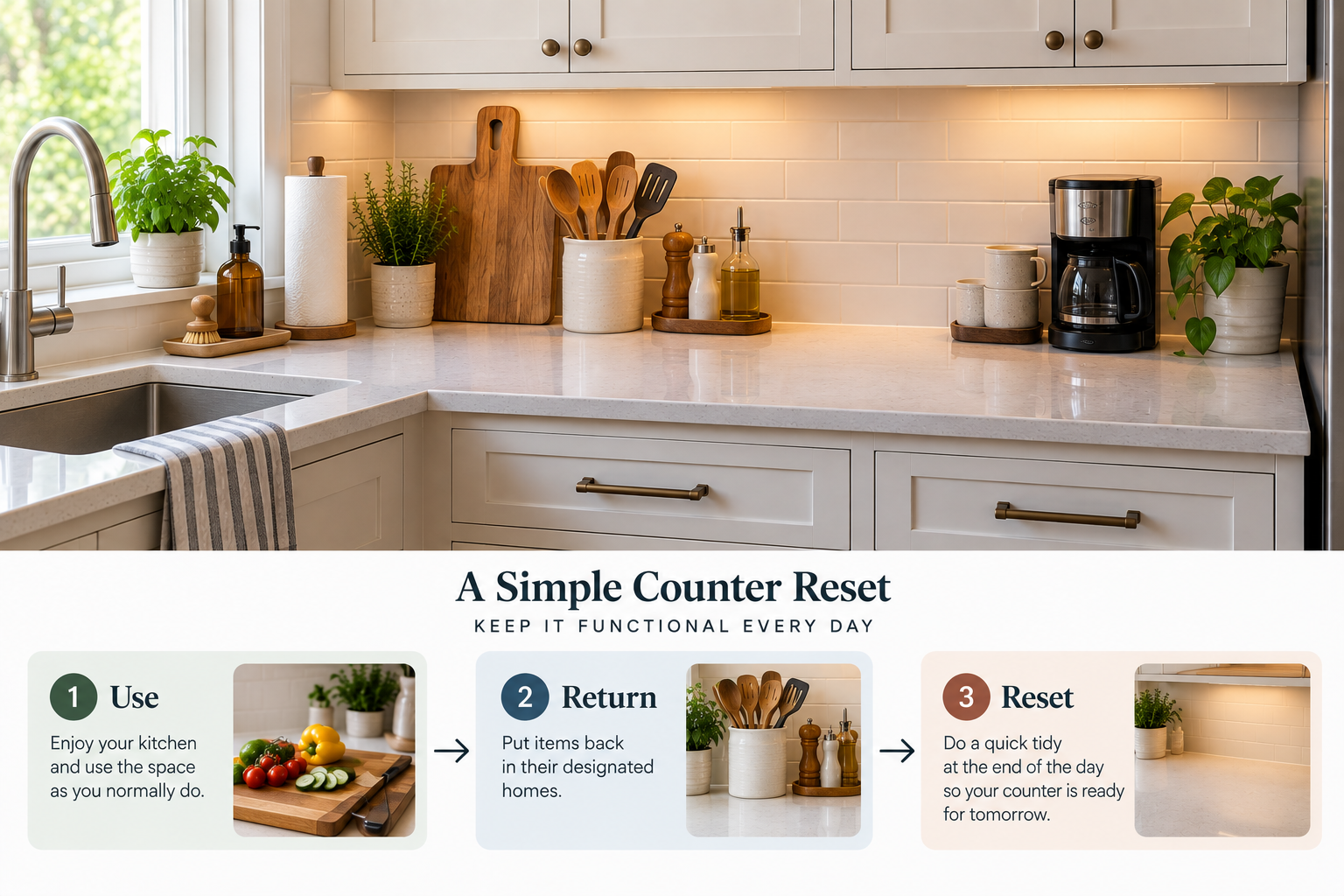
A Simple Counter Reset
Once the system works, maintenance should be straightforward.
You don’t need an elaborate routine.
Use this simple pattern:
Use the kitchen normally.
Return items to their designated homes when you’re finished.
Then do a quick reset so the main working surface is ready for the next day.
The most useful maintenance system is one that fits naturally into your routine.
If returning an item takes too much effort, reconsider its home.
The easier the system is to maintain, the more likely it is to last.
Kitchen Counter Organization FAQ
What should I keep on my kitchen counter?
Keep items that you use frequently, are convenient where they are, and don’t take more valuable workspace than they’re worth. The right combination depends on your kitchen and routine.
What should not be stored on kitchen counters?
Avoid using the counter as general storage for rarely used items, bulky appliances that interfere with your workspace, or objects that belong elsewhere in the home.
How do I keep my kitchen counter clutter-free?
Give frequently used items clear homes, protect your main prep area, create destinations for non-kitchen clutter, and make returning items easy.
How do I organize a small kitchen counter?
Start by protecting the most useful working area. Keep only items that genuinely benefit from being accessible, and move occasional-use items into nearby storage.
Should kitchen appliances stay on the counter?
Not necessarily. Consider how often each appliance is used, how much space it takes, how difficult it is to move, and whether nearby storage would still be convenient.
How many counter zones should a kitchen have?
There is no required number. Create zones around the activities that actually happen in your kitchen. Some kitchens may need only a couple of functional areas.
The Goal Is a Counter That Works
An organized kitchen counter isn’t necessarily the emptiest one.
It is the one that gives you enough working space, keeps useful items accessible, and makes it easy to return things when you’re finished.
Start by clearing the surface. Then decide what deserves to stay, create simple zones around your workflow, protect your working area, and test the system before buying more storage.
The best organization system is the one that makes your kitchen easier to use and easier to reset.