
A small living room can be organized without making it feel even smaller. The key is to protect usable space first, then decide what furniture, storage, and everyday items actually deserve that space.
To organize a small living room without crowding it, start by protecting the floor space you need for movement. Remove furniture that does not earn its footprint, choose pieces by size and function, keep walking paths clear, reduce visual bulk, and add storage only when it solves a specific problem. Test the arrangement before buying anything else.
The Our System at a Glance
- Start With the Space You Need to Protect
- Remove Furniture Before Adding Storage
- Choose Furniture by Footprint, Not Just Appearance
- Fix the Walking Paths Before Styling the Room
- Reduce Visual Crowding, Not Just Physical Clutter
- Use Storage That Gives Space Back
- Use Zones Without Building Walls of Furniture
- Test the Room Before Buying Anything Else
- Know When the Room Has Reached Its Capacity
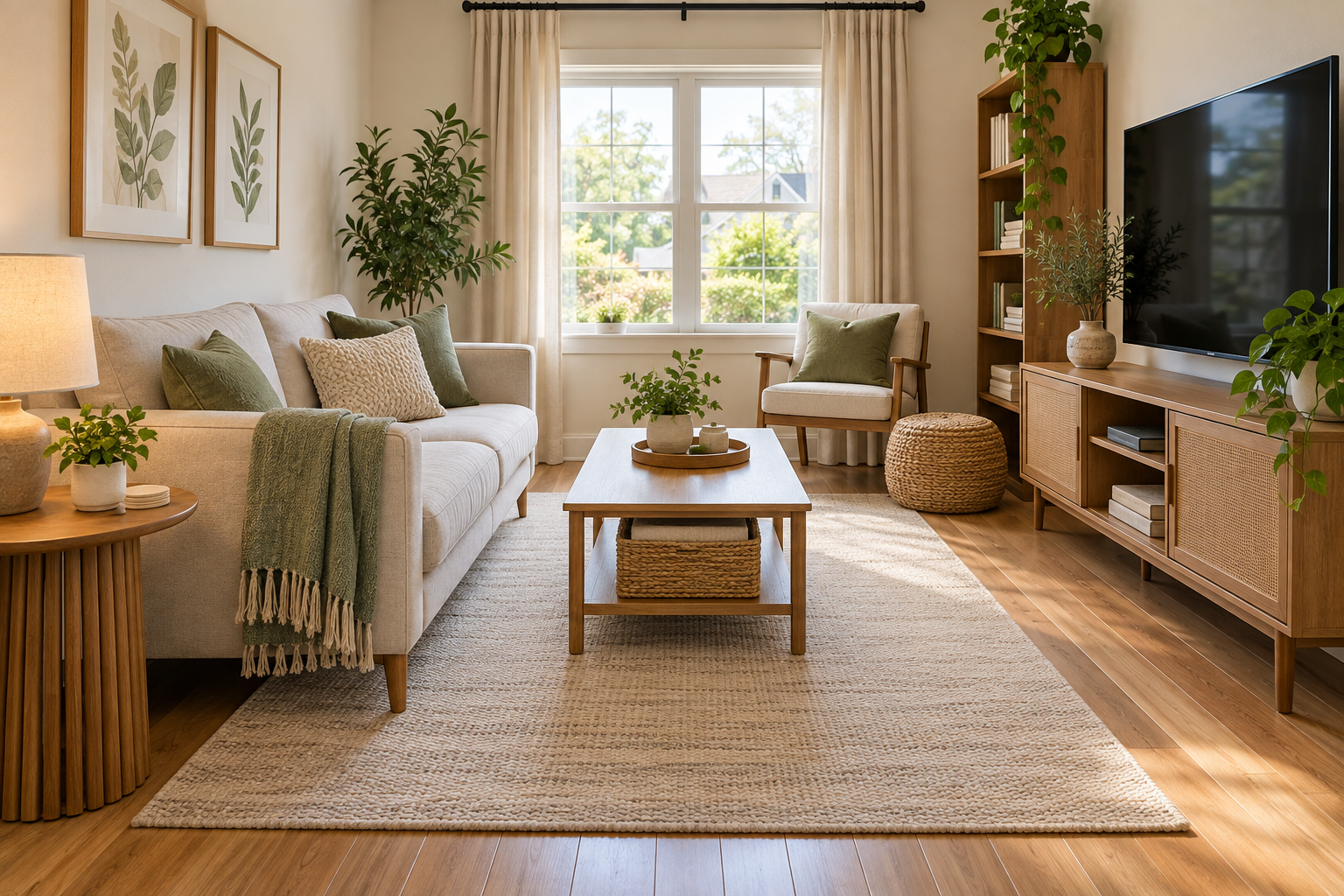
1. Start With the Space You Need to Protect
The first mistake in a small living room is thinking about storage before thinking about space.
Every piece of furniture takes a footprint. Some also create a second cost by narrowing a walking route, blocking a door, making another piece harder to use, or making the room feel visually heavier.
The answer
Protect the floor area needed for comfortable movement before deciding what else the room can hold.
Why it matters
A room can contain plenty of useful furniture and still feel crowded if the remaining space is awkward or difficult to move through.
Look at the room as a map. Identify the doorway, the main seating area, the route to frequently used furniture, and any path that must remain open.
The goal is not to create a large empty center. The goal is to preserve the routes and open areas that make the room usable.
2. Remove Furniture Before Adding Storage
If a small living room feels crowded, the problem may be too much furniture rather than too little storage.
Start by temporarily removing or relocating pieces that have overlapping jobs. A side table that is rarely used, a second occasional chair, a decorative cabinet, or an extra floor basket may consume more useful space than the category they serve is worth.
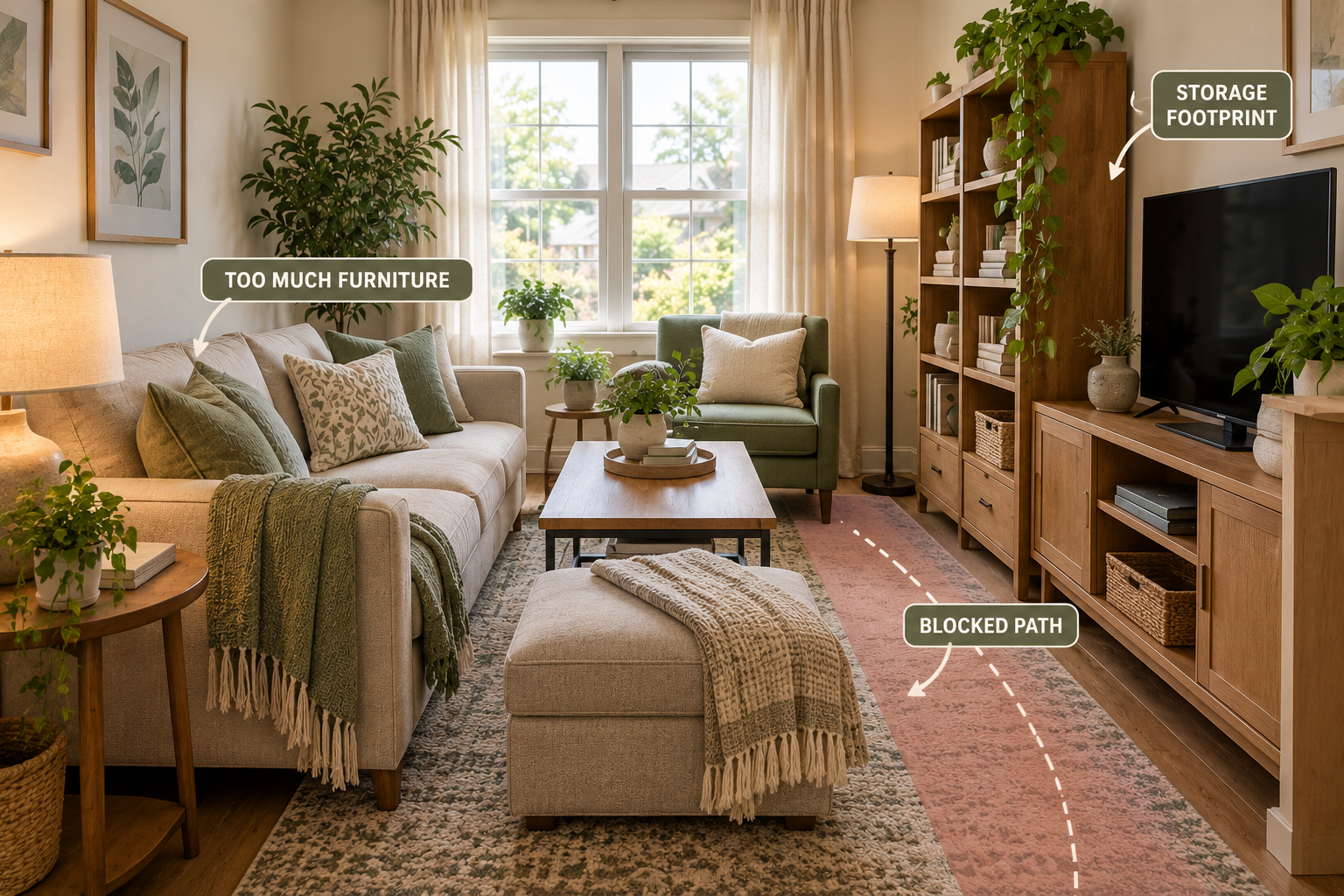
What job does it perform?
If the function is unclear, the footprint deserves another look.
Is that job already covered?
Two pieces doing essentially the same job may not both be necessary.
Does it earn its footprint?
Keep the piece when its useful function justifies the space it occupies.
This does not mean choosing the fewest possible pieces. It means choosing the pieces that support how the room is actually used.
3. Choose Furniture by Footprint, Not Just Appearance
Furniture can look attractive in isolation and still be too large for a small room.
Before keeping or buying a piece, consider its width, depth, height, clearance needs, and relationship to nearby furniture. A visually simple piece can still create crowding if its footprint is too large.
Measure the Real Footprint
- Measure the available area where the piece will sit.
- Mark the approximate footprint on the floor with removable tape or paper.
- Check the walking route around it.
- Open nearby doors and drawers if applicable.
- Walk through the room normally before deciding.
This simple test is more useful than judging a product from a photograph or assuming that a piece described as “small-space” will automatically fit your room.
Think in terms of total footprint, not just the object itself. A table may require room for someone to sit beside it. A cabinet may require door clearance. A basket may need enough surrounding space to be reached without becoming an obstacle.
4. Fix the Walking Paths Before Styling the Room
A room can be technically organized and still feel cramped because the main walking route is awkward.
Identify the paths people naturally use. Then look for furniture corners, baskets, ottomans, plant stands, and other objects that narrow those routes.
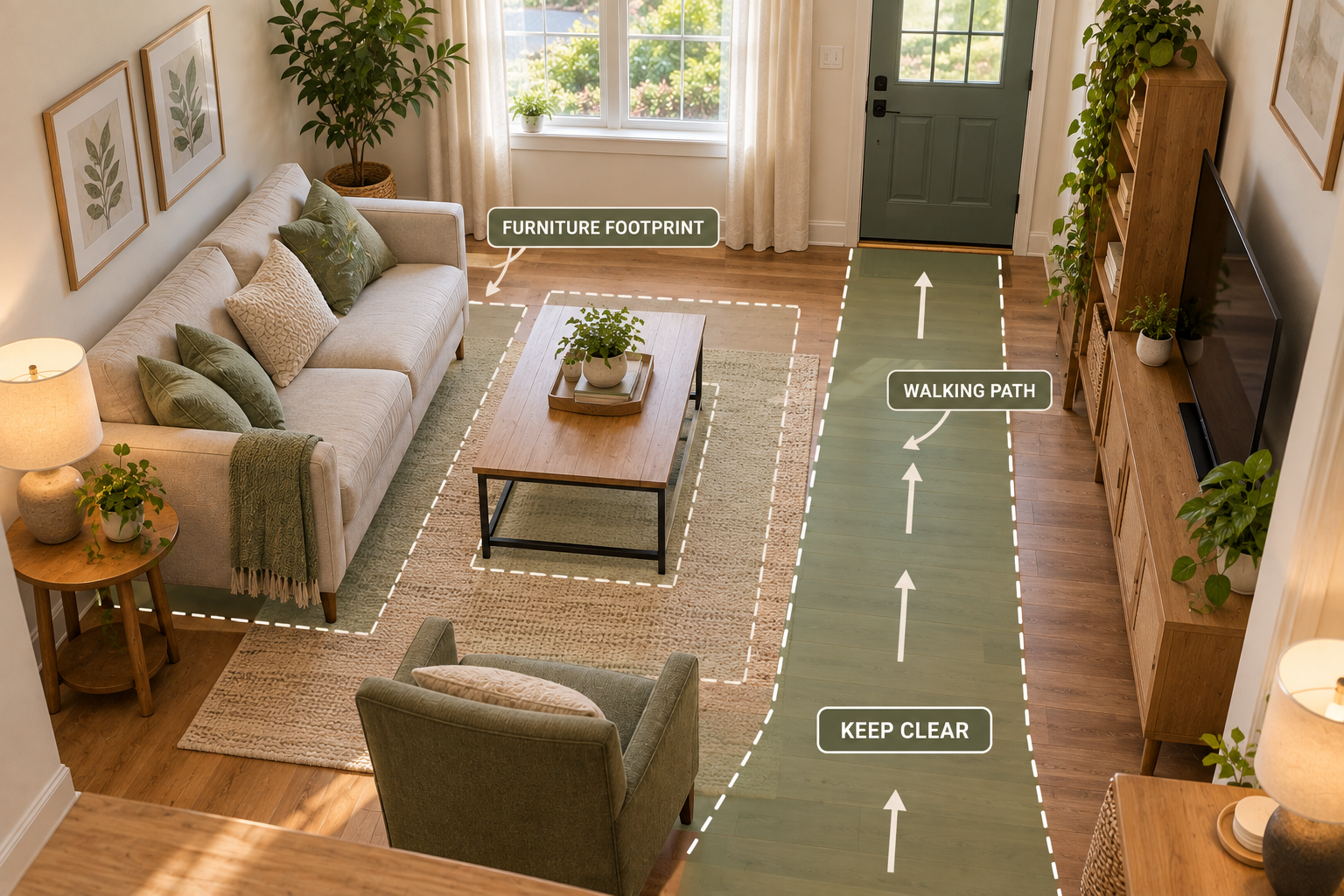
There is no single clearance number that works for every living room. The better test is whether the actual route works comfortably with the furniture in place.
Mark the intended route, walk it, and adjust the furniture until movement feels natural. Check the route from more than one direction because a layout that works from the doorway may still feel awkward around the sofa or coffee table.
Do not use every open patch of floor just because it is available. Some open space is what makes the rest of the room usable.
5. Reduce Visual Crowding, Not Just Physical Clutter
Crowding is not only about how much floor furniture occupies. A room can have a reasonable layout and still look busy when too many objects compete for attention.
Look at the room from the main entrance and from the primary seating position. Notice tall furniture, stacked containers, crowded shelves, large groups of decor, and several small pieces clustered together.
You do not need to remove everything. Instead, reduce visual competition.
- Group similar small items rather than spreading them across several surfaces.
- Keep frequently used surfaces purposeful rather than completely full.
- Limit storage containers that do not solve a defined problem.
- Use vertical space selectively instead of filling every wall.
- Leave some visible breathing room around major furniture.
The goal is a room that is easy to read at a glance. When the eye can identify the sofa, main table, storage, and walking route without visual competition, the room often feels more open even though the physical dimensions have not changed.
6. Use Storage That Gives Space Back
Storage should solve a real problem. It should not be added simply because an empty corner exists.
Before buying an organizer or storage piece, identify what keeps becoming clutter, where that category is used, and how often it needs to be accessed.
What keeps accumulating?
Identify the category that repeatedly becomes clutter.
Where is it used?
Keep its storage close enough that returning it is convenient.
Does the storage earn its footprint?
Choose the solution only when the storage benefit justifies the space it occupies.
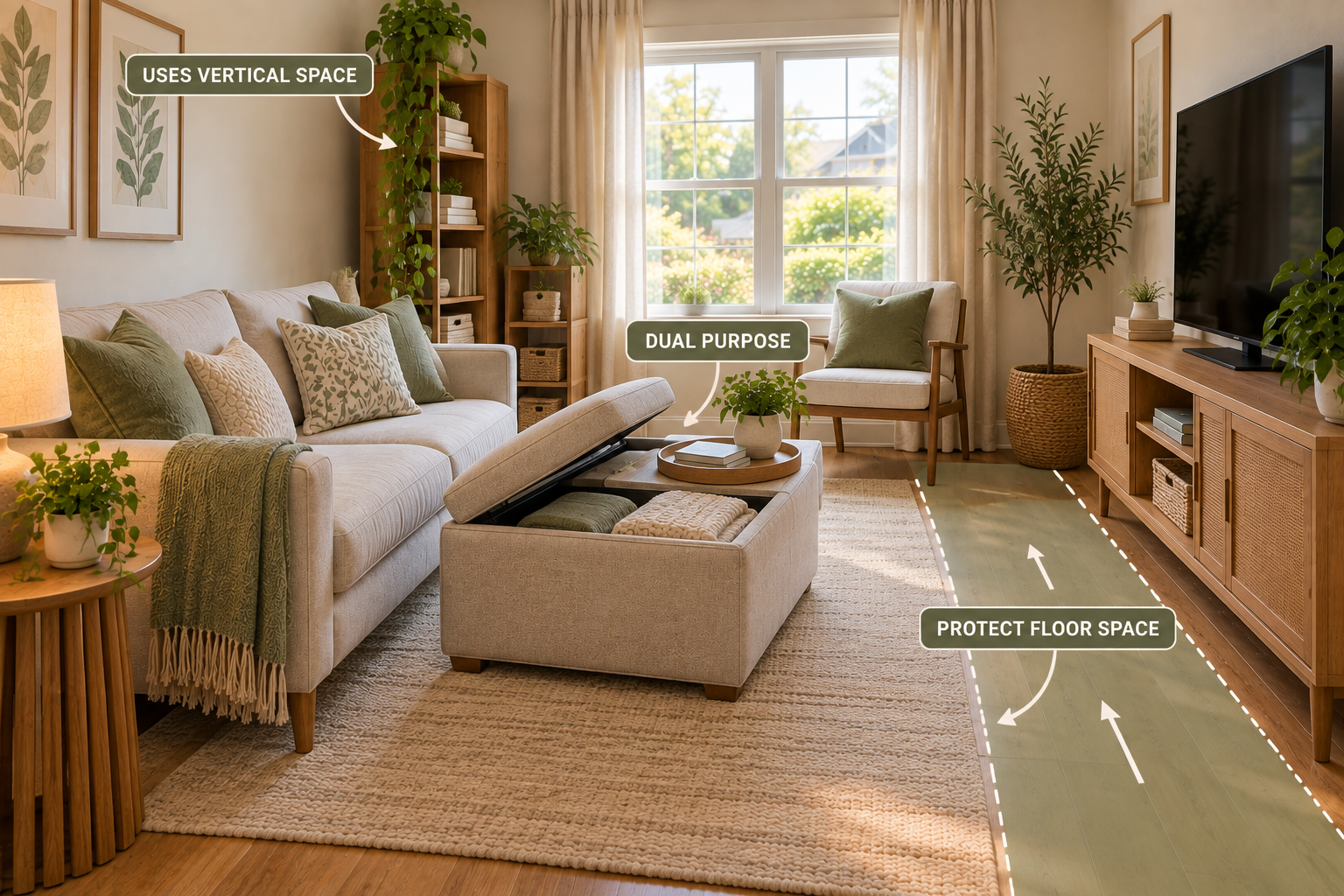
Dual-purpose furniture can make sense when you genuinely need both functions. A storage ottoman, for example, can combine seating or foot support with concealed storage. The important part is that both functions are useful enough to justify one piece.
- Measure the available footprint.
- Confirm that doors, drawers, and walking paths remain usable.
- Check what the storage will actually hold.
- Choose access based on how often the items are used.
Dual-purpose storage seating
A storage ottoman can make sense when you need seating, a footrest, or a flexible surface and also need concealed storage. Measure the room first because a larger bench-style footprint may not suit every small living room.
Compact side-table alternative
A C-shaped or adjustable side table can provide a useful surface while tucking closer to a sofa or chair than a conventional table. Check the actual footprint and clearance in your room before buying.
As an Amazon Associate I earn from qualifying purchases. Some links on this page are paid links, which means Simply Tidy Home may earn a commission if you purchase through them, at no additional cost to you.
7. Use Zones Without Building Walls of Furniture
A small living room may need to support more than one activity: relaxing, watching TV, reading, working briefly, or storing everyday items.
You do not need a separate piece of furniture for every activity. Instead, define simple zones through placement and routine.
| Activity | Simple zone approach |
|---|---|
| Relaxing | Keep the main seating area clear and easy to use. |
| Reading | Use an existing seat and a small nearby surface when possible. |
| TV / media | Keep necessary electronics together rather than spreading accessories around the room. |
| Everyday storage | Place only the storage categories that genuinely belong in the living room. |
The more functions one piece can reasonably support, the less pressure there is to create another furniture footprint.
RELATED GUIDE How to Organize a Small Living Room Use the broader guide for the full organization system—clearing, zoning, assigning homes, storage, and maintenance. This article focuses specifically on preventing those solutions from making the room feel crowded.8. Test the Room Before Buying Anything Else
A small living room is easier to organize when you treat the layout as something you can test rather than something you have to get right immediately.
Move questionable pieces temporarily. Mark a proposed footprint. Live with the arrangement for several days if possible.
Keep it if…
The room remains easy to move through, the furniture has a clear purpose, and the storage solves a recurring problem.
Change it if…
The same route feels awkward, a surface becomes a dumping ground, or the new storage creates another obstacle.
Watch what happens naturally. If an item repeatedly lands on the floor, its storage location may be inconvenient. If a table repeatedly collects things that do not belong there, the category may need a better home. If a walking route still feels awkward, the furniture arrangement needs another adjustment.
This test is especially useful before buying storage. A few days of observation can tell you whether you actually need another product or simply need to change the layout.
9. Know When the Room Has Reached Its Capacity
There is a point where adding another organizer, basket, table, or cabinet makes the system worse.
The room has probably reached its practical capacity when adding one useful item forces you to block a walking route, remove another useful function, create awkward clearance, or fill the remaining visual breathing room.
| If the problem is… | Try this first |
|---|---|
| Too much furniture | Remove or combine overlapping functions. |
| Blocked movement | Rework the furniture footprint and walking route. |
| Too many organizers | Reduce containers and solve the underlying category problem. |
| Heavy visual appearance | Edit surfaces, tall pieces, and groups of small objects. |
| No place for essentials | Create a home near where the items are actually used. |
| Several activities competing | Use simple zones and multi-functional pieces where appropriate. |
Daily
Return everyday items, reset the main surfaces, and keep the primary walking route clear.
Weekly
Notice whether any storage category is overflowing or whether furniture is drifting into the walking path.
Before buying
Measure the footprint and ask whether the new item solves a problem worth the space it consumes.
The goal is not to make a small living room look empty. It is to make the available space work harder without asking the room to hold more than it can comfortably support.
Frequently Asked Questions
How do I organize a small living room without making it feel cramped?
Protect walking space first, remove furniture that does not earn its footprint, choose appropriately scaled pieces, reduce visual bulk, and add storage only for a specific need.
Why does my small living room feel crowded?
Common causes include over-sized furniture, overlapping furniture functions, blocked walking paths, too many storage pieces, and too much visual competition.
How do I add storage without taking up too much floor space?
Start with the storage problem, then consider dual-purpose furniture or carefully chosen vertical storage. Measure the footprint and protect the walking route before adding anything.
Should furniture be against the walls in a small living room?
Not necessarily. The best position is the one that supports the room’s functions and keeps important movement routes usable. Test the layout instead of following a wall-placement rule automatically.
How much furniture should a small living room have?
There is no universal number. Keep the pieces that support real daily functions while leaving enough usable space for comfortable movement and access.
When should I stop adding storage?
Stop when another storage piece blocks movement, removes a useful function, creates awkward clearance, or makes the room feel more crowded than the problem it solves.
Key Takeaways
- Protect useful floor space before adding storage.
- Remove furniture that does not earn its footprint.
- Choose furniture by total footprint and function, not appearance alone.
- Test real walking paths instead of relying on rigid universal measurements.
- Reduce visual bulk as well as physical clutter.
- Use dual-purpose or space-efficient storage only when it solves a genuine need.
- Define activity zones without automatically adding more furniture.
- Test layouts before buying another organizer or furniture piece.
- Stop adding storage when the room’s remaining usable space becomes the bigger problem.
The Simple Rule to Remember
In a small living room, organization should create usable space rather than consume it.
Before adding anything, ask: Does this earn its footprint?
If the answer is yes, make sure the piece fits the actual room, protects movement, and supports a real daily need. If the answer is no, the best organizing solution may be removing something rather than buying something new.