
A small linen closet works best when you organize around its actual capacity. Reduce what needs to fit, measure the shelves, give the easiest space to everyday linens, and use organizers only where they solve a specific problem.
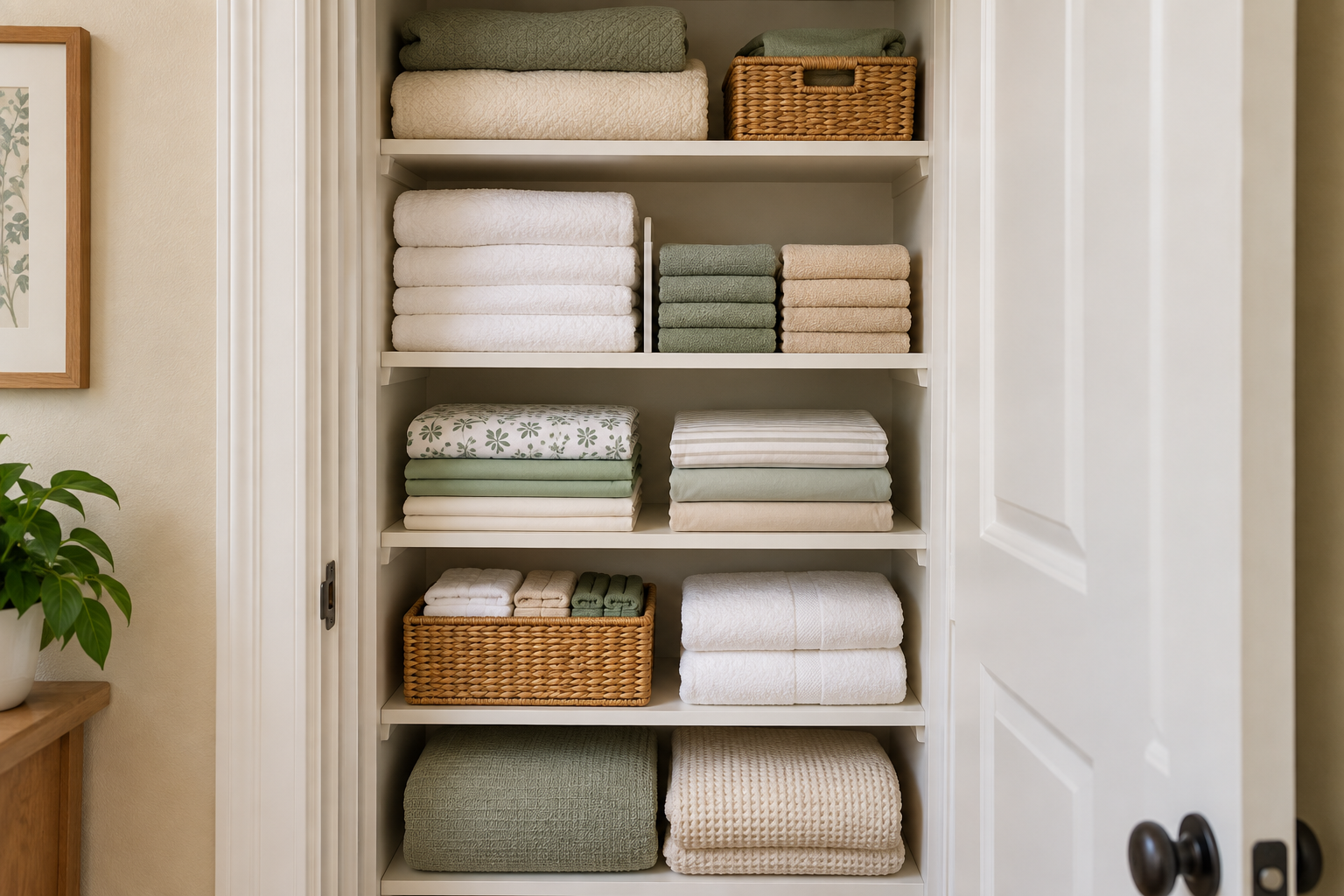
To organize a small linen closet, first remove anything that does not need to live there. Then measure the usable shelf space, group similar linens, give the easiest-to-reach shelves to everyday items, and use dividers or bins only where they solve a real storage problem.
The goal is not to fill every inch. The goal is to make the linens you use easy to see, remove, and put back.
The Small Linen Closet System
A small linen closet has less room for mistakes than a large one. One oversized basket can waste useful shelf space. One unstable towel stack can make an entire shelf difficult to use.
That is why the best approach is to solve the storage constraint first and choose products second.
1. Decide What Actually Needs to Fit
Start by taking everything out of the closet. Put towels, sheets, blankets, washcloths, guest linens, toiletries, and miscellaneous items into separate groups.
Do not organize the closet while it is still full. You need to see the amount of linen you are asking the space to hold before deciding how the shelves should work.
Separate the Inventory
- Everyday bath towels
- Hand towels and washcloths
- Frequently used sheet sets
- Guest or backup linens
- Bulky blankets and bedding
- Items that do not really belong in the linen closet
If the same category is spread across several piles, combine it before deciding how much shelf space it deserves.
2. Remove Items That Are Taking Space Without Helping
A small linen closet cannot give every item prime storage space. Remove worn-out linens, duplicates you no longer use, and unrelated household items that have gradually taken over the shelves.
You do not need to follow an arbitrary rule about how many towels or sheets a household should own. The useful amount depends on how often you do laundry, how many people use the home, and whether you regularly host guests.
If an item has not been used for a long time and you are keeping it only because there is technically room for it, ask whether that space would be more useful for something you reach for regularly.
3. Measure the Usable Shelf Space
Once the closet is empty, measure it before buying storage products. A small difference in shelf depth or vertical clearance can determine whether an organizer helps or simply consumes useful space.
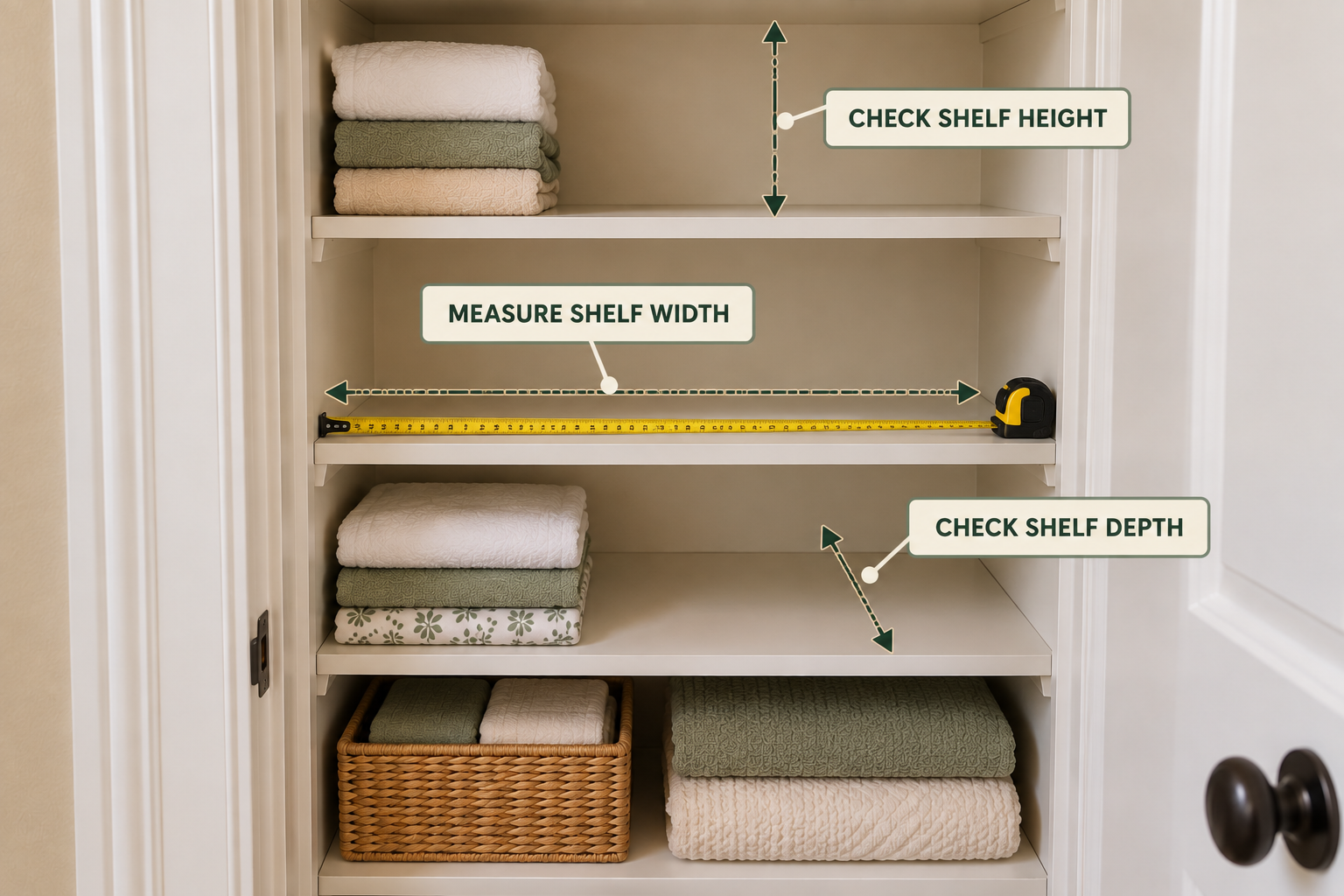
Width
Measure the usable space from one inside wall to the other.
Depth
Measure from the front edge of the shelf toward the back wall.
Height
Check the vertical clearance between shelves before adding a riser, basket, or other organizer.
Door Clearance
If you are considering door storage, check how much space remains when the closet door closes.
Keep these measurements available while shopping. An organizer that looks compact online may take up a large portion of a small shelf once it is actually installed.
4. Give the Best Shelves to the Things You Use Most
A small closet does not need equal access for every category. Everyday items should receive the most convenient locations.
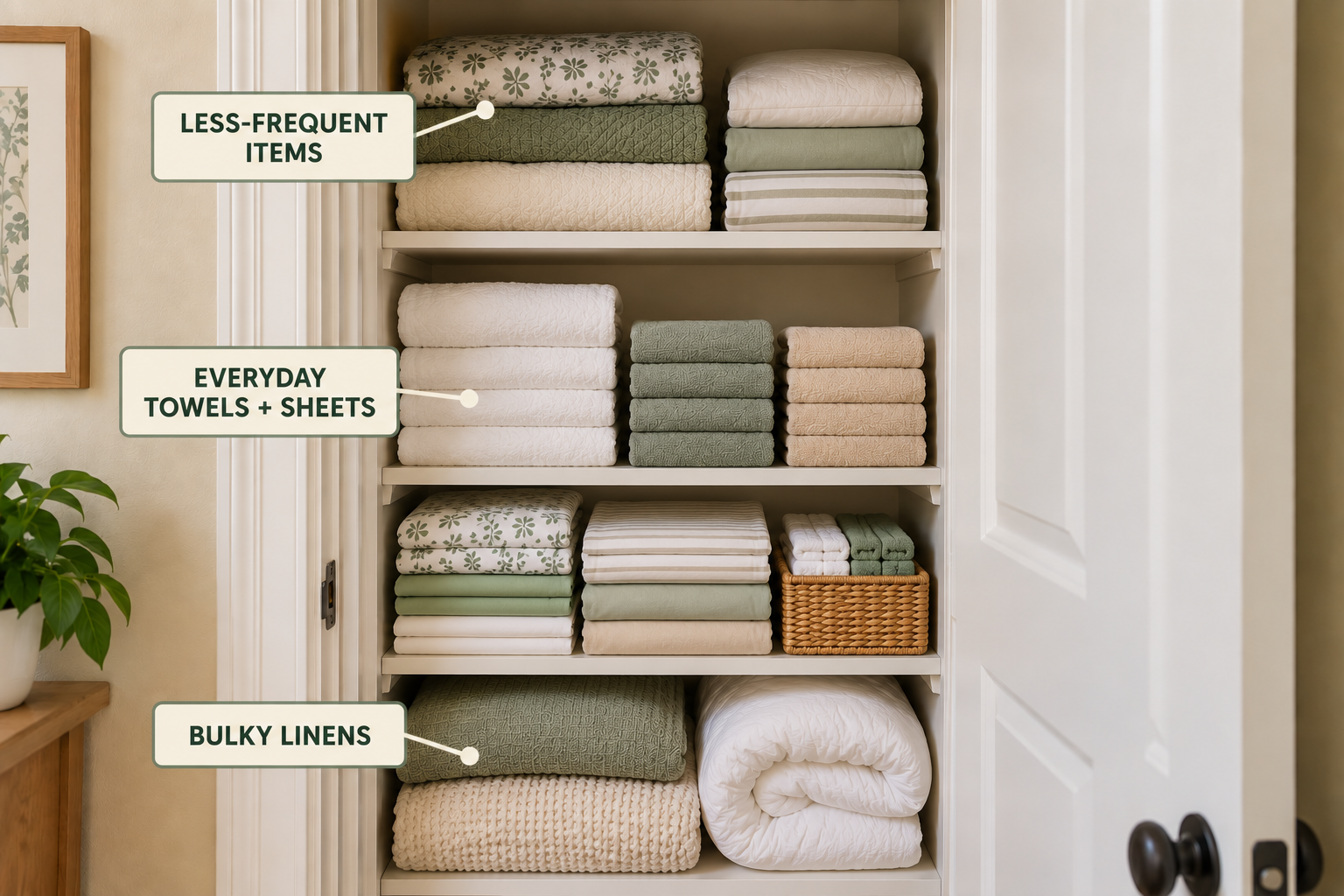
Prime Shelves
Use the easiest-to-reach middle shelves for everyday towels and frequently used sheet sets.
Higher Shelves
Use higher shelves for guest, backup, seasonal, or less frequently accessed linens.
Lower Shelves
Use lower shelves for bulky blankets or other larger items that do not need to be reached every day.
5. Group Small Categories Into Clear Zones
A small linen closet becomes difficult to use when several categories share one large pile.
Instead, give each important category a recognizable home. You do not need a separate basket for every category. A shelf can be a zone by itself.
Simple Linen Zones
- Bath towels
- Hand towels
- Washcloths
- Sheet sets
- Guest or backup linens
- Bulky blankets
6. Keep Complete Sheet Sets Together
Sheet sets are especially easy to lose track of in a small closet. Keep the fitted sheet, flat sheet, and matching pillowcases together as one recognizable unit.
You can fold the pieces into a compact bundle or place the folded pieces together in the same designated area. The important part is that one set does not become several separate categories scattered across the closet.
7. Fold Towels for the Shelf You Actually Have
There is no single folding method that works equally well for every linen closet.
A narrow shelf may work better with compact rectangular folds. A taller shelf may allow larger stacks. The right fold is the one that produces a stable stack without making the contents difficult to remove.
Avoid building stacks so tall that removing the bottom towel causes the entire pile to collapse.
8. Do Not Use a Container Just Because the Closet Is Small
Containers can help, but they also occupy space. In a small closet, the organizer itself becomes part of the capacity calculation.
A stable towel stack may need no container at all. A leaning stack may need a divider. A group of loose washcloths may be easier to manage in a small bin.
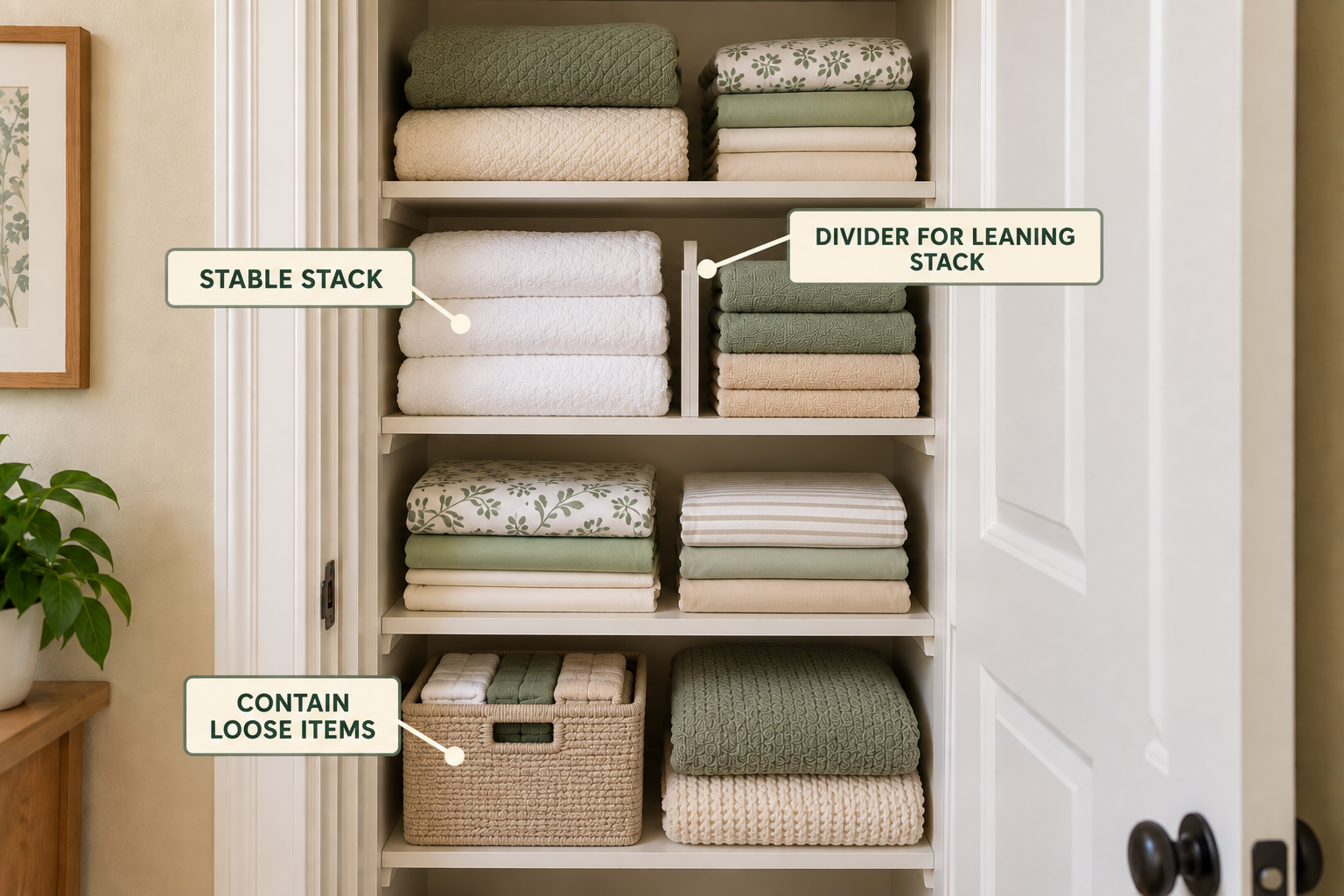
Which Organizer Does the Problem Actually Need?
Leave it open. Adding a container may only consume additional space.
Consider a shelf divider to give the category a defined boundary.
Consider a compact bin that fits the measured shelf space.
Do not use it simply because it looks organized. Try a smaller or simpler solution.
9. Use Vertical Space Without Making the Shelf Harder to Reach
Small linen closets often have unused vertical space. A shelf divider, compact riser, or other vertical-storage solution can sometimes make that space useful.
But vertical storage is only helpful if the new level remains accessible. If you have to move several items every time you need the lower stack, the additional storage may be creating a new access problem.
After adding vertical storage, remove the item you use most from that shelf. If doing so requires moving several other items first, reconsider the arrangement.
10. Consider the Closet Door Only After Checking Clearance
The inside of the door can provide another storage surface in some closets. But door storage is not automatically a good solution.
Before using it, check the door thickness, hinge area, surrounding shelves, and the space required for the door to close normally.
The goal is to gain useful storage without turning the closet into a space where shelves and door-mounted items interfere with each other.
11. Decide What Should Not Live in the Closet
When a small linen closet feels permanently full, the solution may be moving some categories elsewhere rather than adding more storage.
Consider relocating unrelated household items, rarely used supplies, or bulky items that have another suitable storage location.
Keep the closet focused on the linens the household actually needs. A smaller number of clearly defined categories is easier to maintain than a larger collection that barely fits.
12. Build the Closet Around Retrieval, Not Appearance
A small closet can look organized while still being frustrating. A perfectly folded stack is not useful if removing one item causes the entire shelf to shift.
Test each zone by removing the item you use most often. You should be able to take it out without disturbing unrelated categories.
Ask These Three Questions
- Can I see what belongs in this zone?
- Can I remove one item without disturbing the whole shelf?
- Can I put it back without thinking about where it goes?
13. Make Laundry Day the Final Test
The real test of a small linen closet happens after laundry.
Fresh towels and sheets should have obvious homes. You should not need to rebuild the closet every time clean linens come out of the dryer.
If a category repeatedly ends up on top of another category, in front of another stack, or outside the closet, that is useful information. The zone may be too small, the category may have too much inventory, or the location may not match how often you use it.
14. Products That Can Solve Specific Small-Closet Problems
Once the system is working, a couple of simple products can help with specific problems. They should support the layout rather than determine it.
Affiliate disclosure
As an Amazon Associate I earn from qualifying purchases. Some links below are paid links, which means Simply Tidy Home may earn a commission if you purchase through them, at no additional cost to you.
FOR LEANING LINEN STACKS
HBlife Clear Shelf Dividers
Shelf dividers can be useful when a towel or linen stack repeatedly leans, shifts, or mixes with the category beside it.
The clear divider format keeps the shelf visually open while creating a defined boundary between stacks.
Best fit if: a measured shelf has enough room for the divider and a stack keeps losing its shape or moving into the neighboring category.
Before buying: check your shelf thickness and available width so the divider does not interfere with the way the shelf is used.
FOR LOOSE SMALL LINENS
Amazon Basics Collapsible Storage Bins
A compact fabric bin can group small loose linens when they spread across the shelf or become difficult to keep together.
The collapsible design can also be useful when a category is temporary or when you want the option to flatten the bin when it is not needed.
Best fit if: you have measured a suitable shelf space and need one movable category rather than several small loose piles.
Before buying: compare the product dimensions with your actual shelf width, depth, and vertical clearance.
15. Common Small Linen Closet Mistakes
- Buying organizers before measuring. The product becomes another space constraint.
- Trying to use every inch. A completely full shelf can be harder to access and reset.
- Giving every category equal shelf priority. Everyday linens deserve easier access than occasional items.
- Creating oversized towel stacks. A tall stack may look tidy until the bottom item is needed.
- Separating sheet-set pieces. This creates unnecessary searching later.
- Using too many containers. Containers consume space too.
- Ignoring door clearance. A door organizer can create interference if the geometry is wrong.
- Keeping unrelated items in the closet. Small storage works better when the space has a clear job.
16. Small Linen Closet Decision Flow
Use This Order
If not, edit the inventory before buying storage.
If not, measure width, depth, height, and door clearance.
Give those categories the prime shelves.
Choose a divider, bin, or other organizer only if it solves that specific problem.
If items repeatedly have nowhere to go, change the zone or reduce the category before adding more storage.
17. Maintain the Small Linen Closet With a Simple Reset
A small closet does not need a complicated maintenance routine. It needs obvious homes for the items that return most often.
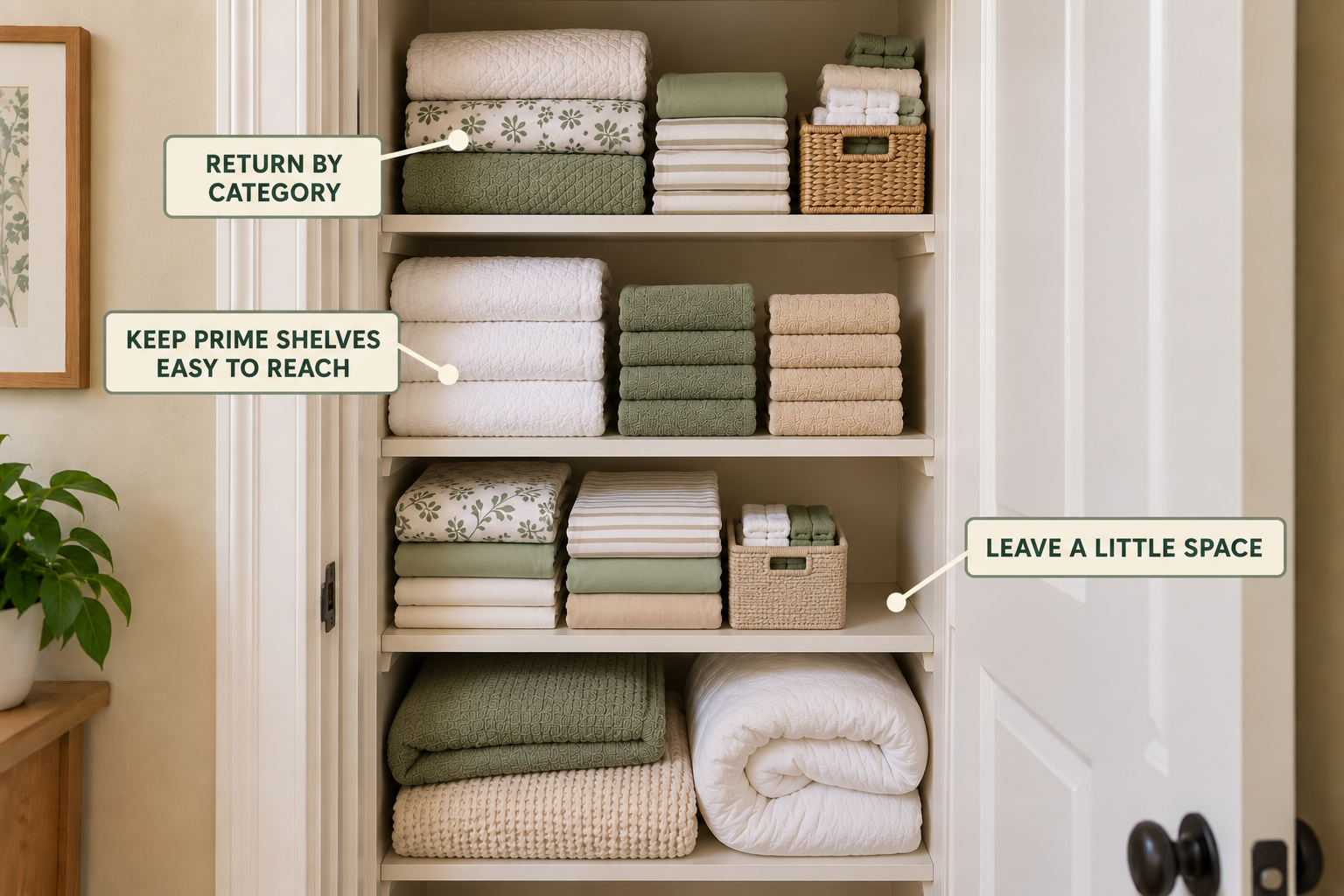
Return by Category
Put each item back into its assigned zone rather than creating a new temporary pile.
Protect Prime Access
Keep everyday towels and sheets easy to reach.
Leave Some Space
Do not keep filling a shelf until there is no comfortable way to remove or return an item.
If one category repeatedly overflows, treat that as a signal. Either the category needs more appropriate space, the quantity needs to be reduced, or another part of the system needs to change.
Frequently Asked Questions
How do you organize a very small linen closet?
Start by removing anything that does not need to live there. Then measure the shelves, group similar linens, and give the easiest-to-reach shelves to everyday towels and frequently used sheets. Use bins or dividers only where they solve a specific problem.
How do I maximize space in a small linen closet?
First maximize usable space rather than simply filling more space. Reduce excess inventory, use stable folds, take advantage of useful vertical clearance, and choose organizers only after measuring the shelves. Leaving some room for retrieval can make the closet more usable than packing every shelf tightly.
Where should towels go in a small linen closet?
Everyday towels generally work best on an easy-to-reach shelf. Less frequently used towels can move higher or to another secondary zone. Keep stacks stable and avoid making them so tall that removing one towel disturbs the rest.
How should sheets be stored in a small linen closet?
Keep complete sheet sets together so the fitted sheet, flat sheet, and pillowcases remain easy to identify. Assign them a consistent shelf or zone instead of scattering individual pieces across the closet.
Should I use bins in a small linen closet?
Use a bin when it solves a specific problem, such as containing loose small linens. Do not assume every shelf needs a bin. A stable towel stack may use less space and remain easier to access without one.
How do I use vertical space in a small linen closet?
Look for useful clearance above existing stacks and consider a divider, riser, or other compact solution only when it remains easy to access. Measure the shelf height first and make sure the added storage does not create a retrieval problem.
What should not be stored in a small linen closet?
Avoid using valuable linen-closet space for unrelated household clutter, rarely used items that have another suitable home, or excess linens that make everyday categories difficult to access.
Related Guides
If you are working through a larger home-organization project, these Simply Tidy Home guides cover related storage problems.
The Goal Is a Linen Closet You Can Actually Use
A small linen closet does not need to hold everything. It needs to hold the right things in places that make sense.
Edit first. Measure the space. Prioritize everyday items. Keep categories together. Add containment only where it helps. Then test the system through normal laundry and everyday use.
When every item has an obvious home and the shelves remain easy to access, a small closet can stay organized without constant rearranging.