
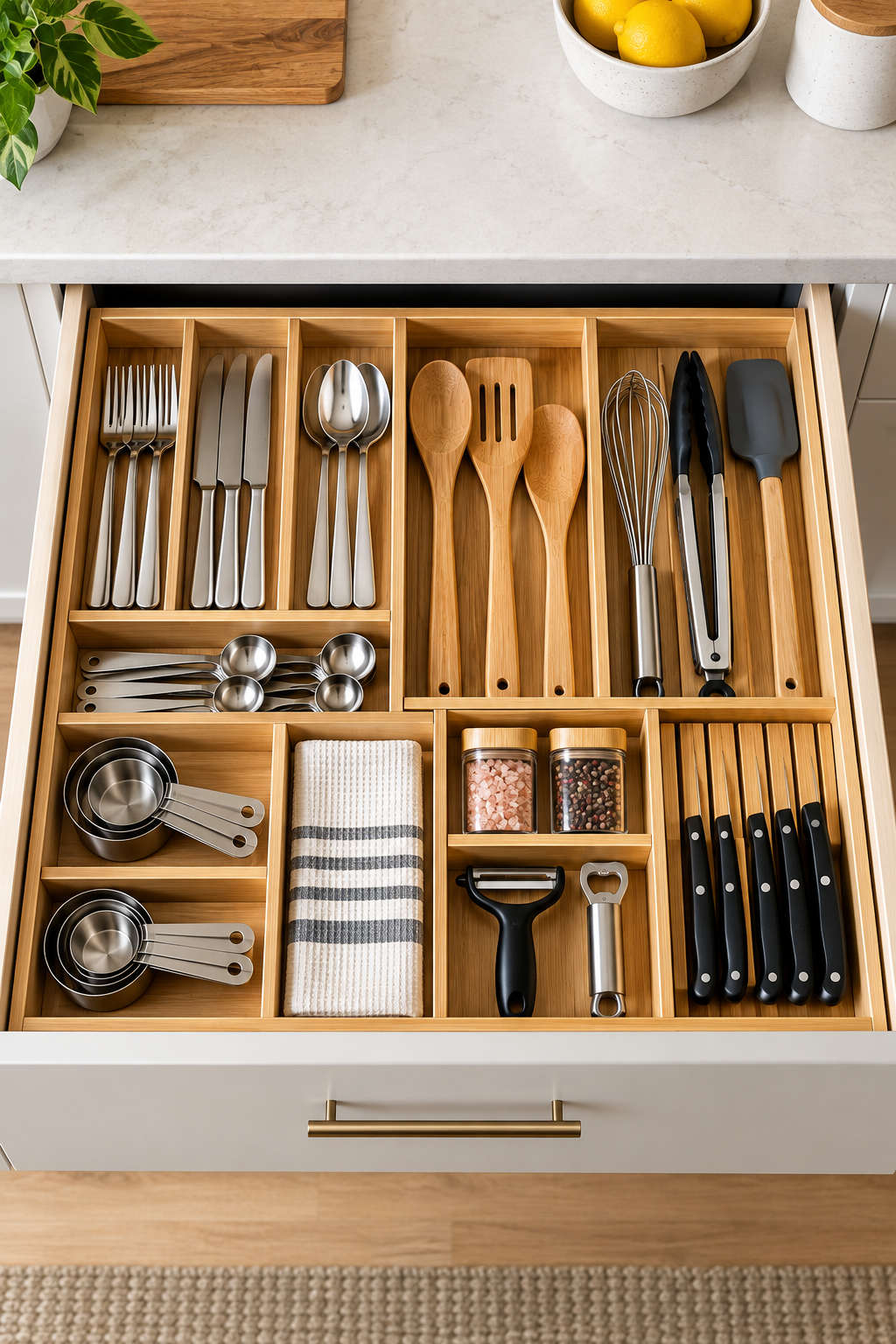
Learning how to organize kitchen drawers is not just about adding dividers or fitting more items into the space. A drawer can look organized and still be frustrating to use if you have to dig through utensils, move several items to reach one tool, or constantly straighten things after cooking.
The goal is to make each drawer easier to see, easier to use, and easier to reset. The best system starts with the drawer itself, then matches the storage method to what you actually keep and how you use it.
The Basic Rule: Organize for Use, Not Just Appearance
A drawer is organized when its contents are easy to see, easy to grab, and easy to return—not simply when everything has its own compartment.
That means the right solution depends on the drawer’s dimensions, the items inside it, how often those items are used, and where the drawer sits in relation to the task.
Start With the Drawer, Not the Organizer
Before buying a kitchen drawer organizer, empty the drawer and look at the space you actually have. A drawer that seems large can have limited usable space because of its sides, hardware, dividers, or the way it opens.
Start by asking three questions:
- What needs to stay in this drawer?
- What is difficult to reach or find right now?
- What could be stored somewhere else?
This prevents a common mistake: choosing an organizer first and then trying to force the drawer’s contents into it.
The 8-Step Kitchen Drawer Organization System
Clear
Remove everything from the drawer. Clean the empty drawer and separate useful items from duplicates, damaged items, and things that belong somewhere else.
Measure
Measure the usable interior width, depth, and height. Also check the drawer opening and any hardware or obstructions that could affect an organizer.
Assign
Decide what the drawer is responsible for. Give it a clear purpose rather than allowing unrelated items to accumulate there.
Zone
Group items according to the tasks they support. For example, preparation tools can form one zone while cooking or cleanup tools belong elsewhere.
Match
Match the storage method to the drawer and its contents. Dividers, trays, bins, or open compartments each solve different problems.
Install
Put the organizer or divider system into place without overcrowding the drawer. Leave enough usable space for items to be removed and returned easily.
Test
Open the drawer fully and use it as you normally would. Check whether anything blocks another item, shifts around, or becomes difficult to reach.
Maintain
Keep the drawer useful by returning items to their assigned zones and removing new clutter before it becomes a larger problem.
Measure Your Kitchen Drawer Before Choosing Storage
Measurements are especially important when choosing a kitchen drawer organizer. Do not rely only on the outside dimensions of the cabinet or drawer front. The organizer needs to fit inside the usable drawer space.
Measure the usable:
- Width from inside edge to inside edge
- Depth from front to back
- Height available inside the drawer
- Opening width if the drawer has a restricted opening
- Space affected by hardware or other obstructions
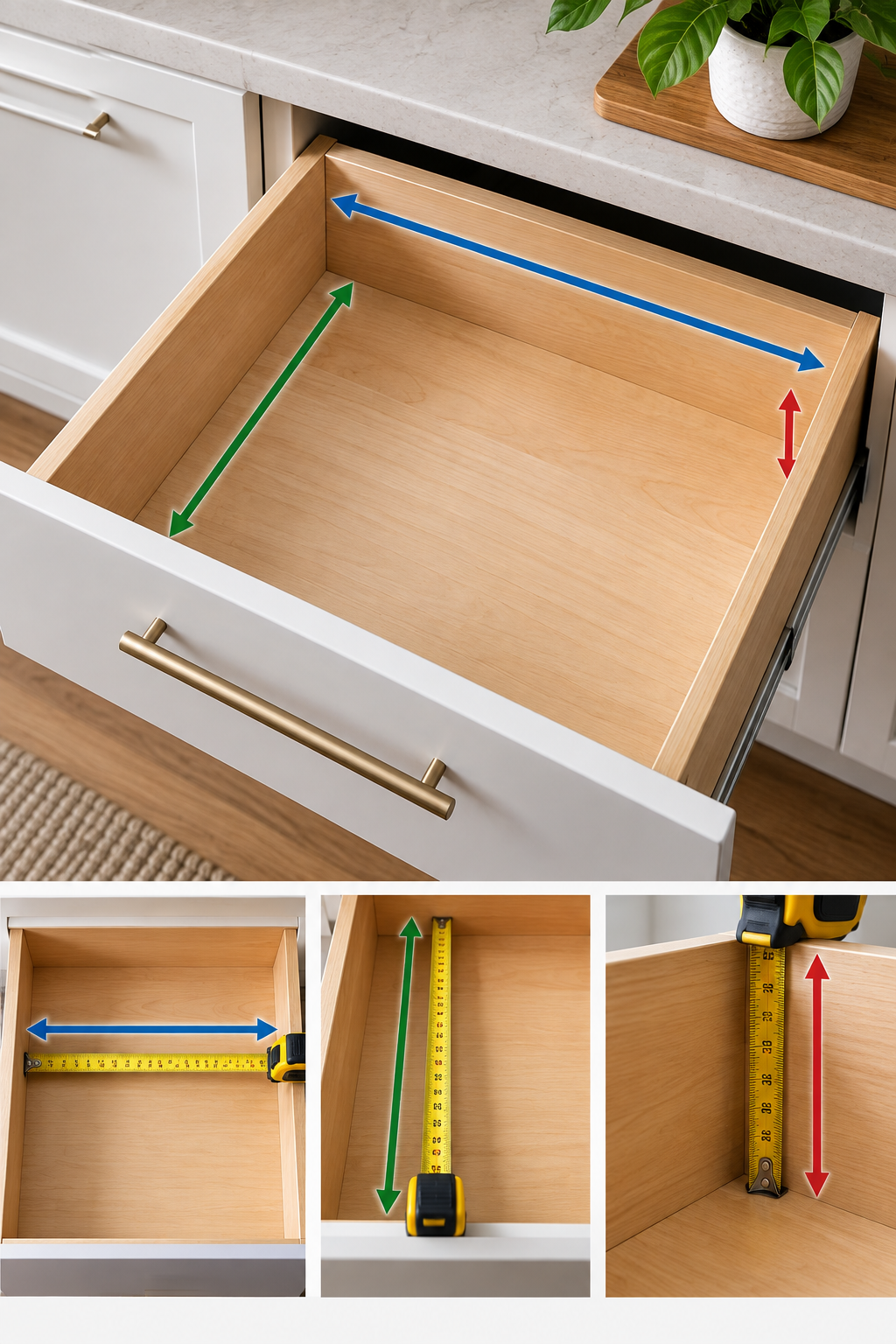
Write down the measurements before shopping. If you are comparing several organizers, use those measurements as your first filter rather than trying to make a nearly-fitting product work.
Measure the space you have first. Choose the organizer second. The organizer should adapt to the drawer—not the other way around.
Decide What Each Drawer Should Hold
Once the drawer is empty, give it a clear job. This reduces the chance that unrelated items will gradually mix together.
A drawer might be assigned to:
- Everyday cutlery
- Cooking utensils
- Food preparation tools
- Measuring tools
- Baking tools
- Food storage accessories
- Wraps, bags, and clips
- Specialty tools used for a specific task
The exact categories do not matter as much as having a clear reason for each drawer. Your cooking habits should determine the system.
Create Zones Based on How You Use the Kitchen
Kitchen drawer organization becomes easier when related items are grouped around the work they support. Instead of treating every drawer as an independent storage box, look at the activities that happen around it.
For example, preparation tools can stay close to the area where food is prepared, while cooking utensils can be kept closer to the stove. Cleanup-related items can be placed near the sink when the drawer location makes that practical.
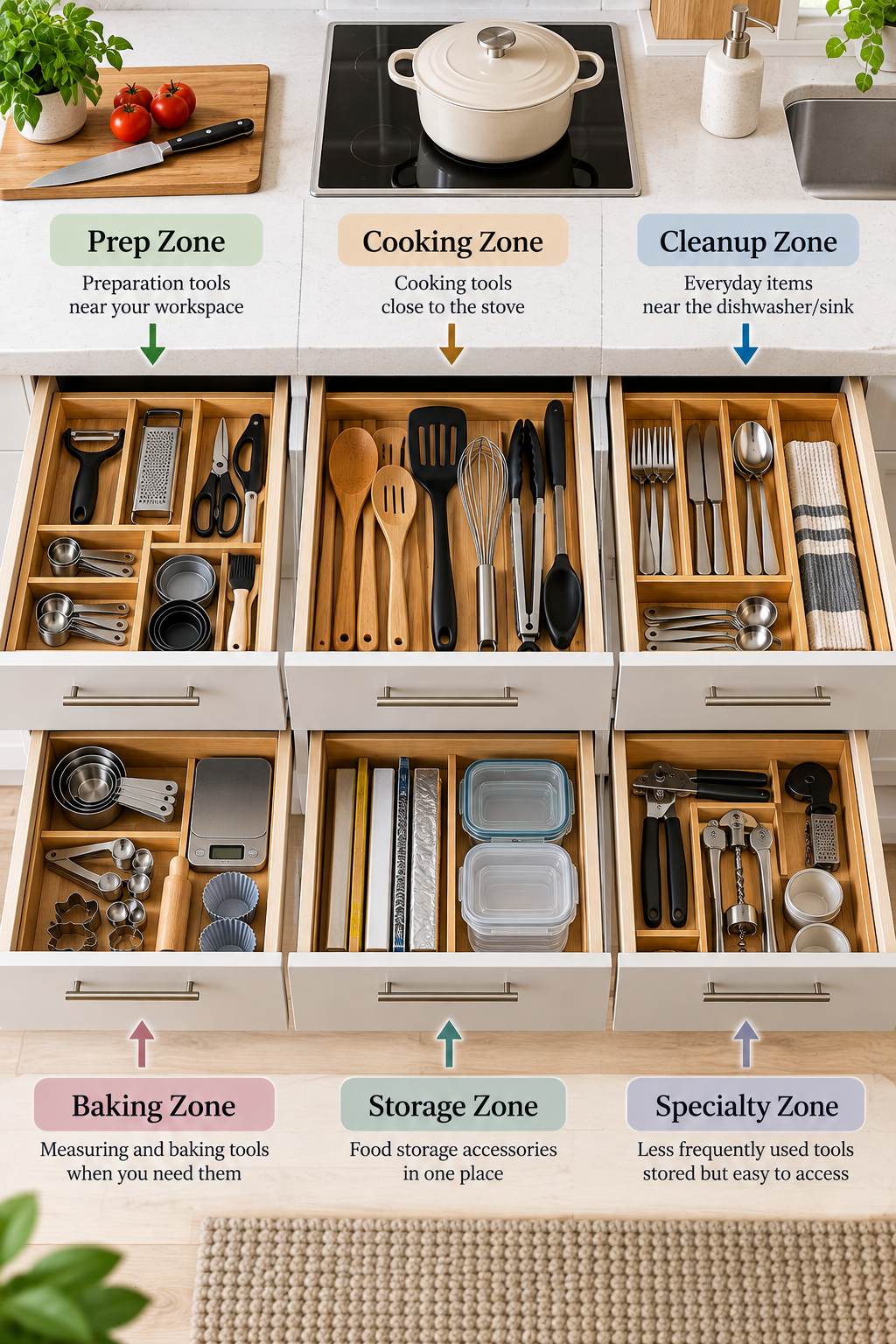
The goal is not to create a perfect set of categories. It is to reduce unnecessary movement and make the items you use together easier to access.
Organize Different Types of Kitchen Drawers
Shallow Kitchen Drawers
Shallow drawers usually work well for smaller, flatter items that can be arranged in a single visible layer. Cutlery, measuring spoons, small utensils, and other compact tools may fit well here.
Use compartments that keep items separated without consuming more space than the contents require.
Deep Kitchen Drawers
Deep drawers can hold larger items, but they can also become difficult to use when items are stacked or hidden behind one another.
Before adding storage, decide whether the drawer is better suited to cookware, containers, larger utensils, or another category. Then arrange the contents so that frequently used items remain accessible.
Narrow Kitchen Drawers
Narrow drawers have less width to work with, so oversized organizers can waste valuable space. Look for a storage method that uses the available width efficiently while leaving enough room to remove items.
Wide Kitchen Drawers
Wide drawers can hold several categories, but mixing everything together can make them harder to maintain. Use clear zones or appropriately sized compartments so the drawer does not become one large mixed storage area.
Awkward or Unusually Sized Drawers
Awkward dimensions may require a simpler approach. Instead of trying to fill every inch, prioritize access and stability. A few well-placed dividers can sometimes work better than a large organizer that leaves unusable gaps.
How to Organize a Deep Kitchen Drawer
Deep kitchen drawers need special attention because their extra height can make it easier for items to become stacked, buried, or difficult to see.
Start by deciding whether the depth is actually useful for the items you want to store there. Large cookware, containers, bowls, and other bulky items may benefit from the space, while small loose tools can become harder to manage if they are simply piled together.
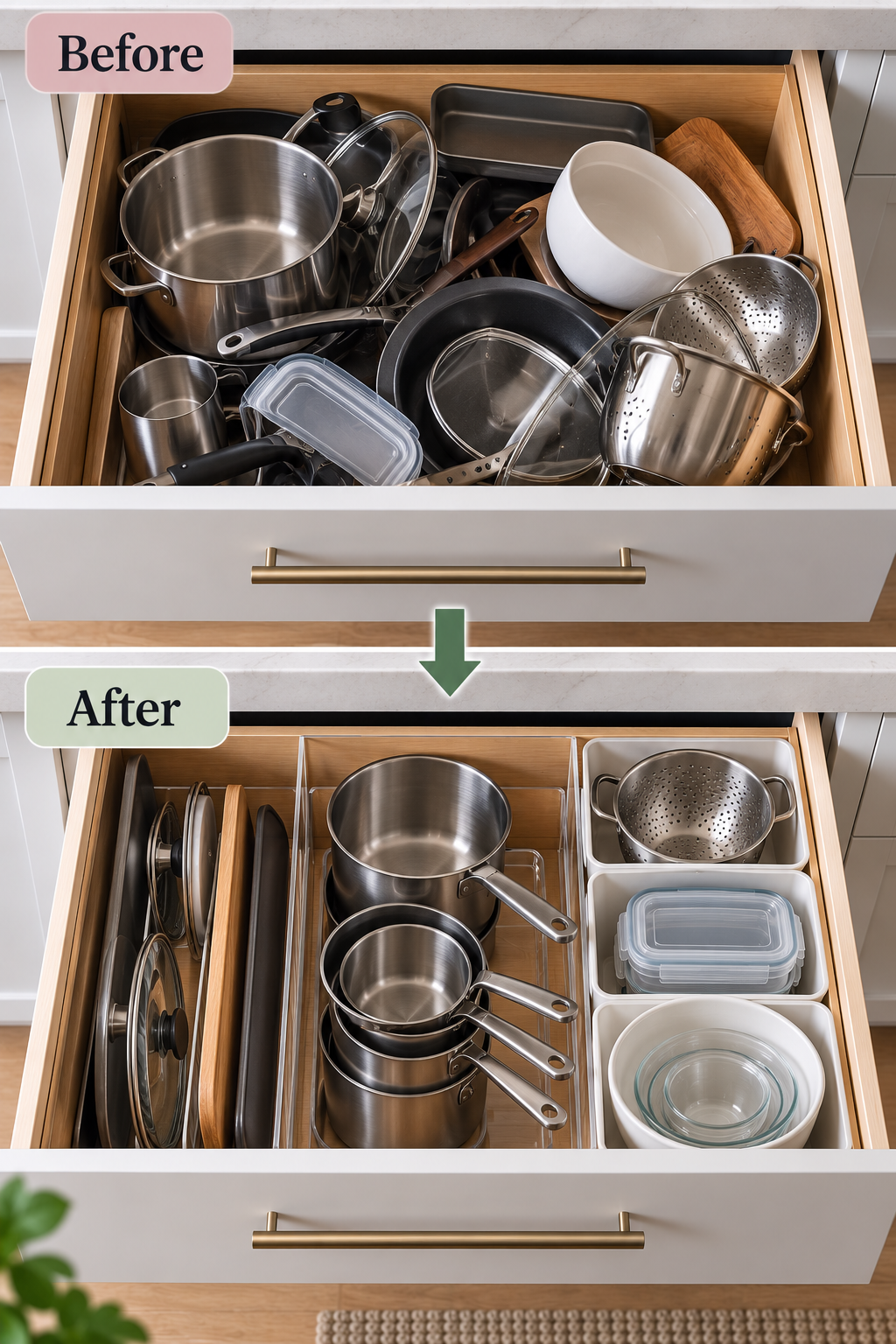
For deep drawers, consider storage that separates layers or keeps items upright when appropriate. The important test is whether you can reach the item you need without having to remove several other items first.
Think About Access Before Capacity
More storage space is not automatically better storage. If adding more items makes the drawer harder to use, the system has become less useful.
Where to Put Common Kitchen Items
The best location for an item is not always determined by its category. A better rule is:
For example, measuring spoons could technically belong with other measuring tools, but if you mainly use them while baking, keeping them near your baking supplies may make more sense.
Use the same logic for other common kitchen items:
- Cutlery: Keep everyday forks, knives, and spoons in an easy-to-reach drawer near the eating or preparation area.
- Cooking utensils: Keep frequently used spatulas, spoons, tongs, and similar tools close to where you cook.
- Measuring tools: Group measuring cups and spoons based on how you actually use them.
- Food storage accessories: Keep wraps, bags, clips, and related tools together if that makes food-storage tasks easier.
- Baking tools: Group frequently used baking tools together rather than scattering them across several drawers.
- Knives: Use protected storage designed for knives, such as an in-drawer knife organizer, rather than leaving loose blades in a drawer.
If an item repeatedly gets returned to the wrong drawer, that can be useful feedback. The assigned location may not match the way you actually use it.
How to Choose a Kitchen Drawer Organizer
Once you know what the drawer needs to hold, you can decide whether an organizer is actually necessary.
Different storage problems call for different solutions:
- Items move around: Consider dividers or compartments that keep groups separated.
- Mixed small items: Use appropriately sized compartments so similar items stay together.
- Unused vertical space: Consider a solution that makes better use of the drawer’s height when appropriate.
- Narrow drawer: Choose a compact organizer that does not waste the limited width.
- Wide drawer: Create separate zones instead of treating the entire drawer as one compartment.
- Shallow drawer: Prioritize low-profile storage that preserves usable height.
- Awkward dimensions: Use adjustable or modular storage when fixed dimensions do not fit well.
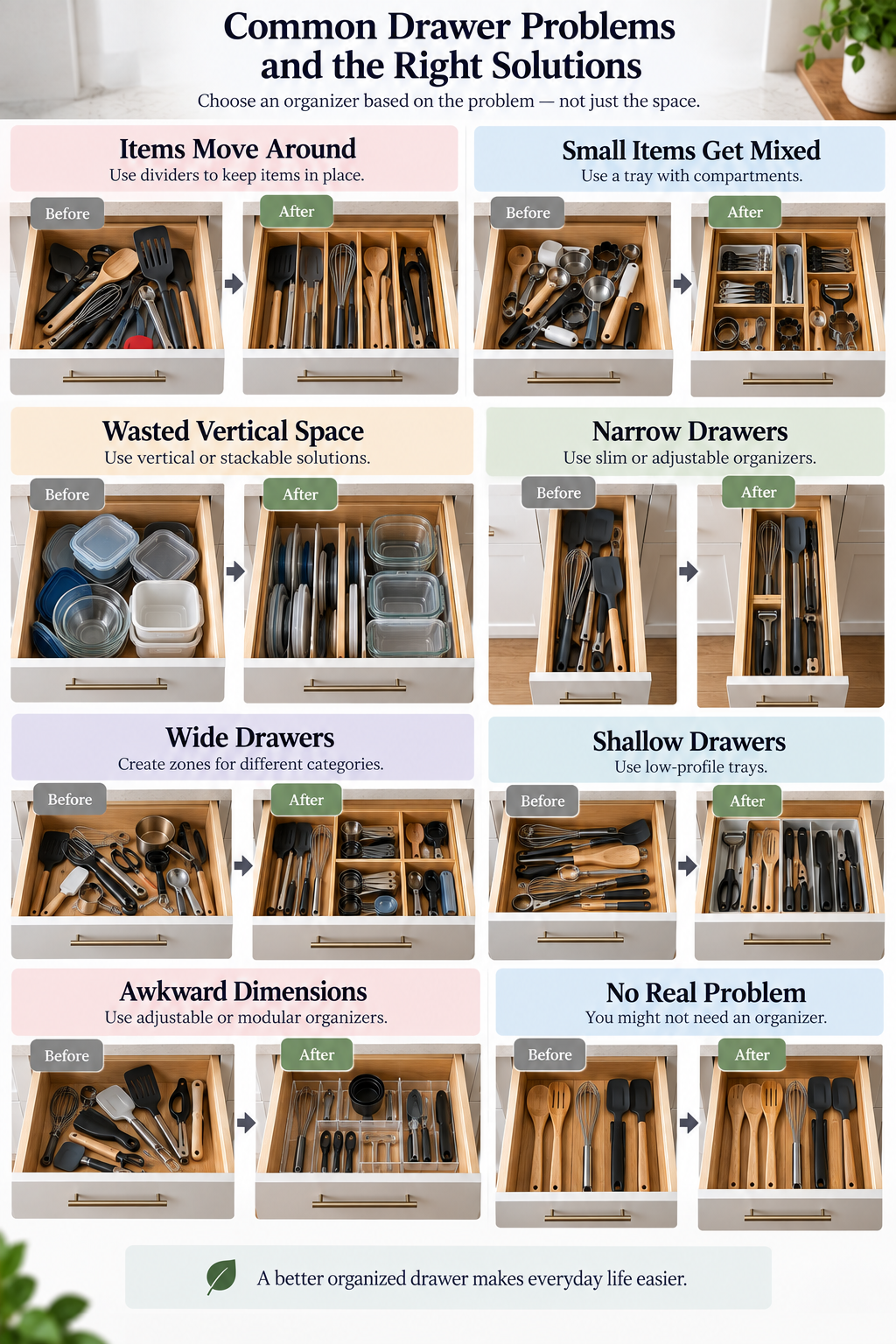
Before you buy a kitchen drawer organizer, compare its usable dimensions with the measurements you recorded earlier. Also consider whether its compartments match the items you actually need to store.
Common Kitchen Drawer Organization Mistakes
Buying the Organizer First
A product can look useful but still be the wrong size or shape for your drawer. Measure and decide what the drawer needs to hold first.
Trying to Fill Every Inch
Empty space is not necessarily wasted space. Leave enough room to remove and return items without constantly disturbing neighboring compartments.
Creating Too Many Categories
Excessive sorting can make a drawer harder to maintain. Use categories that are useful in everyday life rather than creating a separate compartment for every individual item.
Putting Frequently Used Items Too Far Away
Storage should support your normal routines. Items used every day should generally be easier to reach than items used occasionally.
Ignoring What Happens After Installation
A drawer can look perfect immediately after organizing and still fail during normal use. Test the system while cooking, preparing food, or completing the task the drawer supports.
How to Keep Kitchen Drawers Organized
A good drawer system should be easy to maintain. If putting something away requires several steps, the system may be too complicated.
Use these simple maintenance habits:
- Return items to their assigned zones.
- Remove duplicates when they start taking over the drawer.
- Move items that repeatedly end up in the wrong place.
- Keep frequently used items accessible.
- Recheck the system when your cooking habits change.
Kitchen Drawer Organization Checklist
- Empty the drawer completely.
- Remove unnecessary and misplaced items.
- Measure the usable drawer space.
- Give the drawer a clear purpose.
- Group items according to how they are used.
- Create practical zones.
- Choose storage based on the actual problem.
- Install without overcrowding the drawer.
- Test access during normal use.
- Adjust the system when it stops working.
Frequently Asked Questions
How should I organize my kitchen drawers?
Start by clearing the drawer, measuring the usable space, deciding what the drawer should hold, and grouping items by how you use them. Then choose dividers, trays, or other storage only if they solve a specific problem.
What should go in kitchen drawers?
Kitchen drawers can hold cutlery, cooking utensils, measuring tools, baking supplies, food-storage accessories, wraps and bags, or other items that are practical to access from a drawer. The best contents depend on the drawer’s location and how you use your kitchen.
How do you organize deep kitchen drawers?
Start by deciding what the drawer is best suited to hold. Group related items, keep frequently used items accessible, and use storage methods that prevent smaller items from becoming buried or difficult to reach.
How do I organize a narrow kitchen drawer?
Measure the usable width first and avoid oversized organizers. Use compact compartments or dividers that separate the contents without consuming unnecessary space.
Should I use drawer dividers?
Drawer dividers can be useful when items move around, different categories become mixed together, or the drawer needs clearer zones. They are not necessary for every drawer, so choose them based on the problem you are trying to solve.
How do I choose a kitchen drawer organizer?
Measure the drawer first, identify what you need to store, and then choose an organizer whose dimensions and compartments match those requirements. Avoid choosing a product simply because it looks useful.
Where should knives go in a kitchen drawer?
If knives are stored in a drawer, use protected storage designed for knives, such as an in-drawer knife organizer. Avoid leaving loose blades where they can create a safety hazard.
Related Articles
A Better Kitchen Drawer Starts With a Better Decision
Organizing kitchen drawers is easier when you solve the storage problem before choosing the storage product. Clear the drawer, measure the space, decide what belongs there, create useful zones, and then choose an organizer only when it genuinely improves access.
The result should not simply be a drawer that looks tidy. It should be a drawer that works naturally every time you open it.