
A small bathroom does not need more storage everywhere. It needs a better system for deciding what belongs in each space, how often you need it, and how easily you can reach it.
How do you organize a small bathroom? Start by removing duplicates and rarely used items, measure the usable storage space, group products by function, and assign each category to a specific zone. Keep daily-use items easiest to reach, keep wet-use products where they can dry, and move bulk backstock out of prime bathroom space when possible.
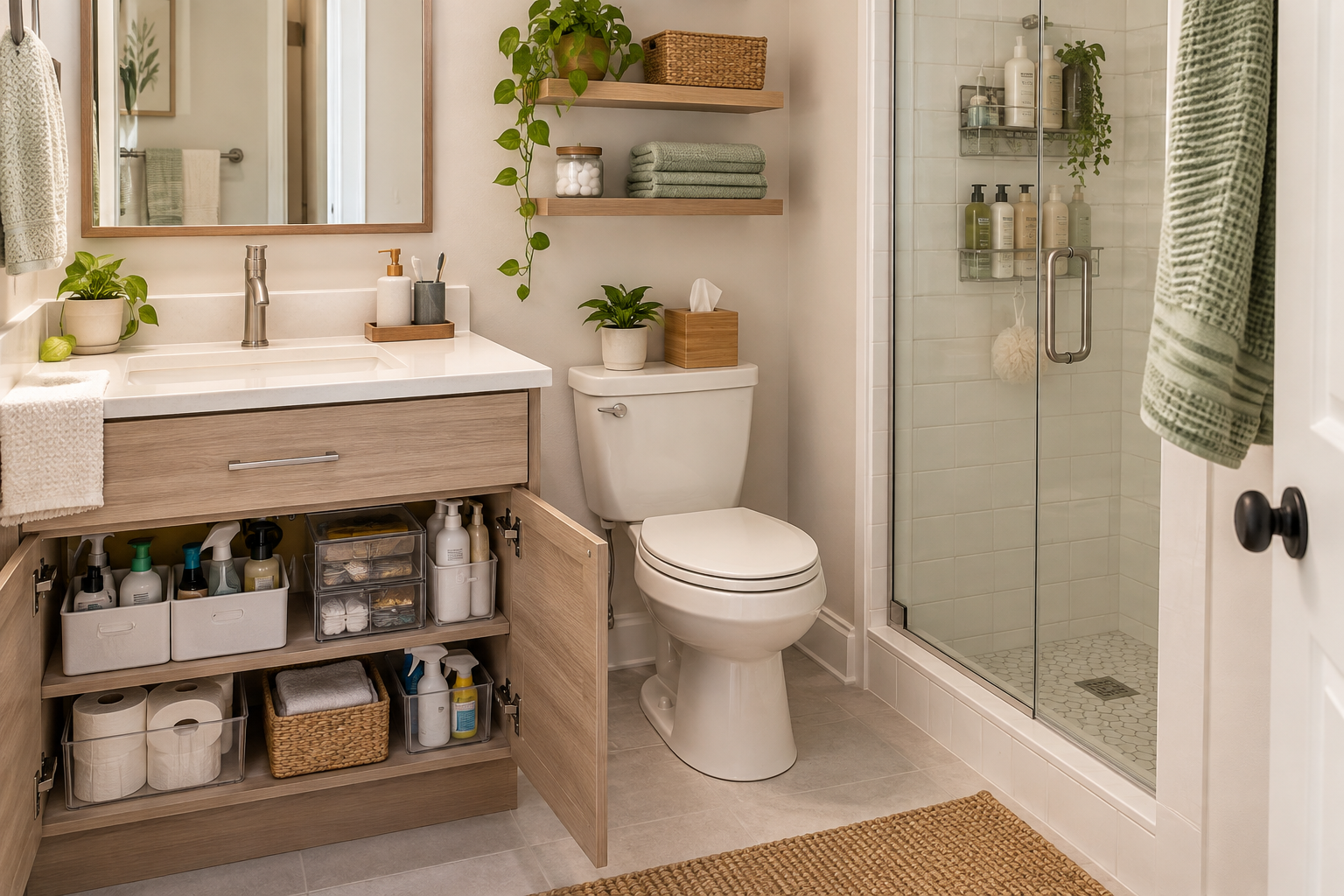
The Small Bathroom System at a Glance
1. Audit What Is Making Your Small Bathroom Feel Crowded
Before buying an organizer, find out what is actually creating the problem. A small bathroom can feel crowded because the counter is overloaded, the vanity is difficult to access, or too many categories are competing for the same small spaces.
Look for these common bottlenecks:
- Crowded bathroom counter
- Overflowing vanity or cabinet
- Too many products inside the shower
- Towels without a consistent home
- Toilet paper or toiletries taking up prime storage
- Cleaning supplies mixed with personal-care products
- Duplicate or rarely used products occupying easy-to-reach space
- Backstock stored where daily-use items should go
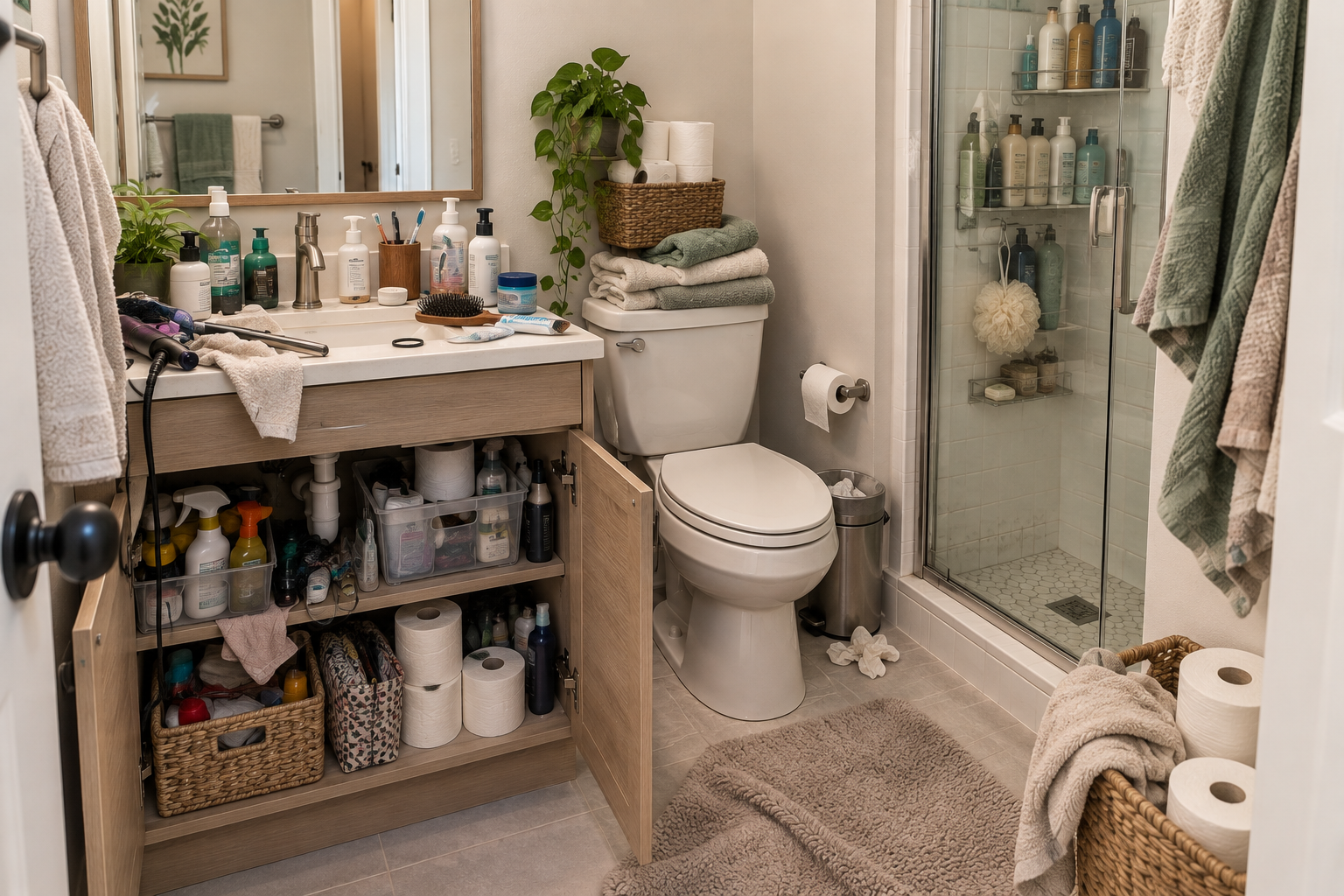
The problem
Too many categories are competing for a small amount of usable bathroom space.
The reason
Storage is often assigned by available space rather than by frequency, moisture, access, and function.
2. Edit Before You Add Storage
More containers cannot solve a bathroom that contains more products than the available space can comfortably support.
Sort everything into five groups:
Keep in the bathroom
Items used regularly and needed as part of the bathroom routine.
Move elsewhere
Items that do not need to occupy limited bathroom storage.
Backup
Extra products that are useful but do not need prime-access space.
Rarely used
Items that can live in less convenient storage.
Remove
Expired, unwanted, empty, duplicate, or unused items.
3. Measure the Bathroom Before Buying Organizers
Measure the actual usable space rather than estimating it. A product that looks small online can be surprisingly difficult to use once doors, plumbing, drawers, and walking space are taken into account.
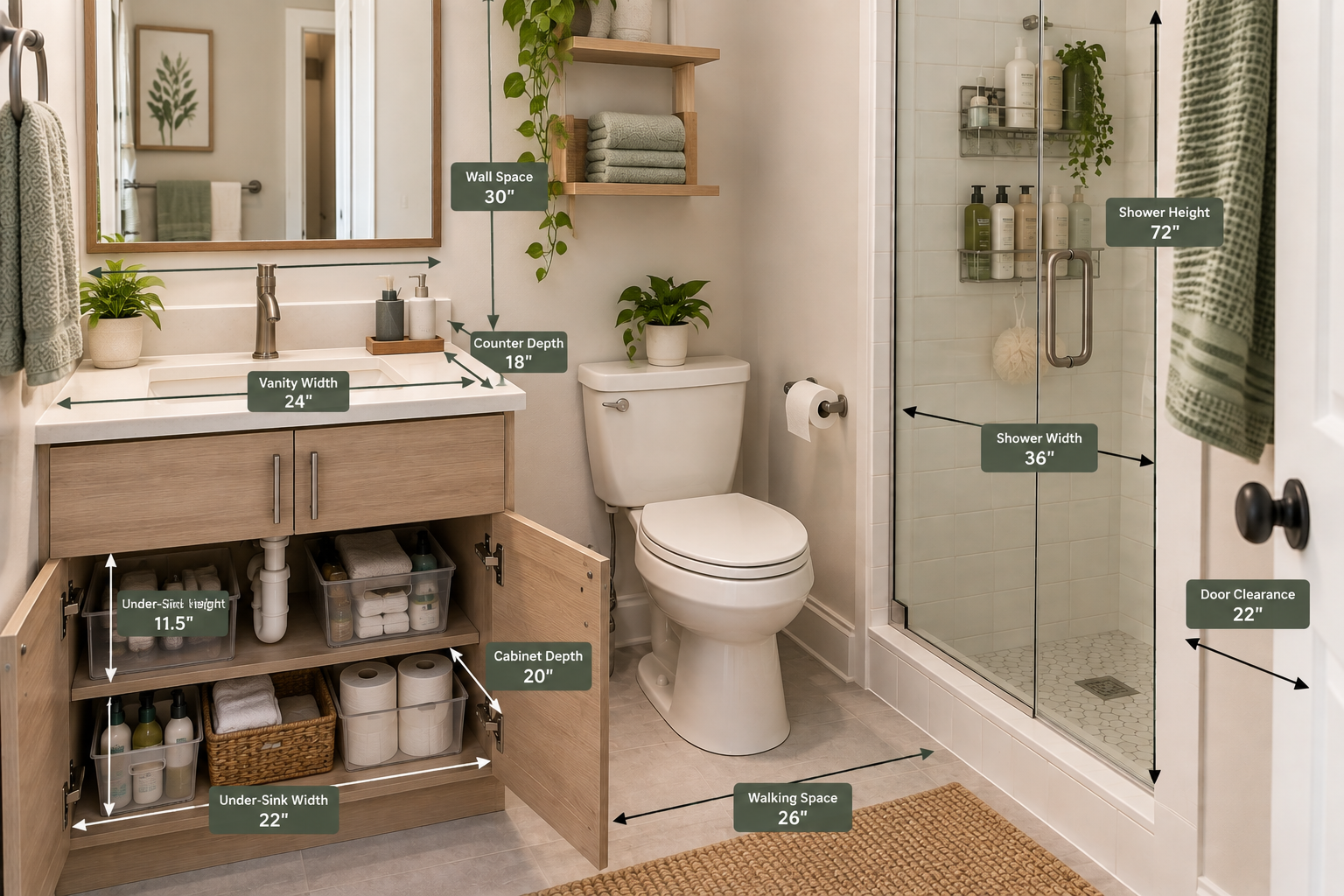
What to Measure
- Counter width and depth
- Vanity or cabinet width and height
- Under-sink clearance
- Drawer width, depth, and height
- Available wall width
- Bathroom door clearance
- Shower or bath storage area
- Toilet-area dimensions
- Walking and standing space
An organizer must fit through the cabinet opening and still allow the door, drawer, plumbing, and surrounding space to work normally.
4. Categorize Everything by Function
Grouping similar items makes the bathroom easier to use because each category gets a logical home.
| Category | Examples | Preferred Location |
|---|---|---|
| Daily routine | Toothbrush, toothpaste, skincare, daily grooming items | Easy-access counter, drawer, or vanity zone |
| Shower | Soap, shampoo, conditioner, active shower products | Shower or bath zone |
| Towels | Bath towels, hand towels, washcloths | Accessible towel zone |
| Toilet supplies | Toilet paper and related supplies | Accessible secondary storage |
| Cleaning | Bathroom cleaners, brushes, cleaning tools | Contained cleaning zone |
| Backstock | Extra toiletries and unopened products | Secondary storage outside prime space |
| Health / medicine | Medicines and health products | According to product storage instructions |
5. Allocate Storage by Frequency
Not everything deserves the same level of accessibility.
Use this access hierarchy
Keep them easiest to reach.
Keep them accessible but not necessarily visible.
Store them in secondary locations.
Move them away from the prime-access zones.
6. Create Six Functional Bathroom Zones
A small bathroom does not need every zone to be large. It needs each zone to have a clear purpose.
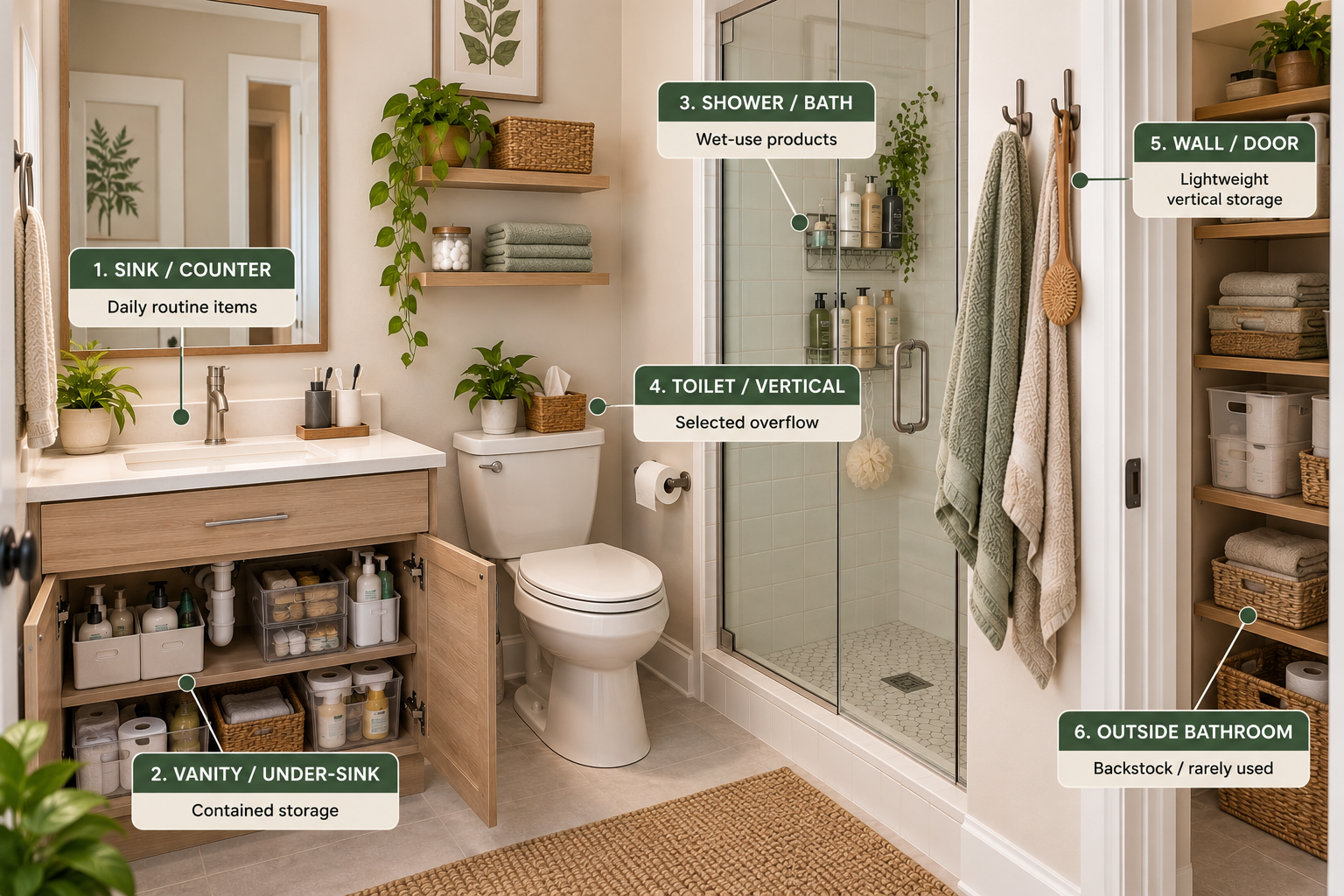
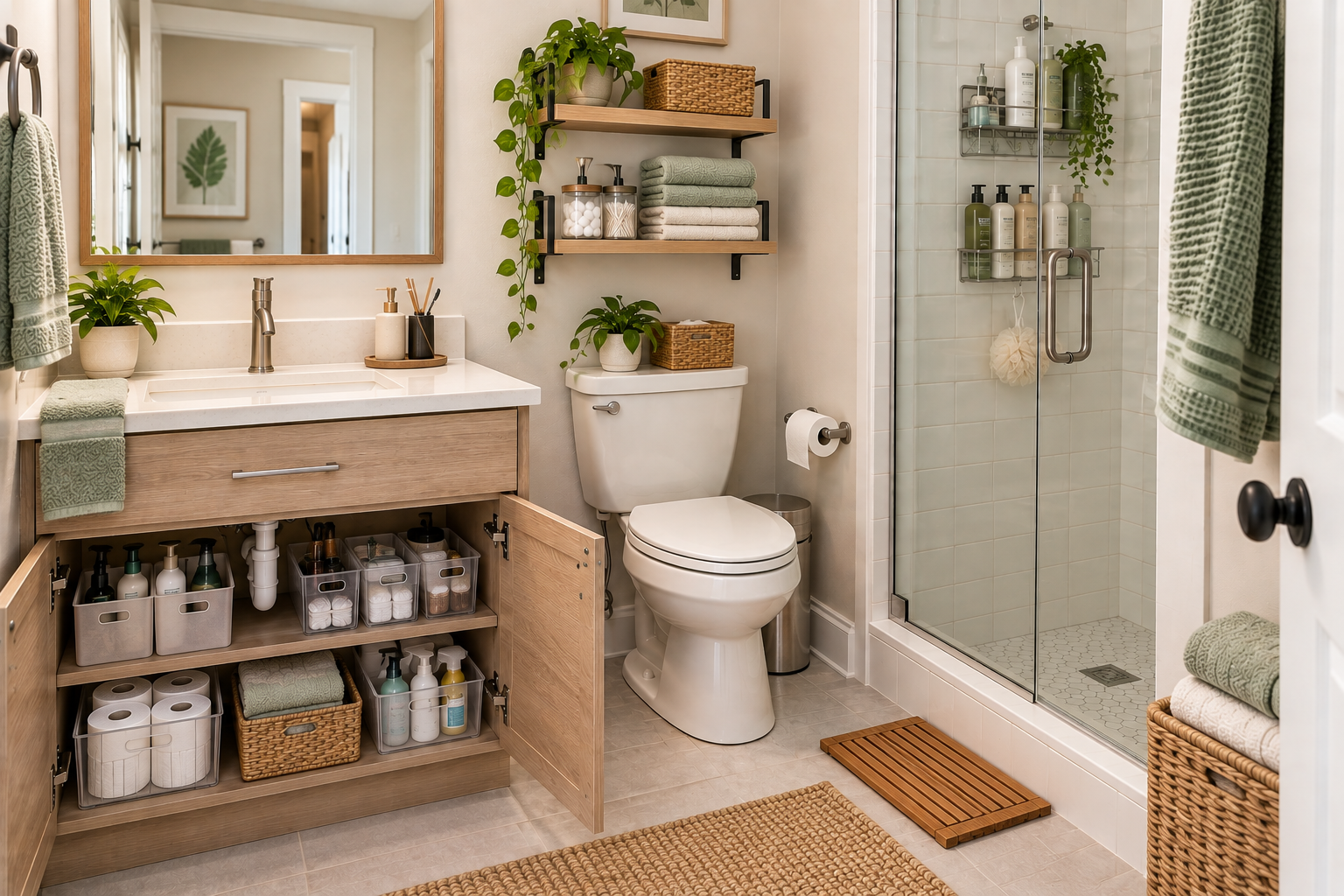
Sink and Counter
Reserve this area for products used during the daily routine. Avoid turning the counter into inventory storage.
Vanity and Under-Sink
Use this area for contained categories while preserving access to plumbing and frequently used items.
Shower and Bath
Keep active wet-use products here and avoid filling the space with backups.
Toilet and Vertical Space
Use selected vertical space for lightweight, appropriate categories rather than treating it as unlimited storage.
Wall and Door
Use suitable vertical surfaces for lightweight items when they do not interfere with movement or door clearance.
Outside Bathroom
Keep bulk backstock and rarely used items elsewhere when practical.
7. Organize the Counter Without Losing Your Work Surface
The bathroom counter is one of the easiest places to create visual clutter because it is both a work surface and a storage surface.
The simplest rule is: visible space should support the routine, not store the inventory.
What should stay on a small bathroom counter?
Keep only the products you reach for regularly.
Use one appropriate container rather than several loose items.
Leave enough open counter space for the actual bathroom routine.
Before You Buy a Countertop Organizer
- Measure the counter area.
- Decide exactly which category it will contain.
- Check whether the organizer leaves enough usable work surface.
- Confirm that the stored items can be reached easily.
- Only then choose the product.
If the problem is a small collection of daily-use products, a compact countertop organizer can make sense.
See the countertop organizer option
8. Organize Under the Bathroom Sink
Under-sink storage often feels larger than it actually is because the plumbing interrupts the usable space. The goal is not to fill every inch. The goal is to make the space accessible.
Use an access hierarchy
Frequent-use products.
Occasional-use categories.
Backups and less frequently used products.
Bulk inventory and rarely used items when practical.
Before You Buy an Under-Sink Organizer
- Measure the cabinet opening.
- Measure around the plumbing.
- Check vertical clearance.
- Check whether drawers or doors can still open.
- Choose storage that keeps the contents accessible.
A pull-out under-sink system can be useful when the main problem is poor access rather than a complete lack of space.
See the under-sink organizer option
9. Control Shower and Bath Storage
Shower storage needs a different approach because moisture is part of the environment.
Keep active products in the shower and move backups elsewhere whenever possible. Avoid creating a storage system that traps water or makes it difficult for wet items to dry.
Keep in the shower
Products currently being used as part of the shower routine.
Keep elsewhere
Backups, bulk products, and rarely used items that do not need to occupy wet storage.
Storage should support airflow and drainage where appropriate rather than trapping moisture around products or tools.
If the problem is limited shower storage, a suitable adhesive or wall-mounted caddy can create vertical storage without taking up floor space. Adhesive systems should only be used on surfaces and in conditions suitable for that installation method.
10. Use Vertical and Door Space Carefully
Walls and doors can provide useful storage in a small bathroom, but vertical space is not automatically free space.
Check four things before adding anything:
- Does it interfere with the door?
- Does it interfere with movement?
- Can the items be reached comfortably?
- Will the surface support the storage method?
11. Give Towels, Toilet Paper, and Backstock a Clear Home
These categories can quickly consume valuable bathroom storage because they are often stored in large quantities.
| Item | Priority | Storage Logic |
|---|---|---|
| Active towels | High | Easy-access towel zone |
| Working toilet-paper supply | High | Accessible secondary storage |
| Extra towels | Medium | Secondary storage when available |
| Toiletry backups | Medium | Secondary or outside-bathroom storage |
| Bulk inventory | Low | Outside prime bathroom space when practical |
12. Do Not Treat the Bathroom Like a Household Warehouse
A small bathroom usually works better when it contains what you actively need rather than every backup and rarely used item in the household.
This is especially useful for:
- Bulk toiletries
- Large backup supplies
- Rarely used grooming tools
- Extra cleaning inventory
- Seasonal or occasional products
For medicines and other health products, follow the storage instructions on the product label or from the relevant healthcare guidance rather than assuming the bathroom is always appropriate.
13. Apply the Moisture Test
Before assigning an item to bathroom storage, ask three questions.
The Moisture Test
If yes, check its storage instructions before keeping it in the bathroom.
If yes, avoid storage that unnecessarily traps moisture.
If yes, reconsider the location or simplify the system.
14. Match the Organizer to the Actual Problem
The organizer should be the final step, not the starting point.
STH Product Decision Logic
Before Buying Any Bathroom Organizer
- Identify the exact storage problem.
- Decide what category needs a home.
- Measure the available space.
- Determine how often you need the items.
- Check access, clearance, and moisture.
- Choose the organizer only after those decisions.
15. Test the System Before Calling It Finished
An organized bathroom should make the routine easier. Give the system a few days and watch where it fails.
Signs the system needs adjustment
- The counter keeps filling up.
- Shower products keep accumulating.
- The same category is stored in several places.
- Backups are occupying prime storage.
- The under-sink area is difficult to access.
- Towels keep migrating to another location.
- Cleaning products keep ending up outside their zone.
- You repeatedly leave the same items out because putting them away is inconvenient.
16. Build a Simple Bathroom Reset Routine
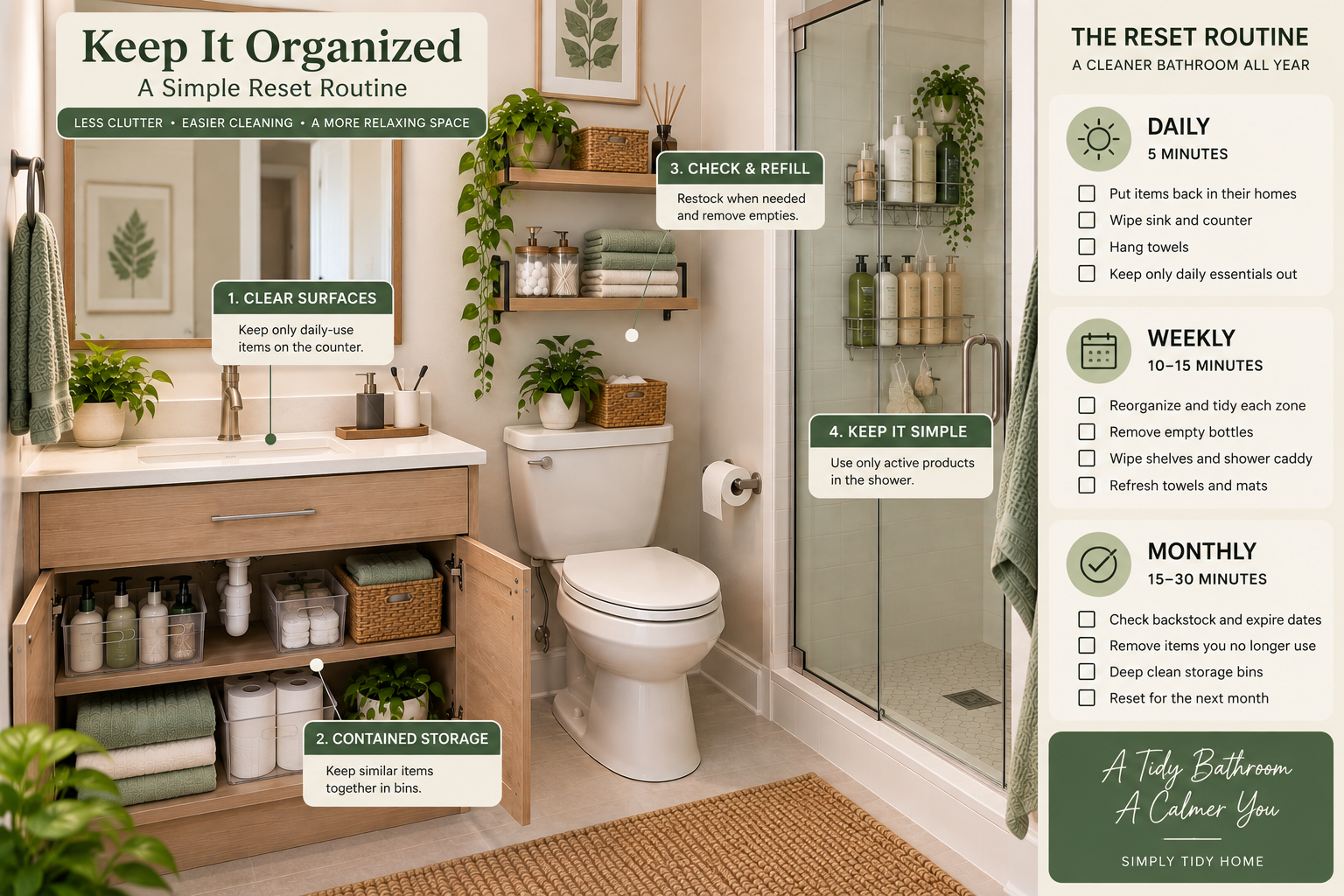
A storage system only works when it is easy to maintain. The goal is not a perfect bathroom. The goal is a bathroom that can return to order without a major organizing session.
Clear the surfaces
Return daily-use products to their assigned homes and clear unnecessary items from the counter.
Check the system
Return misplaced items, remove empty containers, and check whether any category is starting to overflow.
Refill and simplify
Check backups, remove unnecessary duplicates, and adjust storage if your routine has changed.
Small Bathroom Organization in One View
The best small bathroom organization system is not the one that stores the most things. It is the one that makes the things you actually use easy to reach, easy to put away, and easy to maintain.
Frequently Asked Questions
How do I organize a small bathroom?
Start by editing out duplicates and rarely used items, measure the usable storage areas, categorize your belongings, and assign each category to a specific zone. Keep daily-use items easiest to reach and move bulk backstock out of prime space when practical.
How do I organize a small bathroom with little storage?
Prioritize daily-use products, use vertical space carefully, make the under-sink area accessible, control shower storage, and move bulk or rarely used items elsewhere when possible. The goal is to improve usable storage rather than simply add more containers.
How do I maximize space in a small bathroom?
Measure the space first, remove unnecessary items, use functional zones, protect clear work surfaces, and assign storage according to frequency of use. Vertical storage can help when it does not interfere with movement or access.
What should stay on a small bathroom counter?
Keep the products you use regularly during the daily routine. Avoid using the counter as inventory storage for backups, bulk products, or rarely used items.
How should I organize under a bathroom sink?
Put frequent-use items toward the front, occasional-use products farther back, and backups in secondary storage. Measure around plumbing and preserve access to the cabinet doors and pipes.
Where should bathroom backstock go?
Backstock can go in secondary bathroom storage or another suitable household storage area. It does not need to occupy the easiest-to-reach space in a small bathroom.
Should medicine be stored in a bathroom?
Follow the storage instructions on the medicine label or from the relevant healthcare guidance. Do not assume that bathroom storage is appropriate for every medicine because bathroom conditions can vary.
How do I keep a small bathroom from looking cluttered?
Keep visible surfaces focused on daily-use items, contain small groups of products, move backups out of prime space, and give every major category a defined home. A clear counter is often more useful than additional decorative storage.
Related Guides
If you are organizing other small areas of your home, these guides use the same practical, zone-based approach.
A small bathroom does not need to hold everything.
It needs a clear system for what stays, where it goes, how often you reach it, and how easily you can reset the space.