
ENTRYWAY ORGANIZATION
Shoes are one of the easiest things to lose control of in a small entryway. The problem is usually not that you need more storage. It is that too many pairs are competing for the same small amount of space.
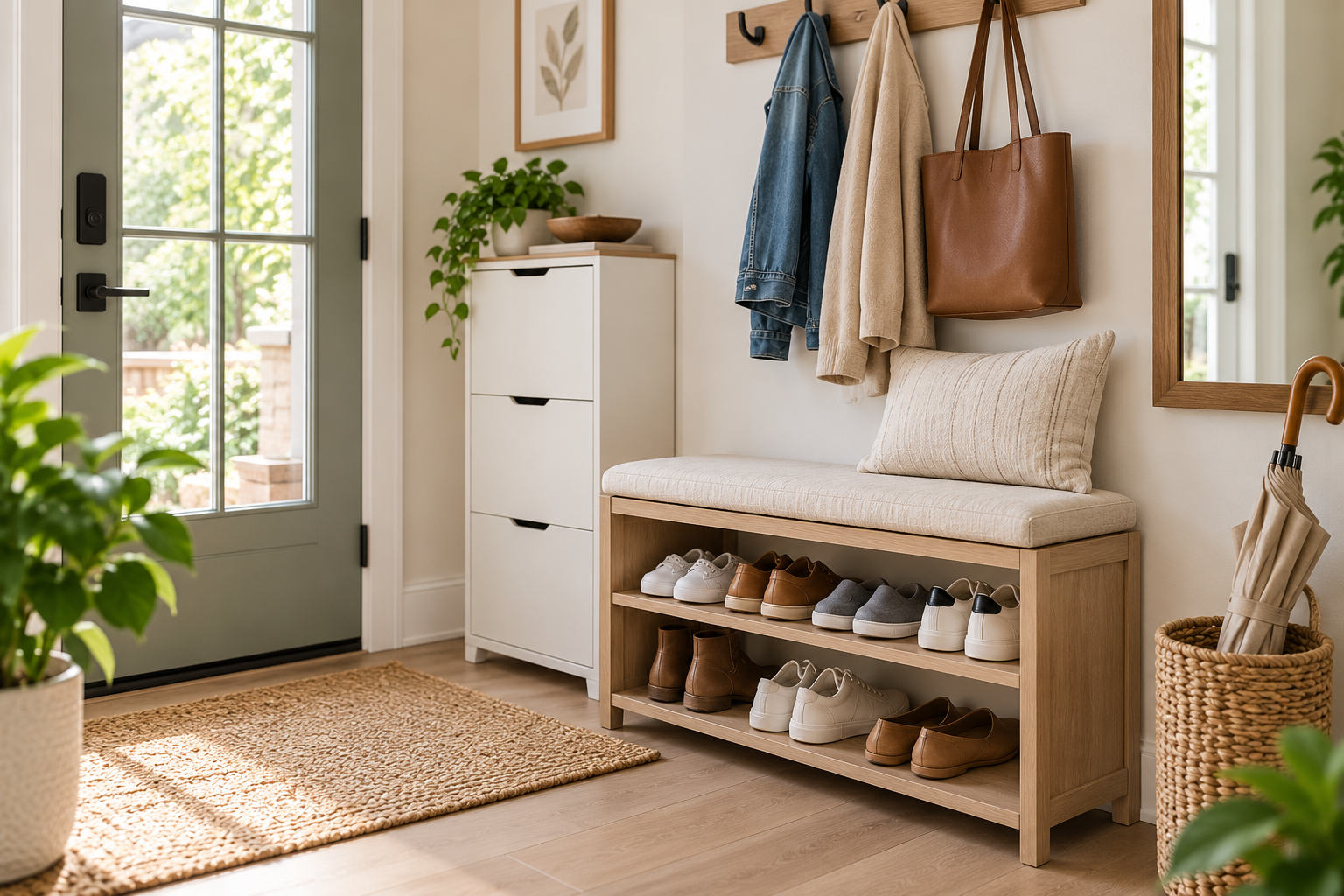
To organize shoes in a small entryway, start by keeping only the footwear that needs to be accessed regularly near the door. Sort the rest into seasonal, occasional, repair, or relocation groups. Then measure the actual space available and choose storage that fits the space, the number of active pairs, and the way your household uses the entryway.
A small entryway works better when its shoe storage is designed around real use rather than maximum capacity.
The goal is not to fit every pair of shoes near the door. The goal is to make the shoes you actually use easy to reach, easy to return, and easy to keep contained.
Why Shoes Take Over a Small Entryway
Shoes create a special organization problem because they arrive and leave the house constantly. That makes the entryway a high-traffic zone.
A small pile can quickly become a larger one when every pair is treated as an entryway shoe.
There are usually three separate problems hiding inside the pile:
- There are more active pairs than the space can comfortably hold.
- The storage format does not match the available space.
- The storage location or routine creates too much friction.
This is why buying a larger shoe rack is not always the first solution. First determine what the entryway actually needs to store.
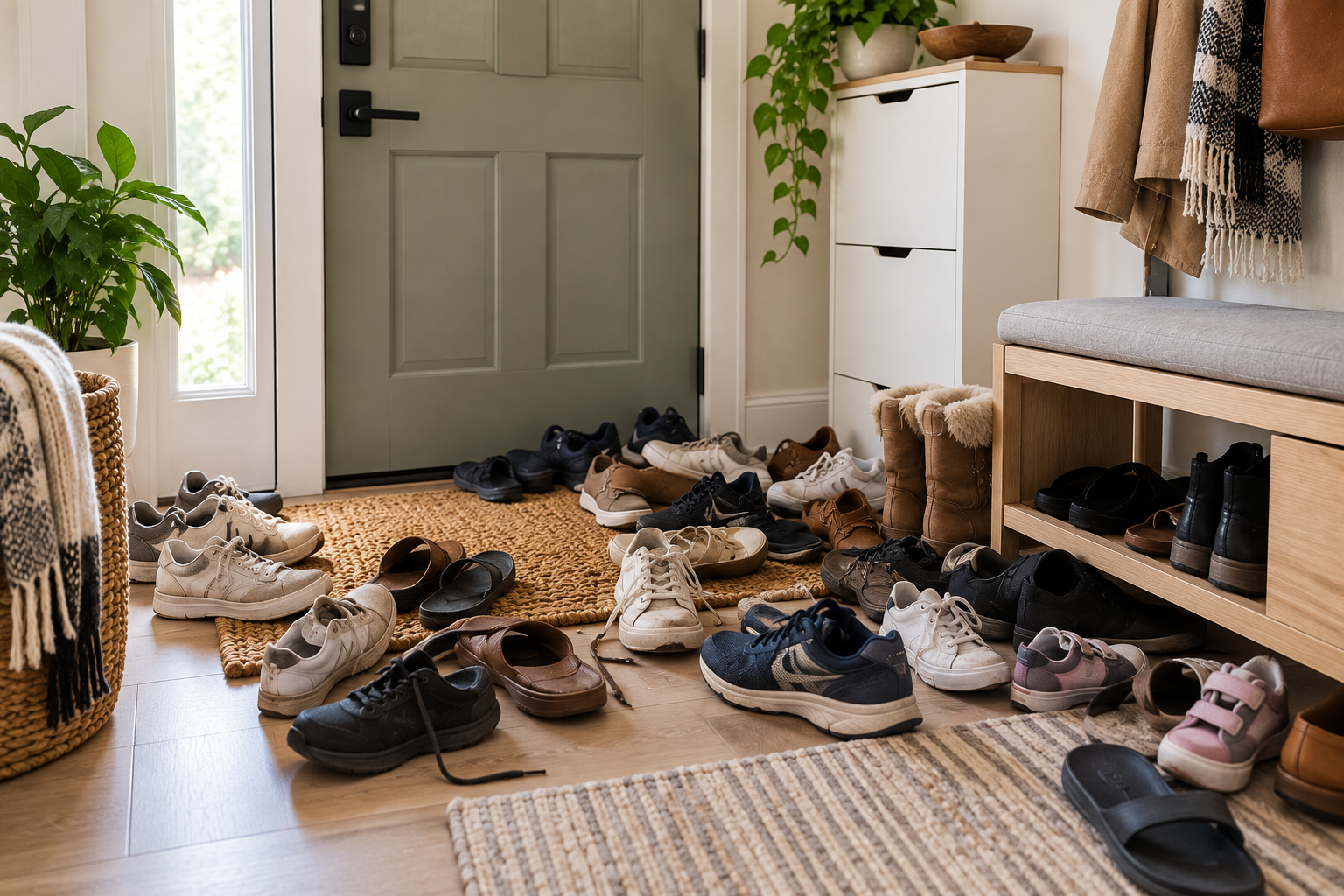
A shoe pile is not always a storage problem. Sometimes it is a capacity problem or a behavior problem. Diagnose that first.
Start by Auditing the Shoes
Before choosing a rack, cabinet, bench, or basket, take every pair currently living around the entryway and sort them.
You do not need to make complicated decisions. Four useful groups are enough:
Active
Shoes used regularly and worth keeping close to the door.
Seasonal
Shoes needed during a particular season but not every day.
Occasional
Dress shoes, special-purpose footwear, or pairs used infrequently.
Remove / Repair
Shoes that are damaged, uncomfortable, no longer used, or waiting for a decision.
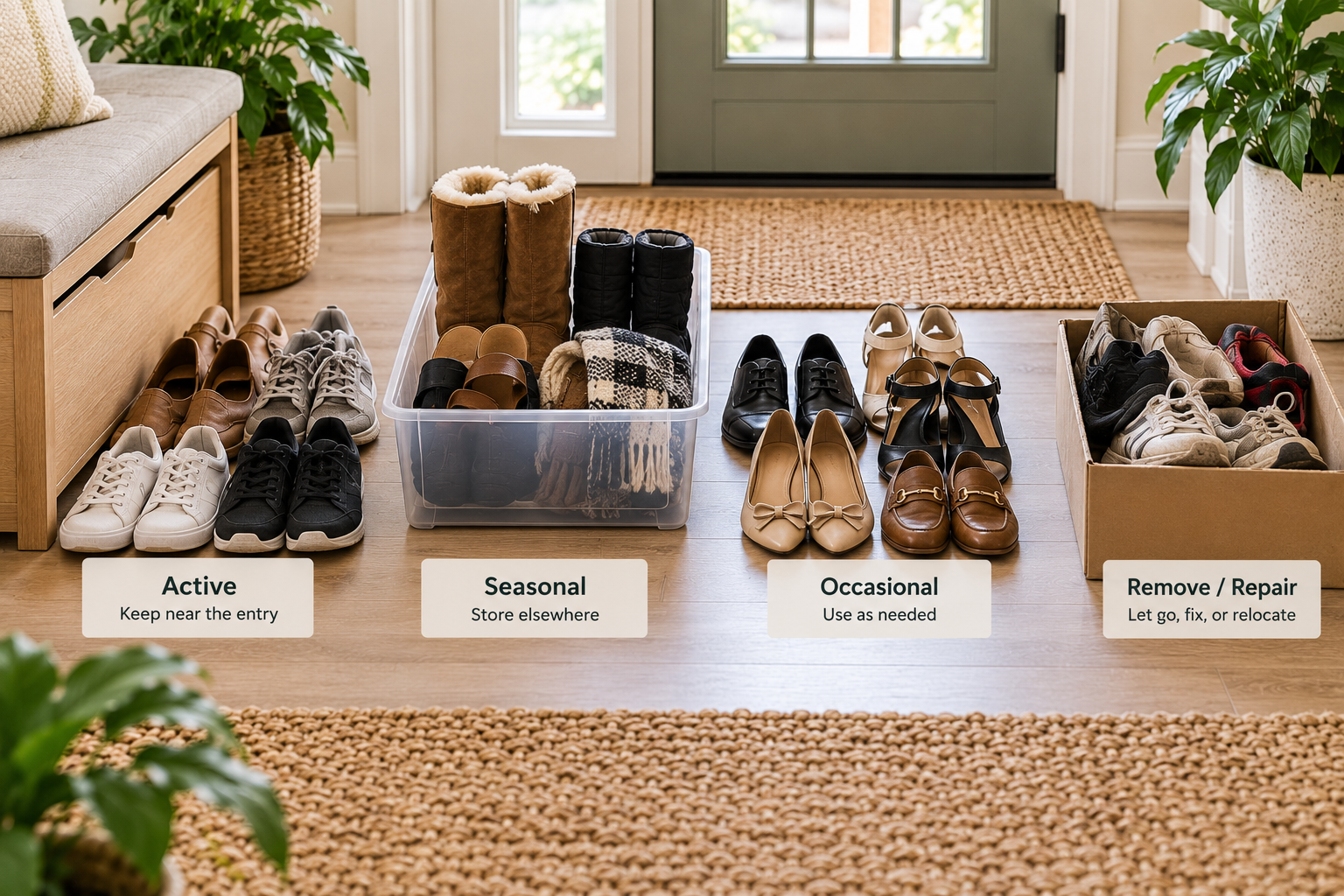
Prime entryway space should go to high-frequency footwear. Seasonal and occasional shoes do not automatically deserve the same storage position.
Create an Active Shoe Rotation
Once you have audited the shoes, create a small active rotation.
This is the footwear that deserves the easiest access because it is used frequently enough to justify taking up valuable entryway space.
The exact number depends on the household. A single person with two daily pairs needs much less capacity than a family with several people.
The important question is not: How many pairs can I fit?
Ask: How many pairs need to be immediately available here?
Move seasonal and occasional footwear to another appropriate storage area whenever possible. The entryway should function as an active-use zone rather than a complete shoe wardrobe.
Define How Much Shoe Storage You Actually Need
Storage capacity should come after the shoe audit.
Count the active pairs you decided should remain near the door. Then consider whether the storage needs to accommodate one person, several people, or a changing seasonal rotation.
Leave enough room for the system to work comfortably. A storage unit that technically fits the current number of shoes can become frustrating if every pair has to be squeezed into a tight opening.
Design the entryway around the footwear that needs daily or frequent access. Store lower-frequency footwear elsewhere instead of expanding entryway storage until it becomes crowded.
Measure the Real Shoe-Storage Space
Do not measure only the wall where you hope to place a shoe rack.
Measure the complete operating area around the storage. This is the shoe-storage envelope.
Check:
- Available width
- Maximum practical depth
- Door swing
- Storage opening and operating space
- Walking route through the entryway
- Whether shoes can be removed and returned without blocking the route
Also consider the shoes themselves. Boots, larger athletic shoes, and bulky footwear can require more usable space than a simple pair of flats or sandals.
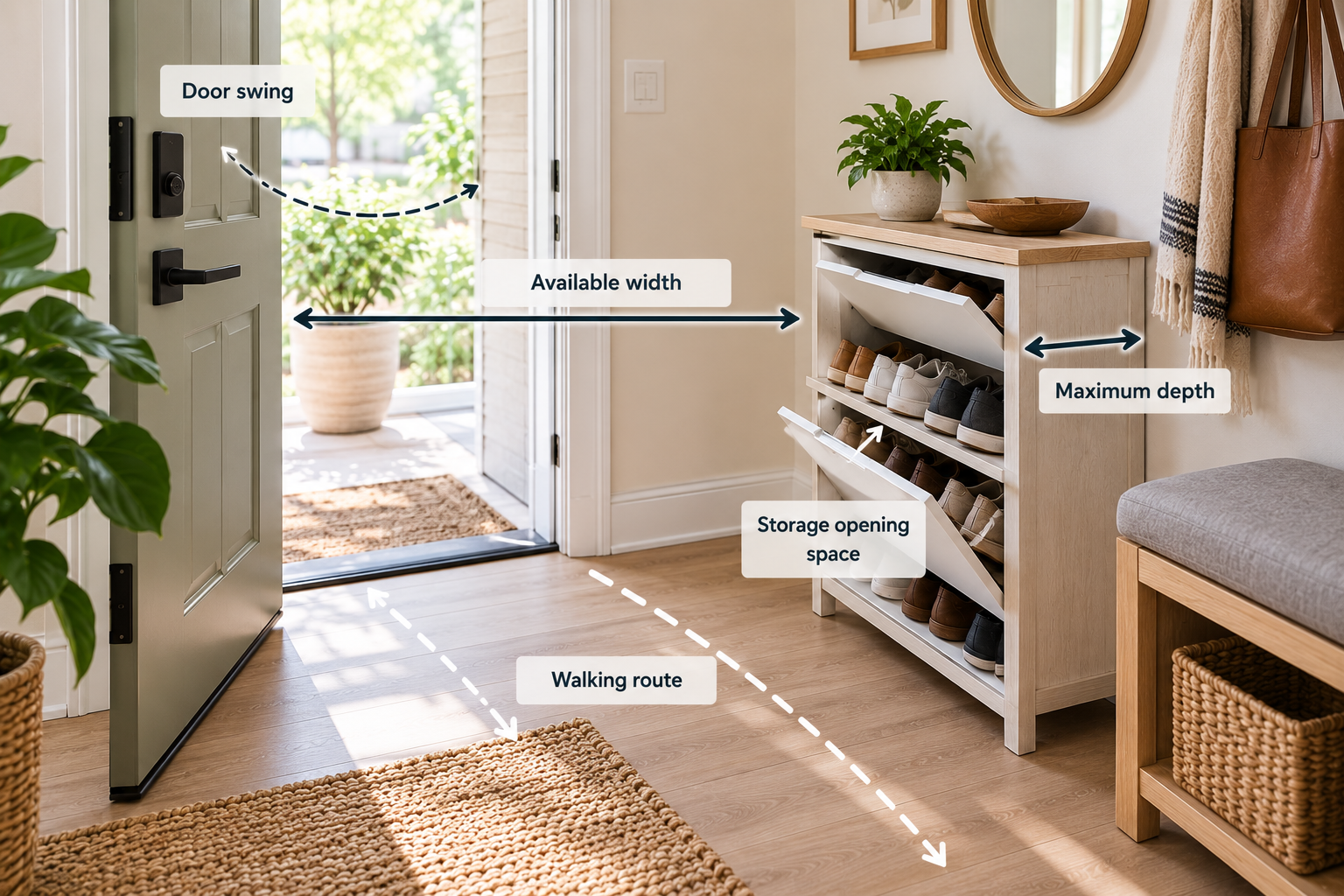
Measure the space the storage needs to operate in, not just the space the furniture occupies.
Choose the Storage Format That Fits the Constraint
There is no single best shoe-storage format for every small entryway. The right choice depends on what is limiting the space.
| Constraint | Storage direction |
|---|---|
| Very little floor depth | Shallow or vertical storage |
| Limited wall width | Compact freestanding storage |
| Visual clutter is the main problem | Closed cabinet |
| Fast daily access matters | Open rack or shelf |
| Seating is also needed | Storage bench |
| Only a few active pairs | Small rack, shelf, or basket |
| Wet footwear is common | Separate washable and ventilated zone |
| Drilling is not practical | Freestanding solution |
| Several people share the entryway | Higher-capacity system if the footprint allows |
Open vs. Closed Shoe Storage
Open and closed storage solve different problems.
Open storage works well when speed matters. Shoes are visible, easy to reach, and easy to return. This can be useful for footwear that is worn every day.
The trade-off is visual. Several pairs of shoes can make a small entryway look busy even when everything is technically organized.
Closed storage can reduce visual clutter and make the room feel calmer. It can be especially useful when the entryway is visible from the main living area.
The trade-off is friction. Doors, drawers, or compartments add another step between the person and the shoes.
Choose based on the behavior you need the system to support, not simply on appearance.
Create a Separate Wet-Shoe Zone
Wet or muddy shoes should not automatically go straight into enclosed storage.
Give them a temporary place where water and dirt can be contained while the footwear dries.
A washable waterproof tray or similar contained surface can work well for this purpose.
Keep this zone separate from the main everyday shoe storage when possible. Once footwear is dry and clean enough to store, return it to its normal location.
Put Shoe Storage Where People Will Actually Use It
Even a perfectly sized shoe rack can fail if it is inconvenient.
The best location is usually close enough to the door that putting shoes away requires very little effort.
Think about the complete movement:
- Enter the home.
- Remove the shoes.
- Place them in their assigned location.
- Continue into the home without blocking the entryway.
If that sequence feels awkward, the storage system may be fighting the household’s natural routine.
Test the Shoe System Before Buying More Storage
You do not always need to buy storage immediately.
First create a temporary version of the system using the space you already have. Keep only the active shoes near the door and assign each pair a clear location.
Use the arrangement for several days.
Watch what happens.
- Which shoes are actually used?
- Which pairs keep getting left outside the storage?
- Does anyone struggle to reach or return a pair?
- Does the active capacity feel sufficient?
- Do wet shoes need their own temporary zone?
These observations tell you more than choosing storage based on appearance alone.
Two Simple Storage Solutions for Different Needs
Once the space and capacity are clear, the product choice becomes much easier.
Compact Open Shoe Storage
An open shoe rack can work well when daily access matters and the entryway has limited depth. It keeps frequently used footwear visible and easy to return.
Storage Bench
A shoe-storage bench can make sense when the entryway also needs a place to sit. It combines two functions in one footprint rather than adding a separate bench and shoe rack.
How to Organize Shoes in Different Small Entryways
If the entryway is narrow
Prioritize depth. A storage unit that is slightly wider but substantially deeper can interfere with the walking route and make the whole entryway feel tighter.
Start with the shallowest storage format that can comfortably hold the active footwear.
If the entryway has very little floor space
Look upward or use a shallow footprint where practical. The goal is to move storage into available space without making the walking route harder to use.
If there is no closet
The entryway needs a clearly defined landing area for the footwear that is actually used there. Avoid turning the whole entryway into a replacement closet.
For the broader no-closet system, see how to organize a small entryway without a closet .
If several people share the entryway
Give the system enough capacity for the active footwear without assuming that every person’s entire shoe collection belongs at the door.
If possible, make individual return locations obvious. A system is easier to maintain when everyone knows where their shoes go.
Common Small Entryway Shoe-Storage Mistakes
More capacity can simply create space for more clutter.
The entryway usually needs an active rotation, not the whole wardrobe.
A storage unit can fit physically while still making doors, walking routes, or shoe removal awkward.
A beautiful system that nobody uses will still become cluttered.
Give wet footwear a separate temporary drying area.
Extra steps create friction and make the floor pile more likely to return.
How to Maintain the Shoe System
A small entryway shoe system should be easy enough to maintain during normal life.
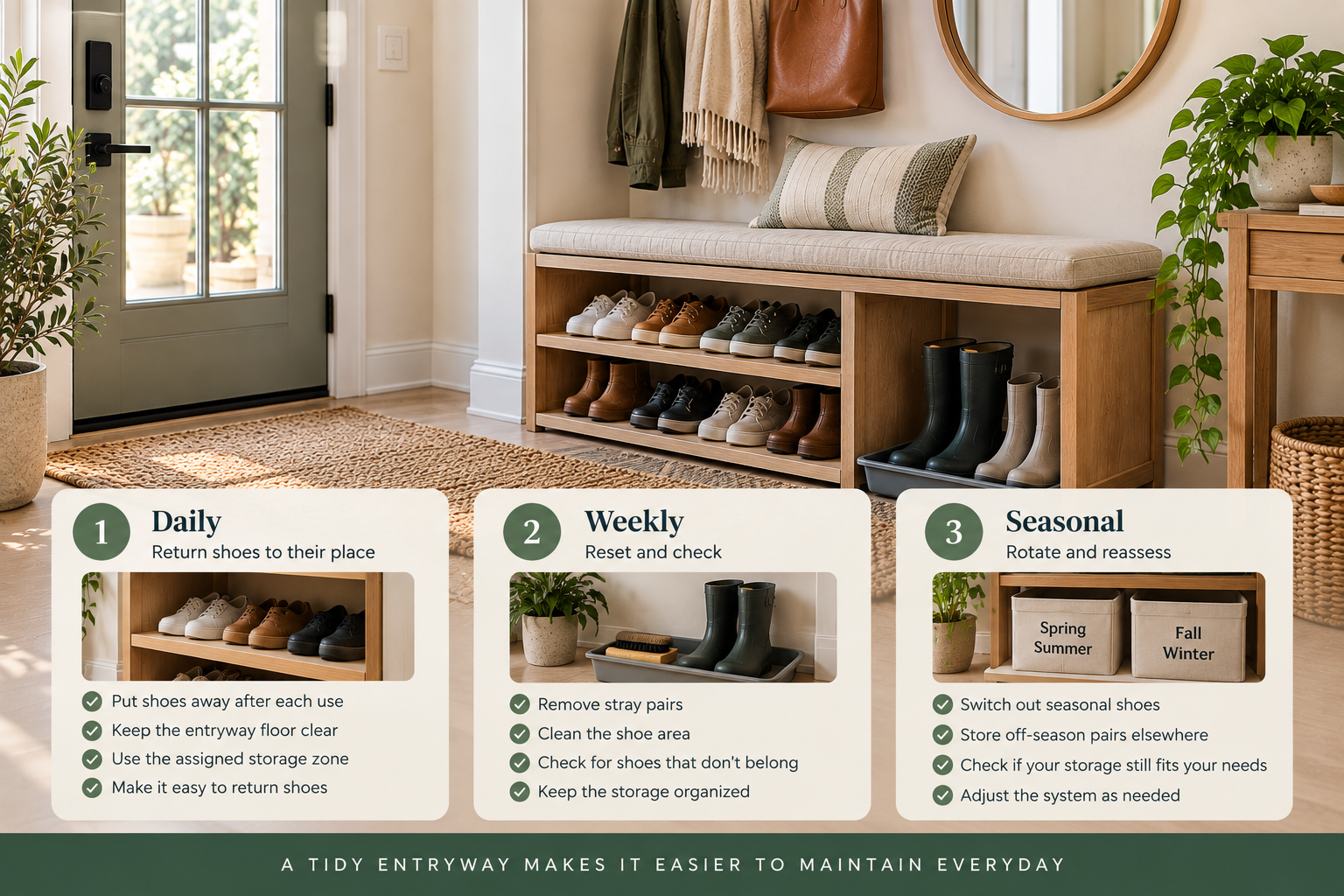
Use three simple maintenance cycles.
Daily Return
Put frequently used shoes back in their assigned location after use.
Weekly Reset
Remove stray pairs, deal with wet footwear, and restore the storage area.
Seasonal Rotation
Move seasonal footwear in or out as the household’s actual needs change.
If the system repeatedly fails, do not immediately buy more storage. Recheck the inventory, capacity, location, storage format, and routine.
Quick Takeaways
- Keep the shoes you use regularly near the door.
- Move seasonal and occasional footwear out of prime entryway space.
- Define the active capacity before buying storage.
- Measure width, depth, door swing, operating space, and walking route.
- Choose open or closed storage according to the behavior you need.
- Keep wet footwear in a separate temporary drying zone.
- Place storage where people can use it with minimal friction.
- If shoes keep piling up, diagnose capacity or behavior before buying more storage.
Frequently Asked Questions
How do you organize shoes in a small entryway?
Keep frequently used footwear near the door, move seasonal and occasional shoes elsewhere, define the active capacity, measure the available space, and choose storage that fits both the footprint and the household routine.
How many pairs of shoes should stay by the door?
Keep the number of pairs that need frequent access and that the entryway can hold comfortably without creating a pile. The right capacity depends on household size, routines, climate, and available space.
What is the best shoe storage for a small entryway?
The best format depends on the constraint. Shallow storage suits limited depth, open storage supports fast access, closed storage reduces visual clutter, and a storage bench can combine seating with shoe storage.
How do you organize shoes without taking up floor space?
Start by reducing the number of active pairs stored at the door. Then consider shallow or vertical storage where the room’s layout allows it, while keeping the walking route clear.
Should entryway shoe storage be open or closed?
Open storage is useful when fast access is important. Closed storage is useful when reducing visible clutter matters more. Choose the format that people are most likely to use consistently.
How do you organize shoes in a narrow entryway?
Prioritize the available depth and walking route. Measure the full storage envelope and choose the shallowest practical storage that can hold the active footwear comfortably.
Where should wet shoes go?
Wet shoes should have a separate washable and ventilated area where they can dry before returning to normal storage. Avoid immediately sealing wet footwear inside closed storage.
How do you keep shoes from piling up by the door?
Reduce the active shoe inventory, give every frequently used pair a clear return location, place storage close to the door, and make sure the storage has enough practical capacity for the household.
How do you organize shoes without a closet?
Create a defined active shoe zone near the door and use compact storage suited to the available footprint. Keep lower-frequency footwear in another appropriate area rather than turning the entire entryway into a closet substitute.
How do you choose a shoe rack for a small entryway?
Measure the available width and depth first, then consider the number and size of active pairs, door swing, walking route, access speed, and whether visible or enclosed storage better fits the household’s routine.
How do you organize shoes for multiple people?
Start with the active footwear each person actually needs near the door. Give the system enough practical capacity and make return locations obvious, while keeping seasonal and occasional footwear elsewhere.
A small entryway does not need to hold every pair of shoes. It needs a clear system for the shoes people actually use.
Audit the footwear. Create an active rotation. Define the capacity. Measure the real space. Match the storage to the constraint. Then make the system easy enough to use every day.
When shoes keep ending up on the floor, treat that as useful information. Recheck the inventory, capacity, location, storage format, and routine before adding more storage.