
A small kitchen does not need a large spice rack to stay organized. Start by auditing the spices you actually use, checking suitable storage conditions, measuring the space you have, and then giving each group a practical home.
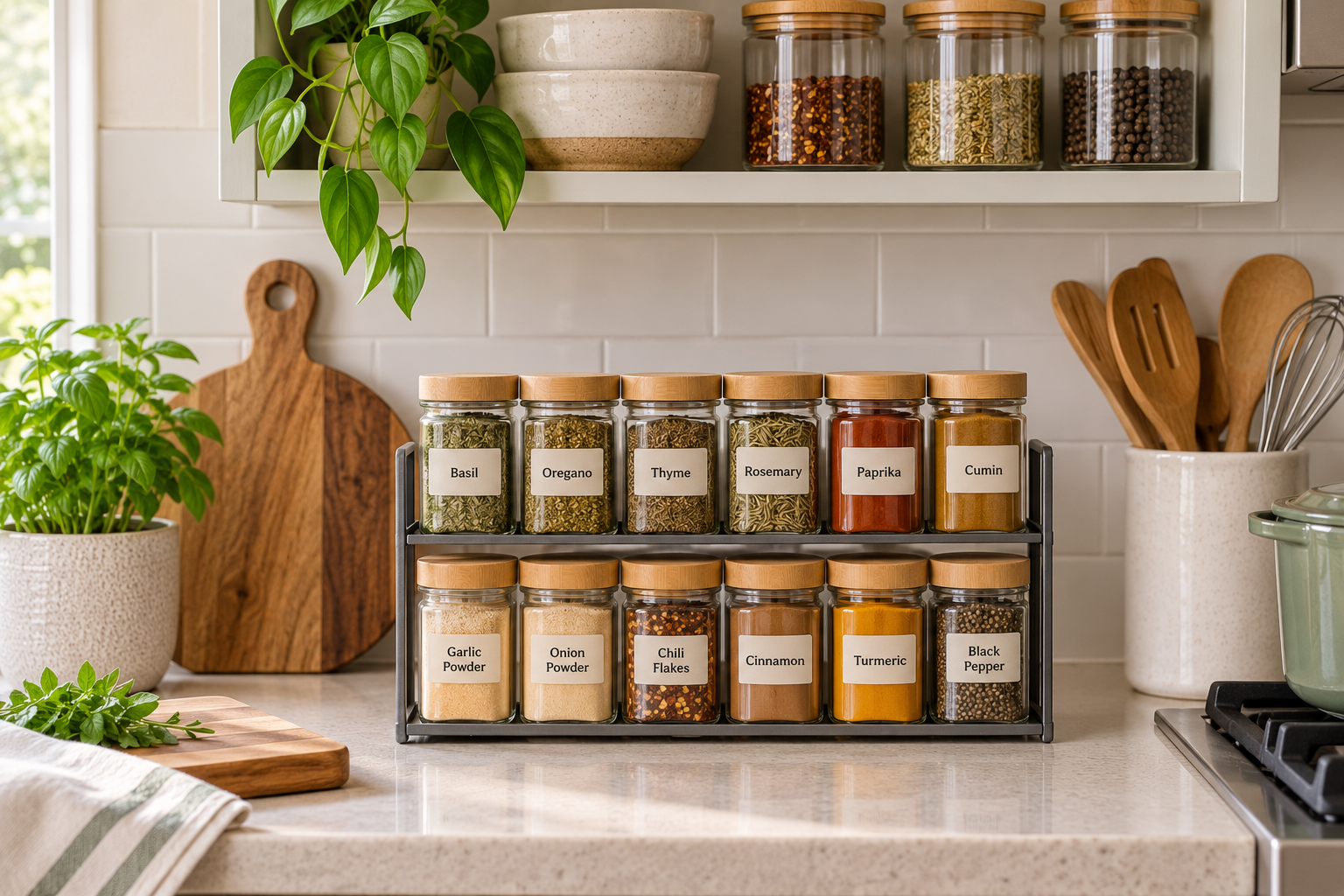
The goal is not simply to fit more spice containers into a small kitchen. It is to make the spices you actually use easy to identify, retrieve, and put away.
AUDIT → CHECK → MEASURE → GROUP → MATCH → TEST → RESET
Start with what you own. Check that the storage location is appropriate. Measure the space and containers. Group spices according to how you use them. Match each group to a practical location, then test whether the system is easy to use and maintain.
Start With a Spice Storage Audit
Before buying containers or moving spices into a new cabinet, gather your spices in one place. This gives you a clearer picture of what actually needs storage.
Look for duplicates, rarely used spices, damaged containers, packets, refill bags, and spices that have gradually spread across different parts of the kitchen.
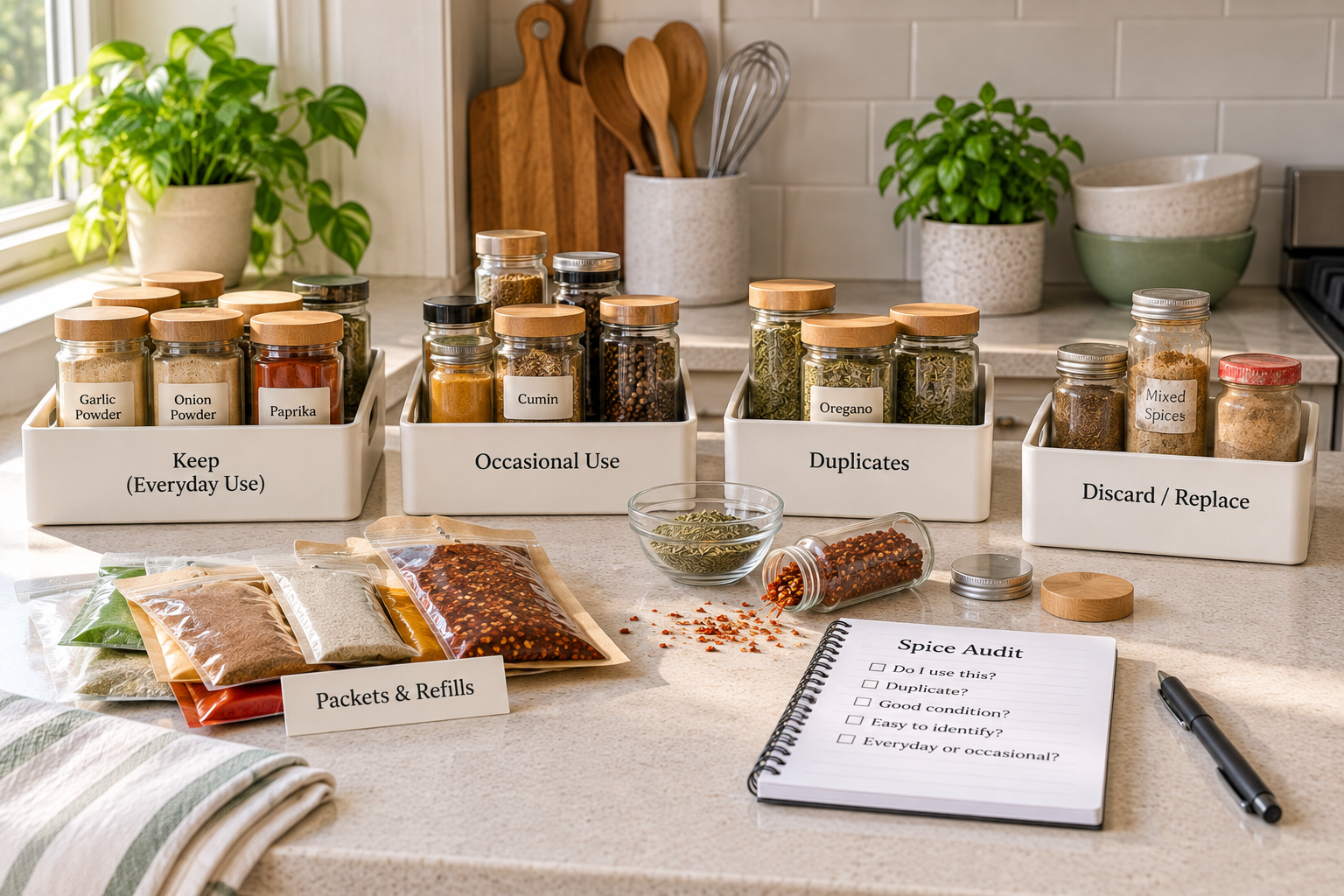
- Do I still use this spice?
- Do I already have another container of it?
- Can I identify it easily?
- Is the package or container still in good condition?
- Is it an everyday, regular-use, occasional, or backup item?
- Is it currently stored somewhere inconvenient?
The purpose of the audit is not to create an arbitrary discard list. It is to understand your collection before designing its storage.
Check the Storage Conditions Before Choosing a Location
Convenience should not be the only consideration when choosing where spices will live.
Spices generally benefit from being protected from excessive heat, moisture, and sunlight. Check the storage information on the package and consider the actual conditions in the location you are considering.
This means the spot closest to your cooking area is not automatically the right location. A convenient cabinet or shelf still needs to be suitable for the products you keep there.
Choose a suitable storage location first. Then optimize accessibility within that location.
Measure Your Actual Spice Storage Space
Do not buy an organizer because it looks like it will fit. Measure the usable space first.
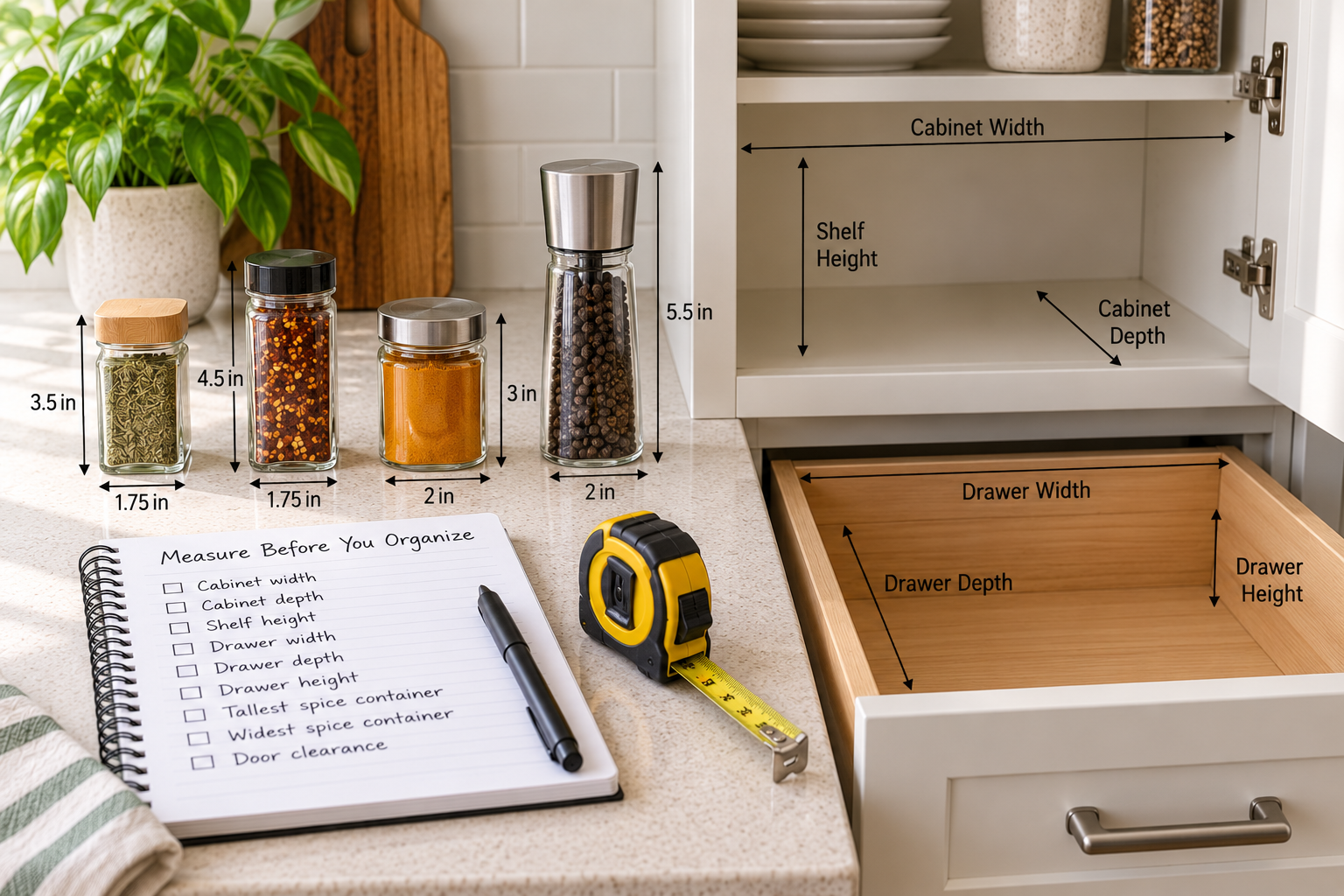
Measure the width
Measure the usable interior width rather than relying on the outside cabinet or drawer dimensions.
Measure the depth
Check how far back containers can sit while remaining practical to retrieve.
Measure the height
Check shelf or drawer height against your tallest spice container.
Check clearances
Consider drawer opening, cabinet doors, shelves, hinges, and surrounding space.
Also measure the containers themselves. Pay particular attention to the tallest and widest containers, grinders, unusual shapes, packets, and refill bags.
A storage system designed around one jar size may fail when several taller or wider containers are added.
Group Spices by How You Actually Use Them
Once you know what you have, group the spices according to your cooking habits. Frequency is more useful than forcing every kitchen into the same arrangement.
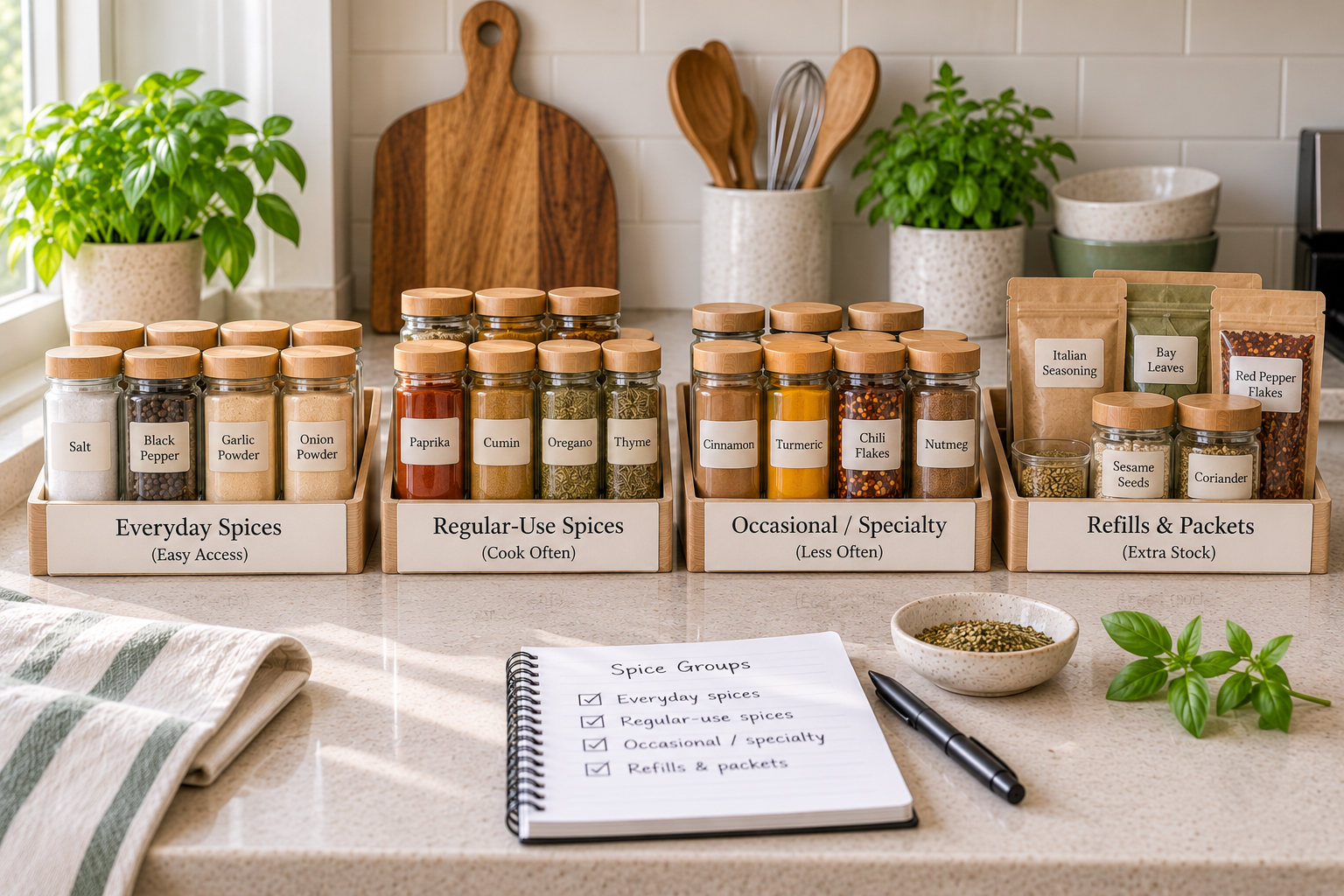
Everyday spices
Spices you reach for frequently should receive the easiest practical access.
Regular-use spices
These are used often but do not necessarily need the most convenient position.
Occasional or specialty spices
Less frequently used items can occupy secondary storage while remaining easy enough to retrieve.
Backup and refill stock
Extra quantities do not need to occupy your prime-access space.
You can organize within these groups alphabetically or by cooking style if that makes the collection easier for you to navigate. The system should remain simple enough that you do not need to remember a complicated map.
Match Your Spices to the Right Storage Location
There is no single storage method that works for every small kitchen. The right choice depends on the space you measured, the containers you own, and how frequently you use the spices.
| Storage location | Consider it when… |
|---|---|
| Drawer | The drawer has enough usable height and allows containers to remain easy to identify and retrieve. |
| Cabinet shelf | The shelf provides enough visibility and does not turn rear containers into inaccessible storage. |
| Tiered storage | Several rows would otherwise hide the labels behind one another. |
| Turntable | A deep storage area makes rotation genuinely useful for reaching the contents. |
| Cabinet door | The available clearance allows added storage without interfering with the door, shelves, or hardware. |
| Counter top | The spices are used frequently enough to justify the space and the location remains suitable for storage. |
The goal is not to maximize the number of containers you can fit. It is to create a bounded storage zone where the spices are easy to identify, retrieve, and return.
How to Organize Spices in a Drawer
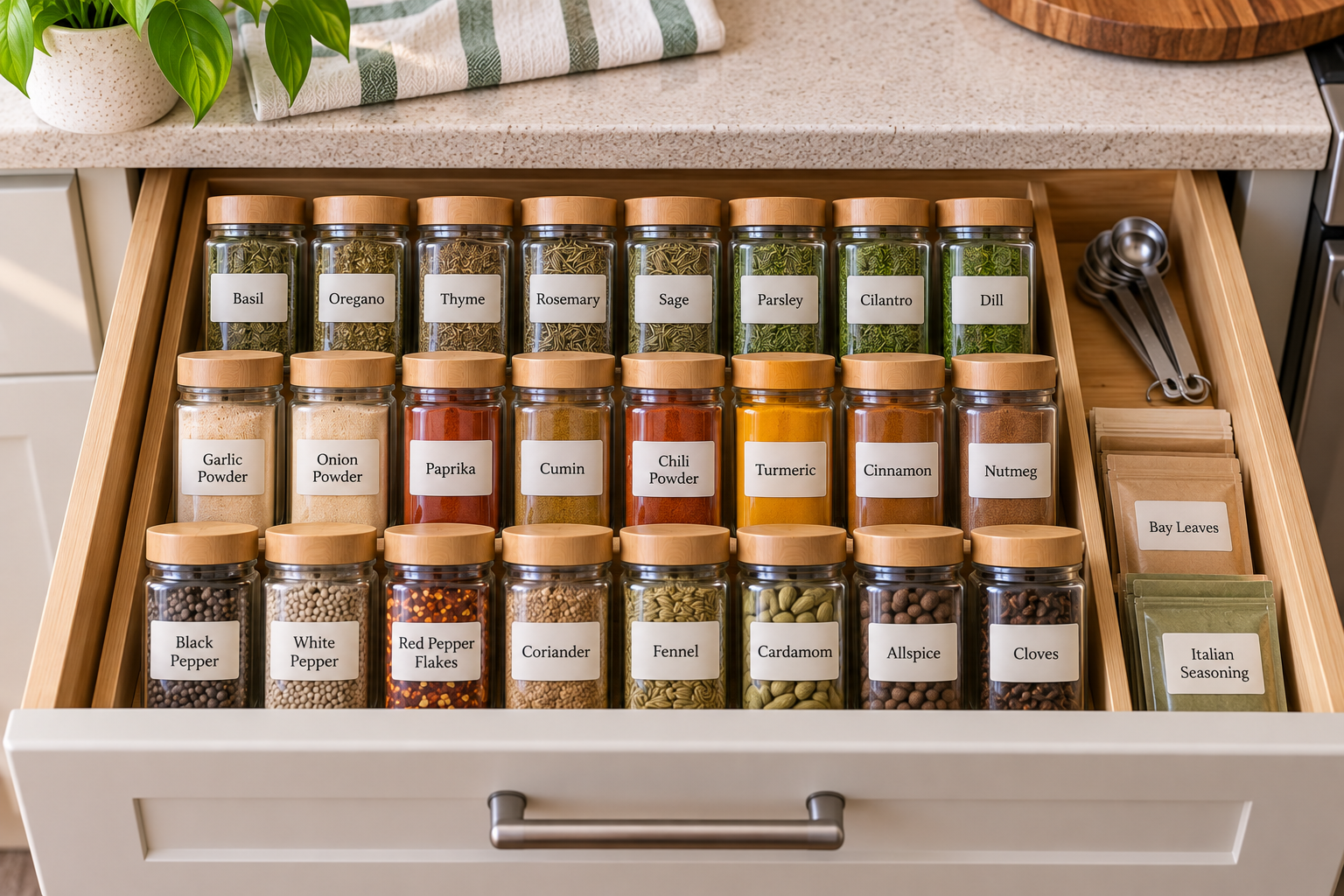
If you have a suitable drawer, start by deciding how the containers will be positioned. The most important question is whether you can identify the spice without pulling several containers out.
Keep similar groups together and arrange them so the labels remain readable. Frequently used spices can occupy the easiest-to-reach section, while less frequently used spices can move farther away.
Avoid filling every available inch. A drawer that technically holds more containers can become harder to use when jars overlap, hide one another, or are difficult to return.
For a broader approach to drawer organization, see how to organize kitchen drawers.
How to Organize Spices in a Cabinet
For cabinet storage, visibility becomes especially important.
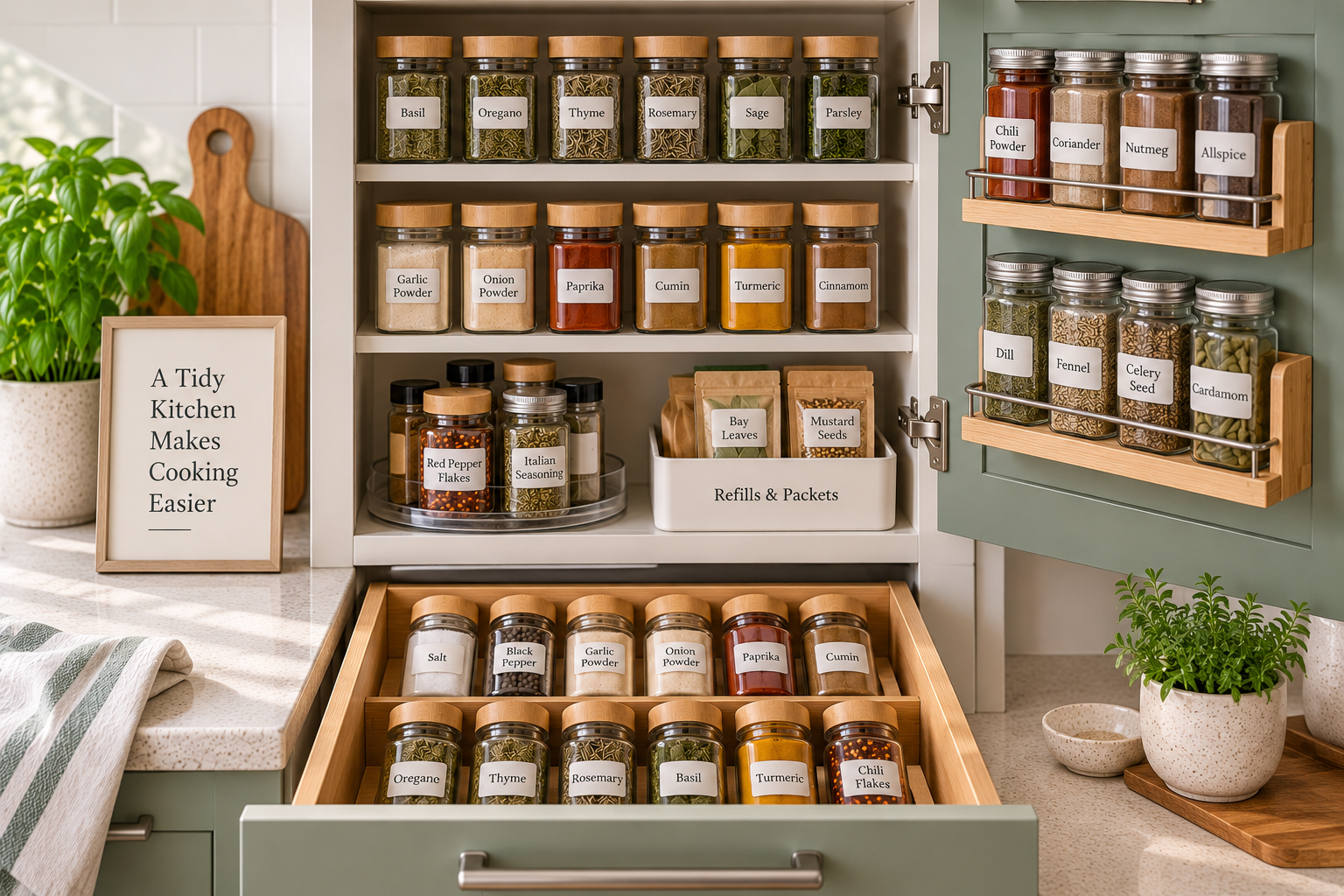
If containers are stored in multiple rows, make sure the arrangement does not turn the back row into forgotten storage. Use the available vertical space when appropriate, but check the actual shelf height and container dimensions first.
Group spices according to your cooking habits rather than creating a complicated classification system. Your everyday cooking spices can have one easily accessible zone, while specialty or occasional spices can occupy a secondary zone.
For more cabinet-specific organization principles, see how to organize kitchen cabinets.
How to Organize Spices Without a Spice Drawer
You do not need a dedicated spice drawer.
Start by choosing one deliberate primary location rather than allowing spices to spread across several unrelated places. That location might be a suitable cabinet shelf, pantry section, cabinet-door area, or another bounded storage zone.
The important part is consistency. If the same spice moves between the counter, cabinet, and pantry depending on the day, the system becomes harder to maintain.
If your pantry is part of the solution, you may also find these pantry organization ideas useful when deciding where a secondary spice zone belongs.
How to Handle Spice Packets, Refills, and Odd-Sized Containers
Not every spice needs to live in a matching jar.
Packets and refill bags create a different storage problem from standard spice containers. Give them their own bounded zone rather than forcing them into the same arrangement as everyday jars.
For unusual containers, measure the actual container before choosing an organizer. If you transfer spices into another container, retain useful product information and follow any storage instructions provided on the original packaging.
Matching containers are optional. A usable system is not.
Use the Spice Retrieval and Return Test
Now test the system before considering it finished. Choose several spices from different groups and use the storage exactly as you would during normal cooking.
- Can I see or identify the spice quickly?
- Can I reach it without moving several other spices?
- Can I remove it without disturbing the rest?
- Can I return it to the same place just as easily?
Find → Retrieve → Use → Return
If one step consistently creates friction, change the storage arrangement rather than simply adding another organizer.
Common Spice Organization Mistakes
Buying the organizer first
The organizer should solve a known storage problem. It should not determine what the problem is.
Keeping every spice equally accessible
Prime storage space is limited. Give the easiest locations to the spices you actually use most.
Storing everything in one crowded group
More storage capacity does not automatically mean better access. If containers hide one another, the system creates retrieval friction.
Ignoring container dimensions
A system designed around one jar size may fail when your collection contains grinders, packets, tall containers, or different shapes.
Organizing for appearance only
A beautiful arrangement that is difficult to retrieve from will not remain organized for long.
Creating too many storage locations
When spices are divided between several unrelated areas, finding and returning them becomes harder.
Ignoring storage conditions
Convenience should not override appropriate storage conditions. Consider heat, moisture, sunlight, and the storage information provided with the products you keep.
How to Keep Spices Organized
A spice system does not need a complicated maintenance routine.
After cooking:
Use → Return
Then occasionally check for:
- Duplicates
- Damaged containers
- Unused spices
- Misplaced spices
- Overcrowded storage
- Spices that have become difficult to identify or retrieve
The goal is to maintain the system you already created, not repeatedly reorganize the entire kitchen.
Frequently Asked Questions
How do you organize spices in a small kitchen?
Start by auditing the spices you actually use, checking suitable storage conditions, measuring your available space, grouping spices by frequency, and choosing a storage location that keeps them easy to identify, retrieve, and return.
Where should spices be stored?
Store spices in a dry location away from excessive heat and sunlight, while following the storage information provided on the product packaging. The location should also make frequently used spices practical to retrieve.
Should spices go in a drawer or cabinet?
Either can work. Choose based on the available dimensions, visibility, frequency of use, and how easily you can retrieve and return the containers.
How do you organize spices without a spice drawer?
Choose one deliberate storage zone, such as a suitable cabinet or pantry section, then group spices so frequently used containers remain easiest to access.
How do you organize spices in a small cabinet?
Measure the cabinet and containers first, then use the available depth and height without allowing rear containers to become difficult to reach.
How should spice packets and refills be stored?
Give packets and refill stock their own bounded area so they do not disappear among everyday spice containers. Measure unusual packages before choosing storage for them.
How do you keep spices organized?
Give each group a consistent home and return each spice to that home after use. Periodically check for duplicates, misplaced items, overcrowding, and spices you no longer use.
Build a Spice System That Fits Your Kitchen
A good spice organization system is not the one that holds the most jars.
It is the one that makes the spices you actually use easy to find, retrieve, and return.
AUDIT → CHECK → MEASURE → GROUP → MATCH → TEST → RESET
Start with what you own. Measure the space you have. Choose storage that fits both. Then test the return path.
If you can find the spice you need without disturbing the rest of the collection—and put it back just as easily—the system is doing its job.