
SMALL LIVING ROOM ORGANIZATION
A small living room with little or no built-in storage does not need storage everywhere. It needs a simple system that creates capacity without sacrificing movement, useful floor space, or visual calm.
To organize a small living room with no storage, first remove items that do not need to live there. Then group what remains by use, make existing furniture work harder, use vertical space selectively, contain the categories that create the most visible clutter, and give everyday items a fixed home. Add storage only when it solves a specific problem without blocking movement.
Our No-Storage System
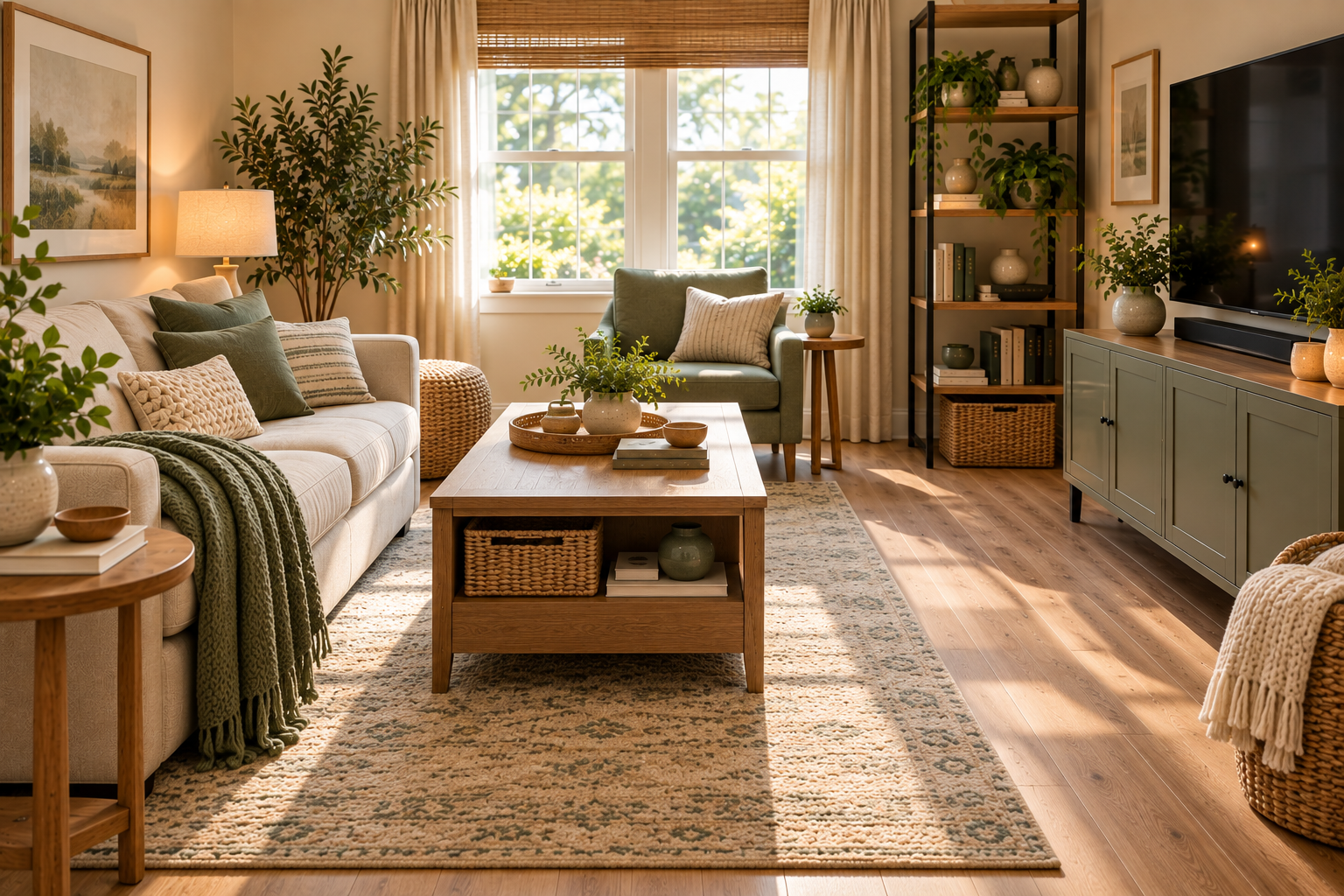
1. Start With What Actually Needs to Stay in the Living Room
When a living room has no built-in storage, the first instinct is often to buy storage furniture.
Start somewhere else.
Decide what genuinely needs to live in the room. Every item you remove from the storage equation creates capacity for the things you actually use.
Stays here
Items used regularly in the living room and worth storing close to where they are used.
Stored elsewhere
Items that may be useful but do not need to occupy limited living-room storage.
Leaves the home
Trash, broken items, duplicates, unwanted belongings, and things that no longer serve a purpose.
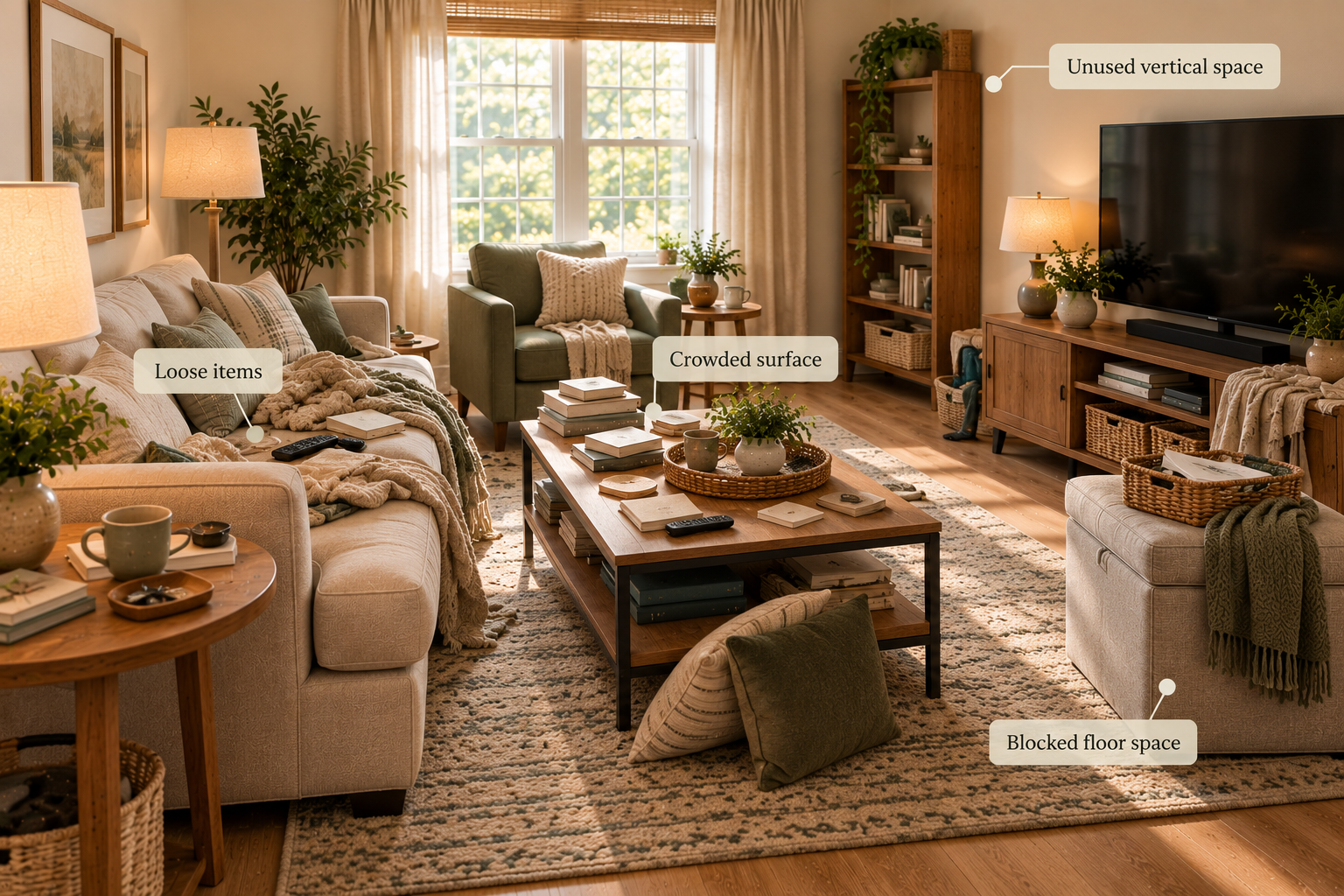
The goal is not to make the room empty. It is to stop limited storage from being consumed by things that do not need to be there.
2. Measure the Space Before Adding Storage
A storage solution can look useful on its own and still be wrong for the room.
Before buying anything, look at the available footprint as a whole.
- Available wall space
- Floor space around the main furniture
- Door and drawer clearance
- Main walking routes
- Existing furniture footprints
- Unused corners or narrow areas
- Vertical space that could be used without making the room feel overloaded
Think of this as the room’s storage footprint. Storage only earns its place when the capacity it creates is worth the space and access it consumes.
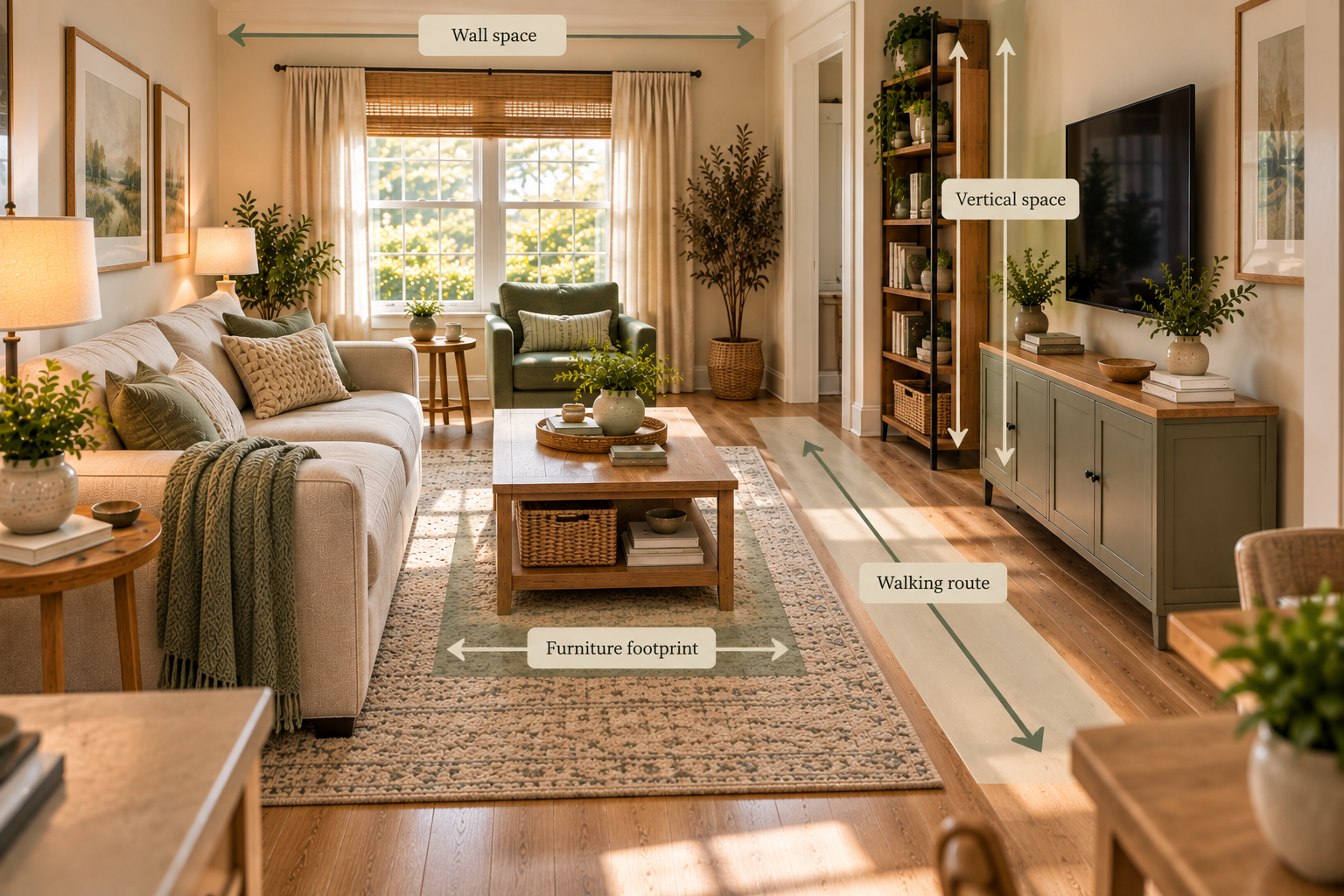
Before adding a storage piece, ask: What exactly needs to be stored? Does it belong in this room? How often is it used? Where is it used? Can existing furniture handle it? Can vertical space handle it? Will the new storage block movement? Will it create more visible clutter?
3. Make Existing Furniture Do More
In a small living room, multi-functional furniture can reduce the need for separate storage pieces.
Look at what you already have before adding another cabinet, table, or basket.
- A coffee table may provide storage as well as a surface.
- An ottoman may provide seating or foot support and concealed storage.
- A media unit may contain electronics and everyday accessories.
- A narrow console may provide a small amount of useful contained storage.
- A bench can sometimes combine seating with storage.
The important question is not whether a piece has storage. It is whether both functions are genuinely useful in your room.
- Measure the available footprint.
- Confirm that doors, drawers, and walking paths remain usable.
- Check what the storage will actually hold.
- Choose access based on how often the items are used.
Dual-purpose storage seating
A storage ottoman can make sense when you need seating, a footrest, or a flexible surface and also need concealed storage. Measure the available footprint first because a larger piece may not suit every small living room.
Compact side-table alternative
A compact or C-shaped table can provide a useful surface while taking less room than a conventional side table in some layouts. Check the actual footprint and clearance before buying.
As an Amazon Associate I earn from qualifying purchases. Some links on this page are paid links, which means Simply Tidy Home may earn a commission if you purchase through them, at no additional cost to you.
4. Use Vertical Space Before Taking More Floor Space
When floor space is limited, walls can sometimes provide useful storage capacity.
Depending on the room, options can include a tall narrow bookcase, vertical cabinet, carefully placed shelving, or another storage solution that uses height rather than spreading across the floor.
Vertical storage should still be selective. Filling every available wall with shelves and containers can replace physical crowding with visual crowding.
Use vertical space for categories that benefit from being visible or easily accessible. Use closed storage for categories that become visually messy when exposed.
Use height to create capacity, but do not use every wall simply because it is available.
5. Create Storage Around the Activities That Happen There
Storage works better when it is close to the activity that creates the need for it.
A small living room may serve several purposes. The solution is not necessarily to create a separate storage unit for every purpose.
Sofa zone
Keep blankets, reading material, and frequently used small items close to the main seating area.
Media zone
Keep remotes, controllers, and necessary electronics together rather than allowing accessories to spread across surfaces.
Book zone
Keep books together in one restrained storage area instead of creating several small stacks around the room.
Everyday-items zone
Give frequently handled objects one contained location near where they are normally used.
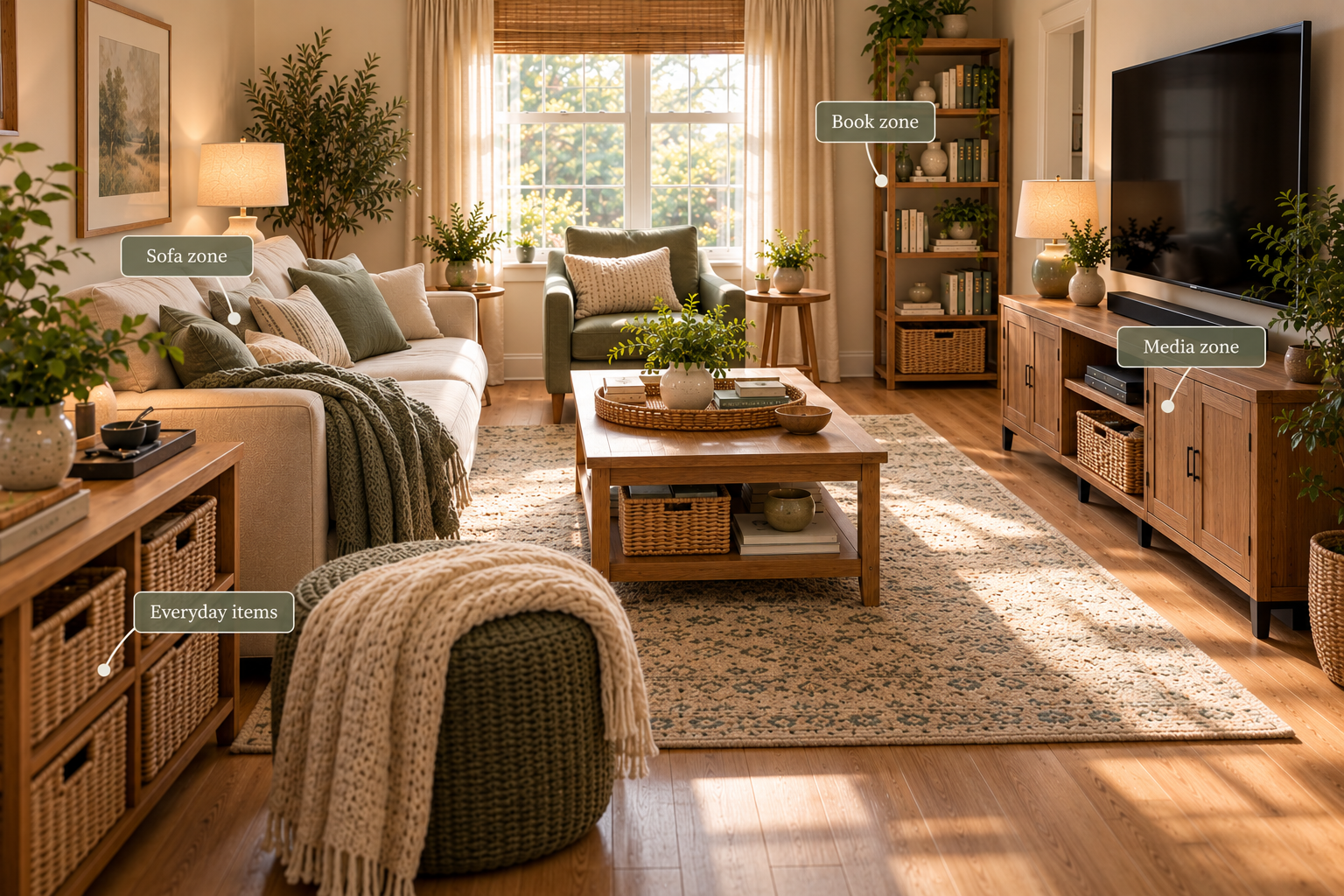
The closer storage is to the point of use, the less effort it takes to put something away. That makes the system easier to maintain.
6. Hide the Categories That Create the Most Visual Clutter
Not everything needs to be hidden. But some categories become distracting when they are spread across open surfaces.
Think about what repeatedly makes the room look untidy.
- Loose electronics and accessories
- Games and small activity items
- Extra cables and chargers
- Small household objects
- Items that are useful but visually inconsistent
These categories often benefit from being contained in a drawer, cabinet, basket, box, or another defined storage location.
Open shelving can work well for books and selected objects. It is less useful when every shelf becomes a collection of unrelated small items.
7. Use Small Spaces That Are Already Being Wasted
Before adding another large storage piece, look for smaller areas that are already available.
- Space underneath suitable furniture
- Unused wall areas
- Narrow gaps beside appropriate furniture
- Unused corners
- Interior space inside existing cabinets or furniture
- Vertical space above low furniture
But do not turn every empty gap into storage.
Some empty space is functional. It allows doors to open, people to move, furniture to breathe visually, and the room to remain easy to use.
Is this truly unused space, or is it space the room needs in order to function comfortably?
8. Choose Storage by the Problem, Not the Product
Shopping first often creates a collection of organizers without solving the original problem.
Start with the category that repeatedly becomes clutter. Then choose the type of storage that fits that specific problem.
| If the problem is… | Consider first… |
|---|---|
| Blankets have nowhere to go | Accessible basket or concealed storage furniture near the sofa. |
| Books are spreading across surfaces | One appropriately sized vertical storage area. |
| Remotes and small accessories migrate | One dedicated contained location near the main seating. |
| Games or activity items spread around the room | One defined container or closed storage area. |
| Media accessories create surface clutter | Closed storage near the media zone. |
| There is too much furniture | Replace or combine functions instead of adding another storage piece. |
| Storage blocks movement | Rework the footprint before buying more storage. |
9. Keep the Room Organized With a Simple Reset
A storage system only works if returning things is easy enough to become a habit.
A short daily reset can prevent small amounts of clutter from becoming another major organizing project.
Return
Put remotes, books, blankets, and everyday items back in their designated homes.
Contain
Move loose small items back into their assigned container or storage area.
Reset
Clear temporary items from the main visible surfaces and restore the walking route.
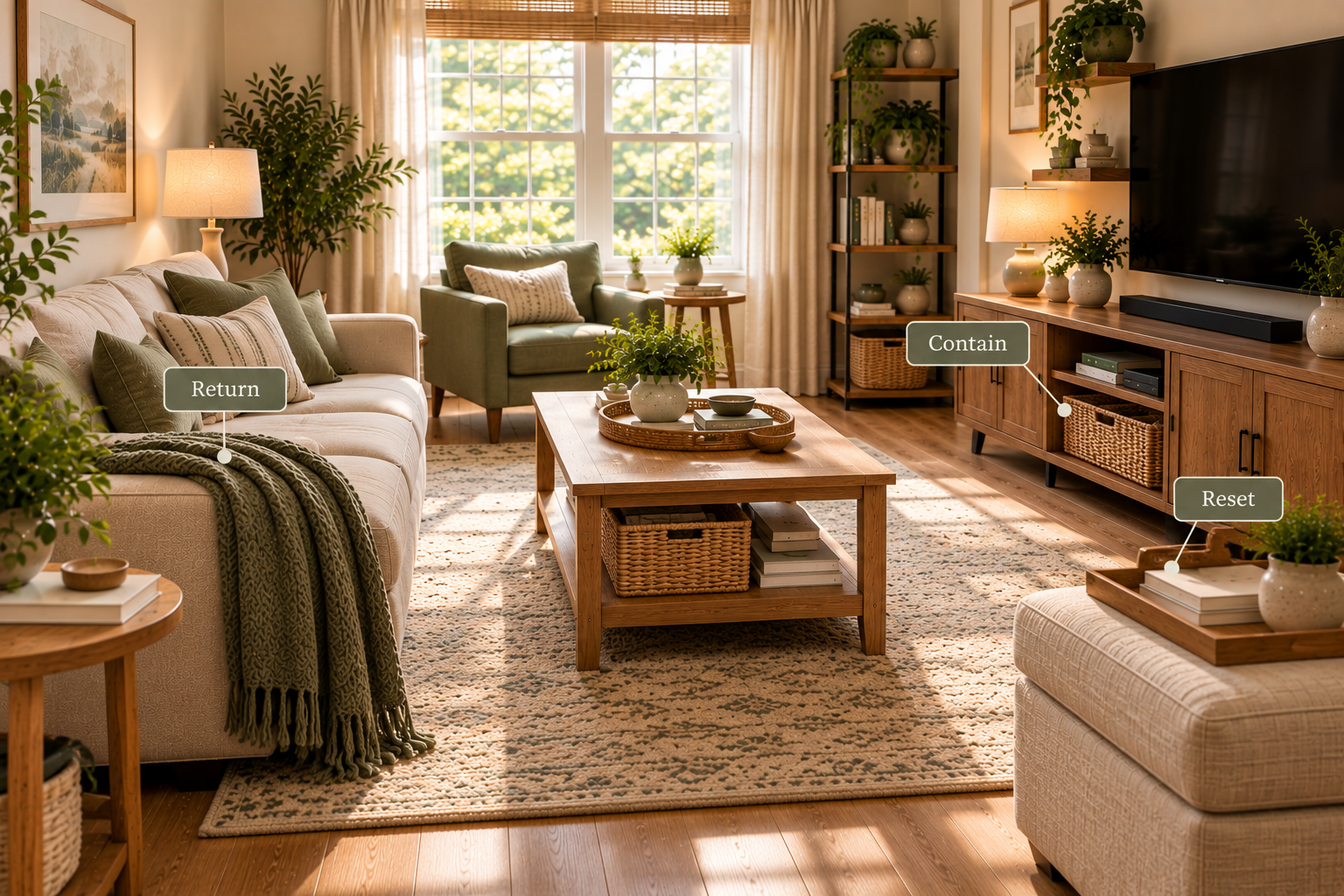
If the same item repeatedly ends up in the wrong place, do not simply put it away again. Ask whether its assigned storage is actually convenient.
Good organization reduces friction. The easier it is to return something, the more likely the system is to stay intact.
10. Common Mistakes When a Small Living Room Has No Storage
- Buying storage before decluttering. More capacity does not solve unnecessary inventory.
- Adding too many small storage pieces. Several baskets and tables can consume more usable space than one carefully chosen solution.
- Filling every wall. Vertical storage should create useful capacity without overwhelming the room.
- Using open shelving for messy categories. Some belongings are easier to manage when contained.
- Storing things far from where they are used. A technically logical location can still fail if returning the item is inconvenient.
- Sacrificing walking space. Storage that blocks movement is usually too expensive in a small room.
- Keeping everything in the living room because there is nowhere else to put it. Not every household category needs to live in this room.
- Buying a product before identifying the problem. Start with the category that creates clutter, then choose the appropriate storage type.
Frequently Asked Questions
How do you organize a small living room with no storage?
Start by removing items that do not need to stay in the room. Then group what remains by use, make existing furniture work harder, use vertical space selectively, contain visually messy categories, and give frequently used items a fixed home.
How can I add storage to a small living room?
First identify what actually needs to be stored. Then consider multi-functional furniture, carefully chosen vertical storage, existing furniture capacity, and small unused areas. Measure the footprint before adding anything that could reduce usable floor space.
Where should I put things if my living room has no storage?
Keep frequently used items close to where they are used. Blankets can stay near the sofa, media accessories near the media area, and books near the main reading area. Items that do not need to live in the room should be stored elsewhere when practical.
What is the best storage for a small living room?
There is no single storage type that works for every room. The useful choice depends on what needs to be stored, where it is used, how often it is accessed, and how much footprint the storage requires.
How do you create storage without taking up floor space?
Look first at vertical space and existing furniture. Tall, narrow storage or carefully placed wall storage can sometimes add capacity without spreading across the floor, but it should still be measured and kept visually restrained.
How do you store blankets in a small living room?
Keep blankets close to the sofa and use an accessible basket or concealed storage furniture when appropriate. The storage should be easy to reach and return to without blocking the main walking route.
How do you organize books in a small living room?
Group books into one defined storage area when possible. A properly sized vertical shelf can use height efficiently, while limiting scattered stacks helps keep surfaces and walking areas clear.
How do you hide clutter in a small living room?
Identify the categories that create the most visual clutter and give them contained homes. Closed cabinets, drawers, baskets, and other defined storage areas can keep useful items accessible without leaving them scattered across visible surfaces.
What furniture is best for a small living room with no storage?
Furniture that performs more than one useful function can reduce the need for separate pieces. Examples include storage ottomans, storage coffee tables, or compact tables that provide a useful surface without requiring a large footprint.
How do you use vertical space in a small living room?
Use appropriately scaled tall or wall-mounted storage where it genuinely improves capacity. Keep it selective rather than filling every wall, and make sure the added storage does not interfere with doors, windows, furniture, or movement.
How do you keep a small living room from becoming cluttered?
Reduce unnecessary items, give frequently used belongings fixed homes, store categories near their point of use, avoid adding storage without a specific purpose, and use a short daily reset to return items before clutter accumulates.
Key Takeaways
- Reduce what needs to be stored before adding storage.
- Measure the room and protect useful floor space.
- Make existing furniture perform more than one useful job when appropriate.
- Use vertical space selectively.
- Store items close to where they are used.
- Contain the categories that create the most visual clutter.
- Choose storage based on the problem rather than shopping first.
- Use a simple return, contain, and reset routine.
A Small Living Room Does Not Need Storage Everywhere
A living room with no built-in storage can still work well when every storage decision has a reason.
Reduce what needs to stay. Measure before adding. Make existing furniture work harder. Use vertical space carefully. Keep storage close to the activities that create the need for it.
The goal is not to make the room hold as much as possible. It is to give the things you actually use a practical home while protecting the space that makes the room comfortable to live in.