
Small kitchen appliances can take over a kitchen surprisingly quickly. A toaster, blender, air fryer, coffee maker, food processor, stand mixer, or slow cooker may each be useful. But when several appliances compete for the same counter and cabinet space, the kitchen starts to feel crowded.
The answer is not to hide every appliance. The better approach is to decide which appliances deserve easy access, which can be stored away, and where each one can live without making everyday cooking harder.
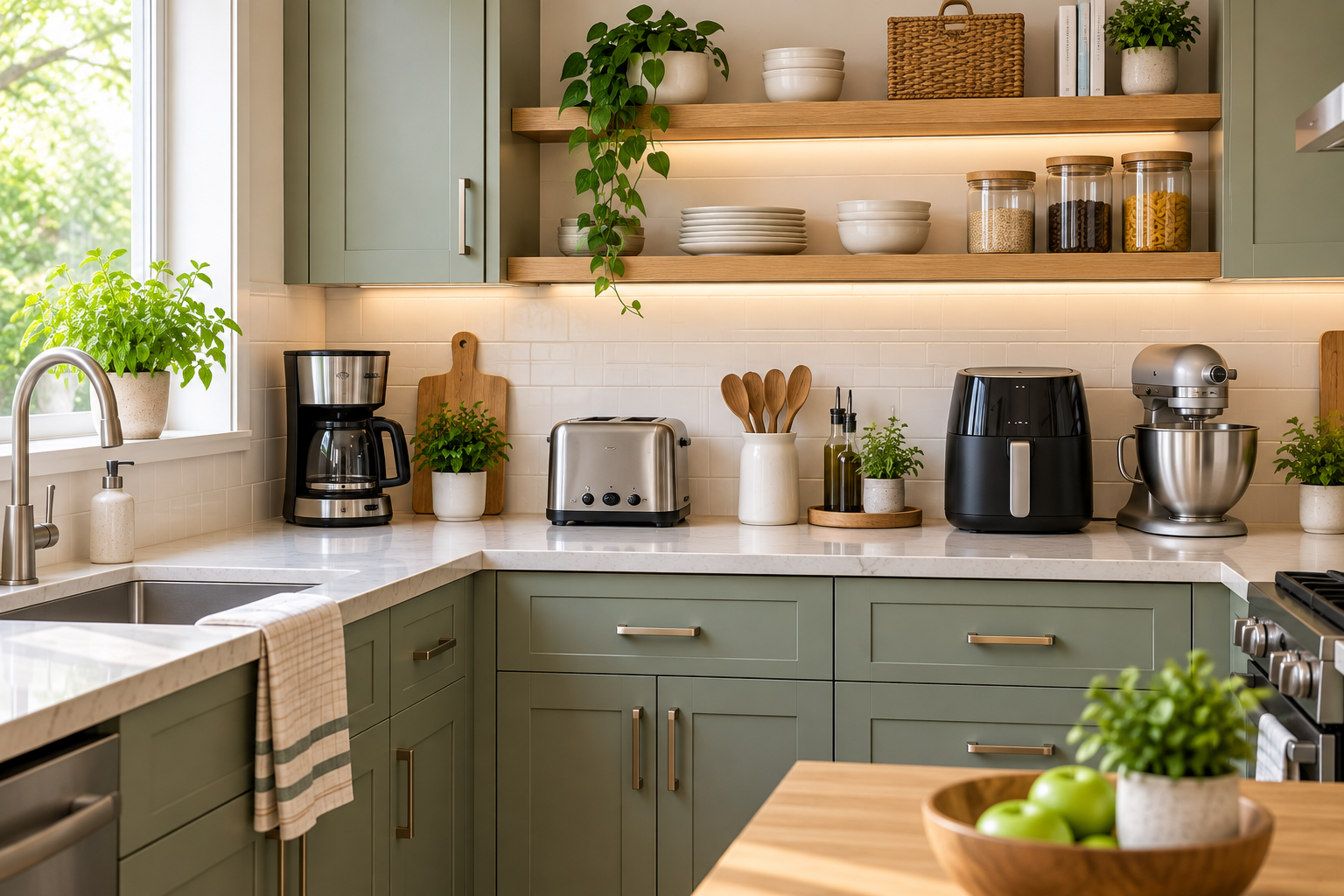
Organize small kitchen appliances by frequency of use, weight, size, retrieval effort, and return friction. Keep the appliances that genuinely earn counter space accessible, move lower-use appliances into measured storage, and test whether each appliance can be retrieved and returned without moving something else first.
The Small-Kitchen Appliance Principle
Storage should reduce friction, not simply hide clutter.
An appliance that takes several steps to retrieve, requires moving other things, and is awkward to return may technically be organized. But the system is unlikely to last.
A better system considers five things:
Frequency → Retrieval Effort → Physical Burden → Footprint → Return Friction
Give the most convenient storage to appliances that are used frequently or are awkward to lift, while keeping the main work surface clear enough to support cooking.
Storage only works when the effort required to retrieve and return an appliance is reasonable for the way you actually use it.
Key Takeaways
- Do not assume every appliance needs to be hidden.
- Measure appliances and usable storage before buying organizers.
- Give frequently used appliances easier access than rarely used ones.
- Consider weight and retrieval effort before choosing storage height.
- Test how easily an appliance can be returned after use.
- If an appliance repeatedly returns to the counter, diagnose the storage system before buying more storage.
For the broader approach to organizing a small kitchen, see our small kitchen organization guide.
START HEREStart With an Appliance Audit
Before buying a shelf, cart, bin, or pull-out organizer, gather the appliances you actually need to organize.
Include appliances that are:
- sitting on the counter
- inside cabinets
- stored in a pantry
- tucked into another room
- missing their accessories
- rarely used
- used so often that they never seem to get put away
Then sort them into four simple groups:
Daily Use
Appliances you use most days and may need within easy reach.
Weekly Use
Appliances you use regularly but do not need constantly.
Occasional Use
Appliances used for specific meals, seasons, or projects.
Rarely Used
Appliances that spend most of their time taking up storage space.
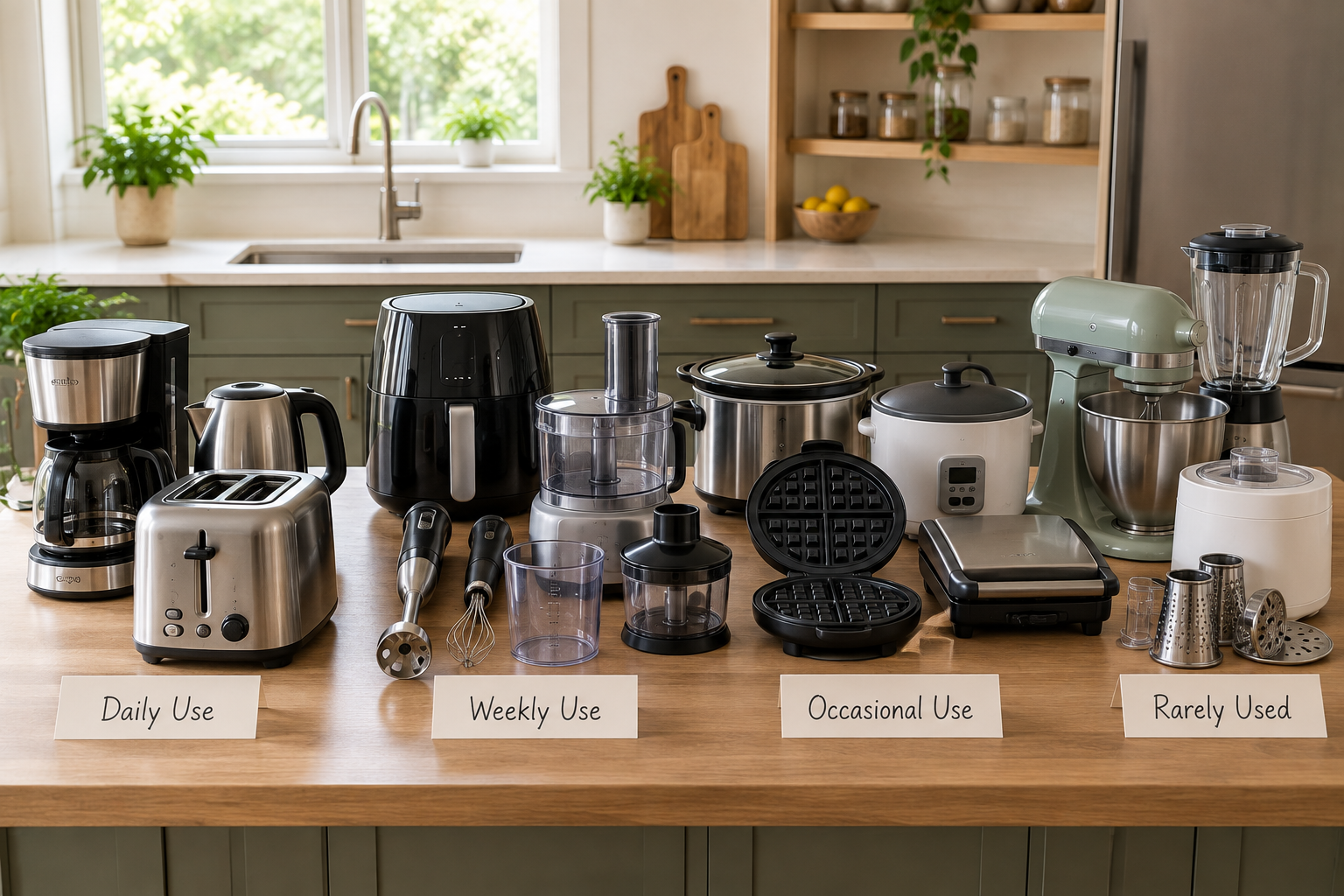
A storage problem can actually be a priority problem.
If several appliances are competing for the same easy-access space, they cannot all receive the same level of convenience. Decide which ones deserve it first.
Measure the Appliances and the Storage
Do not buy an organizer because an appliance appears to fit. Measure first.
For each larger appliance, note:
- width
- depth
- height
- handle clearance
- cord location
- removable parts
- accessories that need to stay nearby
Then measure the storage location:
- cabinet opening
- usable width
- usable depth
- usable height
- shelf position
- door and hinge clearance
- surrounding obstacles
- movement path
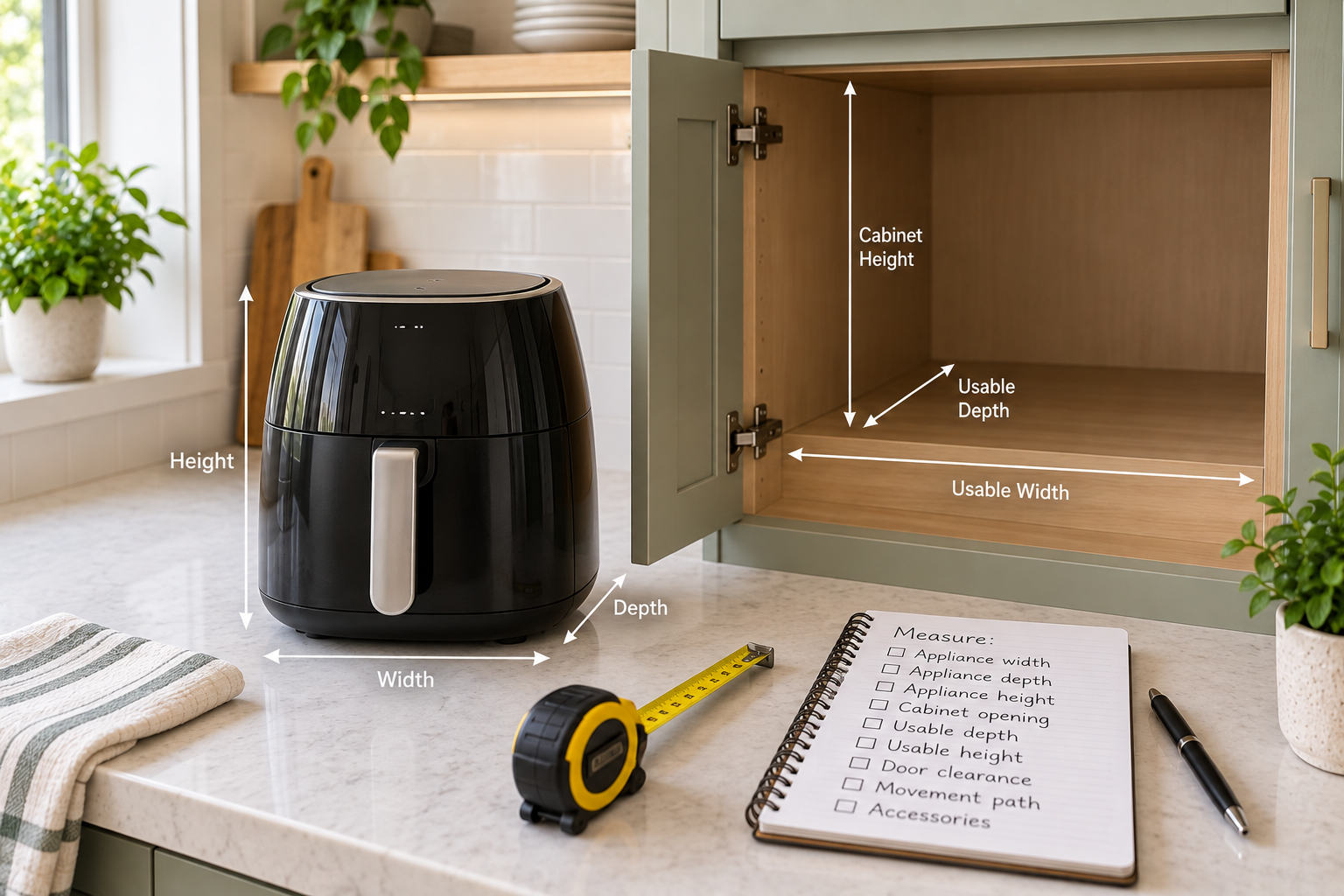
Measure the movement path, not just the empty space.
An appliance can physically fit inside a cabinet but still be a poor storage choice if you have to lift it over another appliance or move several items before reaching it.
Measure the appliance, the storage opening, and the movement path.
- Width, depth, and height
- Handle, door, hinge, and shelf clearance
- Accessory and cord requirements
- The path needed to remove and return the appliance
For more detailed cabinet measurement and organization guidance, see our kitchen cabinet organization guide. If drawers are part of the storage path, our kitchen drawer organization guide covers a similar access-first approach.
SET PRIORITYRank Appliances by How They Need to Be Accessed
Frequency should determine how convenient the storage needs to be. But frequency is not the only factor.
A heavy appliance used once a week may need easier access than a lightweight appliance used less often.
| Appliance characteristic | Storage priority |
|---|---|
| Daily + lightweight | Very easy access |
| Daily + heavy | Very easy, stable access |
| Weekly + lightweight | Nearby storage |
| Weekly + bulky | Accessible cabinet or lower storage |
| Occasional | Secondary storage |
| Rarely used | Lowest-priority storage |
Frequency determines access. Weight affects handling. Size affects fit. Return friction affects whether the system lasts.
Decide Which Appliances Actually Earn Counter Space
A clear counter is useful. But an empty counter is not automatically a better kitchen.
If you use a coffee maker every morning, for example, putting it into a difficult-to-reach cabinet may create more friction than it removes.
Instead, ask:
- How often do I use it?
- Does it interfere with food preparation?
- Is there a nearby storage location that is genuinely easier?
- Does putting it away require moving other things?
- Would storing it elsewhere make the kitchen harder to use?
Keep the appliances that genuinely earn their counter space.
The goal is not to remove every appliance from view. The goal is to make the counter work for the way you actually use the kitchen.
For a broader approach to clearing and organizing the work surface, see how to organize kitchen counters. For a smaller kitchen with especially limited work surface, see our guide to organizing a small kitchen with limited counter space.
CREATE ZONESCreate Appliance Storage Zones
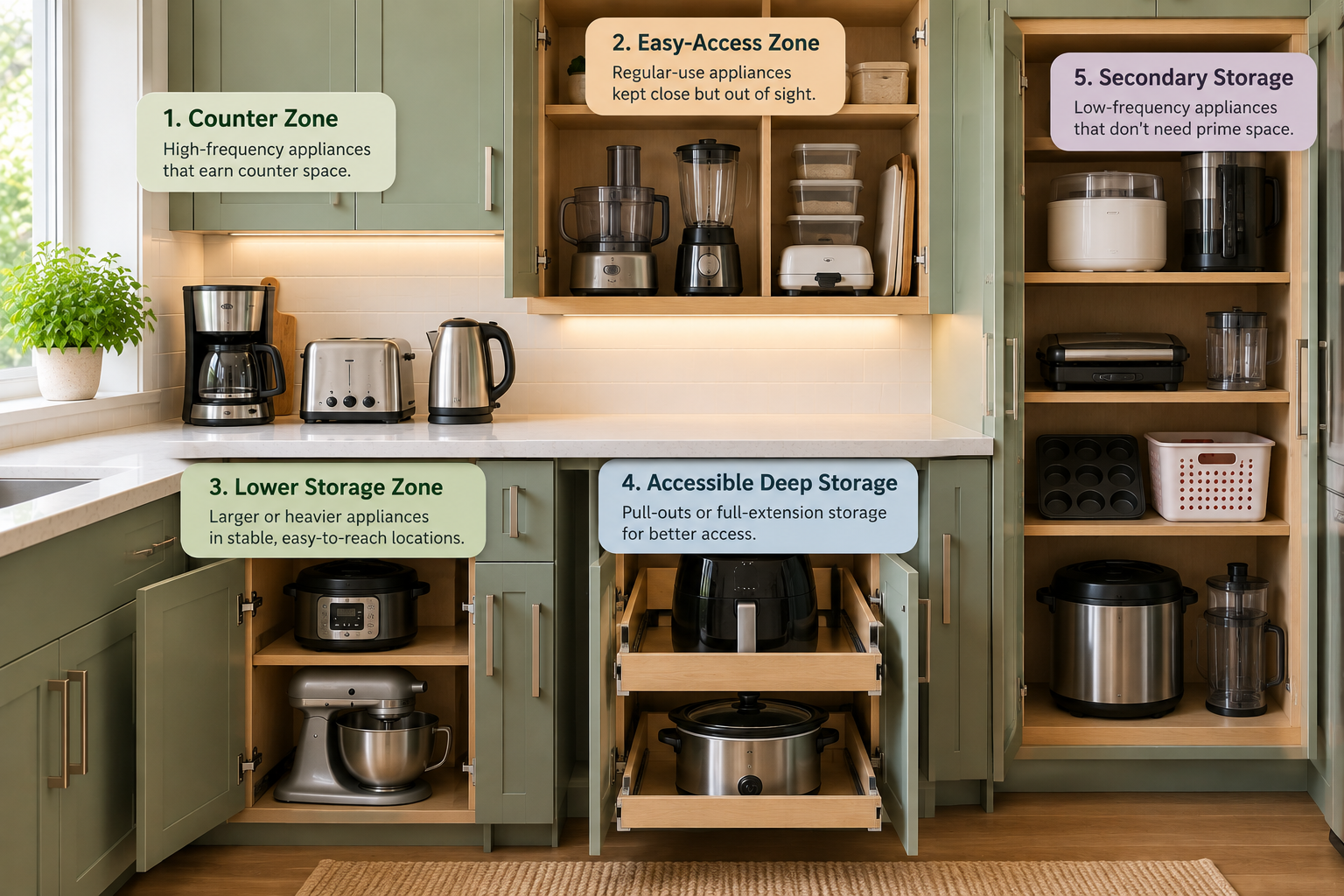
Once you know what you own and how often you use it, divide the kitchen into practical access zones.
Counter Zone
For appliances that are used very frequently and do not interfere with the main work surface.
Easy-Access Zone
For regular-use appliances that should remain close but do not need to stay visible.
Lower Storage Zone
For larger or heavier appliances when the storage provides stable and comfortable retrieval.
Secondary Zone
For occasional appliances that do not need to occupy prime kitchen storage.
Match the Appliance to the Storage Problem
This is where you should resist the temptation to buy an organizer first.
Start with the problem and choose a storage direction that addresses it.
| If the problem is… | Consider… |
|---|---|
| Daily appliance is constantly used | Keeping it highly accessible |
| Weekly appliance is cluttering the counter | Nearby cabinet storage |
| Heavy or awkward appliance | Stable storage that minimizes awkward lifting |
| Deep storage hides the appliance | Improving access before adding capacity |
| Bulky appliance has no convenient home | A dedicated usable zone |
| Rarely used appliance occupies prime space | Secondary storage |
| Very little cabinet space | Carefully chosen overflow storage |
| Appliance repeatedly returns to the counter | Diagnosing return friction |
The same problem-first approach can help with other small kitchen storage areas, including food storage containers and lids and the kitchen junk drawer.
These are directions, not universal prescriptions. Cabinet construction, dimensions, appliance size, and kitchen layout all affect the right choice.
LIMITED STORAGEWhat to Do When You Have Almost No Cabinet Space
Small kitchens sometimes have a simple problem: there is not enough enclosed storage to put everything away.
In that situation, do not try to force every appliance into a cabinet.
- Keep the highest-use appliances accessible.
- Move low-use appliances farther away.
- Use appropriate vertical or secondary storage where it genuinely helps.
- Consider a rolling cart only if it actually replaces counter clutter.
- Remove or relocate appliances that rarely justify the space they consume.
Do not add storage just because you have an empty corner.
Add storage only when it solves the actual problem without creating more work.
If your kitchen has limited pantry space as well, our guide to organizing a kitchen without a pantry may help you decide where secondary storage belongs. You can also see the broader small kitchen organization guide for the room-level system.
Storage Is Not the Same as Operation
There is an important difference between storing an appliance in a cabinet and operating an appliance inside that cabinet.
Never assume that because an appliance physically fits somewhere, it is appropriate to operate there.
For appliances that produce heat or require ventilation, follow the manufacturer’s instructions for clearance, ventilation, placement, electrical connection, and operation.
Simple rule: Store according to the appliance instructions. Operate according to the appliance instructions.
MEASURE → ASSIGN → COMPARE → CHOOSE
- Measure the appliance and usable storage first.
- Assign the appliance to a realistic access zone.
- Compare the storage path with the way you actually use it.
- Choose an organizer only if it removes a specific friction point.
Use the Return Test Before Buying Another Organizer
A storage system is not finished when the appliance fits. It is finished when the appliance can be used and returned without creating a new problem.
The Return Test
After using an appliance, ask:
Can I return it to its home in one simple sequence without moving something else first?
Watch the complete movement:
- Can I reach it comfortably?
- Can I remove it without moving another appliance?
- Can I carry it without an awkward lift?
- Can I return it easily?
- Are its essential accessories nearby?
- Does the cabinet still close normally?
- Does the storage interfere with another kitchen task?
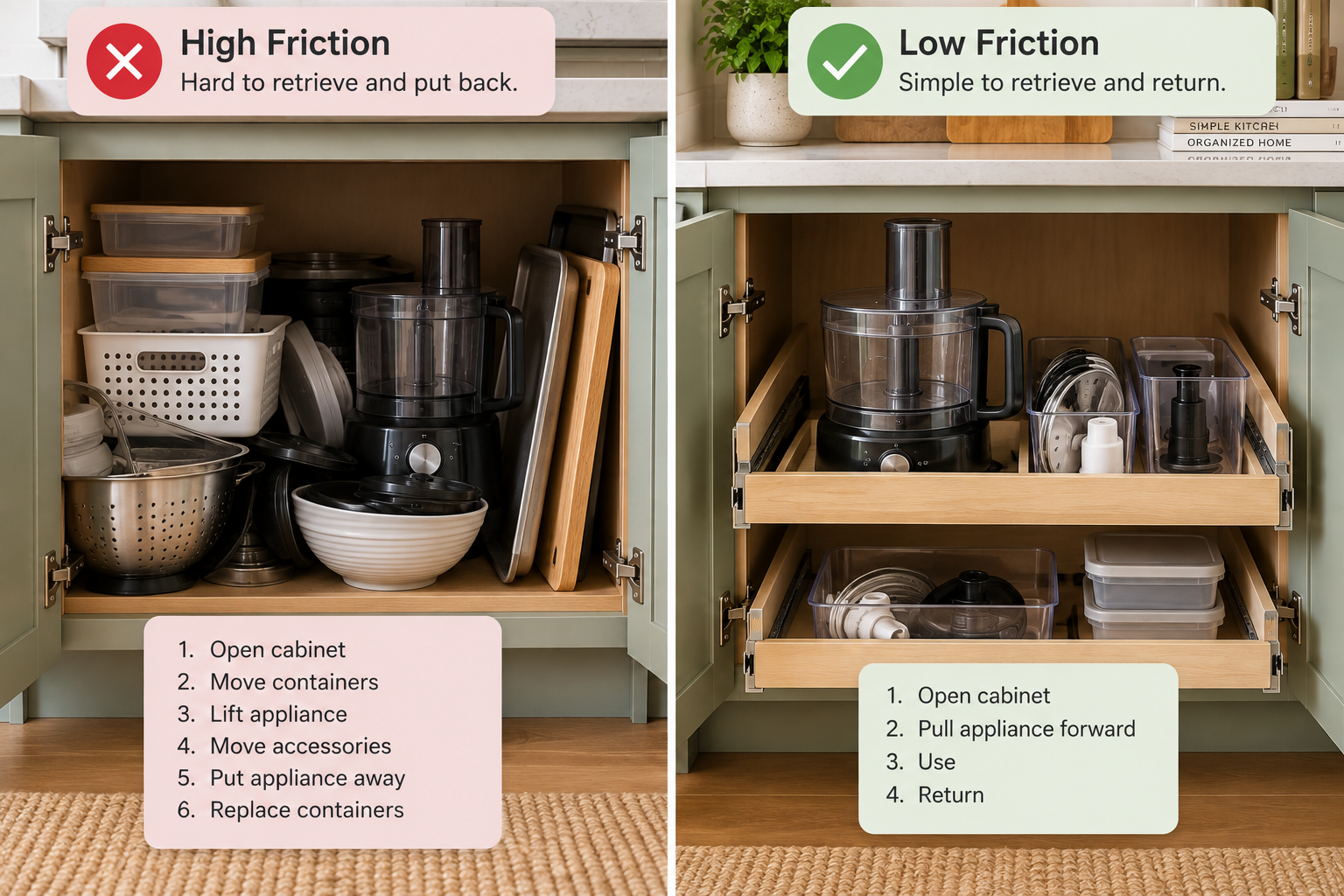
Then use the setup normally.
If the appliance repeatedly returns to the counter, do not automatically conclude that you need more discipline.
Ask:
What is wrong with the storage system?
Maybe the appliance is too heavy. Maybe the cabinet is too deep. Maybe the accessories are stored somewhere else. Or maybe the appliance is simply used too frequently to justify being put away.
Fix the storage path before buying another organizer.
More storage does not solve a retrieval problem when the underlying access path is still difficult.
Common Small-Kitchen Appliance Storage Mistakes
- Trying to hide everything. Some appliances genuinely earn their counter space.
- Buying organizers before measuring. A storage product cannot fix an incorrectly sized space.
- Ignoring weight. A heavy appliance stored in an awkward location creates a different problem from a lightweight one.
- Giving prime storage to rarely used appliances. Your easiest storage should serve the items that benefit most from easy access.
- Ignoring the movement path. Fitting is not the same as retrieving.
- Separating appliances from essential accessories. If the appliance is easy to reach but its attachment is somewhere else, the system is incomplete.
- Operating appliances in inappropriate enclosed spaces. Storage and operation are not the same thing.
- Adding organizers instead of fixing the underlying problem. More equipment does not automatically create a better system.
- Creating storage that is harder to use than the counter. If putting something away is consistently inconvenient, the system will eventually break down.
Return
Put appliances and essential accessories back in their assigned zones.
Review
Remove anything that has migrated to the counter or no longer belongs in the zone.
Re-Rank
If use patterns have changed, give the easiest storage to the appliances that now need it most.
Maintain the Appliance System
A small kitchen changes as your habits change.
Every few months, review:
Review
Which appliances are still used regularly?
Remove
Which appliances or accessories are no longer earning their space?
Re-Rank
Has another appliance become more important to your daily routine?
Re-Zone
Does each appliance still have an appropriate level of access?
You do not need a complicated maintenance routine. Keep the storage aligned with how you actually use the kitchen.
Frequently Asked Questions
Key Takeaways
- Keep frequently used appliances easier to reach than rarely used ones.
- Measure both storage space and the movement path before buying organizers.
- Weight, size, and handling effort matter alongside frequency of use.
- Do not force every appliance off the counter if doing so makes the kitchen harder to use.
- Use the return test to check whether the system works in real life.
What is the best way to store small appliances in a small kitchen?
Start by sorting appliances by frequency of use, size, weight, and access. Keep frequently used appliances in the easiest locations and move occasional appliances into less valuable storage areas.
Should small kitchen appliances stay on the counter?
Not necessarily. Frequently used appliances may deserve counter space if they do not interfere with food preparation. Less frequently used appliances can usually be moved into appropriate storage.
How do you organize small appliances with limited cabinet space?
Prioritize the appliances you use most, measure available storage carefully, and use secondary or vertical storage where it genuinely improves the kitchen. Removing rarely used or duplicate appliances can also create more useful space.
How should heavy kitchen appliances be stored?
Heavy appliances should have a stable, accessible storage location that minimizes awkward lifting and makes retrieval comfortable. For organizers, shelves, or pull-out systems, check the manufacturer’s stated load limits.
Can small appliances be stored inside a kitchen cabinet?
They can often be stored in a cabinet when the cabinet provides enough space and access. However, using an appliance inside cabinetry is a separate question. Follow the appliance manufacturer’s instructions for ventilation, clearance, electrical requirements, and operation.
A small kitchen does not need every appliance hidden away. It needs a storage system that matches the way the appliances are actually used.
Related Kitchen Guides
Make Every Appliance Earn Its Storage Location
The goal is not to get everything off the counter.
The goal is to give every appliance a home that makes sense for its frequency, size, weight, and access needs.
When an appliance is easy to retrieve and easy to return, organization becomes much easier to maintain.
AUDIT → MEASURE → RANK → MATCH → TEST THE RETURN PATH → RESET