
Pantry Organization Ideas That Make Your Space Easier to Use
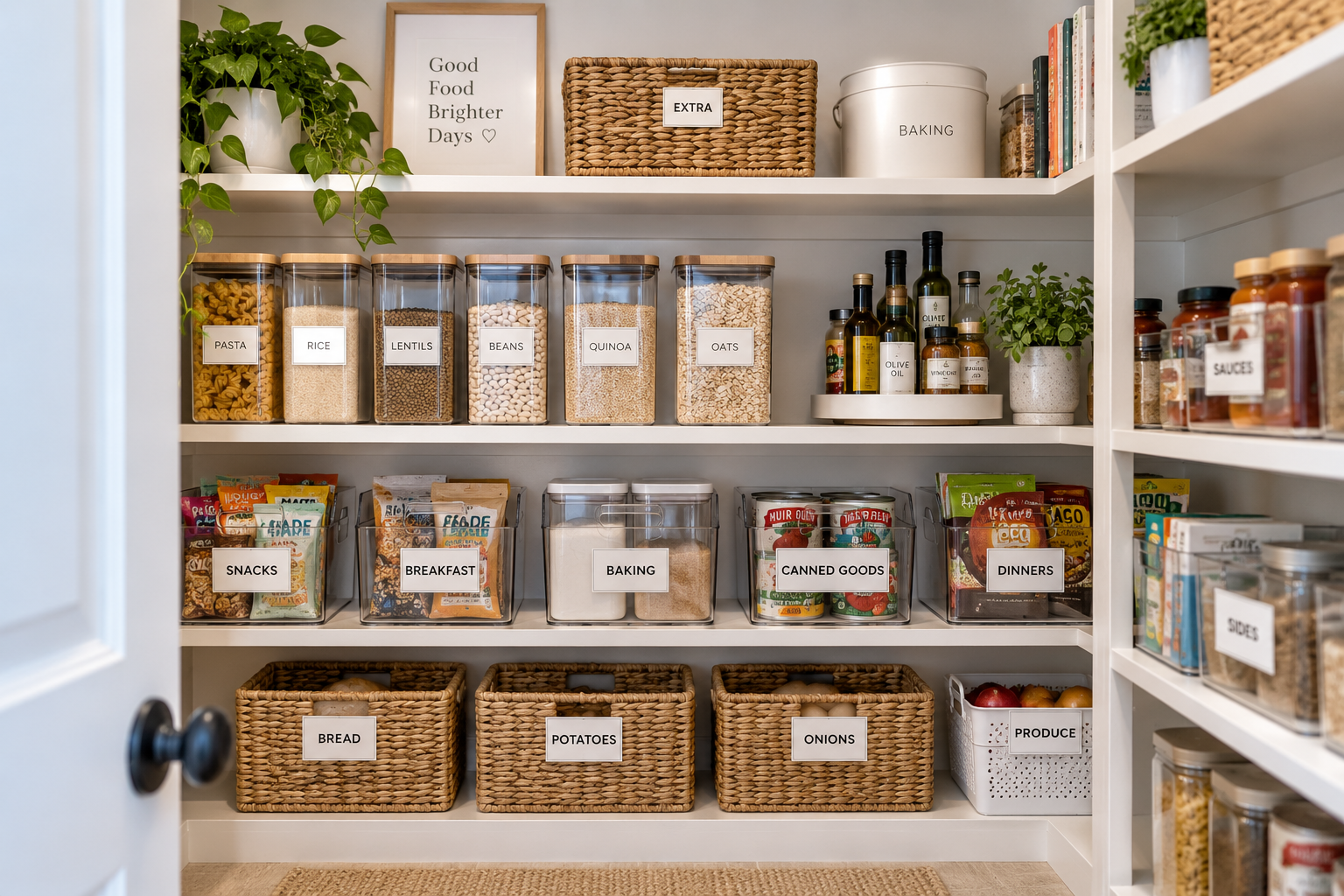
The best pantry isn’t the one with the most containers. It’s the one where you can see what you have, reach what you need, return things easily, and restock without starting over.
The Pantry Organization Principle
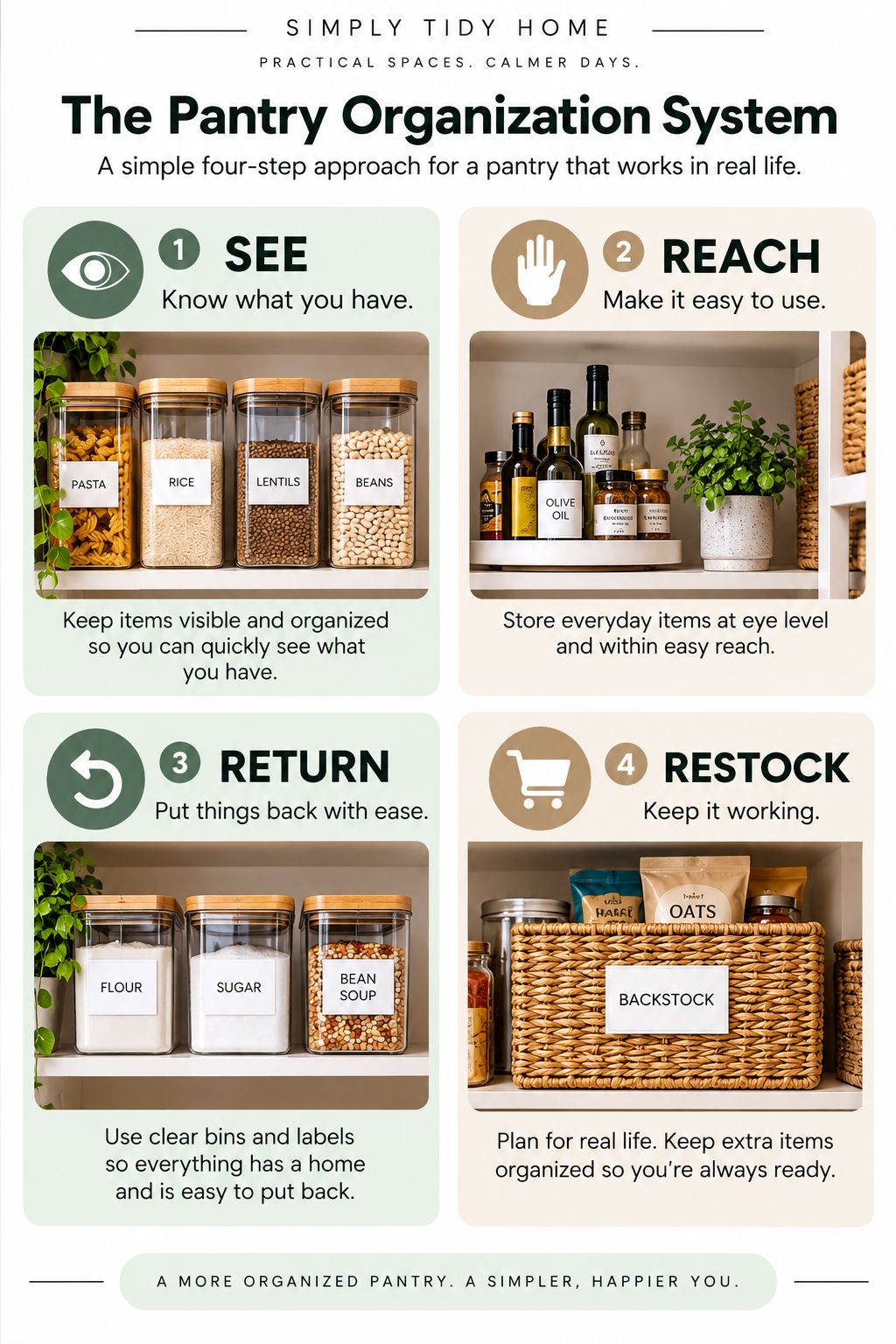
Pantry organization is usually treated as a container problem. But containers are only one possible tool.
A pantry can have matching bins and beautiful labels and still be frustrating if food disappears at the back, everyday items are hard to reach, or groceries have nowhere to go when you bring them home.
A better system focuses on four things:
See
Know what you already have without digging through several layers.
Reach
Get frequently used items without moving half the shelf.
Return
Make it obvious and easy to put things back where they belong.
Restock
Leave enough usable space for normal grocery shopping and backstock.
Usable capacity beats maximum capacity. If you cannot comfortably see, reach, and return an item, filling that space more tightly isn’t necessarily an improvement.
Start With the Pantry You Actually Have
Before buying bins, containers, shelf risers, lazy Susans, or door organizers, understand the physical limits of your pantry.
Measure:
- Shelf width
- Shelf depth
- Distance between shelves
- Door clearance
- Available vertical space
- Awkward corners or narrow areas
Then identify what is actually going wrong.
- Do items disappear behind one another?
- Are everyday foods difficult to reach?
- Are snack packages spreading across the shelf?
- Are cans stacked so deeply that you forget what you own?
- Is useful vertical space going unused?
- Does grocery restocking destroy the arrangement?
Organize the organizers around the pantry.
The 7-Step Pantry Organization System
Once you understand the space and its problems, work through this sequence.
Measure
Record the dimensions and constraints that determine what can actually fit and remain usable.
Clear
Remove unnecessary items, duplicates, expired food, and anything that doesn’t belong in the pantry.
Categorize
Group related foods together without creating so many categories that the system becomes difficult to remember.
Zone
Give categories and routines predictable homes based on frequency of use and accessibility.
Choose an Organizer
Add a product only when it solves a specific storage, visibility, containment, or access problem.
Install and Arrange
Place each solution where it improves access rather than simply making the pantry look fuller.
Maintain
Build a simple reset into everyday use so the pantry doesn’t require another complete reorganization.
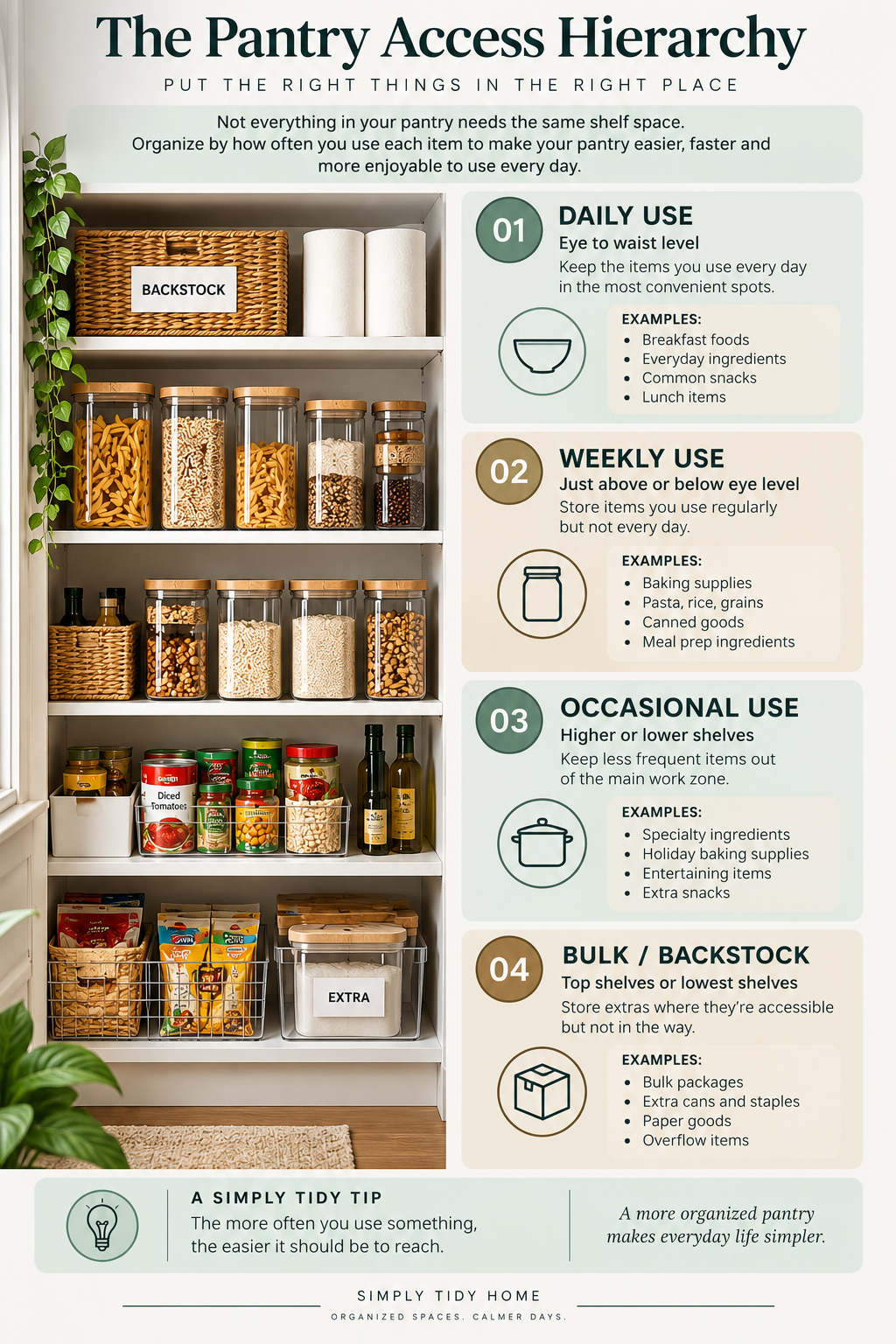
Use a Pantry Access Hierarchy
Not every item deserves the same amount of shelf space or the same level of convenience.
| Use level | Best access | Examples |
|---|---|---|
| Daily use | Easiest access | Breakfast foods, everyday cooking ingredients, common snacks |
| Weekly use | Convenient access | Baking supplies, pasta, canned foods |
| Occasional use | Secondary access | Specialty ingredients and seasonal foods |
| Backstock | Least convenient practical space | Unopened extras and bulk purchases |
This doesn’t mean every pantry should have exactly the same shelf arrangement. The principle is simple: give the easiest access to the things you use most.
Pantry Organization Ideas by Problem
Instead of copying someone else’s pantry setup, start with the problem you’re trying to solve.
Give Frequently Used Foods Their Own Zone
If you reach for the same foods every day, give those items a predictable home in an easy-to-access area.
Breakfast foods, snacks, lunch supplies, coffee supplies, and everyday cooking ingredients can each have a practical zone.
A zone does not necessarily require a separate container. Sometimes keeping related items together is enough.
Use Vertical Space Between Shelves
If short items leave a large unused gap above them, a shelf riser can create another useful level.
This can improve visibility for cans, jars, small boxes, spices, and other shorter items.
Before adding a riser, make sure the new level still leaves enough room to see and remove what is stored there.
Make Deep Shelves Easier to Access
Deep shelves often have plenty of theoretical capacity but poor practical access. Items pushed toward the back can become invisible and forgotten.
Depending on the shelf and what you store there, consider a lazy Susan, pull-forward bin, pull-out solution, or another arrangement that makes the contents easier to reach.
If rotating storage fits your situation, see Best Lazy Susan Pantry Organizers .
Contain Loose Snack Packages
Snack bags and small packets can quickly spread across a shelf. An open-front bin can give them a defined boundary while keeping them easy to grab.
Choose a size that matches your normal inventory. A bin that is much larger than the category can encourage unnecessary accumulation.
See Best Pantry Storage Bins for a deeper look at bin options.
Make Cans Easier to See
Cans stacked on a flat shelf can hide the labels behind one another. A tiered organizer can raise the rear cans and make more of the inventory visible.
The goal isn’t to stack as many cans as possible. It’s to make the inventory easier to see and retrieve.
See Best Can Organizers for Pantry .
Use the Pantry Door When the Layout Allows It
A pantry door can provide useful vertical storage for smaller or lightweight items, but only when the door, shelves, and organizer have enough clearance.
Check door thickness, shelf clearance, weight, and closing clearance before installing anything.
Start with Pantry Door Organization Ideas for layout ideas, then see Best Pantry Door Organizers when comparing products.
Use Clear Containers Selectively
Clear containers can improve visibility and create consistent storage for some dry goods, but transferring every food into a container isn’t necessary.
Use containers when they solve a real problem such as poor visibility, inconsistent packaging, or difficult containment.
For detailed container-selection guidance, see Best Pantry Storage Containers .
Create a Dedicated Backstock Zone
Bulk purchases can overwhelm everyday storage when unopened extras are mixed with the food you’re currently using.
A separate backstock area can make it easier to see what is available now and what is reserved for later.
When the everyday supply gets low, replenish it from the backstock zone.
Organize Around Real Household Routines
Food categories aren’t always the best way to organize a pantry. Sometimes the way your household uses the food is more useful.
For example, a breakfast zone, grab-and-go zone, baking zone, or everyday cooking zone can reduce repeated searching.
Use-based zones answer: “When and how do we use this?”
Give Awkward Corners a Specific Job
Don’t force a large rectangular organizer into a corner simply because it fits on paper.
Awkward areas may be better suited to less frequently accessed items, rotating storage, or a narrow solution that preserves access to the rest of the pantry.
Start With One Shelf If the Pantry Feels Overwhelming
You don’t have to empty and reorganize the entire pantry in one afternoon.
If the project feels too large, choose the shelf you use most.
- Empty one shelf.
- Measure it.
- Group the items.
- Identify what isn’t working.
- Create one practical zone.
- Add an organizer only if the problem requires one.
- Use the shelf normally before changing the rest of the pantry.
A working system on one shelf gives you a model for the rest of the pantry without forcing you to make every decision at once.
Pantry Organization for Small and Deep Spaces
Small Pantries
Small pantries require prioritization more than decoration. Give the easiest access to frequently used foods and be careful not to consume valuable space with oversized organizers.
For a complete small-pantry strategy, see How to Organize a Small Pantry .
Deep Pantries and Shelves
Treat accessibility as the primary constraint. If reaching the back requires moving several other items, the available storage isn’t fully usable.
Limited Vertical Space
When shelves are already close together, don’t automatically add another level. First check whether doing so would make items difficult to remove.
How to Choose Pantry Organizers Without Wasting Money
The right organizer depends on the physical problem.
| Problem | Solution to consider | Check first |
|---|---|---|
| Wasted vertical space | Shelf riser | Available height and hand clearance |
| Loose packets | Open-front bin | Category size and access |
| Hidden cans | Tiered can organizer | Shelf depth and visibility |
| Deep-shelf access | Lazy Susan or pull-forward solution | Rotation or pull clearance |
| Unused door space | Door organizer | Door and shelf clearance |
| Inconsistent dry-food packaging | Selective containers | Size, cleaning, labeling, and actual need |
Before buying, ask:
- What exact problem does this solve?
- Have I measured the space?
- Will the item remain easy to access?
- Will it make restocking easier or harder?
- Will I actually maintain it?
The Grocery-Haul Test
A pantry can look perfect immediately after organizing and still have a broken system.
The real test comes when groceries arrive.
- Can a normal grocery haul fit without destroying the zones?
- Is there a sensible place for unopened backstock?
- Can someone put food away without memorizing the entire system?
- Can you quickly see what you already own?
- Can frequently used items be reached without moving several others?
- Can the pantry recover without a complete reorganization?
If the system only works when the pantry is half empty, it isn’t finished.
Pantry Organization Mistakes That Create More Work
Buying organizers before measuring
A product that almost fits can waste valuable space and make access harder. Measure first.
Decanting everything
Containers can improve some categories, but transferring every food creates additional work and isn’t automatically more functional.
Creating too many categories
If everyone needs a map to remember where snacks belong, simplify the system.
Putting everyday foods in inconvenient places
The most visually pleasing arrangement isn’t always the most useful one.
Ignoring shelf depth
Deep shelves need an access strategy or their rear space can become a forgotten storage zone.
Filling every available inch
Leave enough space to see, grab, and return items comfortably.
Organizing once and never resetting
A pantry changes every time food is purchased and consumed. Maintenance is part of the system.
The 5-Minute Pantry Reset
A good organization system should be recoverable without another major reorganization.
- Return misplaced items to their zones.
- Move older items forward where appropriate.
- Remove empty packaging.
- Check for overflowing categories.
- Notice anything that repeatedly becomes difficult to maintain.
If the same area becomes messy again and again, don’t simply clean it again. Diagnose the system.
Maybe the bin is too small. Maybe the category needs more space. Maybe the item is being accessed too frequently for its current location.
If the same area keeps failing, the solution may be to redesign the system rather than repeatedly tidy the result.
Need a More Specific Pantry Solution?
The right solution depends on the problem you’re trying to solve. Use the guide that matches your pantry.
Frequently Asked Questions
What is the best way to start organizing a pantry?
Start by measuring and clearing the space. Then categorize your food, create practical zones, and choose organizers only for problems that genuinely require them.
Should I buy pantry containers before organizing?
Usually not. Understand your pantry dimensions and storage problems first. This reduces the chance of buying containers that waste space or don’t fit.
How do I organize a pantry with deep shelves?
Focus on visibility and access. Depending on the layout, a lazy Susan, pull-forward bin, pull-out solution, or another accessible arrangement can help prevent items from disappearing at the back.
Are pantry containers worth it?
They can be useful when they improve visibility, containment, consistency, or access. They are not necessary for every food or pantry.
How do I organize a small pantry?
Prioritize frequently used foods, use vertical space carefully, avoid oversized organizers, and consider compatible door or narrow-space storage when appropriate.
How do I keep my pantry organized?
Give categories predictable homes, return items to their zones when restocking, and use a short reset to catch problems before they become another full reorganization.
See it. Reach it. Return it. Restock it.
Start with the pantry you have. Solve the problems that matter. Choose organizers only when they make the system work better.
Order in every space. Simply.