
A junk drawer works best when it has a clear purpose, simple boundaries, and an easy place for the small things you actually use.
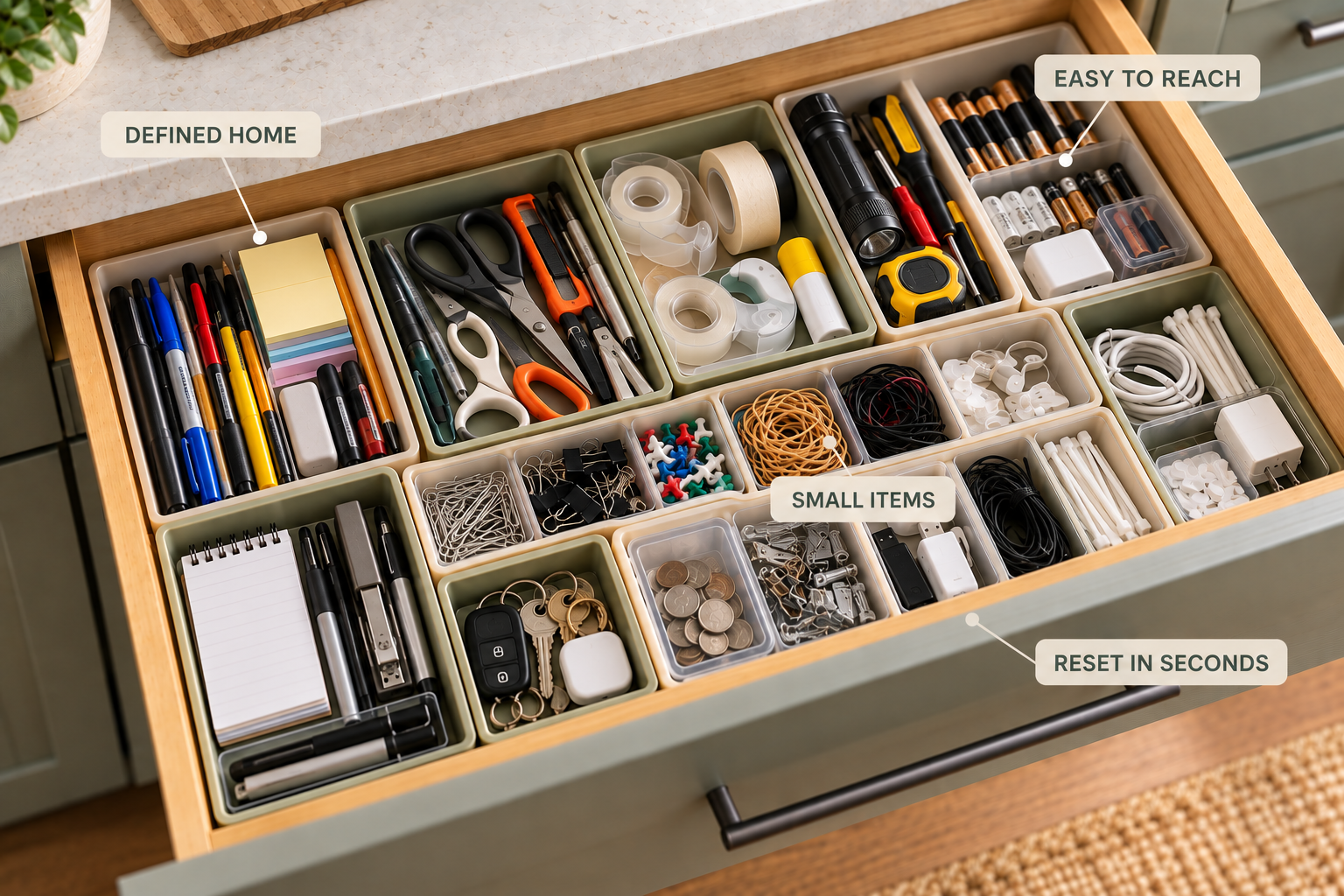
To organize a kitchen junk drawer, first decide what the drawer is actually for. Then empty it, sort everything into simple decisions, remove items that do not belong, create useful categories, and arrange those categories into zones. Choose an organizer only after you know what needs to fit and how the drawer will be used. Finish by putting frequently used items where they are easiest to reach and creating a simple reset routine.
Our Junk Drawer System
- Why Junk Drawers Become Messy
- 1. Decide What Your Junk Drawer Is For
- 2. Empty the Drawer Completely
- 3. Sort Everything Into Four Decisions
- 4. Create Categories That Match How You Use the Drawer
- 5. Build the Layout Before Buying an Organizer
- 6. Put Frequently Used Items Where They Are Easy to Reach
- 7. Choose the Right Type of Drawer Organizer
- 8. What Should Not Go in a Junk Drawer?
- 9. Keep the Junk Drawer Organized
- 10. Common Junk Drawer Mistakes
- Before You Buy a Junk Drawer Organizer
- Frequently Asked Questions
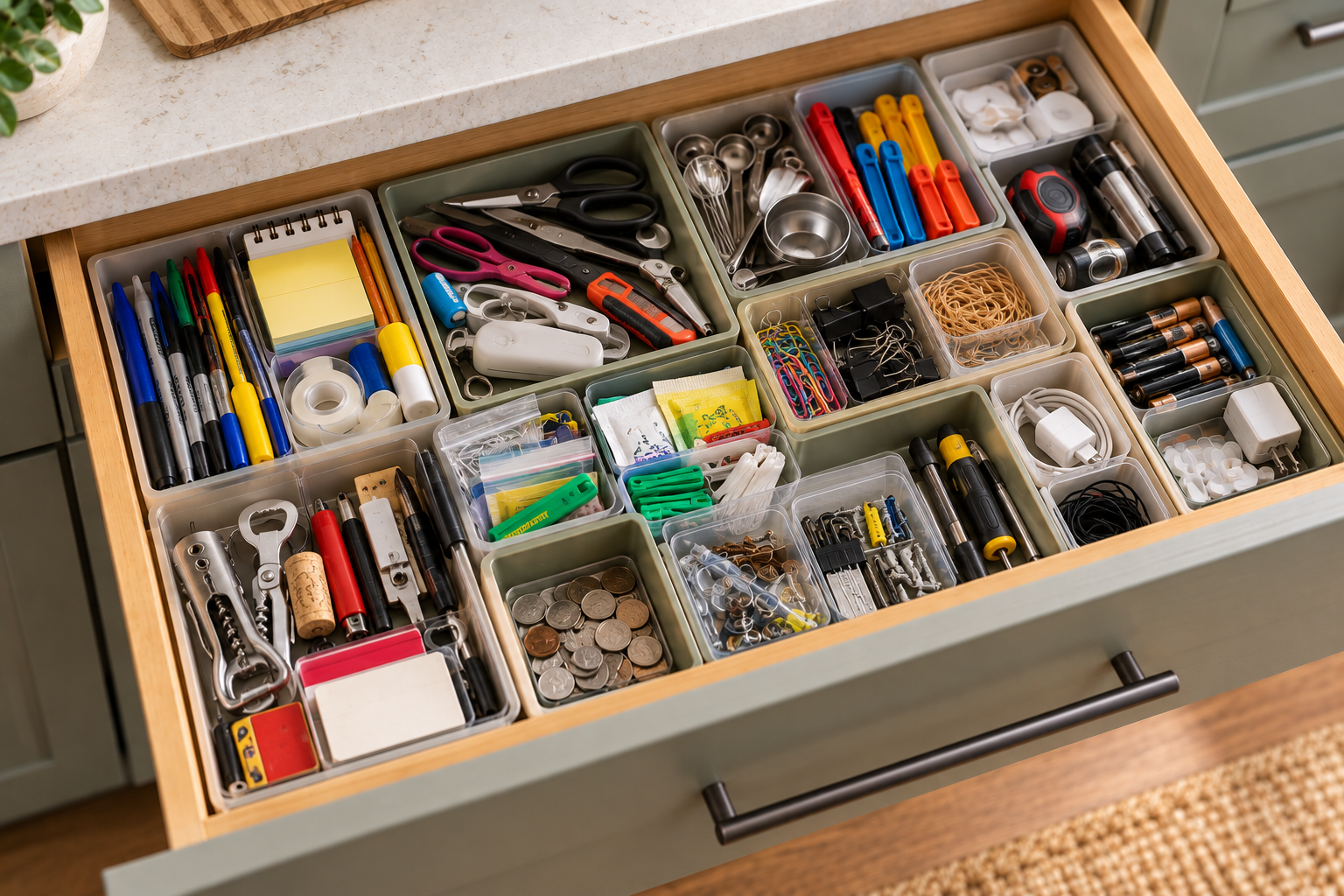
A kitchen junk drawer is different from a normal kitchen drawer. It usually holds a mixture of small items that do not belong in another obvious category: tape, scissors, pens, clips, batteries, small tools, cords, and other household odds and ends.
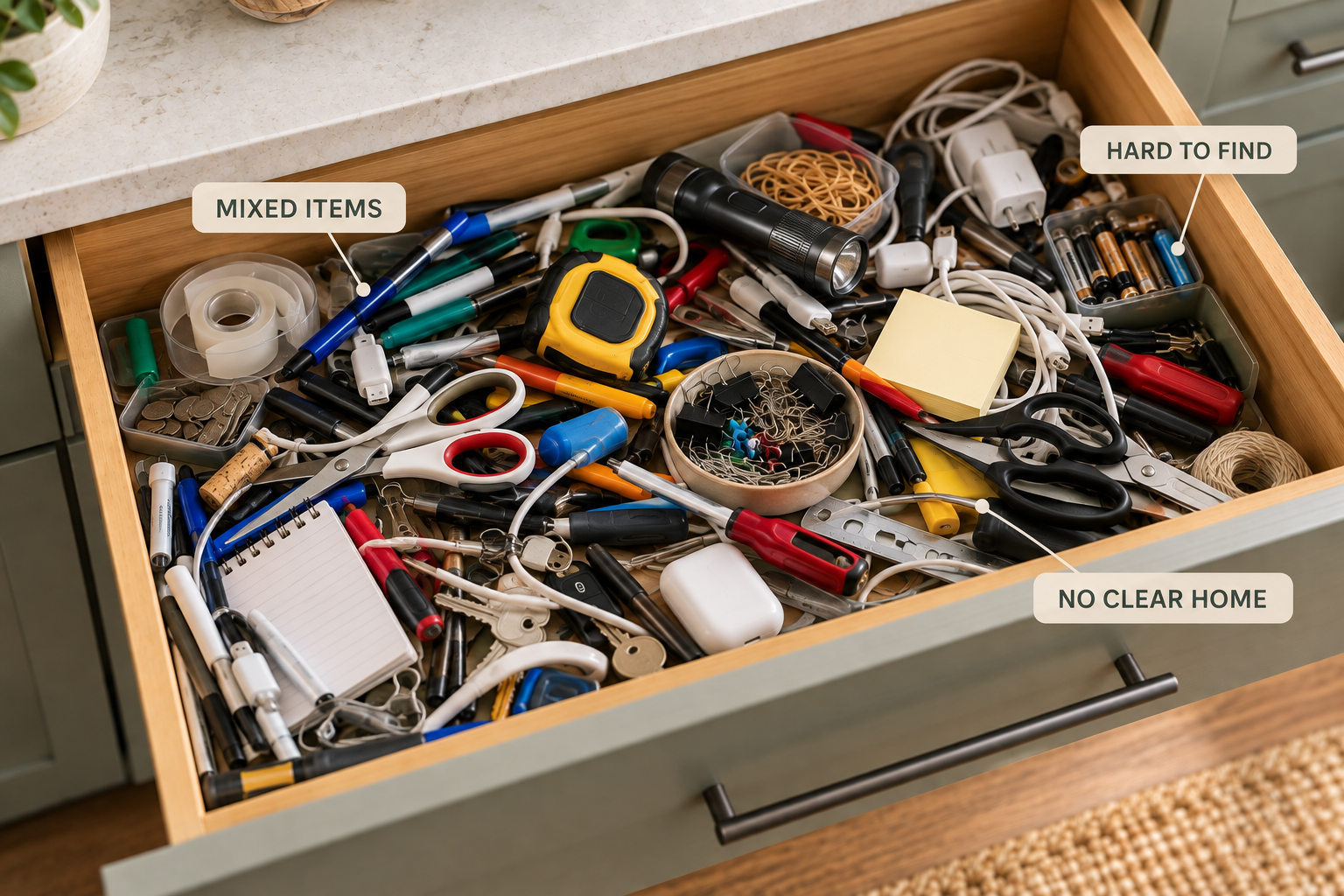
That mixture is not automatically the problem. The problem is usually that the drawer has no clear rules about what belongs there, where items go, or how much it can reasonably hold.
Why Junk Drawers Become Messy
Junk drawers tend to collect items because they are convenient. Something does not have an obvious home, so it gets dropped into the drawer.
Then another small item arrives. Then another. Eventually the drawer becomes a catch-all rather than a useful storage system.
The answer
Give the drawer a defined job and a limited set of categories.
Why it matters
When every small household item can enter the drawer without a boundary, the drawer eventually becomes difficult to search, maintain, and reset.
The goal is not to make every item look perfectly arranged. The goal is to make the drawer predictable enough that you can find something, use it, and return it without creating another pile.
1. Decide What Your Junk Drawer Is For
Before touching an organizer, decide what role the drawer should play.
A useful junk drawer might hold small household items that are used regularly but do not justify a dedicated drawer or cabinet.
Depending on your home, that could include:
- Pens and small writing supplies
- Tape and small adhesive supplies
- Scissors
- Small household tools
- Clips and fasteners
- Rubber bands
- Small batteries
- Small cords or utility accessories
- Other frequently used miscellaneous items
The exact categories should follow how your household actually uses the drawer.
If an item already has a convenient home somewhere else, the junk drawer does not need to become its permanent storage location simply because there is room.
2. Empty the Drawer Completely
Take everything out before deciding where anything belongs.
Working around existing clutter makes it difficult to see how much space the drawer actually has and encourages you to keep items simply because they are already there.
- Remove every item.
- Clean crumbs and debris from the drawer.
- Look for broken or unusable items.
- Separate items that already have homes elsewhere.
- Keep similar items together as you work.
Do not buy storage yet. You need to understand the contents before deciding what the drawer needs.
3. Sort Everything Into Four Decisions
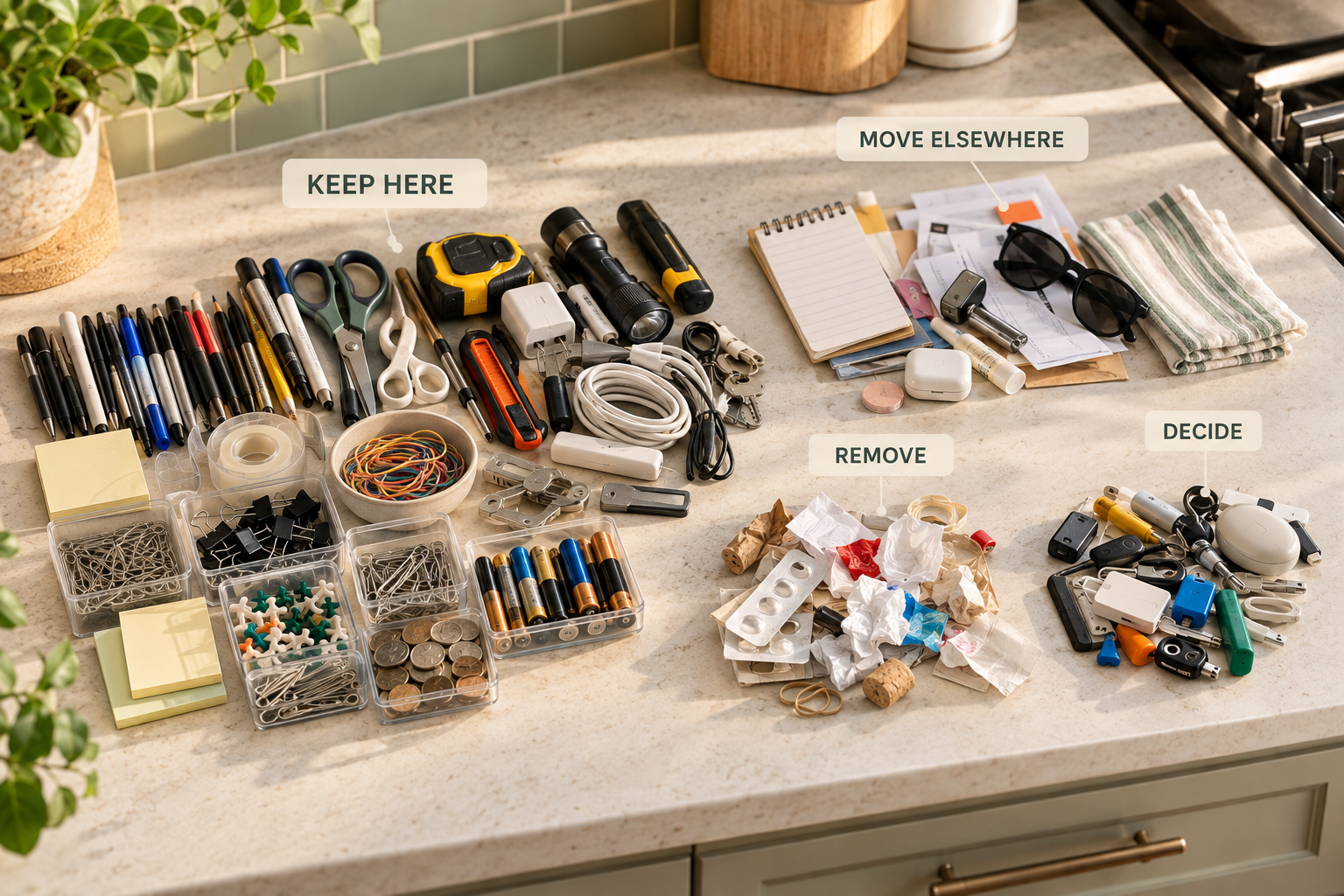
Instead of creating dozens of temporary piles, use four simple decisions:
KEEP HERE
Items that genuinely belong in the drawer and are useful enough to justify the space.
MOVE ELSEWHERE
Items that have a better home in another room, drawer, cabinet, or storage area.
REMOVE
Broken, empty, obsolete, duplicate, or otherwise unnecessary items.
DECIDE
Items that need a separate decision rather than an automatic place in the junk drawer.
4. Create Categories That Match How You Use the Drawer
Once you know what belongs, group similar items together.
Avoid creating a separate category for every object. A junk drawer becomes difficult to maintain when the system is more complicated than the drawer itself.
Practical categories might include:
| Category | Possible contents |
|---|---|
| Writing | Pens, pencils, markers, sticky notes |
| Cutting & tape | Scissors, tape, small adhesive supplies |
| Small tools | Small screwdrivers, measuring tools, utility tools |
| Clips & fasteners | Binder clips, paper clips, rubber bands, small fasteners |
| Small utility items | Batteries, cords, hooks, and similar household accessories |
Your categories do not have to match this list exactly. The best categories are the ones that make sense to the people using the drawer.
5. Build the Drawer Layout Before Buying an Organizer
Now look at the empty drawer and think about how the categories should fit.
Start with the physical space rather than the product.
What needs the most space?
Give larger or more numerous categories enough room to remain usable.
What needs the easiest access?
Frequently used items should not be buried behind less useful categories.
Which categories can share space?
Related small items can sometimes share a larger compartment without becoming difficult to find.
Where will the drawer need open space?
Leave enough room to remove and return items without disturbing the entire arrangement.
This step prevents a common mistake: buying a large organizer set and then trying to invent categories to fill every compartment.
6. Put Frequently Used Items Where They Are Easy to Reach
A junk drawer should not simply look organized when it is closed. It should work when you open it.
Put the things you reach for most often in the easiest locations. Less frequently used items can occupy secondary spaces.
Keep easy to reach
Items you use regularly, especially small tools, writing supplies, scissors, tape, or other household essentials.
Move farther back
Occasional-use items that still belong in the drawer but do not need to be accessed constantly.
If you repeatedly have to move five other things to reach one item, the problem is not solved simply because the drawer contains dividers.
7. Choose the Right Type of Drawer Organizer
Once the categories and layout are clear, choose storage that supports the plan.
For a mixed junk drawer, modular bins can be useful because different categories often need different amounts of space.
- Measure the drawer’s usable width.
- Measure its usable depth.
- Check the drawer height and organizer height.
- Consider how the drawer opens and closes.
- Decide how many categories actually need compartments.
- Leave enough room to retrieve and return items.
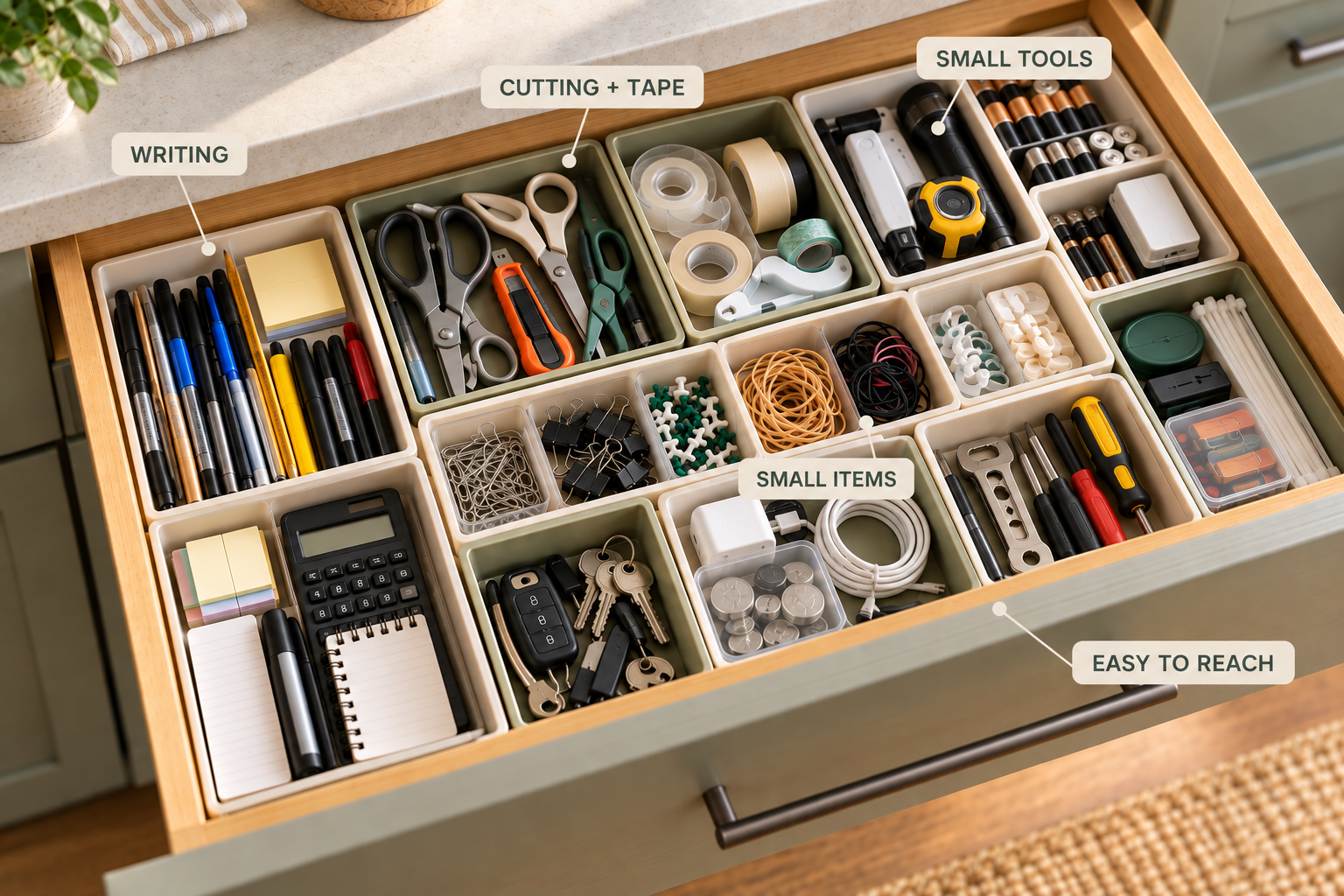
The right organizer is the one that fits the drawer and supports the categories you actually need. More compartments are not automatically better.
Vtopmart 25 Pack Plastic Drawer Organizers
Useful for: A drawer with several small categories that need different compartment sizes.
This type of modular set can be useful when a junk drawer contains a mixture of small items and you want flexibility rather than one fixed tray layout.
STORi SimpleSort 6-Piece Clear Drawer Organizer Set
Useful for: A simpler drawer layout with a smaller number of defined categories.
A smaller modular set can make sense when you do not need a large collection of compartments and want to keep the drawer layout relatively simple.
As an Amazon Associate I earn from qualifying purchases. Some links below are paid links, which means Simply Tidy Home may earn a commission if you purchase through them, at no additional cost to you.
8. What Should Not Go in a Junk Drawer?
There is no universal list because every household uses a junk drawer differently. But some items are usually better stored somewhere else.
- Items that already have a convenient dedicated home
- Large items that consume disproportionate drawer space
- Broken or unusable objects
- Expired or unnecessary items
- Paperwork and documents
- Personal items that need a more appropriate storage location
- Large collections that deserve their own category or storage area
The important question is not whether an object is technically miscellaneous. Ask whether the junk drawer is the most useful home for it.
If every object that has no home automatically enters the junk drawer, the drawer will eventually become the home’s second miscellaneous storage room.
9. Keep the Junk Drawer Organized
A good junk drawer should be easy to reset. You should not need another major decluttering session every time it gets slightly messy.
- Return misplaced items to their normal zones.
- Remove obvious trash or broken items.
- Move frequently used items back into easy reach.
- Combine or simplify categories that keep overflowing.
- Notice anything that repeatedly ends up in the wrong place.
If the same category keeps becoming messy, do not simply tidy it again. Ask why the system keeps failing.
If one category keeps overflowing
It may need less inventory, more appropriate space, or a different storage location.
If items keep migrating
The category may be inconveniently placed or the drawer may not be the right home for those items.
10. Common Junk Drawer Mistakes
Buying an organizer first
A product cannot determine what belongs in the drawer. Define the contents and categories first.
Creating too many compartments
More compartments can make a drawer harder to use if every tiny object needs its own assigned space.
Keeping everything because it might be useful
Storage cannot compensate for unlimited inventory. If an item has no useful role, another compartment will not solve the underlying problem.
Putting frequently used items in difficult locations
A visually neat arrangement can still be inconvenient. Access should influence the layout.
Filling every available inch
Leave enough space to see, grab, and return items comfortably.
Using the drawer as a permanent holding area
The “decide” category should eventually be resolved. Otherwise temporary items become permanent clutter.
Before You Buy a Junk Drawer Organizer
Measure
Record the usable width, depth, and height of the drawer.
Define
Decide what categories and items genuinely belong in the drawer.
Compare
Compare the organizer’s dimensions and compartment layout with your actual drawer and categories.
Choose
Buy only when the organizer solves a specific problem better than leaving the drawer as it is.
If the drawer works without an organizer, you do not have to buy one. The purpose of storage is to improve the system, not to make the drawer look more complete.
Key Takeaways
- Define the junk drawer’s job before organizing it.
- Empty the drawer completely before making storage decisions.
- Sort items into keep, move, remove, and decide.
- Create categories based on how the drawer is actually used.
- Plan the layout before buying an organizer.
- Keep frequently used items easy to reach.
- Choose storage that fits the drawer rather than forcing the drawer around the product.
- Make the system simple enough to reset quickly.
Frequently Asked Questions
How do I organize a kitchen junk drawer?
Start by deciding what the drawer is for. Empty it completely, sort everything into keep, move, remove, and decide, then create simple categories. Arrange those categories into practical zones and choose an organizer only if it improves access or containment.
What should go in a kitchen junk drawer?
A junk drawer can hold small household items that are useful but do not need a dedicated storage location, such as pens, tape, scissors, clips, rubber bands, small tools, and similar utility items. The exact contents should depend on how your household uses the drawer.
What should not go in a junk drawer?
Items that already have a better home, large objects, broken items, unnecessary duplicates, paperwork, and categories that have grown too large for the drawer are usually better handled elsewhere.
Do I need a junk drawer organizer?
Not necessarily. If the drawer remains easy to use without one, you may not need an organizer. Add storage when it solves a specific problem such as mixed categories, small items becoming difficult to find, or contents shifting into one another.
How many categories should a junk drawer have?
There is no universal number. Use enough categories to make items easy to find without making the system complicated. Several related small items can often share a compartment when they remain easy to identify and retrieve.
How do I keep a junk drawer from getting messy again?
Give every retained category a predictable home and reset the drawer whenever items start migrating between zones. If the same area keeps becoming messy, change the system rather than repeatedly tidying the same result.
A Junk Drawer Should Have a Job
The easiest junk drawer to maintain is not necessarily the one with the most compartments. It is the one where the contents make sense, the categories are easy to remember, and returning an item takes almost no thought.
Define the job. Remove what does not belong. Create simple zones. Then choose storage only where it genuinely makes the drawer easier to use.