
Pots and pans can take up more kitchen space than their size suggests. They stack awkwardly, handles get in the way, lids disappear into piles, and the pan you need often ends up underneath several others.
In a small kitchen, the goal is not to make every piece of cookware fit into the smallest possible cabinet. The goal is to create a system where the cookware you use most is easy to retrieve, easy to put away, and not constantly in the way.
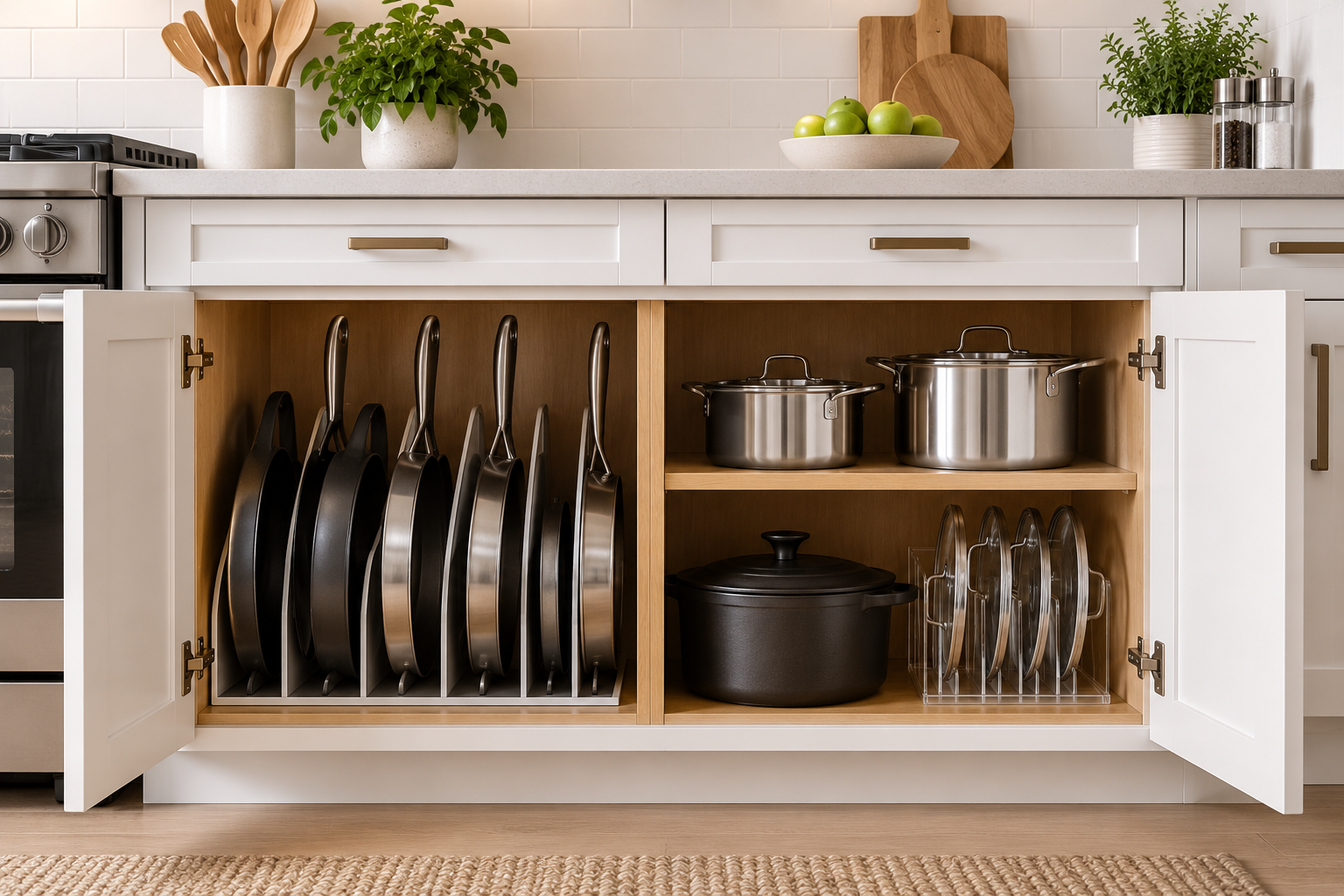
Organize pots and pans in a small kitchen by auditing what you use, measuring the actual storage space, separating cookware by retrieval needs, assigning practical zones, and testing whether each piece can be removed and returned without unnecessary rearranging.
A good cookware system makes the pieces you use most easy to retrieve and easy to return without forcing you to unpack the rest of the cabinet.
In a small kitchen, cookware competes for limited storage. Frequency, retrieval effort, physical burden, footprint, and return friction determine whether a neat-looking arrangement will actually remain usable.
That is why fitting more pieces into the smallest possible space is not the same as creating a better system.
Give frequent-use cookware the easiest practical access.
Separate pieces that are buried, awkward, heavy, or difficult to return.
Match the cookware and storage method to real dimensions and clearances.
If not, change the arrangement before adding another organizer.
If your kitchen has limited overall space, start with the broader principles in How to Organize a Small Kitchen. Then use the steps below to solve the cookware problem specifically.
Start With a Cookware Audit
Before changing the cabinet, take your pots, pans, lids, and specialty cookware out.
Group the cookware by how often you actually use it:
Daily
Pieces you reach for most days. These deserve the easiest access.
Weekly
Cookware you use regularly but not every day. It can tolerate slightly less convenient storage.
Occasional
Items used for specific meals, cooking methods, or larger gatherings.
Rarely Used
Items you seldom reach for. These should not automatically occupy your best storage locations.
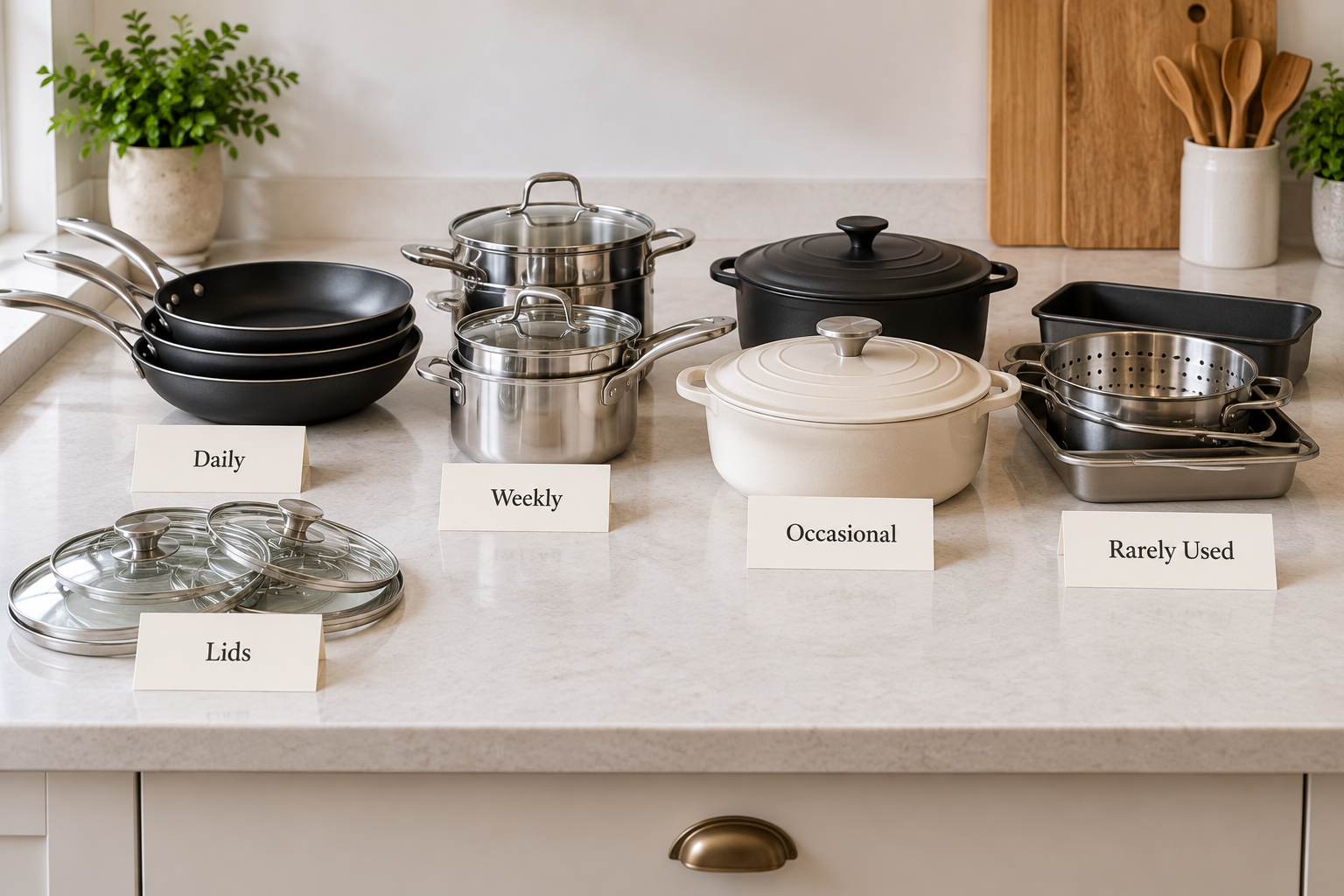
Then separate the collection into pots, frying pans, saucepans, specialty cookware, and lids.
A useful question
For every piece, ask: If I needed this tomorrow, where would I want to find it?
That answer is more useful than simply grouping everything by shape.
Measure the Storage Before Choosing a System
Once you know what you are keeping, measure the storage space.
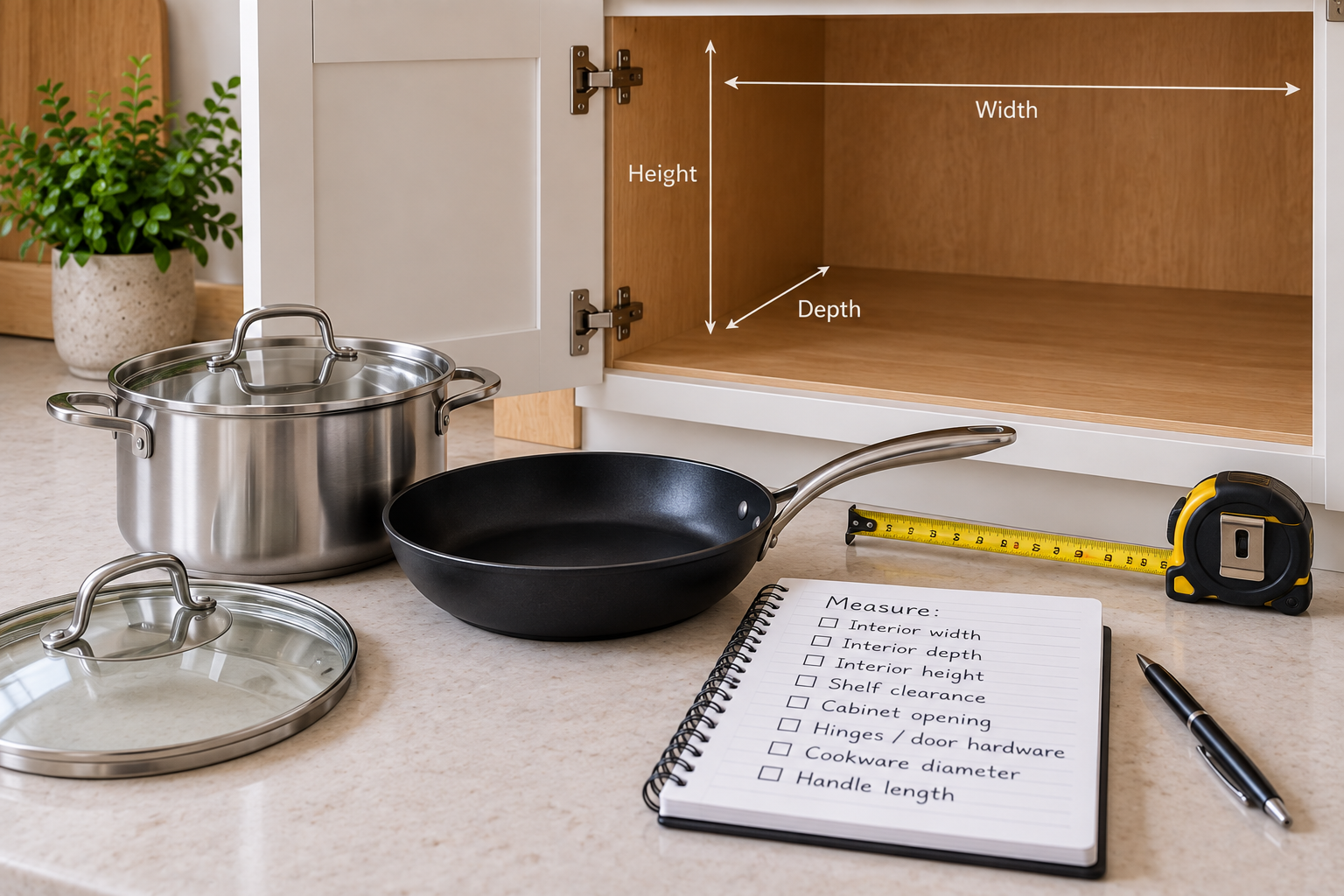
For a cabinet, check:
- Interior width
- Usable depth
- Interior height
- Shelf clearance
- Cabinet opening
- Hinges and door hardware
- Obstructions inside the cabinet
For a drawer, check the inside width, depth, usable height, drawer opening, and anything nearby that could interfere with the drawer.
Then measure the cookware that needs to go there.
Pay attention to pan diameter, pot height, handle length, lid diameter, handles that stick out, unusual shapes, and nesting height.
Measure the movement path too
An organizer can fit perfectly inside a cabinet and still create a bad storage system.
Imagine removing the largest pan. Can you pull it out without hitting the cabinet frame? Can you lift it without catching the handle on the shelf above? Can you return it without moving another piece?
That movement path is part of the storage space.
For more cabinet-specific guidance, see How to Organize Kitchen Cabinets. For related kitchen storage, see how to organize food storage containers and lids.
Record the usable space, not just the cabinet size
Measure width, depth, height, opening, hinges, nearby obstructions, and the cookware itself. Then check the movement path: the piece must fit and come out without unnecessary interference.
Measure → Compare → Test clearance → Choose
Separate Cookware by Retrieval Needs
Not every pot or pan needs the same type of access.
Instead of creating one giant cookware stack, think about how each group needs to be retrieved.
| Cookware situation | Storage direction |
|---|---|
| Daily frying pan | Easiest available access |
| Frequently used saucepan | Easy-access cabinet or drawer |
| Several similar pans | Vertical storage may reduce stacking |
| Nested pots | Nest only when pieces remain easy to separate |
| Heavy cookware | Low, stable storage |
| Loose lids | Dedicated lid zone |
| Large specialty cookware | Separate space if necessary |
| Rarely used pieces | Secondary or less convenient storage |
The goal is not perfect symmetry. The goal is low-friction access.
A little empty space can be more useful than squeezing one additional pan into an already difficult stack.
Decide Which Cookware Deserves Prime Storage
Small kitchens have limited prime real estate.
The easiest-to-reach cabinet or drawer should not automatically go to whichever cookware happens to fit there. Give priority to the pieces you use most.
For example, a frying pan used almost every day should not be buried underneath a roasting pan that comes out twice a year.
Likewise, a heavy Dutch oven may need a lower and more stable location even if that means giving it more space.
Think of storage as a hierarchy:
- Most-used + easiest to handle → easiest access
- Less-used + awkward → secondary access
- Rarely used → least valuable storage space
This keeps your storage aligned with real kitchen activity.
Create Cookware Storage Zones
Once the cookware has been ranked, divide the available space into practical zones.
Primary Cooking Zone
Cookware you reach for constantly. Keep it as close to the main cooking area as practical.
Easy-Access Zone
Regular cookware that does not need to stay immediately at hand.
Lower Storage Zone
Useful for heavier pots and cookware that is less frequently handled.
Secondary Storage Zone
Occasional and rarely used cookware that does not need prime cabinet space.
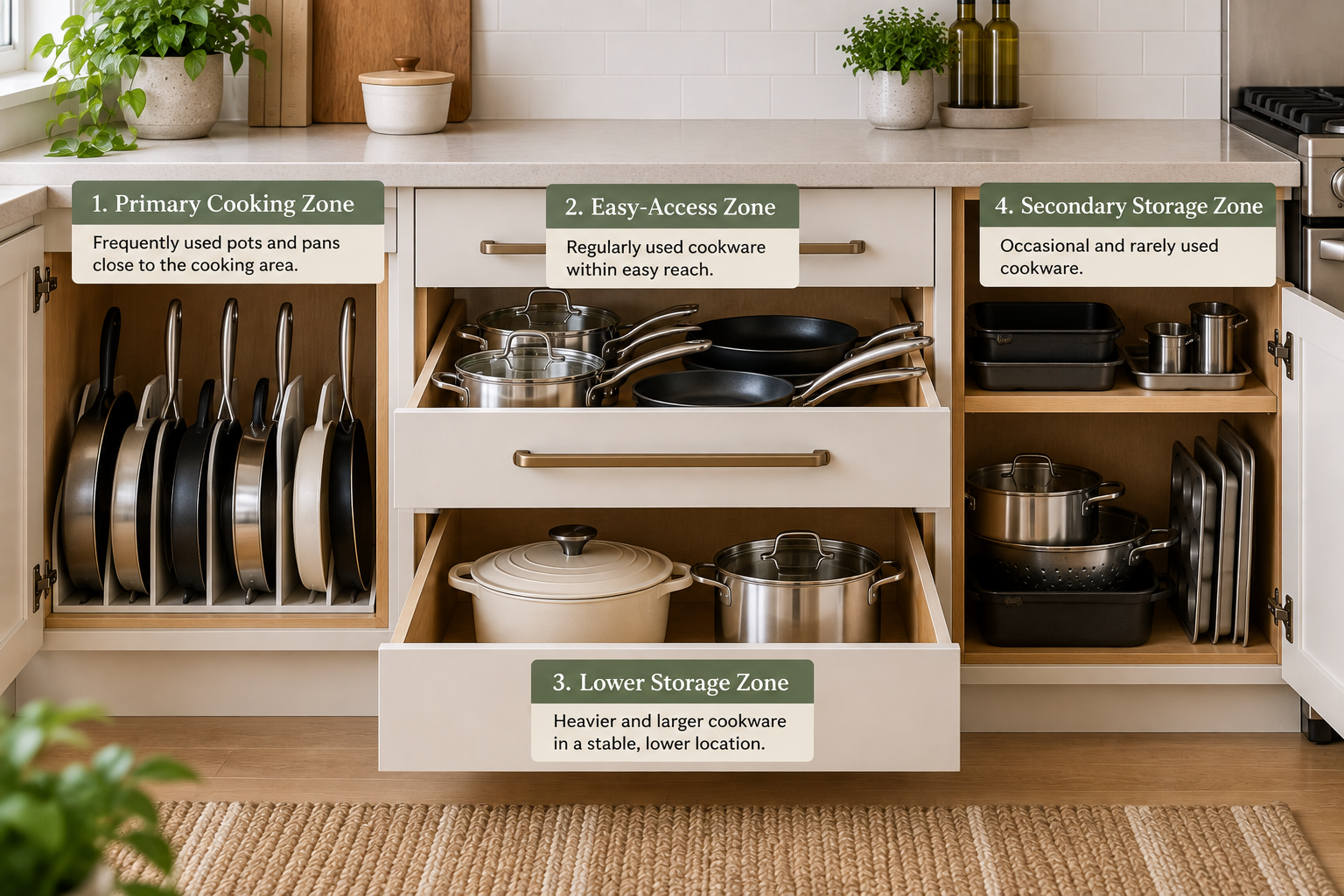
The exact location of each zone will depend on your kitchen. The important part is the logic behind the zones.
How to Store Pots and Pans in a Small Kitchen
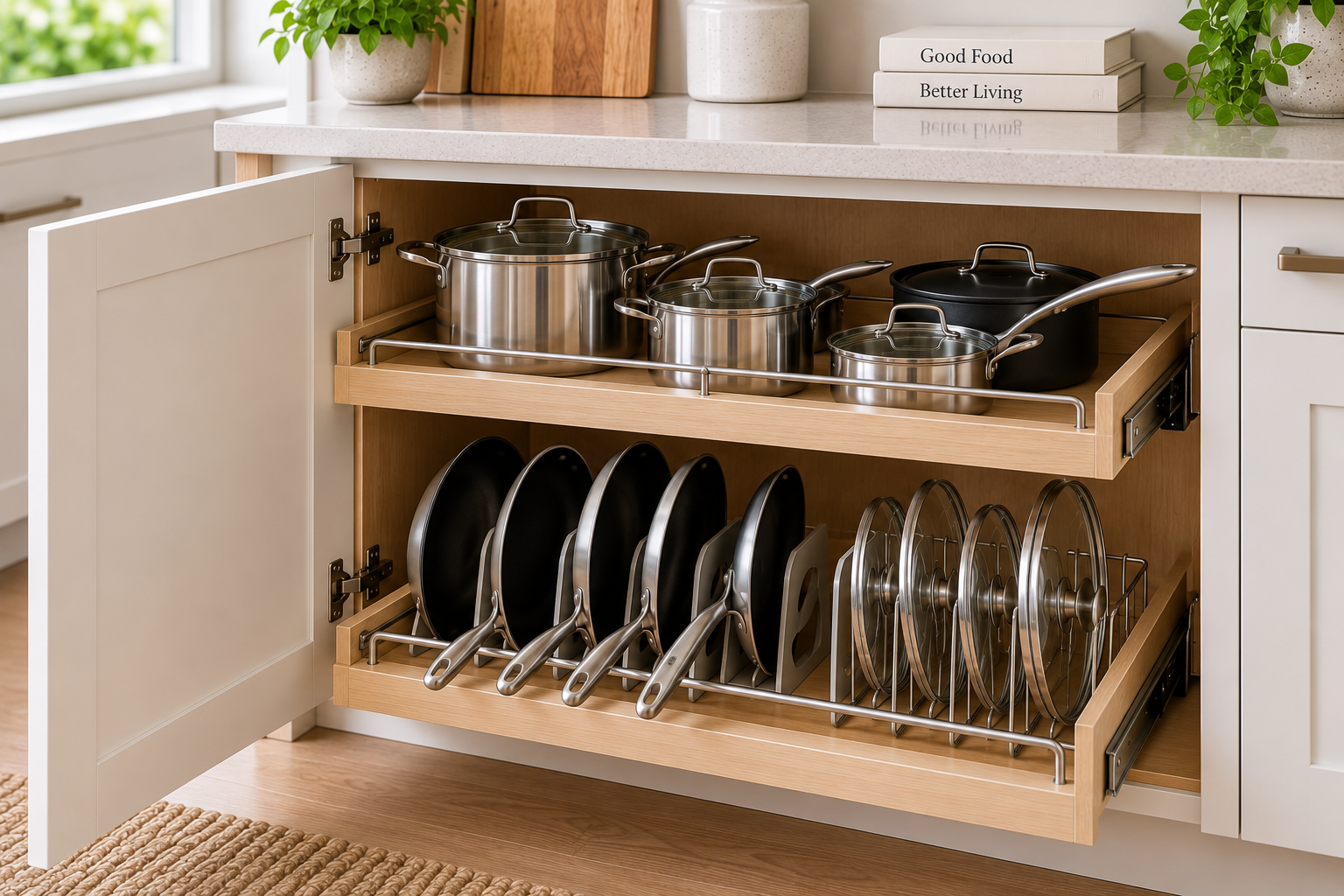
For a small kitchen, start with the simplest storage method that lets you retrieve one piece without unpacking the rest. Vertical dividers work well for individual pans, deep drawers can make heavier cookware easier to reach, separate lid storage prevents loose lids from disrupting the cabinet, and wall or door storage can reclaim space when the clearance and installation conditions are suitable. The right choice depends on your actual cabinet dimensions, cookware, and cooking frequency.
Match the Storage Method to the Problem
Choose the storage method that removes the specific problem you have—stacking, poor visibility, deep reach, loose lids, awkward weight, or lack of cabinet space.
There is no universal best cookware organizer. A method only helps when it improves access within the space and cookware you actually have.
There is no single best way to store pots and pans. The right method depends on what is making your current system difficult.
Vertical Storage
Vertical dividers can work well for pans that are awkward to stack. Instead of lifting several pans to reach the bottom one, you can potentially retrieve an individual pan from its slot.
This works best when the cabinet has enough height and the dividers do not make the cabinet opening harder to use.
Deep Drawers
A deep drawer can be useful for cookware because the contents can be brought forward rather than buried at the back of a cabinet.
But drawer dimensions matter. A drawer that is too shallow or crowded can simply create a different kind of stacking problem.
If your kitchen has drawers that could be used more effectively, see How to Organize Kitchen Drawers.
Shelves
Traditional shelves can work perfectly well when cookware is limited and nesting remains easy.
The problem starts when the entire shelf becomes one large pile. If you have to remove several pieces to reach one pan, consider whether separating the cookware would make more sense.
Cabinet-Door Storage
The inside of a cabinet door can sometimes provide useful space for lids or smaller cookware.
But check the clearance first. The door must still close properly, and stored items should not interfere with shelves, hinges, or the cabinet frame.
Wall Storage
Wall storage can free cabinet space, but it should not be treated as an automatic solution.
Consider the available wall space, installation requirements, cookware weight, clearance, frequency of use, and whether the location is convenient.
Use wall space when it genuinely improves the kitchen rather than simply moving clutter from one location to another.
Pot Racks
Pot racks can make cookware accessible, but they also keep cookware visually exposed.
They may work well in some kitchens and poorly in others. The question is not whether a pot rack is clever. The question is whether it creates a safer, easier, and more useful storage location in your particular kitchen.
Nesting
Nesting can save space. It can also create retrieval friction.
If you can easily remove the top piece but have to unpack half the stack to reach the bottom piece, the space savings may come at the cost of usability.
Nest cookware only as deeply as you can comfortably manage.
Give Pot Lids Their Own Storage System
Lids often become the loose pieces that make an otherwise organized cookware cabinet difficult to use.
Instead of dropping them wherever there is space, give them a defined location.
Depending on your kitchen, that could be:
- A vertical divider
- A drawer section
- A cabinet-door solution
- A dedicated shelf area
- Storage alongside the corresponding cookware
The important thing is that the lid should be easy to identify and retrieve.
If several lids look similar, storing them upright or separating them can make the right one easier to find.
Do not over-organize the lids
First determine whether the real problem is too many lids, poor separation, or insufficient space. The simplest system that solves the actual problem is usually the better one.
What to Do When You Have Almost No Cabinet Space
Sometimes the problem is not poor organization. There simply is not enough useful storage.
Start by reducing the amount of cookware that needs prime space.
Ask:
- Do I have several pieces that perform the same job?
- Which pans do I actually reach for?
- Are specialty pieces taking up everyday storage?
- Can rarely used cookware move to secondary storage?
- Can an existing drawer or cabinet be reorganized?
- Is there unused vertical space that can be used safely?
If you have a very small kitchen, you do not need to make every piece equally accessible. You need to make the right pieces accessible. For another kitchen storage problem, see how to organize a kitchen junk drawer.
For more small-kitchen strategies, see How to Organize a Small Kitchen. organizing kitchen utensils and organizing spices.
Store Heavy Cookware Safely
Heavy cookware deserves extra attention.
A large cast-iron pan, Dutch oven, or other heavy piece should have stable storage that makes it reasonably easy to lift and return.
Avoid assuming that every shelf, drawer, rack, or organizer can safely support any cookware you own. If an organizer has a stated load capacity, stay within the manufacturer’s limits.
Also consider how the cookware is lifted, not just where it fits.
A heavy pot stored at an awkward height can be more difficult to handle than the same pot stored in a lower, more accessible location.
Test the Retrieval and Return Path
This is the step that separates a storage arrangement from a working system.
Choose the cookware you use most. Take it out. Then put it back.
Watch what happens.
The Retrieval Test
Can I remove it in one simple sequence?
Do I have to move another piece first?
Does the handle catch on anything?
Can I see the piece I need?
Can I return it without rearranging the cabinet?
If the answer is no, change the storage location or the storage method.
Test the return path too
A system that is easy to use but annoying to reset will gradually become messy again.
MEASURE → ASSIGN → COMPARE → CHOOSE
- Measure the usable cabinet, drawer, shelf, or wall area.
- Measure the cookware, lids, handles, and nesting height that must fit.
- Identify the actual problem the organizer is supposed to solve.
- Check clearances, movement paths, door and drawer operation, and stated load limits.
- Choose only after the storage job and dimensions are clear.
Common Pots and Pans Storage Mistakes
- Stacking everything together: Stacking saves space but can make individual pieces difficult to retrieve.
- Organizing by shape alone: Two pieces can have similar dimensions but completely different usage patterns.
- Giving rare cookware prime space: Your everyday pan should not have to compete with something used twice a year.
- Ignoring the lids: A cabinet can look organized until loose lids start falling over everything else.
- Storing heavy cookware in awkward locations: Fit is not the only consideration. Handling matters too.
- Buying an organizer before measuring: An organizer that almost fits can make the cabinet harder to use.
- Filling every available inch: A completely full cabinet can have more retrieval friction than a cabinet with a little breathing room.
- Creating a system that looks better than it functions: The best system is not necessarily the prettiest one. It is the one you can use and reset without unnecessary effort.
Maintain the System
Cookware collections change. You may buy a new pan, stop using an old one, or change how you cook.
A quick review can prevent the cabinet from slowly becoming crowded again.
REVIEW → REMOVE → RE-RANK → RE-ZONE
Return misplaced cookware, move pieces that no longer deserve prime space, and restore the easiest access to the cookware you actually use.
Review
Look at what is actually being used.
Remove
Move cookware that no longer deserves prime space.
Re-Rank
Give the easiest access to the cookware you use most.
Re-Zone
Adjust storage locations when your collection or cooking habits change.
The system should adapt to the kitchen. You should not have to adapt your daily routine to a storage system that no longer works.
Key Takeaways
- Start with the cookware you actually use.
- Measure usable storage and cookware before choosing a method.
- Reduce retrieval effort instead of simply maximizing capacity.
- Give frequently used and heavy cookware appropriate access.
- Give lids a defined home.
- Test both the retrieval and return paths.
Frequently Asked Questions
What is the best way to organize pots and pans in a small kitchen?
Start by grouping cookware according to frequency of use and measuring the available storage. Then choose a storage method that allows frequently used pieces to be retrieved without moving several other pieces.
Should pots and pans be stacked or stored vertically?
Either can work. Stacking is useful when cookware can be separated easily, while vertical storage can make individual pans easier to retrieve. The better choice depends on the cookware, available space, and how easily each piece can be removed.
How should pot lids be stored in a small kitchen?
Give lids a defined location rather than letting them become a loose pile. Vertical dividers, drawers, cabinet-door storage, or a dedicated shelf can work depending on the available space and clearances.
Where should heavy pots and pans be stored?
Heavy cookware generally benefits from stable, accessible storage where it can be lifted without unnecessary reaching or awkward handling. Check the capacity of any shelf or organizer before placing heavy cookware on it.
How do you organize pots and pans when you have very little cabinet space?
Prioritize the cookware you use most, move rarely used pieces to secondary storage, and look for unused space in existing drawers, cabinets, or suitable vertical areas. Avoid trying to make every piece equally accessible.
Make Every Piece of Cookware Earn Its Storage Location
A small kitchen does not need a complicated cookware-storage system. It needs a system that matches the way you actually cook.
Start with the cookware you own. Measure the space you have. Separate pieces by how they need to be accessed. Give frequently used cookware the easiest locations. Create a dedicated solution for lids. Then test the entire retrieval and return path.
If you can take out the piece you need and put it back without unnecessary rearranging, you are much closer to a system that will stay organized.
AUDIT → MEASURE → SEPARATE → ZONE → MATCH → TEST → RESET
That is the goal: not simply fitting more cookware into a small kitchen, but making the cookware you keep easy to use and easy to put away.