
A small kitchen does not need a storage spot for every utensil to be equally convenient. The better approach is to sort the tools you actually use, measure the storage you have, group utensils around the tasks they support, and give each group a practical home.
To organize kitchen utensils in a small kitchen, start by gathering and sorting the tools you actually use, measure the storage you have, group utensils around the tasks they support, and assign each group to a location that makes retrieval and return easy. Choose an organizer only after you know the problem it needs to solve.
The Utensil Organization System
How to arrange utensils in a small kitchen: keep the tools you use most often in the easiest-to-reach zone, group utensils by the tasks they support, separate long or awkward tools from smaller ones, and use the available drawer, cabinet, counter, or vertical space according to its actual dimensions.
The goal is not to fit every utensil into one drawer. It is to create clear zones so you can find, use, and return each tool without disturbing the rest.
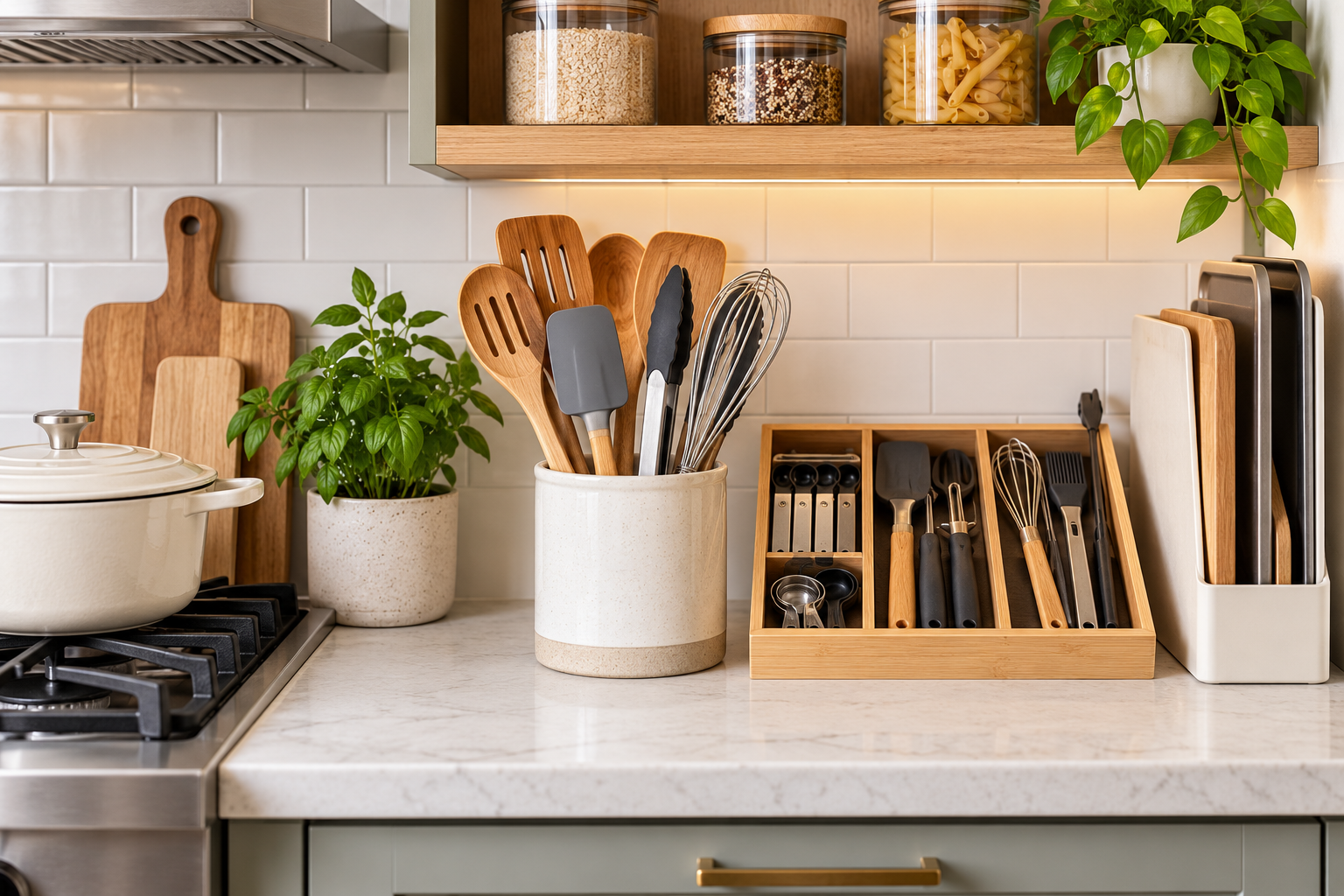
The goal is not simply to make a drawer or counter-top look tidy. It is to make the utensil you need easy to find, easy to retrieve, and easy to put back.
AUDIT → SORT → MEASURE → ZONE → MATCH → TEST → RESET
This approach helps you solve the storage problem before choosing an organizer.
1. Start by Auditing Your Kitchen Utensils
Before buying an organizer or rearranging a drawer, find out what you are actually storing.
Gather your cooking utensils from drawers, cabinets, counter-tops, and other places where they have ended up. Seeing the whole collection at once makes duplicates, rarely used tools, damaged items, and misplaced utensils easier to spot.
The answer
Audit the full utensil collection before choosing storage.
Why it matters
If the collection is larger than the available storage, a new organizer may only hide the underlying capacity problem.
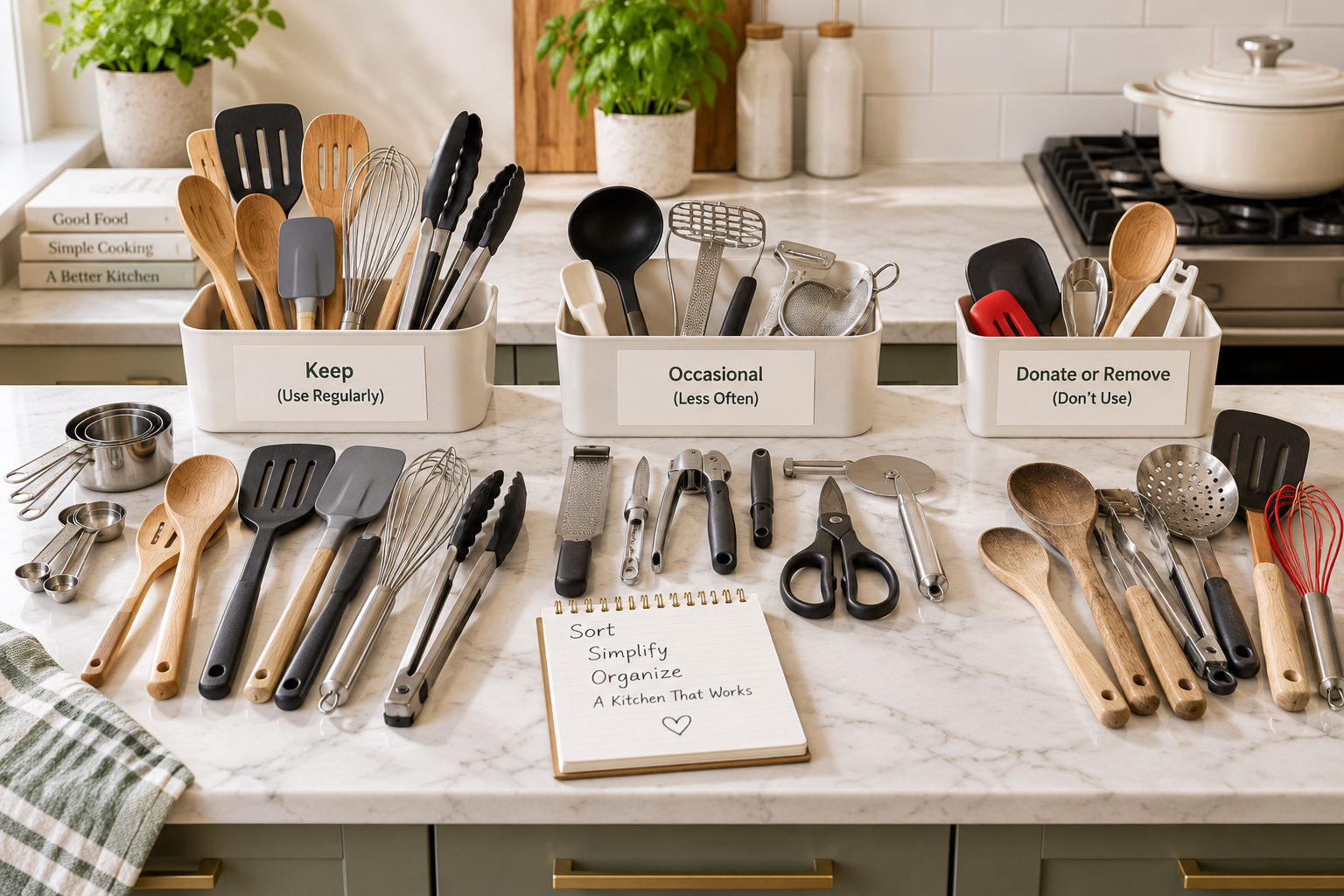
What to Check While Sorting
- Do I use this regularly?
- Does another utensil already do the same job?
- Is it still in good condition?
- Does it belong with everyday cooking tools or somewhere else?
- Is it difficult to store because of its size or shape?
- Would I choose this utensil again today?
Do not decide on an exact number of utensils that everyone should own. Cooking habits differ, and a useful collection for one household may be unnecessary for another.
You are not trying to create a perfect-looking pile. You are trying to understand the actual storage problem. If the utensil problem is part of a wider space issue, see how to organize a small kitchen before adding more storage.
If ten utensils are competing for a space that comfortably holds six, a better organizer may not solve the underlying problem.
2. Sort Utensils by How You Actually Use Them
Once you know what you have, group the remaining utensils according to how they support your kitchen routines.
A useful starting point is:
- Everyday cooking
- Food preparation
- Baking
- Serving
- Occasional or specialty use
The categories do not need to be rigid. A whisk might belong with everyday cooking if you use it frequently. In another kitchen, it may belong with baking tools.
Sort for Access, Not Appearance
The important question is not, “Which utensils look good together?”
Ask:
Which utensils do I reach for together?
That answer gives you a more useful storage group.
3. Measure the Storage Before Choosing an Organizer
An organizer can look like the right size online and still waste space once it is inside your actual drawer or cabinet.
Measure the usable storage area, including:
- Width
- Depth
- Height
- Drawer opening
- Cabinet opening
- Shelf position
- Door clearance
- The length of your longest utensils
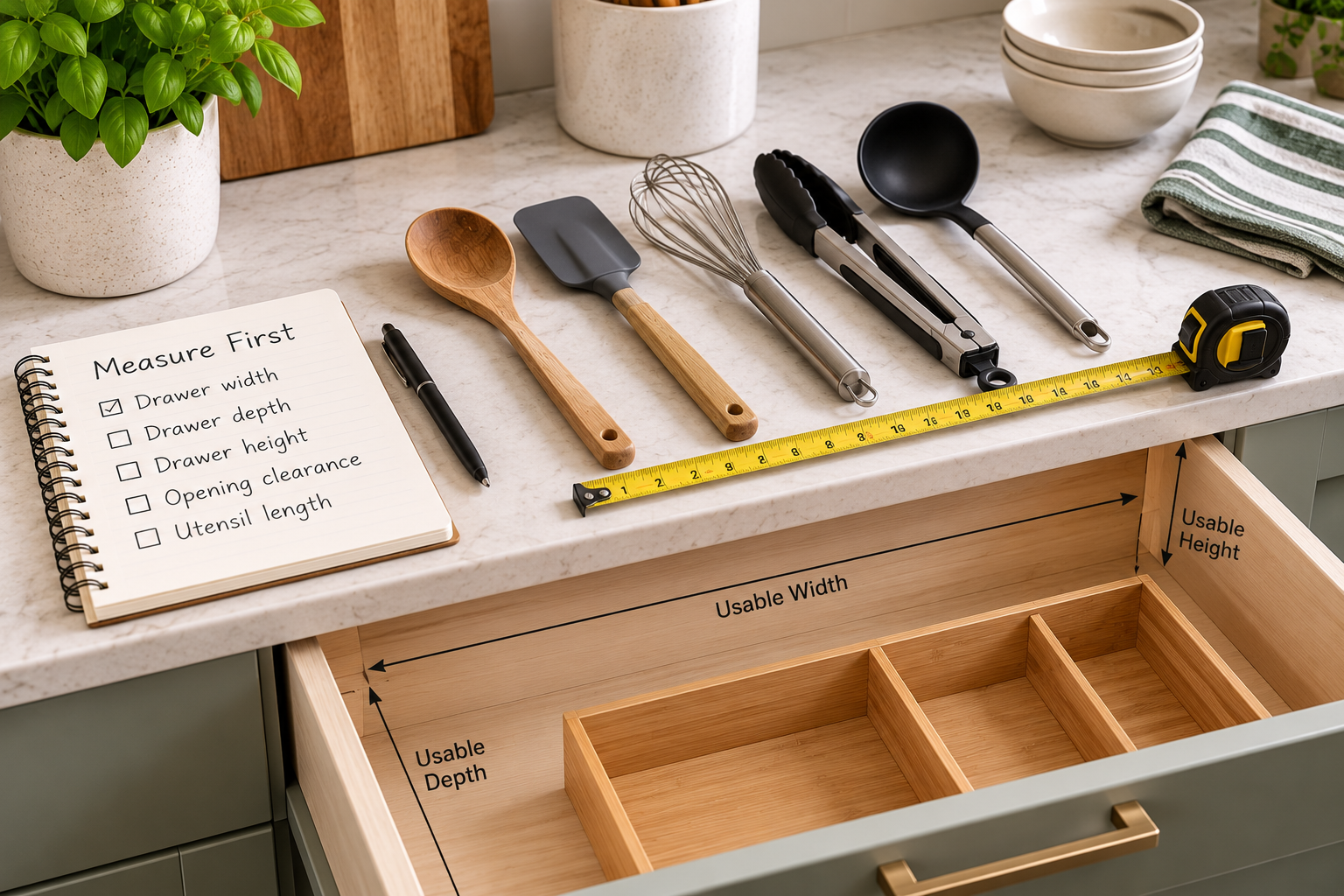
For drawers, measure the usable interior rather than relying on the outside dimensions.
For cabinets, pay attention to the opening. A shelf may have enough depth for an item while the cabinet opening makes that item difficult to remove.
Measurement Check
Record the usable width, depth, and height of the storage space, then compare them with the length and shape of the utensils you need to store. Do not shop from the outside cabinet or drawer dimensions alone.
Measure the Utensils Too
Long utensils can create problems even when there is technically enough storage volume.
A drawer may be deep enough for several tools but too short to let a long spatula or pair of tongs lie comfortably.
That means the question is not simply, “How much storage do I have?”
What storage shape matches the tools I actually own?
4. Create Utensil Zones Around Your Cooking Workflow
After sorting and measuring, decide where each group should live.
The best zone is usually the one that makes the utensil easy to access when you need it without giving every tool prime real estate.
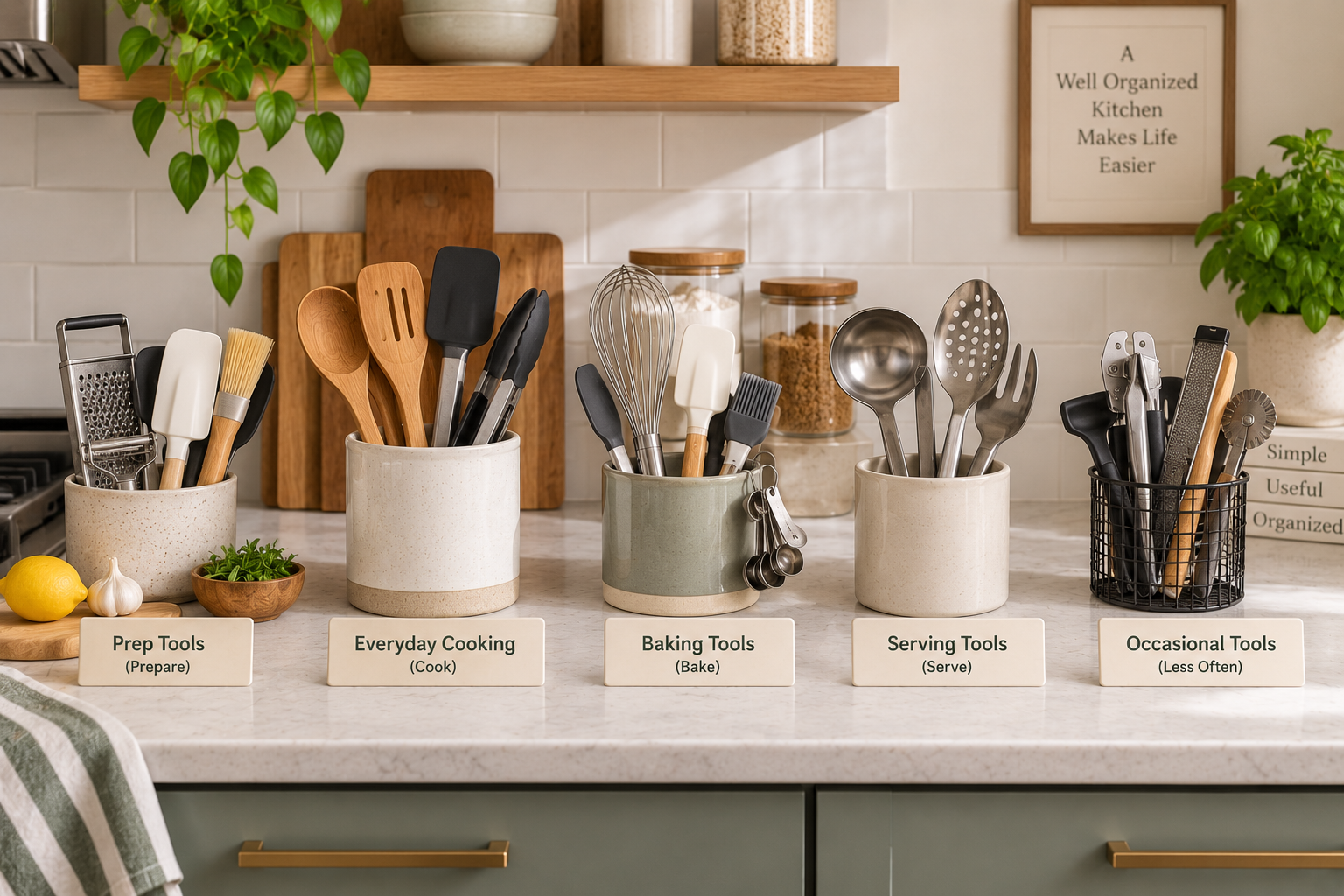
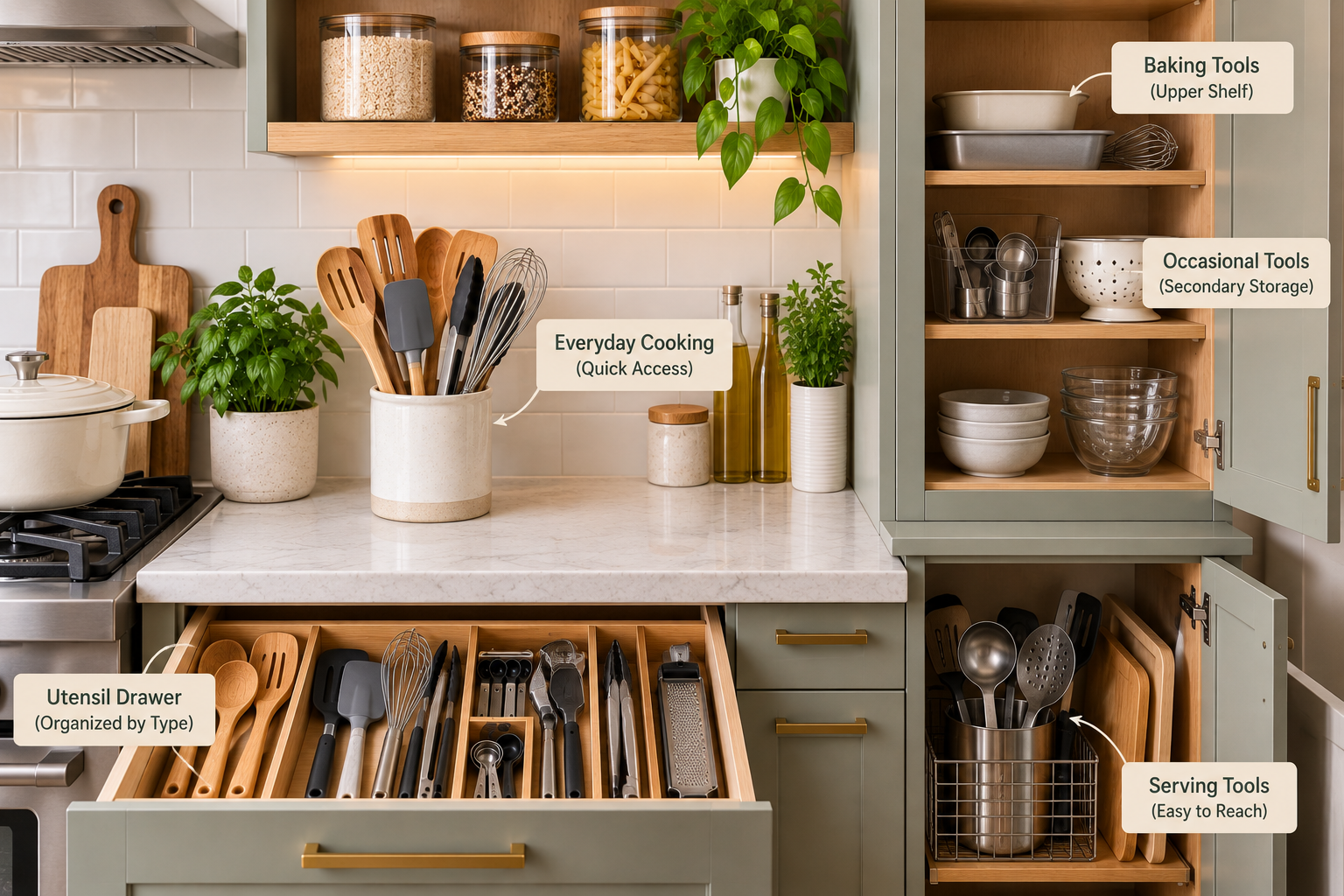
Everyday Cooking Tools
Frequently used cooking tools deserve convenient storage.
Depending on your kitchen, that could be a nearby drawer, counter-top container, accessible cabinet, or another storage area close to the cooking zone.
The exact location depends on the layout. There is no universal rule that every spatula belongs beside the stove.
Prep Tools
Peelers, zesters, graters, and similar tools may make more sense near the area where food preparation happens.
If you regularly prepare food in one part of the kitchen, storing the tools there can reduce unnecessary movement. The same task-based approach can help with nearby categories such as spices in a small kitchen.
Baking Tools
Baking tools do not necessarily need to occupy the most convenient everyday cooking storage.
If you bake occasionally, giving those tools a dedicated secondary zone can free prime space for things you use every day.
Serving Tools
Serving spoons, salad tongs, and similar utensils can be grouped together if that reflects how you use them.
The goal is to make the group predictable.
Occasional Tools
Specialty utensils that you use only occasionally do not necessarily need to occupy the easiest-to-reach storage.
Move them to a less convenient but still accessible location if doing so gives everyday tools more usable space.
5. Match Each Utensil Group to the Right Storage Location
Once you know what belongs together, choose the storage environment.
Do this after sorting and measuring—not before.
Need frequent access?
Start with the most convenient nearby storage that does not consume more space than the utensil deserves.
Need separation?
Use compartments or zones when mixed utensils are creating retrieval problems.
Need a different orientation?
Change the storage direction or location when long or awkward tools do not fit the available space naturally.
When a Drawer Works Well
Drawers can work particularly well when utensils can be separated into clear sections.
A useful drawer should let you see the tools, retrieve them without digging, keep categories separated, and return tools without disturbing the rest.
If your drawer is already dedicated to utensils but constantly becomes tangled, the problem may be the arrangement rather than the amount of storage.
For more detail on designing the drawer itself, see How to Organize Kitchen Drawers.
When Counter-top Storage Makes Sense
A counter-top container can make sense for utensils you use frequently.
But the counter should not become the place where every utensil goes simply because the drawers are full.
Does keeping this tool visible make it easier to use often enough to justify the counter space?
If not, another storage location may work better.
For broader decisions about what deserves counter space, see How to Organize Kitchen Counters.
When Cabinet Storage Makes Sense
Cabinets can work well for utensil groups that do not need to be immediately visible.
The important consideration is access.
A cabinet that technically holds everything may still be a poor utensil zone if reaching one item requires moving several others.
See How to Organize Kitchen Cabinets for the larger cabinet-storage system.
When You Have Very Little Drawer Space
A small kitchen does not have to depend entirely on drawers.
Depending on the layout, alternatives can include counter-top storage for genuinely frequent tools, cabinet storage, inside-cabinet storage, vertical storage, or wall-mounted storage where appropriate.
But do not add storage simply because an empty wall exists. The new storage still needs to make the utensil easier to use. For larger cooking equipment that competes for nearby space, see how to organize pots and pans in a small kitchen.
6. How to Handle Long and Awkward Kitchen Utensils
Long utensils are often difficult because their shape does not match the storage space.
Examples include:
- Long tongs
- Ladles
- Large spatulas
- Long-handled spoons
- Specialty cooking tools
Instead of forcing them into a crowded horizontal drawer, consider whether another storage orientation makes more sense.
Can the utensil be removed and returned without disturbing the rest of the zone?
If not, change the storage arrangement.
7. Use the Utensil Retrieval and Return Test
A storage system is not finished just because it looks organized.
Test it.
Find It
Can you immediately tell where the utensil belongs?
Retrieve It
Can you remove it without digging through several other tools?
Use It
Does its location make sense for the task you use it for?
Return It
Can you put it back in one simple sequence?
The Key Question
Can I find the utensil I need and return it without rebuilding the storage zone?
If the answer is repeatedly no, do not immediately buy another organizer. First reconsider the location, category, spacing, or number of tools in that zone.
That is the difference between organizing the utensils and designing a system that works.
8. A Simple Utensil Storage Decision Table
| If the utensil is… | Consider… |
|---|---|
| Used every day | The most accessible nearby storage |
| Used during food preparation | Storage near the prep area |
| Used mainly while cooking | Storage close to the cooking zone |
| Long or awkward | A storage orientation that allows easy removal |
| Used occasionally | A secondary storage location |
| One of many similar tools | A clearly separated category |
| Constantly difficult to return | Reconsidering its storage location |
These are decision principles, not universal placement rules. Your kitchen layout and actual habits should determine the final arrangement.
9. Common Kitchen Utensil Organization Mistakes
Putting Everything in One Drawer
A single drawer can become a storage bottleneck when different shapes and frequencies compete for the same space. If the drawer has become a mixed catch-all rather than a utensil zone, see how to organize a kitchen junk drawer.
Organizing Before Measuring
An organizer cannot compensate for a storage space that is the wrong size or shape.
Giving Rarely Used Tools Prime Space
If a specialty tool occupies the easiest-to-reach section while an everyday spatula is buried behind it, the zone is working against your routine.
Buying Organizers Before Identifying the Problem
An organizer should solve a known problem. It should not be the starting point.
Organizing Only for Appearance
A drawer can look excellent immediately after organizing and still be frustrating to use.
The retrieval and return test matters more than the photograph.
Making the Return Path Difficult
If putting a utensil away requires moving other utensils first, the system will gradually become harder to maintain.
10. How to Keep Kitchen Utensils Organized
A useful system should be easy to reset.
After using a utensil:
Use → return → continue.
If the return step becomes complicated, reconsider the storage location.
Every so often, check for:
- Duplicates
- Damaged utensils
- Tools that have moved into the wrong zone
- Categories that have become overcrowded
- Tools that are consistently difficult to retrieve
Your storage system can change as your cooking habits change.
The goal is not permanent perfection. The goal is a kitchen where the storage continues to support the way you actually use it.
Use the drawer, cabinet, or counter-top you already have as the starting point. The goal is to buy only when a product solves a specific storage problem.
- MEASURE the usable space and the longest utensils.
- ASSIGN the job and the utensil group the storage must support.
- COMPARE the organizer’s usable dimensions and compartment layout with your actual needs.
- CHOOSE only when the product improves access without creating a new return or crowding problem.
Frequently Asked Questions
How do you organize kitchen utensils in a small kitchen?
Start by gathering the utensils you own, removing duplicates or damaged items, grouping the remaining tools by how you use them, and measuring the available storage. Then assign each group to a location that makes retrieval and return easy.
Where should kitchen utensils be stored?
Store frequently used utensils in the most convenient locations that fit your kitchen, while less-used tools can occupy secondary storage. The best location depends on your layout, cooking habits, utensil size, and available storage.
Should kitchen utensils go in a drawer or a container?
Either can work. A drawer is useful when utensils can be separated and retrieved easily, while a counter-top container can make frequently used tools convenient to reach. Choose based on access and the amount of space the storage method consumes.
How do you organize kitchen utensils without drawers?
Use whatever storage environments your kitchen provides, such as accessible cabinets, counter-top storage, inside-cabinet storage, or appropriate vertical storage. The goal is to create predictable zones rather than trying to reproduce a drawer system somewhere else.
How do you organize long kitchen utensils?
First measure the usable storage and the longest utensils. Choose an arrangement that allows those tools to be removed and returned without tangling with shorter utensils or blocking other storage.
Which kitchen utensils should stay near the stove?
Tools you regularly use while cooking can benefit from being close to the cooking zone. This might include frequently used spatulas, spoons, tongs, or other cooking tools, but the exact group should reflect your own cooking routine.
How do you stop a utensil drawer from becoming messy?
Reduce unnecessary duplicates, separate different categories, avoid overfilling the drawer, and make sure each tool has a simple return path. If the drawer repeatedly fails the retrieval-and-return test, reconsider the storage arrangement rather than simply adding more organizers.
Build a Utensil System That Works With Your Kitchen
Organizing kitchen utensils in a small kitchen is less about finding one clever storage product and more about matching your tools to the space you actually have.
Start with the utensils.
Audit → Sort → Measure → Zone → Match → Test → Reset.
The final test is simple:
Can you find the utensil you need, use it, and put it back without making the rest of the kitchen harder to use?
If yes, the system is doing its job.
If not, change the system—not just the organizer.