
Food storage containers have a way of turning one small kitchen cabinet into a daily puzzle. Containers get mixed together, lids disappear into piles, and finding one matching set can mean moving half the cabinet.
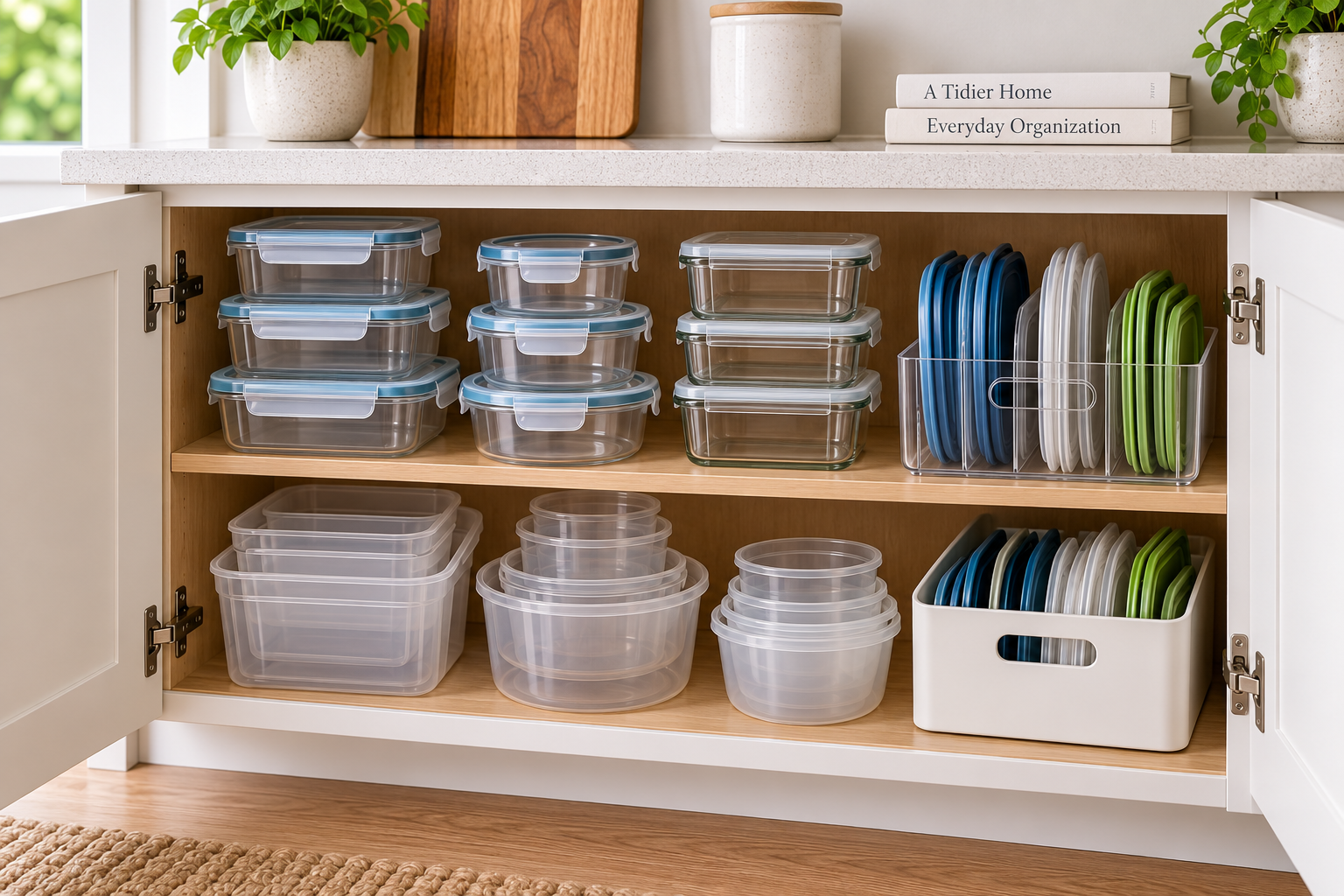
The solution is not simply to stack everything more neatly. A useful container system should make it easy to find the right container, find its lid, and put both away without rebuilding the storage area.
This system follows seven steps: AUDIT → MATCH → MEASURE → NEST → ZONE → TEST → RESET.
The most reliable way to organize food storage containers in a small kitchen is to match containers with their lids, reduce unnecessary pieces, measure the usable storage, nest compatible shapes, give lids a defined home, and test whether the system is easy to retrieve and reset.
Start With a Food Storage Container Audit
Before choosing a bin, divider, shelf insert, or other organizer, take everything out of the area where your food containers are stored.
Gather the containers and lids together. This gives you a complete picture of what you actually own instead of trying to organize pieces while some are still hidden in the back of a cabinet.
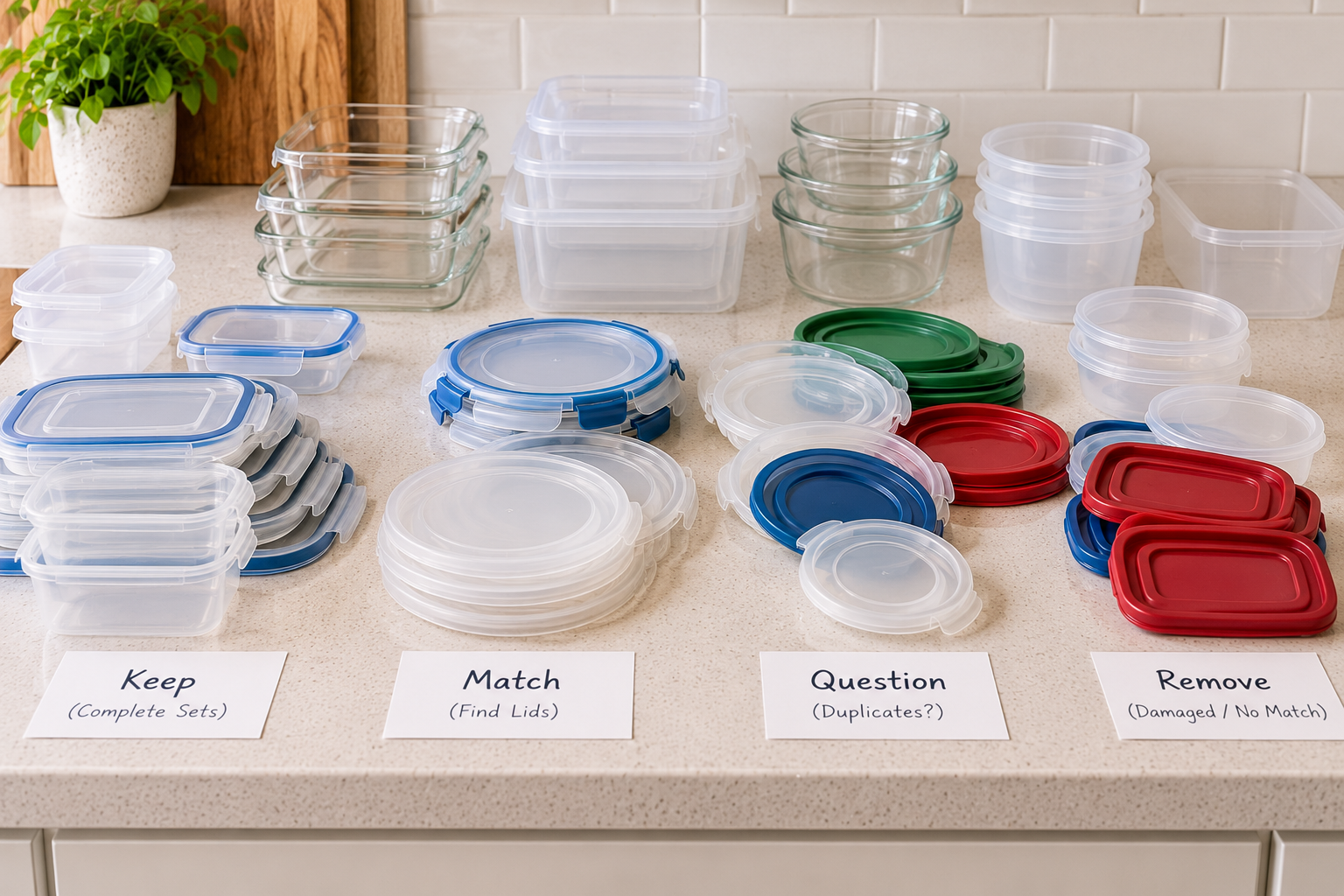
Now separate the collection into a few practical groups.
- Complete sets: a usable container with its matching lid.
- Needs matching: a container or lid that may still have its partner somewhere in the collection.
- Question: duplicates, rarely used pieces, awkward shapes, or items you are unsure about keeping.
- Remove: pieces that are damaged, unusable, or no longer have a useful purpose for your household.
Do not feel that every container without a lid must automatically be thrown away. The useful question is whether it deserves space in your kitchen. If a piece has another legitimate purpose, make that decision separately instead of allowing it to remain mixed into the main food-container system.
Match Containers and Lids Before Choosing Storage
Once everything is visible, match the containers with their lids.
This sounds obvious, but it is one of the most important steps. A cabinet can look organized while still being frustrating if you have to try several lids before finding the right one.
For each container, ask: Can I identify its matching lid without guessing?
For each lid, ask: Can I identify which container it belongs to without searching through the entire collection?
Similar-looking lids deserve particular attention. Two lids may appear interchangeable but still belong to different containers. Keep them with the correct set rather than creating a category of “probably fits” pieces.
The objective is not to create the largest possible collection of matching pieces. It is to create a collection that is easy to understand and easy to use.
Measure the Storage Space You Actually Have
After the collection has been reduced and matched, measure the storage area.
Start with the usable width, depth, and height. Then look at the cabinet or drawer opening itself. The inside of a cabinet may have plenty of theoretical space, but a narrow opening can make a tall or deep stack difficult to retrieve.
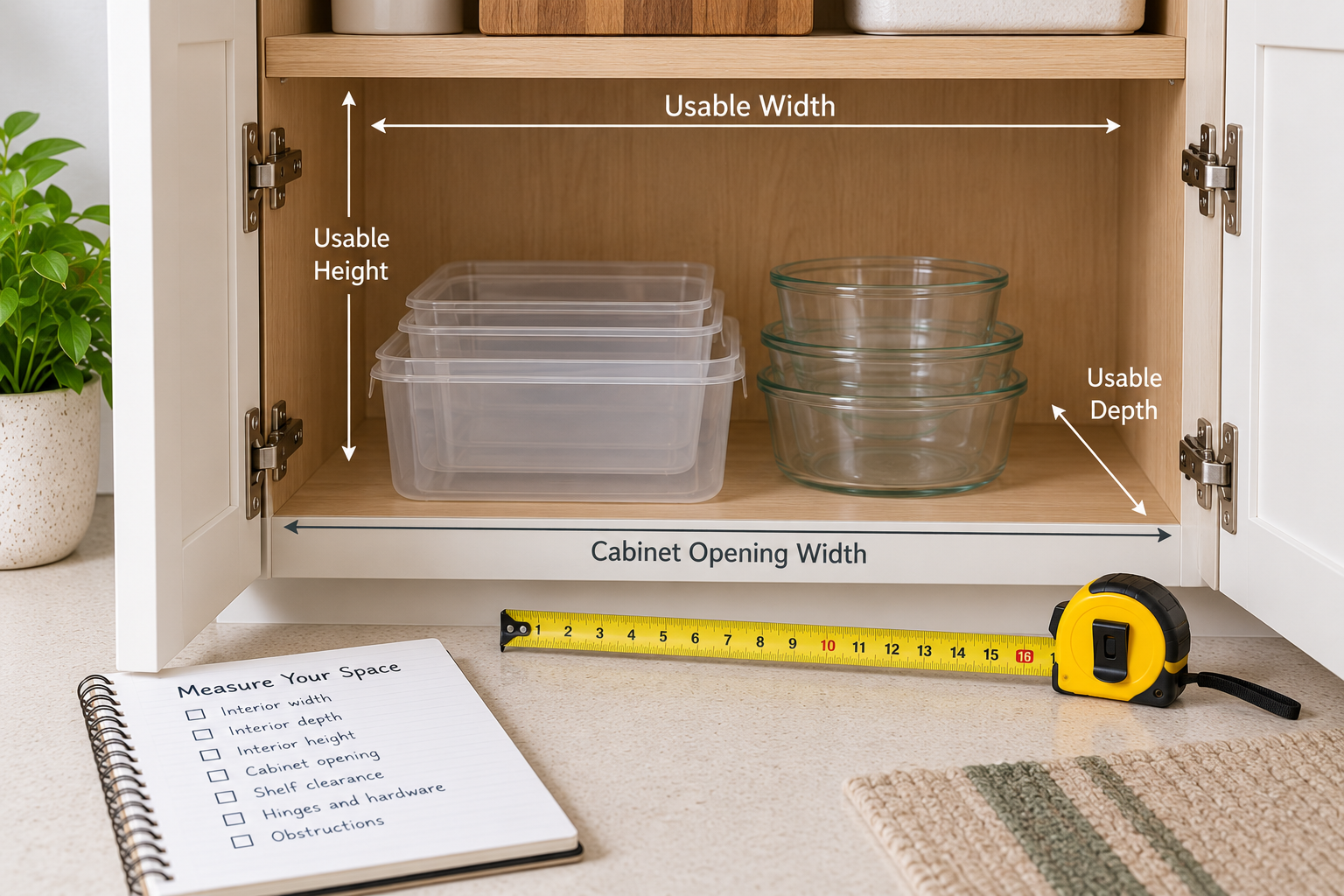
- Usable cabinet width: measure the space available from side to side.
- Usable cabinet depth: measure from the front edge toward the back.
- Usable vertical height: check the space between shelves.
- Cabinet opening: check the actual opening if the cabinet has a narrow frame or doors.
- Drawer dimensions: measure the interior if lids or containers may be stored in a drawer.
- Clearance: note hinges, doors, shelves, trim, or other features that reduce usable space.
Also measure your largest practical container stack and the space needed for your lid storage.
The important distinction is between empty space and usable space. A storage area is not successful simply because everything technically fits inside it. You need enough room to retrieve and return the pieces without creating another problem.
Nest Containers by Shape and Size
Once you know what you are keeping and how much space you have, reduce the footprint of the container bodies.
Compatible containers can usually be nested together by shape and size. Keep square containers with compatible square containers, rectangular containers with compatible rectangular containers, and round containers with other round containers.
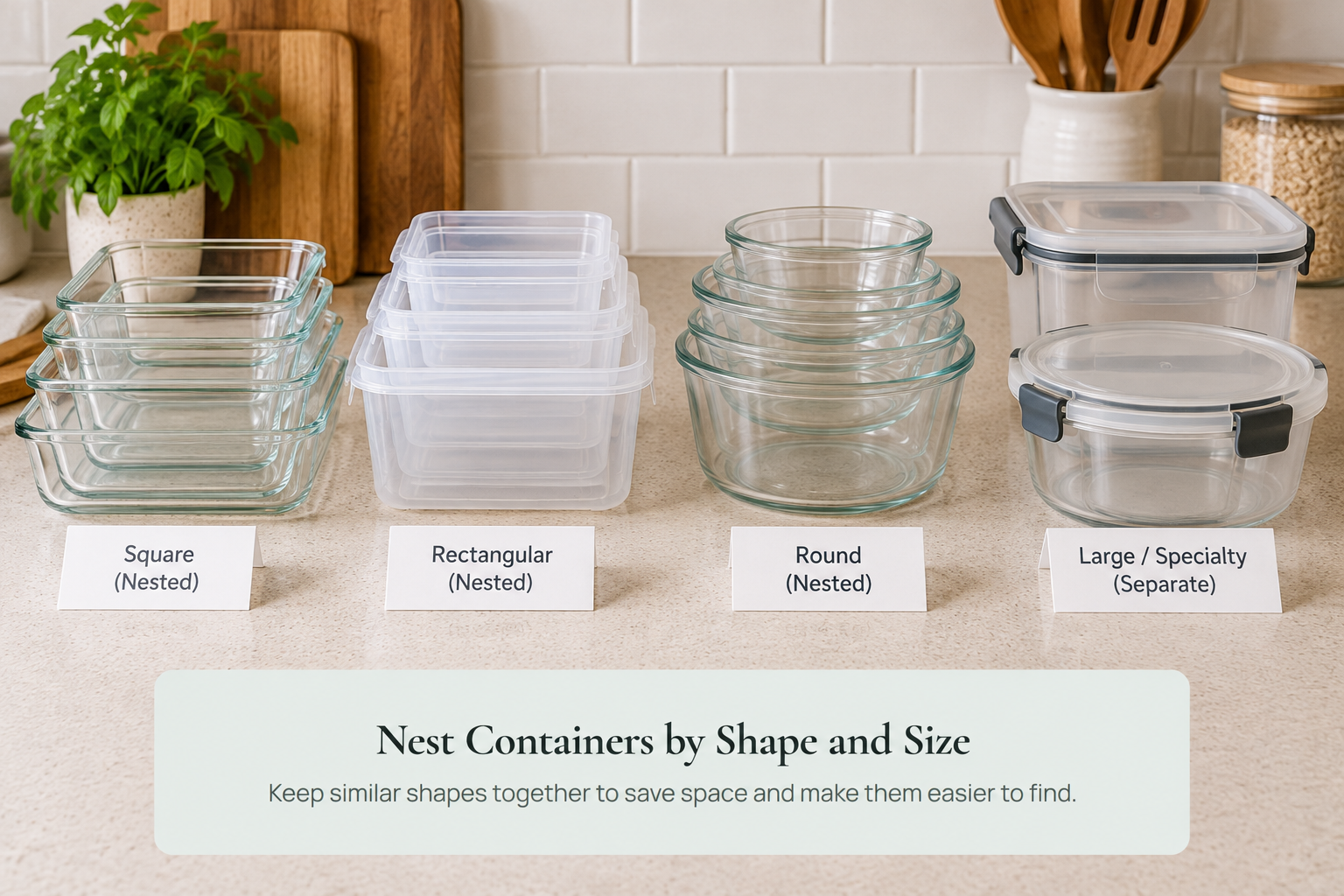
Avoid forcing unrelated shapes into the same stack simply because they technically fit. A stack that saves a little space but becomes difficult to separate can increase storage friction.
Large or specialty containers may deserve their own area rather than being forced into a nesting system that does not work well for them.
Choose a Lid Storage Method That Fits Your Kitchen
Lids create a different storage problem from container bodies. They are flat, easy to scatter, and difficult to identify when stacked in a deep pile.
There is no single storage method that works for every collection. Choose the arrangement that makes matching and retrieval easiest in your available space.
Store Lids With Their Containers
Keeping lids with their containers can work well when the collection is small, the shapes are uniform, and the resulting stacks remain easy to handle.
This method can make matching simple, but it may use more vertical space than nesting the container bodies separately.
Store Lids Separately
Separate lid storage can work better when the container bodies nest efficiently and the collection contains many different sizes or shapes.
The important part is visibility. You should be able to identify the lid you need without digging through a flat pile.
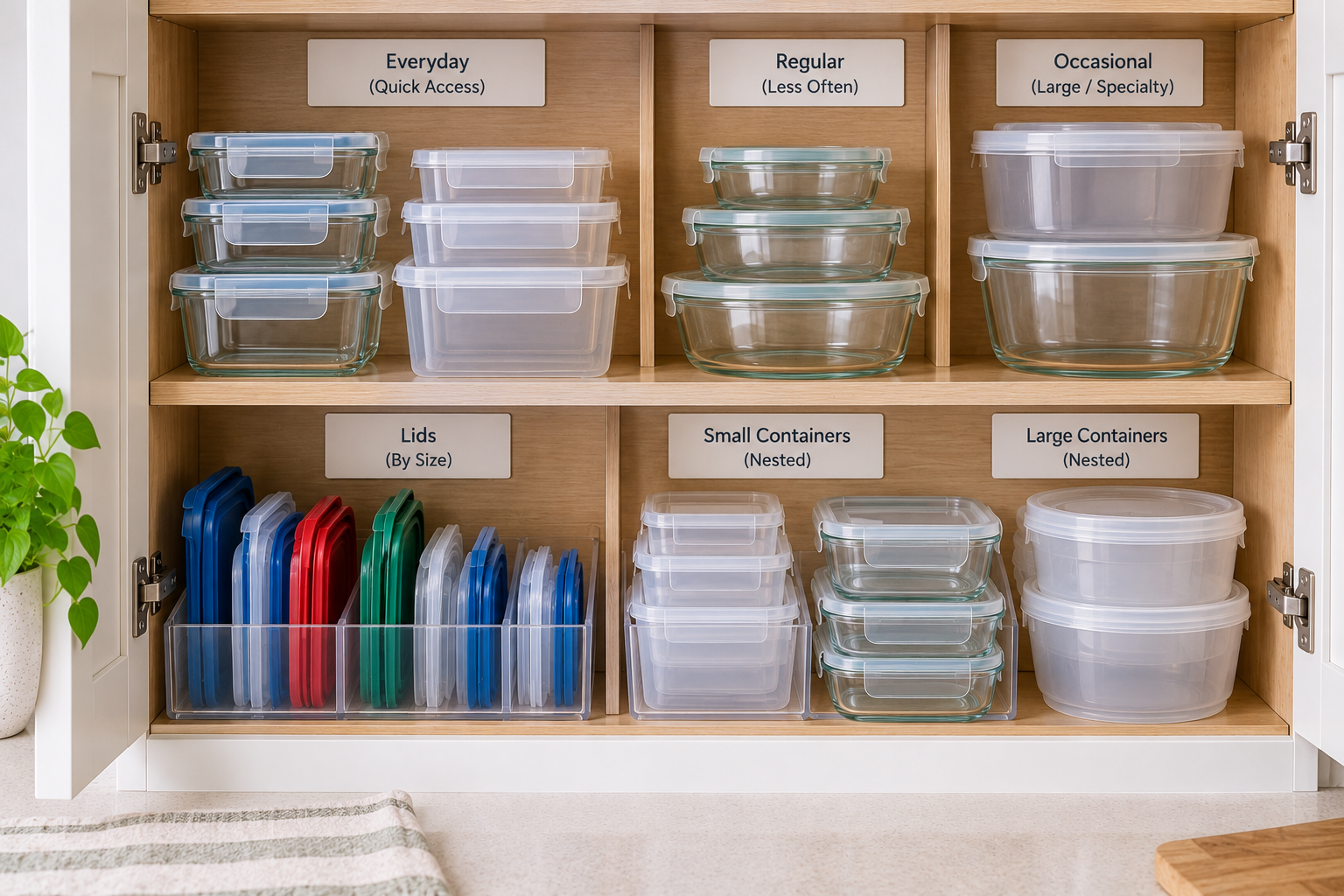
Store Lids Upright
Upright storage can make individual lids easier to see and remove. Dividers can help keep different sizes or shapes from sliding into one another.
Use a Drawer for Lids
A drawer can be useful when looking down at the collection gives you better visibility than reaching into a deep cabinet. Before using one, make sure the drawer has enough height for the lids and any divider system you choose.
If you are deciding between organizing kitchen cabinets and using a drawer, let the actual retrieval path guide the decision.
Do not ask, “Which lid-storage method looks best?” Ask, “Which method lets me identify and retrieve the lid I need without disturbing the rest?”
Create Everyday and Occasional Zones
Not every container needs the same level of access.
Give your most frequently used containers the easiest location. Less frequently used pieces can move to less convenient areas.
Everyday
Keep lunch containers, leftover containers, and your most commonly used sizes within easy reach.
Regular
Store containers you use often but do not need every day in the next level of access.
Occasional
Give oversized, specialty, or rarely used containers less valuable storage space.
This prevents an oversized container that is used once in a while from taking the easiest spot while your everyday containers become difficult to reach.
The same principle applies if you are organizing a small kitchen more broadly: prime storage should support the things you reach for most often.
If your containers compete with cookware, utensils, or other cabinet contents, see how to organize pots and pans in a small kitchen and how to organize kitchen utensils in a small kitchen so each category has a defined storage job.
Choose Between a Cabinet, Drawer, Bin, or Divider
Once the collection is understood, you can decide whether an organizer is actually necessary.
A cabinet may work well when there is enough vertical space. A drawer may provide better visibility from above. A narrow bin can contain a specific category, while a divider can prevent lids from sliding into a mixed pile.
The organizer should solve a demonstrated problem. It should not become another object that the cabinet has to accommodate.
If the problem is poor visibility, improve visibility. If the problem is loose lids, create boundaries. If the problem is too many containers, reducing the collection may solve more than another storage accessory.
This is also why organizing kitchen drawers should begin with the items being stored rather than with the drawer organizer itself.
MEASURE → IDENTIFY → COMPARE → CHOOSE
- Measure the actual usable space.
- Identify whether the problem is visibility, loose lids, access, or capacity.
- Compare the organizer’s dimensions and storage method with the problem.
- Choose it only if it makes retrieval or return easier.
What If You Have Almost No Cabinet Space?
When storage space is extremely limited, the first step is not to squeeze every possible container into the cabinet.
Reduce the collection first. Then use the available space more deliberately.
- Keep the most frequently used containers in the easiest location.
- Nest compatible shapes to reduce the footprint of the container bodies.
- Give lids a defined area so they do not spread across the cabinet.
- Move oversized or occasional pieces away from prime storage.
- Use vertical space where the cabinet dimensions allow it.
- Set a practical capacity limit for the collection.
A capacity limit is especially useful in a small kitchen. Once the designated storage area is full, adding more containers should trigger a review of what is already there rather than automatically expanding the storage system.
Test the Retrieval and Return Path
Your containers are not fully organized just because the cabinet looks good.
Test the system using the way you actually use it.
- Find: Can you identify the container you need quickly?
- Match: Can you identify its lid without searching through the entire collection?
- Retrieve: Can you remove the container without moving several others first?
- Return: Can you put the container and lid back without rebuilding the storage area?
- Reset: Would another person understand where the pieces belong?
Ask: “Can I return this container and lid to their home in one simple sequence without moving something else first?”
If the answer is no, change the arrangement. A system that requires constant unpacking is likely to become disorganized again, even if it looked perfect on the day you created it.
Common Food Storage Container Organization Mistakes
The same principle used for organizing spices in a small kitchen applies here: give each collection a defined home instead of letting unrelated items compete for the same storage space. A kitchen junk drawer has a similar problem when its storage job is not clearly defined.
Organizing Before Matching
If you put containers into stacks before finding their lids, you may create a neat-looking collection that is still difficult to use.
Buying Organizers Before Measuring
An organizer that is too wide, too deep, or too tall can reduce usable storage instead of improving it.
Keeping Every Orphan Lid
A drawer full of unmatched lids consumes valuable space while making the useful lids harder to find.
Creating One Large Lid Pile
Flat stacks can hide the lid you need. If lids are stored separately, give them boundaries and enough visibility to make individual retrieval easy.
Mixing Every Shape Together
Different shapes often require different nesting and storage arrangements. Keeping compatible groups together can make the collection easier to understand.
Filling Every Available Space
A completely full cabinet can be harder to use than one with some breathing room. Leave enough space for normal retrieval and return.
Giving Occasional Containers Prime Space
Large specialty pieces do not need to occupy the easiest storage location if you rarely use them.
Creating a System Only One Person Understands
If the rest of the household cannot tell where containers and lids belong, the system is more likely to break down.
How to Keep Food Storage Containers Organized
The easiest system to maintain is one that is simple to reset.
After containers are washed and ready to store, return compatible bodies to their shape groups and return lids to their assigned area. Keep everyday pieces accessible and avoid allowing new orphan containers or lids to accumulate.
You do not need an arbitrary schedule for reorganizing the cabinet. Instead, watch for the signs that the system is failing.
- You are regularly searching for lids.
- Containers are no longer staying in their groups.
- You have to move several pieces to reach one.
- The cabinet is difficult to close or retrieve from.
- New containers no longer have an obvious home.
When those signs appear, repeat the audit rather than simply rearranging the same collection.
When lids become hard to find, containers stop staying in their groups, or the cabinet becomes difficult to retrieve from, repeat the audit and restore the collection to its capacity.
Key Takeaways
- Match containers and lids before designing storage.
- Measure usable space rather than relying on outside dimensions.
- Nest compatible shapes without creating difficult stacks.
- Give everyday containers the easiest access.
- Give lids a defined, visible home.
- Choose organizers only when they solve a demonstrated problem.
- Test both retrieval and return before considering the system finished.
Frequently Asked Questions
Should food storage containers be stored with their lids on?
It depends on the size of your collection and the storage space available. Keeping lids with containers can make matching simple, while separate lid storage can save space when container bodies nest efficiently. Choose the method that makes retrieval and return easiest in your kitchen.
How should food storage lids be stored in a small kitchen?
Store lids in a defined area where you can see and retrieve them without digging through a pile. Upright storage or a divided drawer can work well when the dimensions of your storage area allow it.
Is it better to store food containers in a drawer or cabinet?
Neither is automatically better. Compare the usable dimensions and retrieval path of the two spaces. A drawer may provide better visibility, while a cabinet may offer more vertical capacity.
How do you organize food containers when you have too many?
Start by removing everything, matching containers with their lids, and separating complete sets from damaged, duplicate, rarely used, or unmatched pieces. Then establish a realistic capacity for the storage area and keep frequently used pieces easiest to reach.
What should you do with containers that have no lids?
Decide whether the container still has a useful purpose. If it does, give it an appropriate home outside the main matched container system. If it no longer serves a useful purpose, removing it can free valuable storage space.
How do you stop food storage containers from getting messy again?
Make the return path simple. Containers should have defined groups, lids should have a defined area, and the collection should stay within the capacity of its storage space. If the system repeatedly becomes difficult to use, reassess the collection rather than simply rearranging it.
Organizing food storage containers in a small kitchen is less about finding the perfect organizer and more about making the collection easier to use.
Start with an audit. Match containers and lids. Measure the real storage space. Nest compatible containers. Zone the collection by frequency and access. Then test the retrieval and return path.
Finally, reset the system whenever it starts becoming difficult to use.
The goal is simple: find the container, find its lid, use it, and put both away without rebuilding the cabinet.