Best Pantry Storage Containers: How to Choose the Right Ones
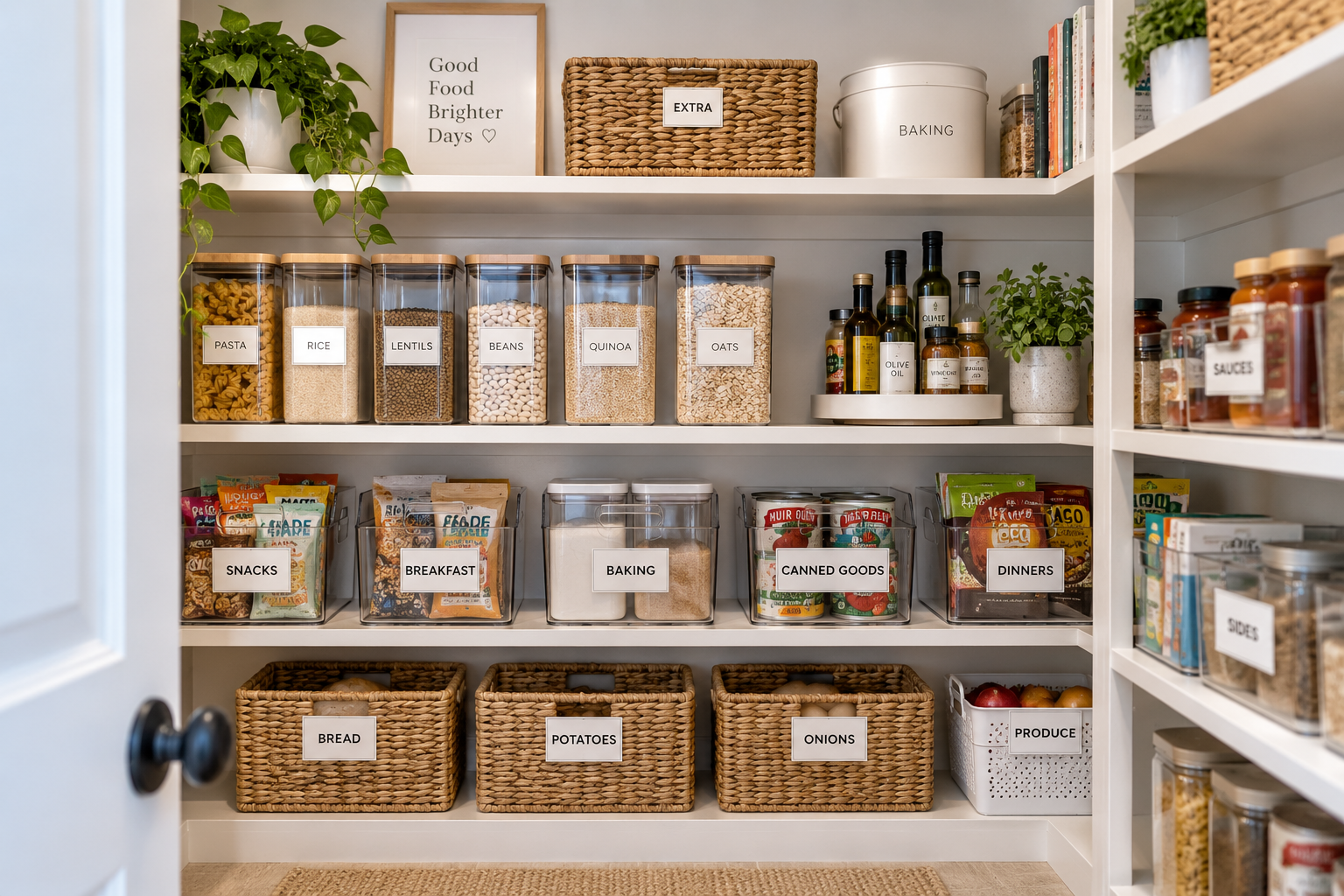
The best pantry storage container isn’t necessarily the biggest set, the most expensive brand, or the prettiest option. It should fit your shelves, suit what you actually store, and make everyday pantry use easier.
Before buying anything, use this simple test:
This helps you buy containers because they solve a problem—not because a matching set looks good in a photo.
What Makes a Good Pantry Storage Container?
A good pantry container should do more than hold food.
It should make the food easier to see, access, store, and maintain.
- Fits your space: The container should work with your shelf height, depth, and width.
- Matches the food: Pasta, flour, cereal, rice, and snacks don’t necessarily need the same shape or capacity.
- Uses space well: A container that is too tall, wide, or awkward can reduce usable pantry capacity.
- Makes contents easy to identify: Clear sides can make it easier to see what you have and what is running low.
- Is easy to maintain: If the lid is frustrating to remove, the container is difficult to wash, or refilling is annoying, the system may not last.
The goal isn’t to put everything into containers.
The goal is to make your pantry easier to use.
Measure Your Pantry Before Buying Containers
This is the step people often skip.
A container can be excellent on its own and still be completely wrong for your pantry.
Measure the usable space, not simply the advertised shelf dimensions.
- Shelf height: Will the lid clear the shelf above it?
- Shelf depth: Can you reach the container without moving everything in front?
- Available width: How many containers can realistically fit side by side?
- Front clearance: Can you pull the container out comfortably?
- Container height when full: A container that barely fits empty may become awkward to handle when full.
If you are reorganizing the entire pantry, start with our Pantry Organization Ideas guide first. If space is especially tight, our small pantry organization guide can help you plan around limited shelf capacity.
Usable capacity beats maximum capacity.
A shelf packed with oversized containers isn’t necessarily more organized. It may simply be harder to use.
The 5-Step Pantry Container Test
Before adding a container to your cart, run it through five questions.
MEASURE
Will it actually fit where I want it? Measure first rather than buying a set and hoping the dimensions work later.
MATCH
Does this container make sense for what I’m storing? The food should influence the container—not the other way around.
STORE
Does it use the shelf efficiently? Consider capacity, shape, stackability, clearance, and loaded weight.
SEE
Can I quickly tell what’s inside? Visibility can make it easier to identify contents and notice when something is running low.
MAINTAIN
Will I actually keep using it? Think about cleaning, refilling, opening, and everyday convenience.
Best Pantry Storage Containers
There isn’t one container that’s best for every pantry. The strongest options serve different needs.
As an Amazon Associate I earn from qualifying purchases. Some links below are paid links, which means we may earn a commission if you make a qualifying purchase at no extra cost to you.
Which Container Fits You?
| If you want… | Start with… |
|---|---|
| A coordinated modular pantry | OXO Good Grips POP |
| Larger staple storage | Rubbermaid Brilliance Pantry |
| A lower-cost starter system | Vtopmart |
| Baking-focused storage | Progressive ProKeeper+ |
| Glass storage | Glass pantry containers |
OXO Good Grips POP
Best for: A modular everyday pantry system
Why we chose it: A broad range of sizes and shapes makes it easier to build a coordinated system around different pantry foods.
Tradeoff: Premium pricing can make a complete pantry conversion expensive, and buying every size may leave you with containers you don’t need.
Good fit if: You want a cohesive system and use pantry containers frequently.
Check OXO POP on Amazon (paid link)
Rubbermaid Brilliance Pantry
Best for: Larger pantry staples
Why we chose it: The range includes multiple capacities, including larger formats that can work well for staples purchased in greater quantities.
Tradeoff: Larger containers require more shelf clearance and can become heavy when full.
Good fit if: You want a modular system with larger capacity options for everyday pantry staples.
Check Rubbermaid Brilliance Pantry on Amazon (paid link)
Vtopmart
Best for: A budget starter system
Why we chose it: Multi-piece sets provide several container sizes for readers who want to organize multiple pantry staples at once.
Tradeoff: A larger number of pieces isn’t automatically useful. Some sizes may not match your pantry.
Good fit if: You want a starter system while keeping the initial cost lower.
Check Vtopmart Storage Containers on Amazon (paid link)
Progressive ProKeeper+
Best for: Frequent bakers
Why we chose it: The system includes ingredient-specific containers and accessories designed around common baking staples.
Tradeoff: Specialized baking containers may not be worth the space if you rarely bake.
Good fit if: Baking is a regular part of your kitchen routine.
Check Progressive ProKeeper+ on Amazon (paid link)
Glass Pantry Containers
Best for: Readers who specifically prefer glass
Why we chose it: Glass can work well when visibility, durability, and material preference are priorities.
Tradeoff: Glass is heavier and can break, making it less convenient for some high or frequently accessed shelves.
Good fit if: You prefer glass and can store it where the extra weight isn’t a problem.
Pantry Containers by Food Type
| Food | What to prioritize |
|---|---|
| Flour | Larger capacity, easy scooping, secure seal |
| Sugar | Capacity, wide access, easy scooping |
| Pasta | Tall shape, visibility, easy access |
| Rice | Capacity, secure seal, manageable weight |
| Cereal | Larger capacity, wide opening, easy pouring |
| Snacks | Visibility, easy access, appropriate capacity |
| Baking ingredients | Ingredient-specific sizes and useful accessories |
| Small dry goods | Smaller modular containers that don’t waste shelf space |
The important point is that you don’t need the same container for every food.
A pantry often works better when container shapes are chosen intentionally. For canned foods, a dedicated organizer can make more sense than transferring cans into containers; see our guide to best can organizers for pantry storage.
Plastic vs. Glass Pantry Containers
The right material depends on how you use your pantry.
Plastic makes sense when:
- containers need to be lightweight
- shelves are high
- you move containers frequently
- you want a modular matching system
- everyday convenience matters
Glass makes sense when:
- you specifically prefer glass
- container weight isn’t a concern
- the storage location is appropriate
- you want glass for particular frequently used foods
There is no universal winner.
For a busy family pantry, ease of use usually matters more than material prestige.
What Size Pantry Containers Do You Need?
This is where buying a large set can go wrong.
Container capacity should be based on what you buy and how quickly you use it, not simply on the number printed on the package.
Different foods have different storage needs. A container that works well for cereal may be unnecessary for a small quantity of baking ingredients, while a frequently purchased staple may justify a larger capacity.
Ask three questions before choosing a size.
- How much of this food do I normally have at one time?
- How much shelf space can I give it?
- Can I comfortably use the container when it is full?
A huge container may technically hold more, but if it’s too heavy to move or leaves unusable space around it, you’ve gained capacity while losing convenience.
Choose containers around your normal inventory, not your maximum possible inventory.
If you are looking for open storage rather than sealed containers, compare your options with our guide to best pantry storage bins.
Should You Decant Everything?
No.
Decanting is useful when it solves a real problem.
- frequently used dry staples
- foods that come in awkward bags
- ingredients you want to see at a glance
- foods where a better opening makes scooping easier
- items where secure storage is useful
But some foods are perfectly fine in their original packaging.
You don’t need to transfer something simply because a pantry photo on Pinterest shows it inside a matching container.
For items that are difficult to reach because they sit deep on a shelf, a rotating organizer may solve the access problem better than another storage container. See our guide to best lazy Susan pantry organizers.
Ask: What problem will this container solve?
If the answer is “none,” skip it.
When Pantry Containers Make Organization Worse
More containers don’t automatically mean more organization.
They can actually make a pantry harder to use when:
You buy before measuring
The containers don’t fit properly, so you end up rearranging the entire shelf around them.
You buy too many sizes
Instead of creating a simple system, you create a collection of containers that all behave differently.
The containers are too large
You lose usable shelf capacity around them.
Heavy containers go on high shelves
A full container can be much harder to lift than an empty one. Think about the loaded weight.
Refilling becomes a chore
If transferring food is annoying, you’ll eventually stop doing it.
Appearance becomes more important than access
A perfectly matching pantry isn’t useful if everyday food is difficult to reach.
“Does this pantry look organized?”
The better question is:
“Can I use this pantry without fighting it?”
How Many Pantry Containers Do You Actually Need?
Start smaller than you think.
Buy for your current pantry inventory—not your imaginary perfect pantry.
Instead of buying a 30-piece set immediately, choose one shelf and test the system first.
Pick the shelf containing several dry foods you use regularly.
- Measure the shelf.
- Identify the foods.
- Group similar items.
- Decide which foods genuinely benefit from containers.
- Choose only the sizes you need.
- Use the system for a while.
- Expand only when you discover another genuine problem.
This is the One-Shelf Starting Point.
It gives you a chance to test the system before spending money on containers that may not belong in your pantry.
Pantry Container Mistakes to Avoid
- Buying the set before measuring: A bargain isn’t a bargain if half the containers don’t fit.
- Using one container size for everything: Different foods and shelves create different requirements.
- Choosing maximum capacity over usability: Bigger isn’t automatically better.
- Putting heavy containers high up: Think about the loaded weight, not the empty container.
- Decanting everything: Only transfer foods when the container makes storage or use better.
- Ignoring refilling: A system should be easy to maintain, not just easy to photograph.
- Organizing around containers instead of food: Your pantry should serve your household’s routine.
FAQ
Are pantry storage containers worth it?
They can be, especially for frequently used dry foods where visibility, access, or better storage solves a real problem. You don’t need containers for everything.
Are airtight containers necessary for pantry storage?
Not every food requires an airtight container, but a secure seal can be useful for dry foods where protection from moisture and pests matters.
Is glass or plastic better for pantry storage?
Neither is universally better. Plastic is generally lighter and convenient for everyday pantry use, while glass can appeal to people who prefer the material and don’t mind the extra weight.
What size container should I use for flour and sugar?
Choose based on the quantity you normally store and the available shelf space. The container should hold your typical amount while leaving enough room to scoop or pour comfortably.
Should cereal go in an airtight container?
It can be useful when the container improves freshness, visibility, pouring, or pantry organization. Choose a capacity that fits the amount of cereal you normally keep rather than automatically choosing the largest container.
Do pantry containers keep bugs out?
A properly sealed food container can help reduce access by pantry pests, but no container should be treated as an absolute guarantee against infestation. Good pantry hygiene and appropriate food storage still matter.
Do I need to decant everything?
No. Decant foods when the container makes storage or everyday use meaningfully better. Otherwise, keeping the original packaging may be simpler.
How many pantry containers do I need?
Start with the foods and shelves that cause the most trouble. The One-Shelf Starting Point is usually a better approach than buying a huge set and trying to find uses for every piece.
A Better Pantry Starts With Better Decisions
The best pantry container is not necessarily the one with the most features.
It’s the one that fits your shelf, your food, and your routine.
Before buying, remember: MEASURE → MATCH → STORE → SEE → MAINTAIN
Then buy only the containers that pass the test.
A pantry doesn’t become easier to use because every package has been transferred into a matching container.
It becomes easier when everything has a sensible place, everyday foods are easy to reach, and the system is simple enough to maintain.