
PANTRY ORGANIZATION
Best Pantry Door Organizers: How to Choose the Right One
The best pantry door organizer is not the one with the most shelves. It is the one that fits your door, clears your pantry shelves, holds the right type of items, and makes everyday access easier.
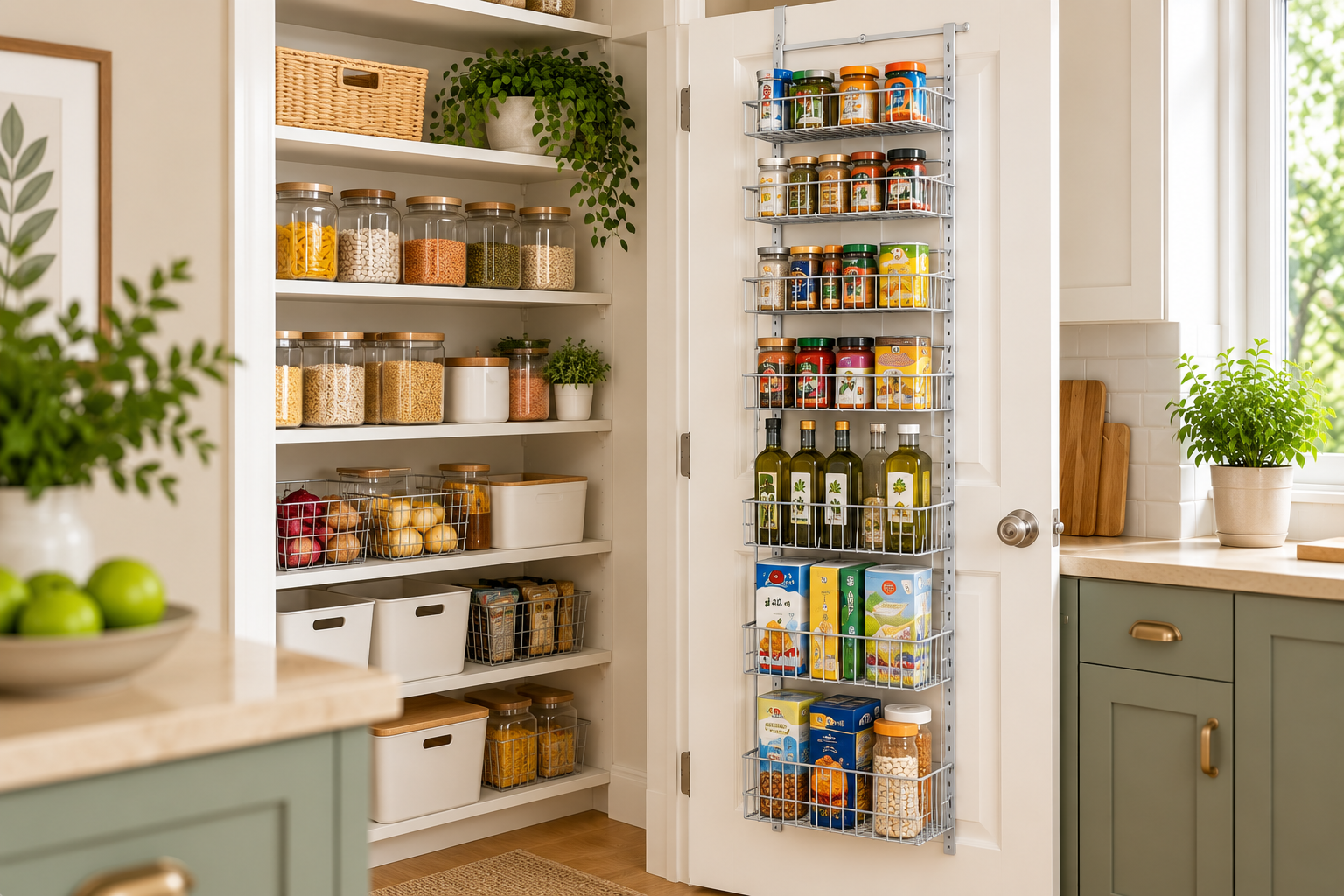
Pantry doors can provide useful storage space, especially when shelf space is limited. But adding an organizer to the door can also create a new problem if it is too deep, too heavy, or positioned too close to the shelves.
That is why the right organizer starts with the door and the pantry around it—not with the number of shelves or baskets.
If you are starting with the pantry as a whole, see our pantry organization ideas for the larger system. This guide focuses specifically on choosing storage for the pantry door.
KEY PRINCIPLE
Measure the space before you buy.
An over-the-door pantry organizer only works when the door can still open and close normally. Measure first, then match the organizer to the available space and the job you want it to do.
Why Pantry Door Organizers Sometimes Do Not Work
Adding storage to a pantry door sounds simple. In practice, the door has to move through the same space it always did.
Problems usually come from four things:
- The organizer is too deep for the available clearance.
- The loaded organizer becomes too heavy for comfortable use.
- Items are difficult to reach once the shelves are loaded.
- The organizer adds storage but makes the pantry harder to use.
A good door organizer should improve access, not simply add more places to put things.
If the door itself is the main storage problem, you may also want to compare these ideas with our pantry door organization ideas.
Measure Before You Buy
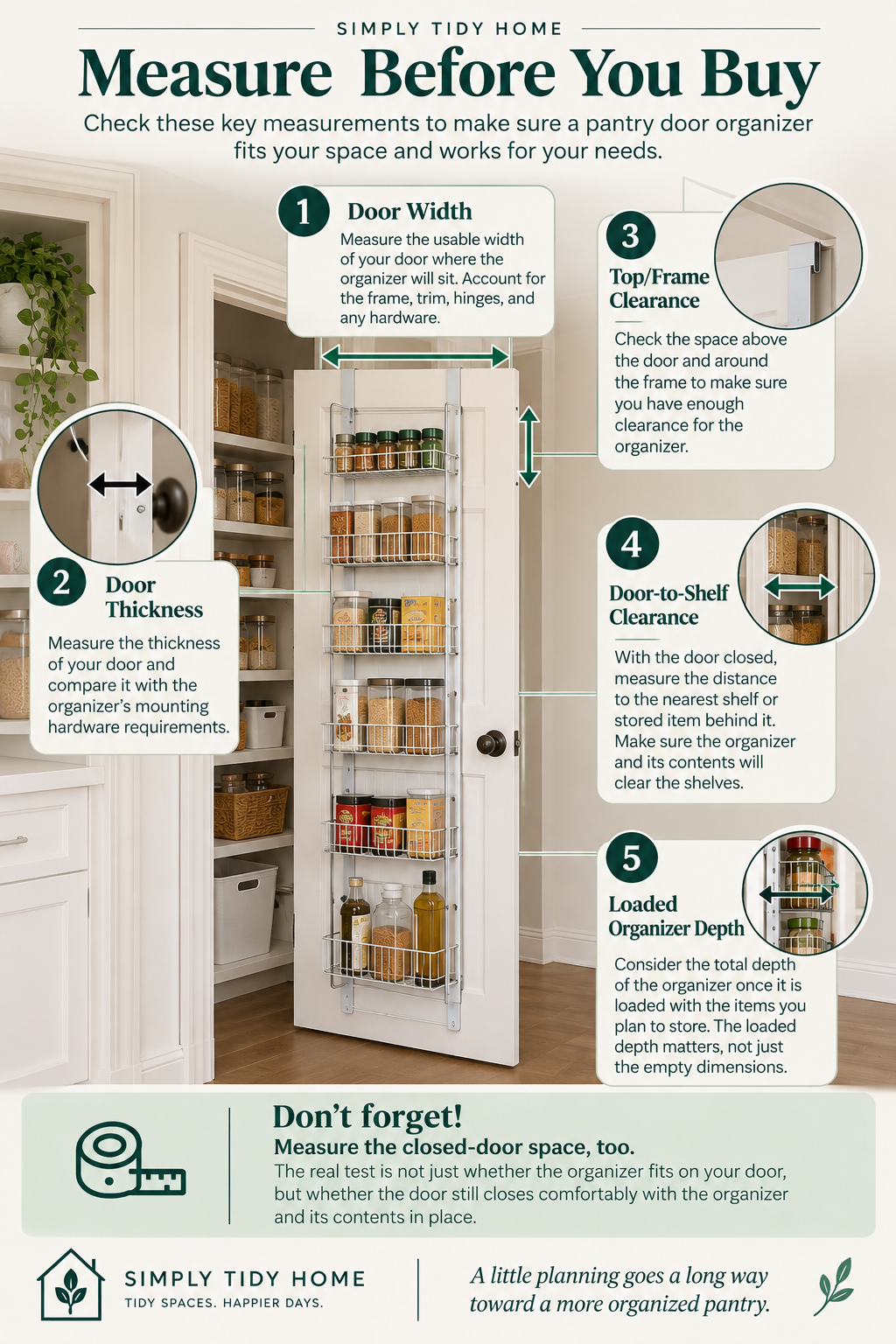
Take these five measurements before choosing a pantry door organizer.
Door width
Measure the usable width where the organizer will sit.
Door height
Check how much vertical space is available and where the organizer can safely start and finish.
Door thickness
Check the thickness of the door against the organizer’s mounting requirements.
Door-to-shelf clearance
Measure from the inside of the closed door to the nearest pantry shelf or stored item.
Loaded depth
Think beyond the empty organizer. Items placed inside it add depth and can change how the door swings.
If your pantry is especially small, it is worth solving the space constraints before adding another storage system. Our guide to how to organize a small pantry covers that process in more detail.
The Pantry Door Clearance Check
This is the most important check before buying an over-the-door pantry organizer.
- Close the pantry door.
- Identify the nearest shelf or item behind the door.
- Measure the available space between the door and that obstruction.
- Compare that space with the organizer’s depth.
- Consider how far the loaded baskets or shelves will extend.
- Make sure the door can still open and close normally.
The key question
Do not ask only, “Will this organizer fit on my door?” Ask, “Will the loaded organizer fit between my door and the pantry shelves?”
A Simple Decision Framework
Use this six-step system to choose a pantry door organizer:
MEASURE
Know the door and clearance before shopping.
MATCH
Choose an organizer that fits the physical space.
LOAD
Match the organizer to the weight and size of your items.
PLACE
Keep frequently used items where they are easy to reach.
TEST
Check clearance, load, reach, and swing.
MAINTAIN
Keep door storage limited to useful categories.
Types of Pantry Door Organizers
Multi-Tier Rigid Rack
These organizers use several shelves or baskets. They work well when you want dedicated storage for multiple pantry categories and have enough door-to-shelf clearance.
Their main advantage is capacity. Their main risk is depth and weight.
Slim Pantry Door Rack
Slim racks make more sense when clearance is limited. They give up some capacity in exchange for a narrower profile.
This can be the better choice when a deeper organizer would interfere with the shelves behind the door.
Fabric or Pocket Organizer
Fabric pocket systems can work for lightweight, small items. They are useful when the storage job does not require rigid baskets or heavy pantry goods.
Small Dedicated Organizer
Sometimes the best answer is not a full-height rack. A smaller organizer can be enough when you only need one specific category within easy reach.
Best Pantry Door Organizers for Different Needs
Once you know your clearance, door dimensions, and storage needs, you can narrow the choices quickly. The three options below represent different fits rather than a single universal winner.
Affiliate disclosure
As an Amazon Associate I earn from qualifying purchases. Some links below are paid links, which means Simply Tidy Home may earn a commission if you purchase through them, at no additional cost to you.
Quick Comparison
| Organizer | Dimensions | Best for |
|---|---|---|
| DELAMU 6-Tier | 5″D × 12″W × 52.1″H | General pantry storage |
| DELAMU Narrow 8-Tier | 4.65″D × 13″W × 65″H | Narrower clearance |
| Moforoco 9-Tier | 5.2″D × 16.5″W × 74.8″H | Larger pantry categories |
BEST OVERALL
DELAMU 6-Tier Pantry Door Organizer
A strong general-purpose choice when you have enough clearance for a multi-tier door rack and want several pantry categories within easy reach.
Dimensions: 5″D × 12″W × 52.1″H
- 6-tier configuration
- Adjustable metal over-the-door design
- Useful for multiple pantry categories
- Verify your clearance before buying
Check the DELAMU 6-Tier Pantry Door Organizer on Amazon (paid link)
BEST FOR NARROW CLEARANCE
DELAMU Narrow 8-Tier Pantry Door Organizer
Its narrower depth makes this a useful option when you want substantial door storage but need to pay closer attention to the space behind the door.
Dimensions: 4.65″D × 13″W × 65″H
- 8-tier configuration
- Narrow over-the-door design
- Useful for multiple smaller pantry categories
- Verify door thickness and clearance before buying
Check the DELAMU Narrow 8-Tier Pantry Door Organizer on Amazon (paid link)
BEST FOR LARGER CATEGORIES
Moforoco 9-Tier Over-the-Door Pantry Organizer
This is the largest of the three options, making it worth considering when you want more dedicated category space and have enough room around the pantry door.
Dimensions: 5.2″D × 16.5″W × 74.8″H
- 9-tier configuration
- Over-the-door basket-style storage
- Useful for larger category groupings
- Requires careful clearance and load planning
Check the Moforoco 9-Tier Pantry Door Organizer on Amazon (paid link)
Before you buy
Product availability, pricing, dimensions, and options can change. Check the current Amazon listing and confirm the size and fit before purchasing.
If you are still deciding between different types of pantry storage, our guide to the best pantry storage containers explains how to match containers to the space and the items you actually own.
For pantry bins rather than door racks, see our guide to the best pantry storage bins.
How to Match the Organizer to Your Pantry
| Your situation | Better direction | Why |
|---|---|---|
| You have enough clearance and want general storage. | Multi-tier rack | Provides several accessible categories in one place. |
| Your shelves sit close behind the door. | Slim rack | Reduces the chance of interference when the door closes. |
| You need storage for several small categories. | Multiple smaller baskets or tiers | Keeps categories separated and easier to find. |
| You only need storage for lightweight items. | Small or pocket organizer | Avoids adding unnecessary storage capacity or weight. |
| You have very limited clearance. | Measure again before buying | The pantry door may not be a suitable storage location. |
How to Load a Pantry Door Organizer
Once the organizer fits, loading it correctly matters just as much.
Keep frequently used items easy to reach
The door is a good location for items you reach for often. Put everyday items where you can grab them without moving other containers.
Group items by category
Give each basket or shelf a clear job. One area might hold sauces while another holds snacks or baking supplies.
Keep heavy items under control
Do not turn every available basket into a maximum-capacity shelf. Weight affects how the door feels and how the organizer performs.
Leave enough room to see what you own
A packed door organizer can become another clutter zone. Leave enough visibility that you can recognize categories without digging.
If cans are one of the categories creating access problems, a dedicated can organizer may be a better solution than using the pantry door.
The Four Tests
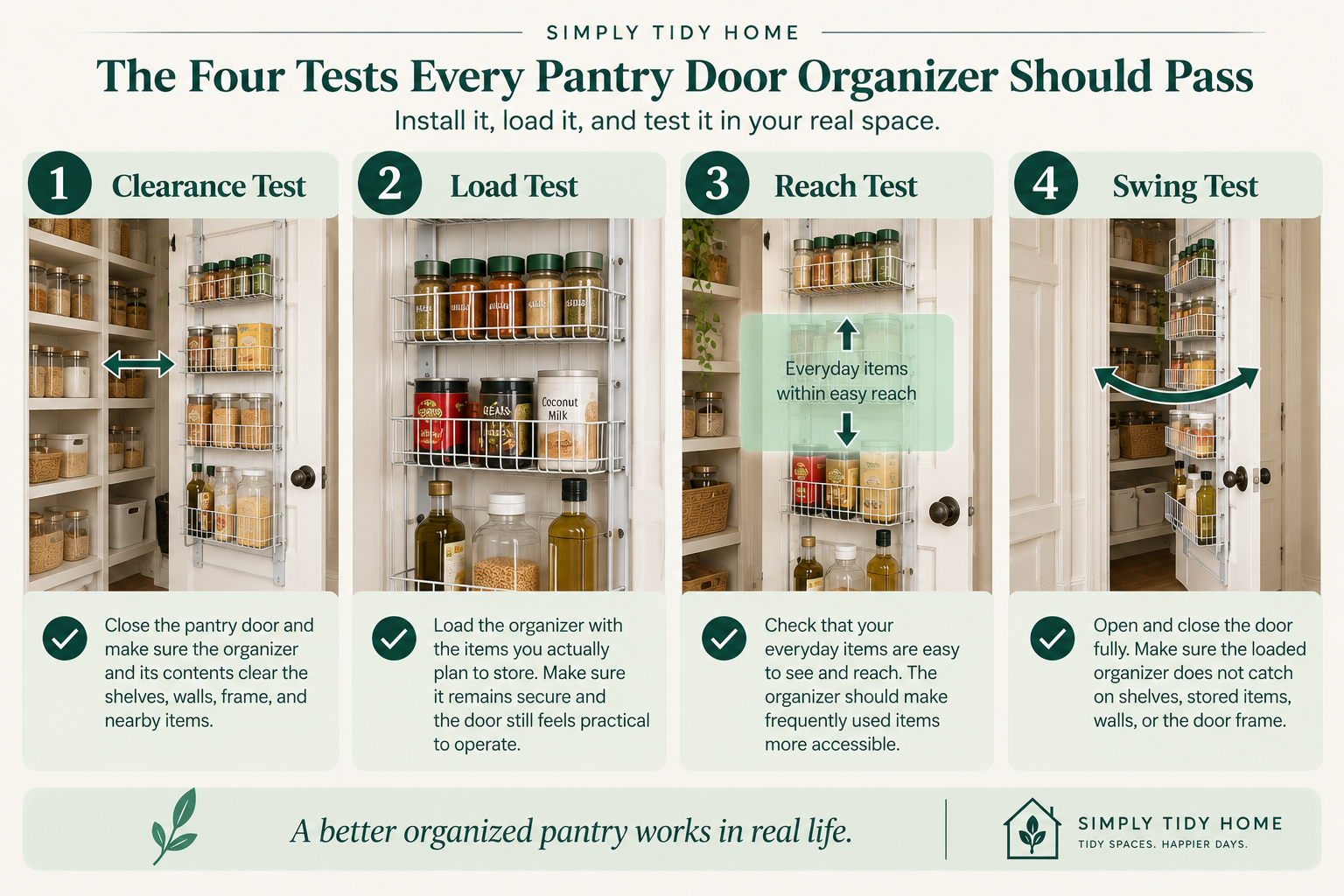
1. Clearance Test
Close the pantry door. Make sure the loaded organizer does not collide with shelves, stored food, or other pantry hardware.
2. Door-Load Test
Think about the total weight of the items you intend to store. A useful organizer should not become an unnecessarily heavy burden on the door.
3. Reach Test
Open the door and check whether the items are genuinely easier to reach. If you have to stretch, move several things, or remove a basket every time, the layout needs work.
4. Swing Test
Open and close the door through its normal movement. Make sure the organizer remains clear of the pantry shelves and does not interfere with the door frame or surrounding space.
A door organizer has to work in motion.
The empty organizer may fit perfectly. The real test is whether the pantry still works once the organizer is loaded.
When a Pantry Door Organizer Is Not the Best Solution
Sometimes the best organization decision is not to use the door.
Skip or reconsider an over-the-door organizer when:
- The door-to-shelf clearance is too tight.
- The door is already difficult to open or feels overloaded.
- The items you want to store are too heavy for the setup.
- The organizer would block access to the shelves behind it.
- You have very little usable door space.
In these situations, improving the shelves themselves may create a better pantry system.
Reset and Maintain the Door Storage
Door storage works best when it stays limited to useful categories.
- Remove items that no longer belong there.
- Return each category to its assigned basket or shelf.
- Move rarely used items away from the easiest-to-reach positions.
- Check that the door still closes normally.
- Recheck the arrangement after a grocery haul.
The goal is not to fill every shelf. The goal is to make the pantry easier to use every day.
Key Takeaways
- Measure the door and the space behind it before buying an organizer.
- The most important measurement is often the clearance between the closed door and the nearest shelf or item.
- Choose the organizer based on the storage problem, not the number of tiers alone.
- Keep heavy items under control and frequently used items easy to reach.
- Always check the loaded organizer, not just the empty one.
- If the door becomes harder to use, the organizer is solving the wrong problem.
Frequently Asked Questions
How do I know if a pantry door organizer will fit?
Measure the usable door width and height, door thickness, organizer depth, and the clearance between the closed door and the nearest pantry shelf or stored item. Then consider how much depth the organizer will have once loaded.
How deep should a pantry door organizer be?
There is no single depth that works for every pantry. The organizer needs to fit within the available door-to-shelf clearance while still allowing the door to close normally after it is loaded.
Are deeper pantry door organizers always better?
No. More depth can provide more storage, but it can also reduce clearance, make the door heavier, and interfere with shelves behind the door.
What should I store in a pantry door organizer?
Use the door for categories that benefit from easy access and fit comfortably within the organizer. Lightweight or frequently used pantry items are often easier to manage than very heavy items.
What if my pantry door does not have enough clearance?
Do not force an organizer into the space. Consider a slimmer option or use the pantry shelves themselves for storage improvements instead.
The Bottom Line
The best pantry door organizer is the one that fits your specific pantry rather than the one with the biggest capacity.
Start with the Pantry Door Clearance Check. Measure the door, check the space behind it, decide what you actually need to store, and then choose an organizer that matches those constraints.
If the door still opens normally, the items are easy to reach, the organizer is not unnecessarily heavy, and the shelves behind it remain accessible, you have solved the right problem.
SIMPLY TIDY HOME