
A small closet can become difficult to use long before it is completely full. The problem may be crowded hanging space, poorly used shelves, items that are hard to reach, or too many things competing for the easiest storage areas.
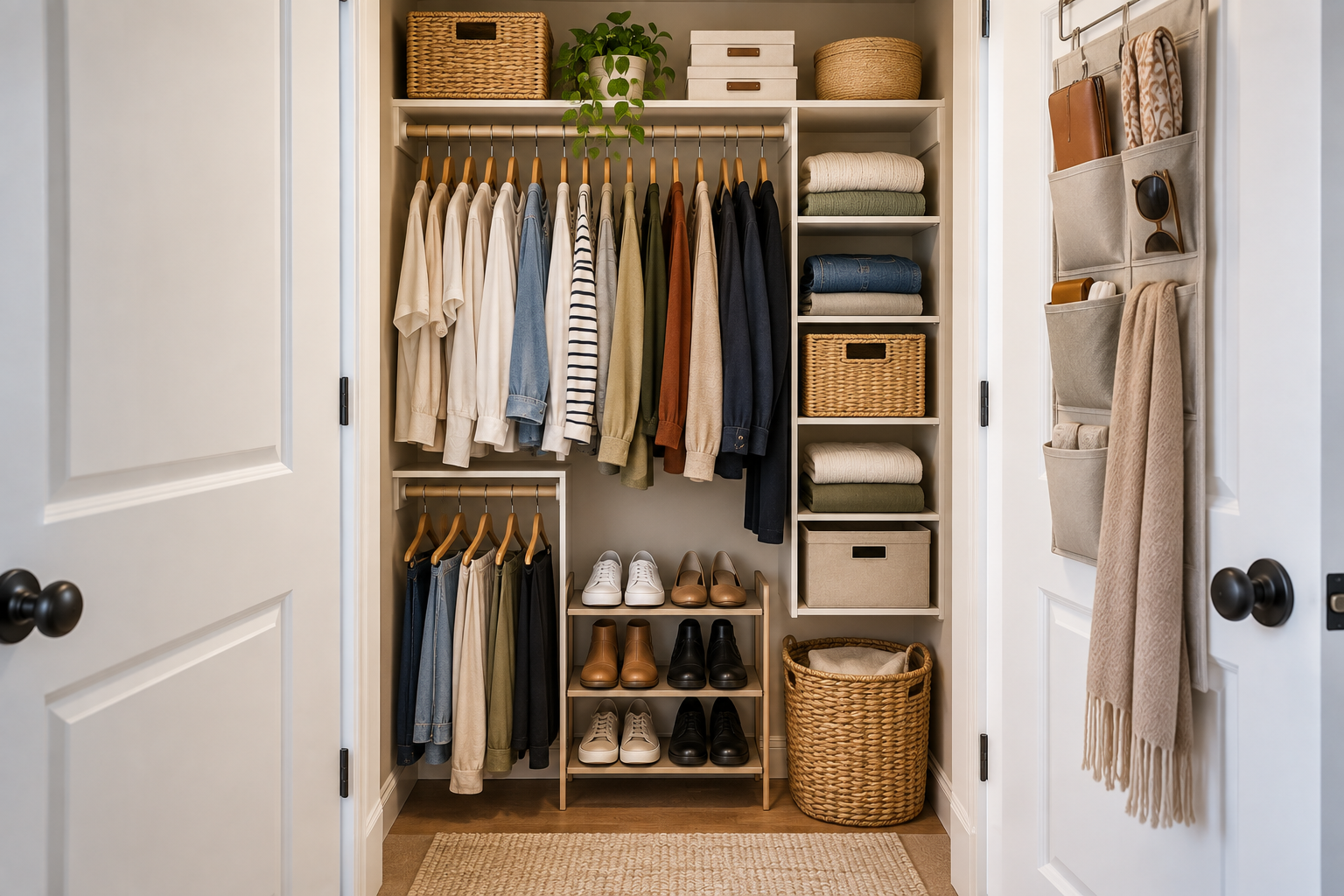
The solution is not always another organizer.
Start by understanding what you have, measuring the space you can actually use, deciding what needs to stay, and then giving each category a practical home.
AUDIT → MEASURE → EDIT → ZONE → MATCH → TEST → RESET
The goal is not a perfect-looking closet. It is a closet where you can find what you need, remove it without disturbing everything else, and put it back just as easily.
If you are working with another tight area of your home, you can also explore our small-space organization guides for more ways to work with limited storage.
1. Audit Your Small Closet Before Changing Anything
Before buying storage products or moving shelves around, look at how your closet works now.
Open the doors and pay attention to the areas that create the most friction.
- What do I use every day?
- What do I use only occasionally?
- What is difficult to reach?
- What keeps falling over?
- What ends up on the floor?
- What gets pushed to the back?
- What do I keep taking out and leaving somewhere else?
- What is stored here even though it belongs somewhere else?
Look for storage friction
At Simply Tidy Home, we think about organization in terms of storage friction.
Storage friction is the effort required to find, remove, use, and return something.
A closet can look tidy and still have high storage friction.
For example, if your everyday shirts are buried behind rarely worn clothing, the problem is not necessarily a lack of storage. The problem is the location.
Likewise, if folded clothing repeatedly falls over when you remove one item, the problem may be the storage arrangement rather than the amount of clothing.
Identify where the closet makes everyday use harder before deciding what needs to change.
2. Measure the Usable Closet Space
Once you understand the problems, measure the space before deciding what should go where.
You do not need a complicated floor plan. You need enough information to understand what the closet can realistically hold.
- Hanging-rod width
- Shelf width
- Shelf depth
- Space between shelves
- Vertical space above the hanging rod
- Floor width and depth
- Door clearance
- Usable wall or door space
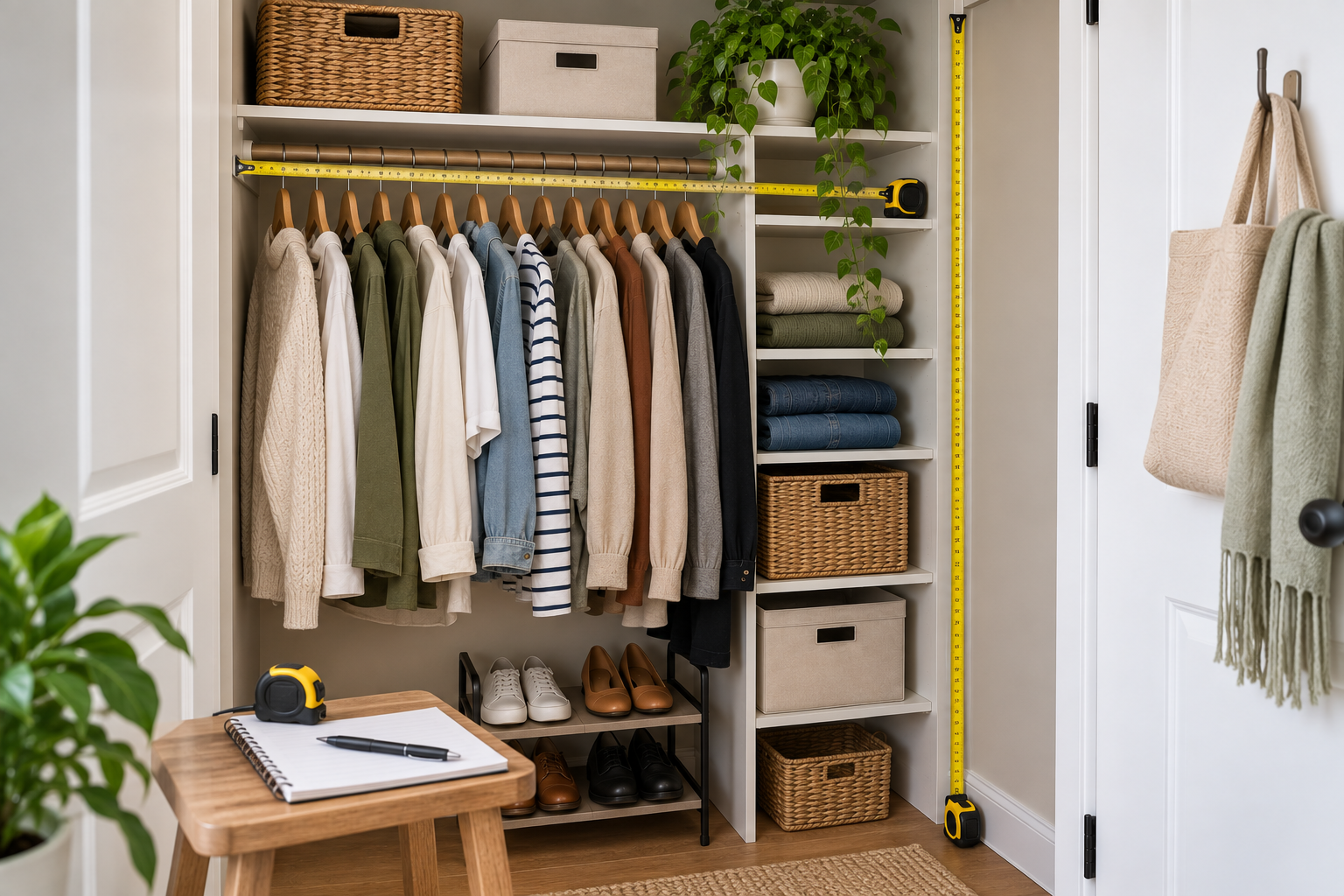
Measure usable space, not just overall space
A closet may look large from the outside but have less usable storage than expected because of shelves, doors, corners, hardware, or limited clearance.
Your measurements also help prevent a common mistake:
Buying an organizer first can leave you with a product that does not fit the space you actually have.
Write your measurements down before shopping for anything.
3. Edit What Actually Needs to Stay in the Closet
Now look at the contents again.
The goal is not to force yourself into owning a certain number of clothes. The goal is to make the available storage match what you actually need to keep there.
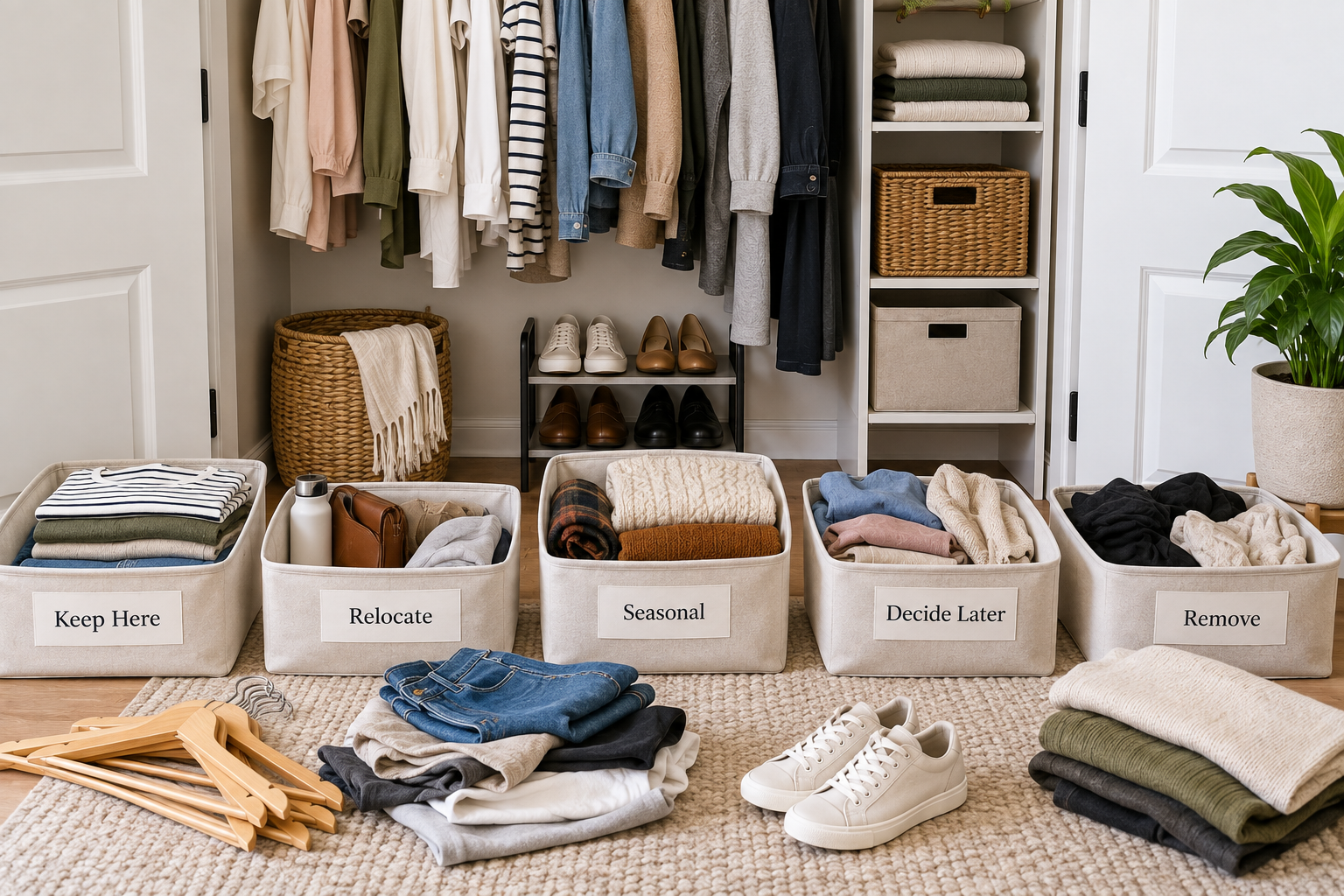
Keep Here
Items that belong in this closet and are used regularly.
Relocate
Items that belong somewhere else in the home.
Seasonal or Occasional
Items you still use but do not need taking up prime-access space.
Decide Later
Items that need a separate decision. Do not let one uncertain item derail the entire organization process.
Remove
Items you no longer need, want, or intend to use.
Once you have made these decisions, the closet has a much clearer job.
It no longer has to store everything simply because everything used to be there.
4. Create Zones Based on Use and Access
Now decide where each category should live.
Instead of putting things wherever there happens to be room, connect each category to:
| Closet zone | Suitable use |
|---|---|
| Easiest-to-reach space | Everyday clothing |
| Middle / eye-level areas | Regular-use items |
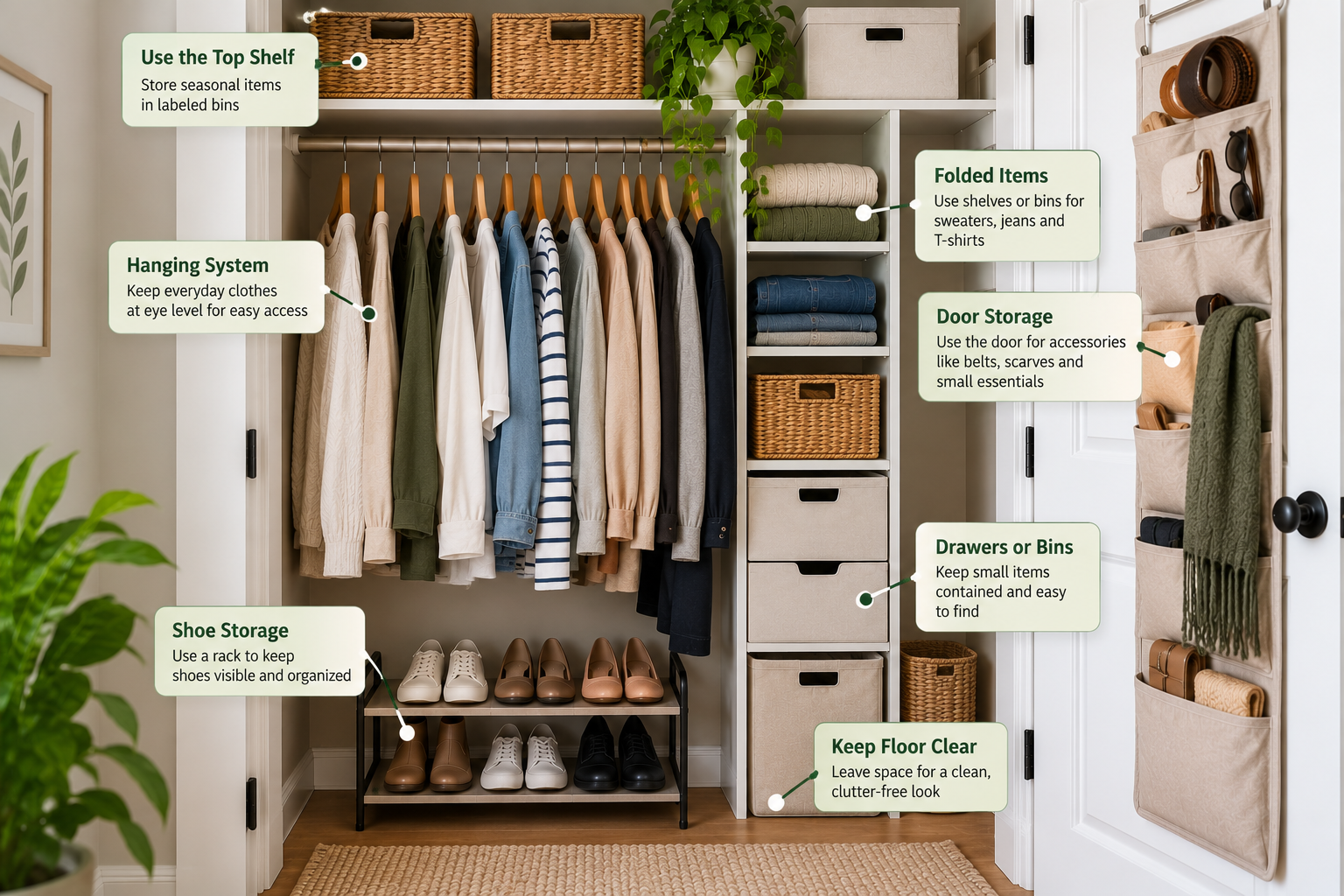
| Higher storage | Seasonal or occasional items |
| Lower areas | Appropriate folded items or shoes |
| Door or wall space | Accessories when the space allows |
| Less accessible areas | Items used infrequently |
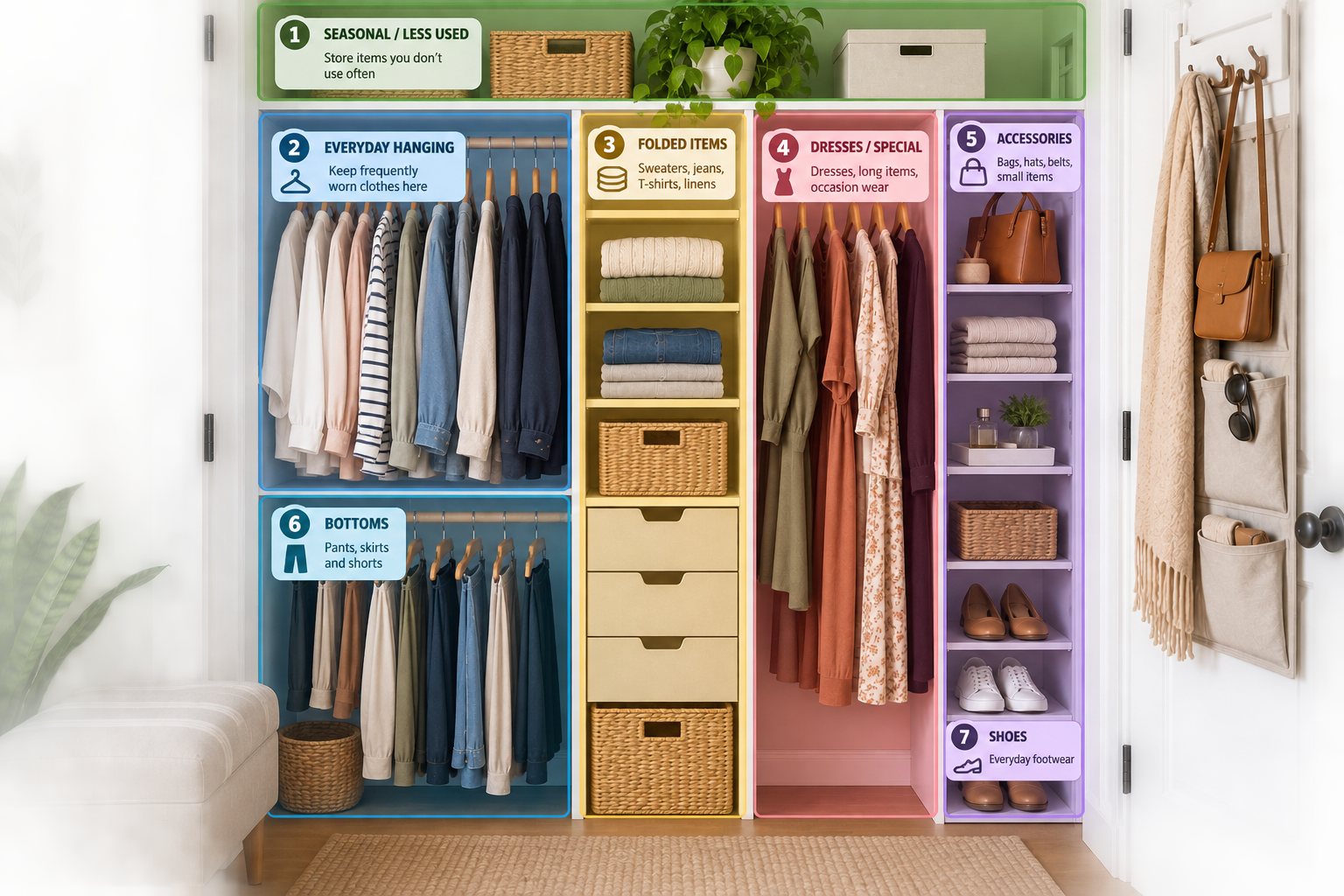
The exact arrangement depends on your closet.
The important principle is:
The easiest space should go to the things you use most. That reduces unnecessary reaching, searching, and moving.
Do not organize only by category
“Shirts together” and “pants together” can be useful. But category alone does not always solve the problem.
A better question is:
How often do I use this, and how difficult should it be to reach?
An item you use every morning should not have the same access priority as something you use twice a year.
5. Use Vertical Space Deliberately
Small closets often have unused vertical space.
Look above:
- Hanging clothing
- Shelves
- Storage boxes
- Existing organizers
But do not assume that every empty area needs to be filled. Unused space is only a problem if it could serve a useful purpose.
When a second hanging level may help
A second hanging level can be useful when:
- The closet has enough vertical height.
- The clothing categories are suitable for shorter hanging space.
- The installation is appropriate for the closet.
- The added level does not make retrieval harder.
For example, shorter garments may allow a second hanging area below the existing rod.
But do not install one simply because you have empty space.
Added storage should make the closet easier to use, not simply make it capable of holding more.
Follow the manufacturer’s installation and load requirements for any hardware you install.
6. Make Shelves Easier to Use
Shelves can create a surprising amount of friction in a small closet.
A tall stack may technically use the shelf efficiently, but if removing one item causes the entire stack to shift, the arrangement is working against you.
Keep similar items together
Group categories that naturally belong together.
Avoid unnecessarily deep stacks
If you regularly need the item at the bottom, the stack is creating retrieval friction.
Use shelf boundaries when needed
Dividers or other storage solutions can help when categories repeatedly collapse into each other.
But do not automatically add containers.
First ask:
If the problem is excessive stacking, changing the arrangement may solve it without buying anything.
7. Give the Closet Floor a Specific Job
The closet floor can quickly become a miscellaneous storage area.
Shoes, bags, laundry, boxes and clothing can all end up competing for the same space.
Instead, decide what the floor is actually for.
For example, it might hold:
- Frequently worn shoes
- A specific category of footwear
- A small amount of appropriate storage
- Another category that works better low to the ground
The exact choice depends on your closet and routine.
The important thing is that the floor should have a defined purpose.
If you cannot explain why something is sitting on the floor, it probably needs a different home.
8. Use Door Space Only When It Actually Works
The back of a closet door can provide useful storage space.
But it is not automatically available storage.
Before using the door, check:
- Can the door still close properly?
- Will stored items interfere with clothing?
- Is there enough clearance?
- Will the added weight or depth create a problem?
- Can you still retrieve the items easily?
If the answer is yes, the door may be useful for smaller categories such as accessories.
If the answer is no, leave it alone.
Unused space is not automatically wasted space. Sometimes keeping an area clear is what allows the rest of the system to function.
9. Match the Storage to the Actual Problem
This is where many closet organization projects go wrong.
A product can fit inside a closet without actually solving the problem.
Instead, start with the constraint.
| If the problem is… | Evaluate first |
|---|---|
| The hanging rod is crowded | Whether everything needs hanging space and how hanging categories are allocated |
| Unused height | Whether the height can support another useful storage level |
| Folded clothing keeps collapsing | Stacking depth, category separation, and retrieval frequency |
| The floor keeps becoming cluttered | Whether the floor has a defined storage purpose |
| Accessories are difficult to find | Whether they need a visible, dedicated zone |
| The door has usable space | Whether door storage works without interfering with clearance or clothing |
| Seasonal clothing takes up prime space | Whether appropriate seasonal items can move to less-accessible storage |
| The closet is crowded because too much is stored there | Editing the contents before adding more storage |
The principle is simple:
10. Apply Our Organizer Decision Rule
Before buying an organizer, ask four questions:
What problem am I trying to solve?
Do not start with the product. Start with the problem.
What space am I trying to improve?
Is the problem on the rod, shelf, floor, door, wall, or another area?
How often will I use the items?
Daily-use storage needs different access from seasonal storage.
Will this make retrieval and return easier?
If the organizer makes the closet look fuller but makes everyday access harder, it may not be an improvement.
11. Run the Small Closet Retrieval Test
Your closet is not finished simply because it looks organized.
Test it.
Choose several things you use regularly.
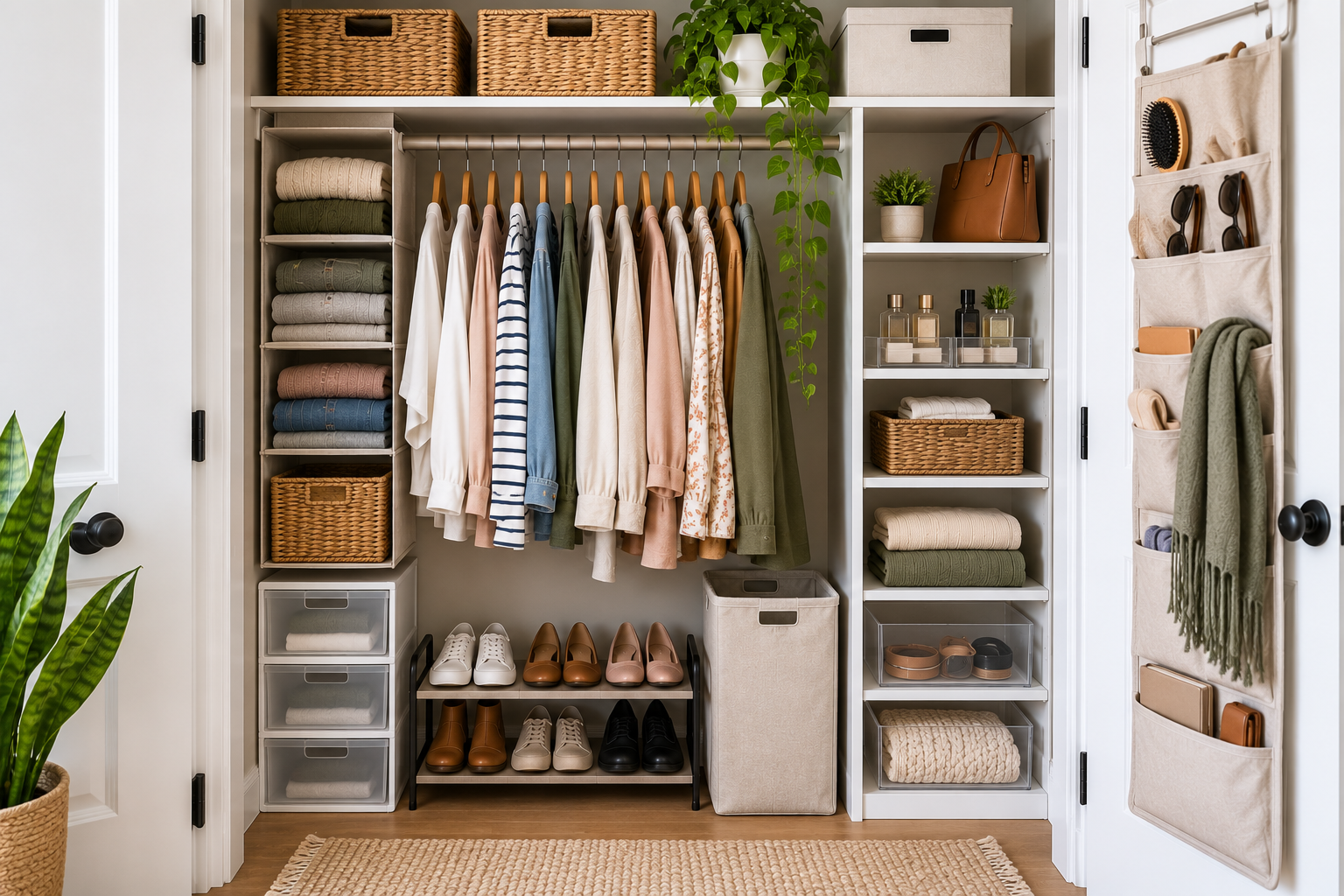
For each item, ask:
Can I see it?
If not, visibility may be the problem.
Can I reach it?
If not, the location may be wrong.
Can I remove it without disturbing several other items?
If not, the arrangement may be creating unnecessary friction.
Can I return it without rebuilding the zone?
If not, the system may be too complicated.
SEE → REACH → REMOVE → USE → RETURN
The goal is to complete this sequence without creating a new mess.
12. Fix the Part That Keeps Failing
After you have used the closet for a few days, pay attention to what happens.
If one category repeatedly becomes messy, do not just reorganize it again.
Find the reason.
- It may be stored too far away.
- The category may be too large for the available space.
- The items may be difficult to see.
- The storage format may not suit them.
- The location may not match how often the items are used.
- Returning them may take too many steps.
This is an important distinction.
Use that feedback to change the system instead of repeatedly restoring the same arrangement.
13. Reset the Closet Without Starting Over
A small closet should not require a complete reorganization every time something moves.
Use a simple reset loop:
If something repeatedly fails, change its home or storage method.
If something rarely gets used, reconsider whether it needs prime space.
If a category keeps overflowing, reassess its volume.
The goal is not permanent perfection.
The goal is a system that can recover easily from normal daily use.
A Simple Small-Closet Checklist
- Audit what is currently stored in the closet.
- Identify the areas creating the most storage friction.
- Measure the usable width, depth, height, shelves, and floor space.
- Separate items into practical decision groups.
- Move items that belong elsewhere.
- Give everyday items the easiest access.
- Create zones based on frequency and category.
- Use vertical space only when it improves the system.
- Match organizers to specific problems.
- Test whether everyday items are easy to retrieve and return.
- Adjust the parts that repeatedly fail.
- Create a simple reset routine.
Frequently Asked Questions
How do you organize a small closet?
Start by auditing what you have, measuring the usable space, editing what actually needs to stay, and creating zones based on frequency and access. Then match storage solutions to specific problems and test whether everyday items are easy to retrieve and return.
How do you organize a small closet with lots of clothes?
First determine whether all of the clothing needs to occupy the closet. Separate everyday clothing from seasonal and occasional items, then use the available hanging, shelf, floor, and vertical space according to how often each category is used.
How do you maximize space in a small closet?
Start by measuring the usable space and identifying areas that are being wasted or creating friction. Then consider vertical space, hanging allocation, shelves, floor space, and the closet door where appropriate. More storage is useful only when it makes the closet easier to use.
How do you use vertical space in a small closet?
Look at unused space above shelves or the hanging rod and determine whether it can support another useful storage level. A second hanging level can work for suitable clothing when there is enough vertical clearance and the installation is appropriate.
Can you organize a small closet without buying organizers?
Yes. Begin with auditing, editing, relocating misplaced items, regrouping categories, and changing storage locations. Only add an organizer when a specific problem remains after those steps.
What should go on the top shelf of a closet?
The top shelf can be useful for items that are used less frequently, such as seasonal or occasional items, provided they can be stored safely and retrieved appropriately.
How do you keep a small closet organized?
Make the system easy to use every day. Give frequently used items accessible homes, keep categories defined, and pay attention to places that repeatedly become difficult to maintain. Use those failures to adjust the system rather than simply tidying the same area repeatedly.
Final Thought
A small closet does not need to hold everything in the easiest possible place.
It needs to hold the right things in the right places for the way you actually use them.
Start with the space you have.
AUDIT → MEASURE → EDIT → ZONE → MATCH → TEST → RESET
When the system makes everyday items easy to see, retrieve, use, and return, the closet becomes easier to maintain—not because you found a perfect organizer, but because the storage finally matches the way you live.