Best Pantry Storage Bins: How to Choose the Right Ones
The best pantry storage bins are not necessarily the biggest, clearest, or most uniform. They’re the ones that solve a specific storage problem while keeping everyday food easy to see, reach, group, and put away.
Key Takeaways
- Measure your actual shelf space before choosing a bin.
- Choose the bin for the job, not simply the largest size.
- Use bins to create useful categories instead of forcing everything into containers.
- Check depth carefully because a bin that is too deep can make the back difficult to reach.
- Usable capacity matters more than maximum capacity.
- Start with the shelves and categories that cause the most trouble.
- A good bin system should make grocery-day restocking easier, not harder.
If your pantry needs a complete organization system before you start shopping for storage products, begin with Pantry Organization Ideas .
What Makes a Good Pantry Storage Bin?
A good pantry bin should make a shelf easier to use—not simply make it look more uniform.
The right bin should fit the available space, suit the category you’re storing, and make it easier to see and reach what you need.
That means the best bin for one shelf may be the wrong bin for another.
Use this five-part buying lens:
Measure
Know the usable width, depth, and height before you buy.
Match
Choose a bin that solves the specific storage problem on that shelf.
Group
Give each bin a clear category or purpose that matches real household use.
Access
Make sure the bin doesn’t turn easy-to-store items into hard-to-reach items.
Maintain
Leave enough room for normal use, consumption, and grocery restocking.
1. Measure Your Pantry Shelves Before Buying Bins
The easiest pantry-bin mistake to avoid is buying first and measuring later.
A bin can look perfect online and still be too deep, too tall, or too wide for your shelf.
Measure the usable space rather than relying only on the advertised shelf dimensions.
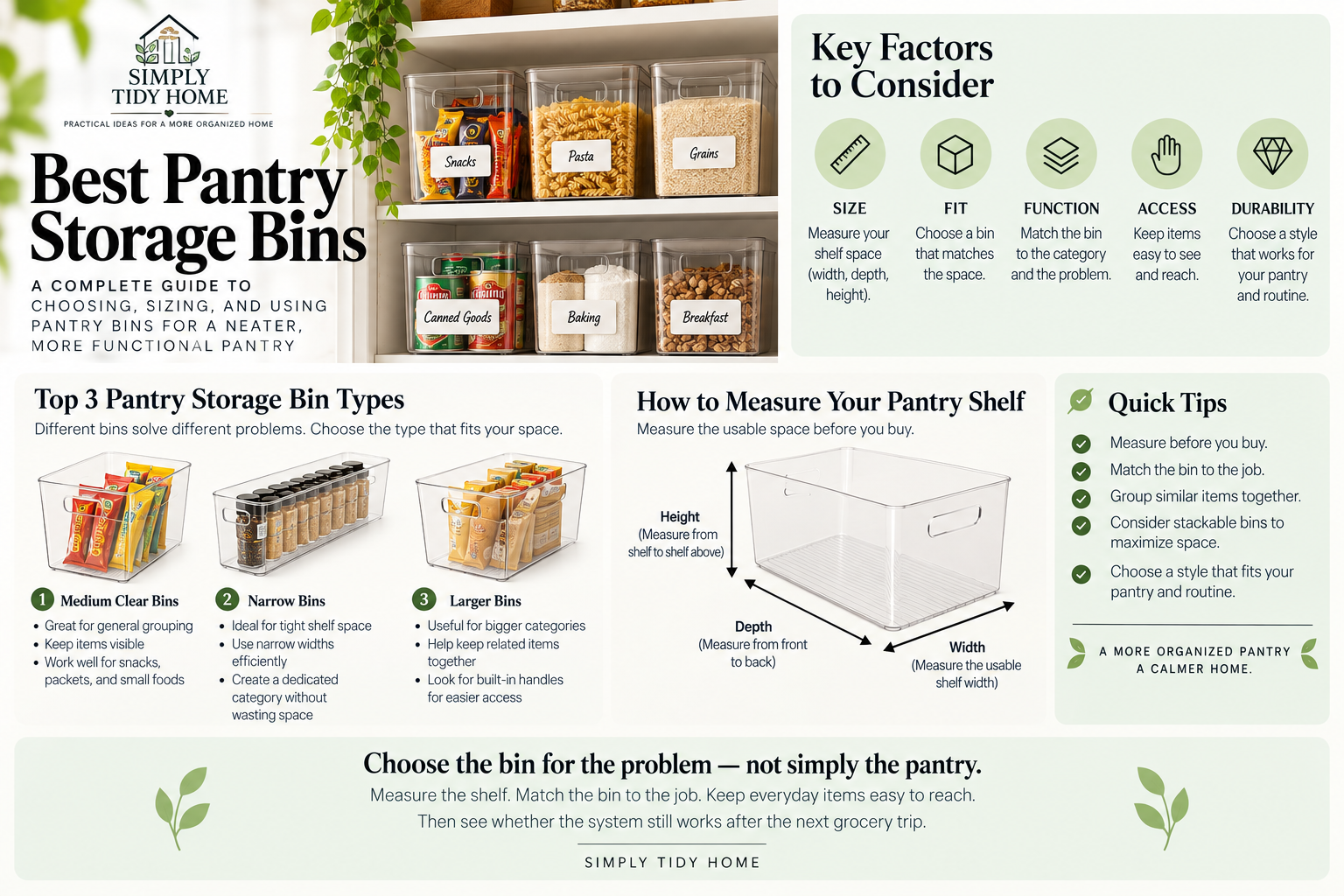
- Width: Measure the space available from side to side.
- Depth: Measure from the usable front edge to the back of the shelf.
- Height: Measure the clearance between shelves.
- Front clearance: Check whether the bin can be pulled forward without hitting a door, frame, or shelf lip.
Also look for fixed shelf supports, hinges, doors, or other obstructions that could reduce the usable space.
If limited shelf space is the main constraint, see our How to Organize a Small Pantry guide before buying bins.
2. Match the Bin to the Storage Problem
Instead of asking, “Which pantry bin should I buy?” start with a better question:
The answer should determine the type of bin you choose.
| Pantry problem | Bin approach to consider |
|---|---|
| Loose packages spread across a shelf | Medium bins that group related items |
| Narrow or awkward shelf space | Long, narrow bins that fit the available width |
| A large category needs to stay together | A larger bin with enough usable capacity |
| Items disappear toward the back | A shallower or easier-to-pull bin |
| Too many unrelated items share one shelf | Several smaller category bins |
This is why there is no single pantry bin that is best for every situation. The right choice depends on the constraint you’re trying to solve.
3. Choose the Right Type of Pantry Storage Bin
Medium Clear Bins for General Pantry Grouping
Medium clear bins are useful when the main problem is loose packages spreading across a shelf.
They create simple category zones without requiring you to transfer every food item into a matching storage container.
They can work especially well for snacks, packets, small packaged foods, and other groups that are easier to manage when contained together.
Narrow Bins for Tight Shelf Space
A narrow bin can be more useful than a large bin when width is the limiting factor.
Long, narrow bins can turn an awkward section of shelf into a dedicated category without taking more horizontal space than necessary.
This approach is especially useful when a standard-width bin would leave unusable gaps or interfere with neighboring storage.
Larger Bins for Bigger Categories
Larger bins make sense when a category contains enough items to justify the additional capacity.
But bigger is not automatically better.
A deep, heavily loaded bin can become difficult to move or search through. If you have to dig through the contents every time you need something, the extra capacity may not be helping.
4. Use the Reach Test Before Choosing Deep Bins
Depth is one of the easiest pantry-bin features to overlook.
A deep bin may hold more, but that does not mean it will be easier to use.
If the answer is no, the bin may be too deep for that location.
This matters most for everyday categories. If you regularly use snacks, breakfast foods, baking supplies, or other frequently accessed items, easy reach can be more valuable than maximum capacity.
A bin that technically holds more food is not an improvement if the extra contents become difficult to see, reach, or return.
5. Think Carefully About Stacking
Stacking can use vertical space efficiently, but it can also create another access problem.
Before stacking bins, check the full vertical clearance and consider how you will reach the lower bin.
- Check the available height between shelves.
- Leave enough room to access the contents.
- Consider how often you use the category.
- Do not sacrifice everyday access simply to gain another layer of storage.
For occasional or backstock items, stacking may make sense. For everyday items, easy access should usually win.
6. Group Items Before Filling the Bins
A bin works best when it has a clear job.
Instead of filling every bin with whatever happens to fit, group related items first.
Depending on your household, useful categories might include:
- Snacks
- Breakfast items
- Baking supplies
- Packets and mixes
- Small packaged foods
- Backstock
Your categories should follow the way you actually shop and use food.
A bin should make a category easier to manage. It should not force you to create artificial categories simply to make the pantry look uniform.
Best Pantry Storage Bins: Our Focused Picks
These recommendations are intentionally limited. Instead of listing a long collection of similar bins, the goal is to give you a few options for different pantry constraints.
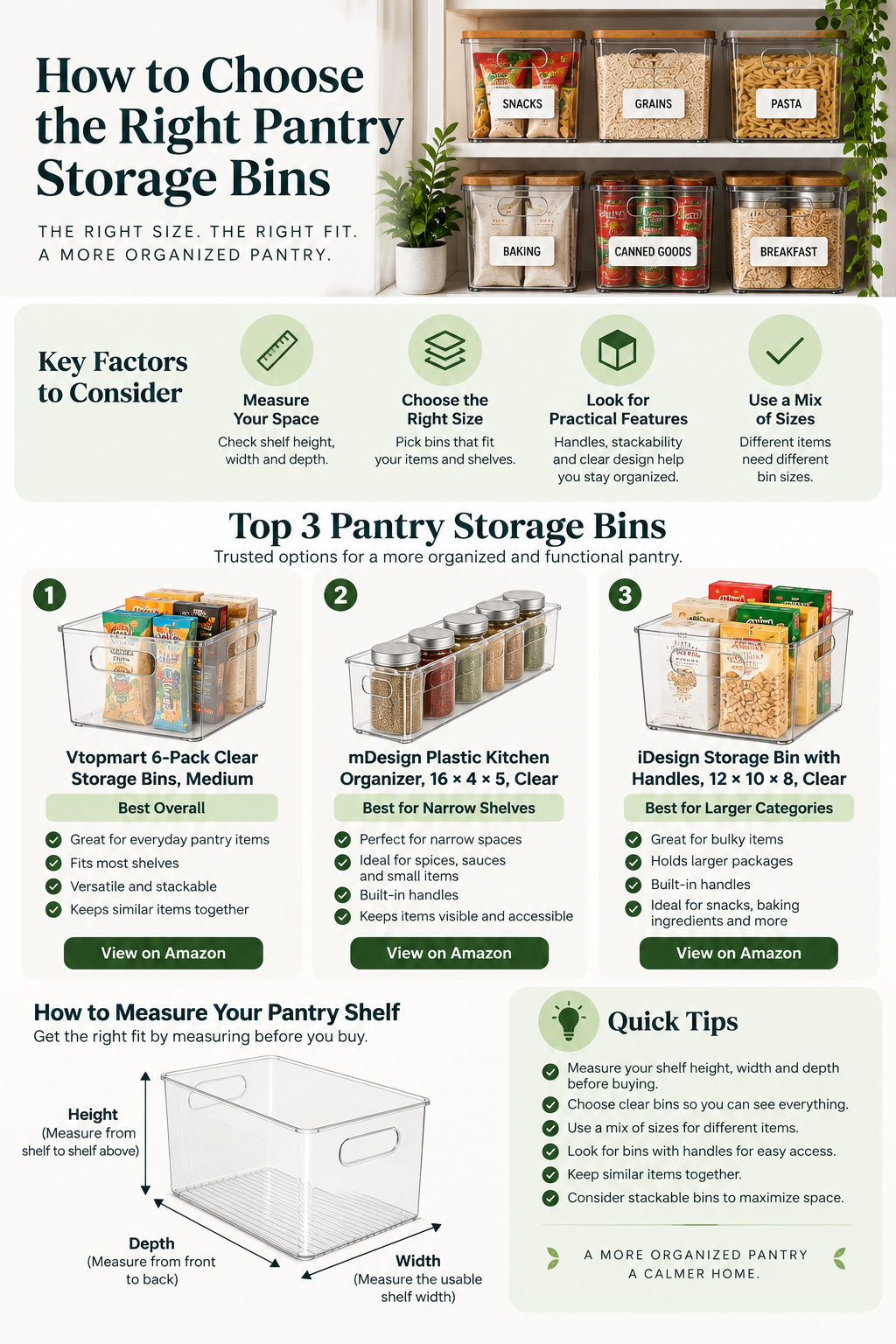
Vtopmart 6-Pack Clear Storage Bins, Medium
Best for: General pantry grouping
This medium clear-bin format is a practical choice when you want to group loose pantry packages without converting the entire pantry to matching food-storage containers.
The six-piece set can also help create several related category zones while keeping the contents visible.
mDesign Plastic Kitchen Organizer, 16 × 4 × 5, Clear
Best for: Narrow or awkward shelf space
The 16 × 4 × 5-inch format is useful when shelf width is the limiting factor and a standard medium bin would take up too much room.
Its narrow footprint can create a dedicated category without consuming unnecessary horizontal space.
iDesign Storage Bin with Handles, 12 × 10 × 8, Clear
Best for: Larger pantry categories
The 12 × 10 × 8-inch format gives larger categories more room without requiring several smaller bins for the same group.
The built-in handles also provide a practical way to pull the bin forward when you need access to the category.
Product availability, pricing, dimensions, and options can change. Check the current Amazon listing and confirm the size before purchasing.
Bins vs. Pantry Storage Containers: Which Do You Need?
Pantry bins and pantry storage containers solve different problems.
Bins are mainly useful for grouping and organizing packaged foods. They can keep several related items together and make a shelf easier to manage.
Storage containers are more useful when you want to transfer food into another container for reasons such as visibility, easier scooping, capacity, or a more secure seal.
You do not need to choose one approach for the entire pantry.
If you are deciding between open organizer bins and containers for dry foods, our Best Pantry Storage Containers guide covers that choice in more detail.
Many pantries work better with a combination of original packaging, organizer bins, and dedicated food-storage containers.
If you’re specifically looking for food-storage containers rather than open organizer bins, see Best Pantry Storage Containers .
When You Should Not Buy Pantry Bins
Sometimes the best storage decision is to buy nothing.
If the real problem is too much inventory, poor shelf placement, or items being stored in the wrong location, another bin may simply hide the problem.
For a broader reset of the pantry before adding more storage products, start with Pantry Organization Ideas .
Before buying, ask:
- Do I actually need to contain this category?
- Would removing expired or unused items solve the problem?
- Is the shelf itself the problem?
- Would moving the category to a better location make more sense?
- Will this bin make the items easier to reach?
Storage products should support the system. They should not become the system.
Common Pantry Storage Bin Mistakes
Buying Before Measuring
A bin that does not fit the shelf properly can create more work instead of solving a problem.
Using the Same Bin Everywhere
Uniform bins can look tidy, but different shelves and categories may need different dimensions.
Choosing Maximum Capacity Over Easy Access
A bin is not more useful simply because it holds more. If the contents become difficult to reach, usable capacity has gone down.
Overfilling the Bins
A completely packed bin becomes harder to search, harder to remove from the shelf, and harder to maintain.
Creating Categories That Do Not Match Real Life
Your pantry should reflect how your household actually shops and eats. A category system that looks good but is difficult to follow will not last.
Buying Too Many Bins at Once
A large multipack can look like a bargain until you discover that several bins do not fit the shelves or do not have a useful job.
Start with the problem areas first.
7. Make the Bin System Easy to Maintain
A good pantry system should survive a normal grocery trip.
You should be able to put new items away without rebuilding the entire shelf.
If yes, your bins are supporting the way you actually use the pantry.
If the category is difficult to access rather than difficult to contain, a rotating solution may work better. See Best Lazy Susan Pantry Organizers for that type of problem.
If no, the problem may be the category, the bin size, the shelf location, or simply having too much inventory in the space.
Need a More Specific Pantry Solution?
The right storage solution depends on the problem you’re trying to solve. Use the guide that matches your pantry.
Frequently Asked Questions
What are the best pantry storage bins?
The best pantry storage bin depends on the shelf and the category you’re organizing. Medium clear bins are useful for general grouping, narrow bins can solve tight shelf spaces, and larger bins can work for categories that need more capacity.
Are clear pantry bins better?
Clear bins can make it easier to see what is inside and notice when a category is running low. They are particularly useful when visibility is part of the storage problem.
What size pantry bins should I buy?
Measure your shelf first, then choose a bin that fits the available width, depth, and height. The right size also depends on how much of the category you normally store and how easily you need to access it.
How deep should pantry storage bins be?
They should be deep enough to use the available shelf without making the contents difficult to reach. Use the Reach Test before choosing a deep bin, especially for categories you access frequently.
Should pantry bins be stackable?
Stacking can make good use of vertical space, but it is only helpful when you can still access the lower bin easily. For everyday categories, easy access is usually more important than adding another storage layer.
How many pantry storage bins do I need?
Start with the shelves and categories that cause the most trouble. You do not need to replace every organizer at once. A small number of well-matched bins can solve the biggest problem areas first.
Are pantry bins worth it?
They can be worthwhile when they group loose packages, create useful categories, improve visibility, or make a difficult shelf easier to use. They are less useful when they simply add containers without solving an actual storage problem.
Should I put all my pantry food into storage bins?
No. Bins are useful for grouping and organizing packaged foods, while dedicated food-storage containers can be better for foods that benefit from being transferred. You do not need to move everything into matching containers for a pantry to work well.
Choose the bin for the problem—not simply the pantry.
Measure the shelf. Match the bin to the job. Keep everyday items easy to reach. Then see whether the system still works after the next grocery trip.
Order in every space. Simply.