
A blind corner kitchen cabinet can hold a surprising amount of storage, but that does not mean the space is easy to use. The back can disappear from view, frequently used items can become difficult to reach, and the wrong organizer can make the opening even harder to work with.
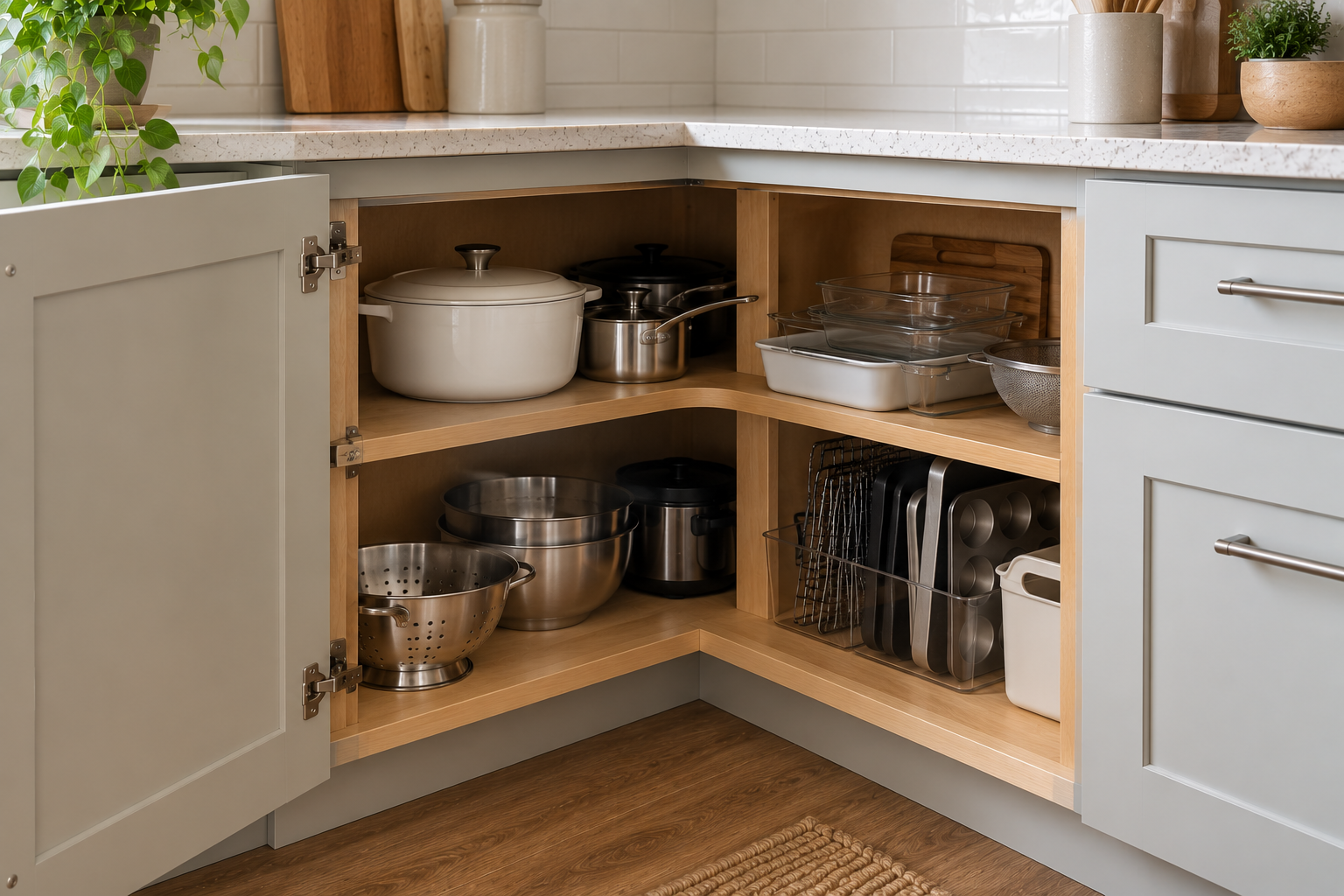
The solution is not automatically a Lazy Susan, pull-out, or another organizer. Start by understanding the cabinet, measuring the usable space, and deciding what needs to be easy to retrieve.
Key Takeaways
- Identify the cabinet configuration before choosing storage.
- Measure the opening, usable space, and movement path.
- Keep frequently used items in the easiest-access areas.
- Choose storage only when it solves a specific access problem.
- Test the finished system before deciding that it works.
If you want the broader cabinet organization system first, see our guide to organizing kitchen cabinets. This article focuses specifically on the extra access problems created by blind corners.
First, Make Sure You Have a Blind Corner Cabinet
A blind corner base cabinet is created where two runs of cabinets meet and part of one cabinet extends behind the neighboring cabinet. The defining problem is that some of the interior is hidden beyond the normal door opening.
That is different from a corner cabinet designed around an angled opening or an existing rotating mechanism. The distinction matters because a storage solution that works well in one configuration may not work in another.
Before organizing, ask:
- Can you see the entire cabinet interior from the open door?
- Does part of the cabinet disappear behind the adjacent cabinet?
- Does the door opening restrict what can move through it?
- Is there already rotating, pull-out, or other hardware installed?
If you are unsure which configuration you have, identify the cabinet before buying anything. The physical opening and movement path will determine what is actually practical.
Clear the Cabinet Before You Organize It
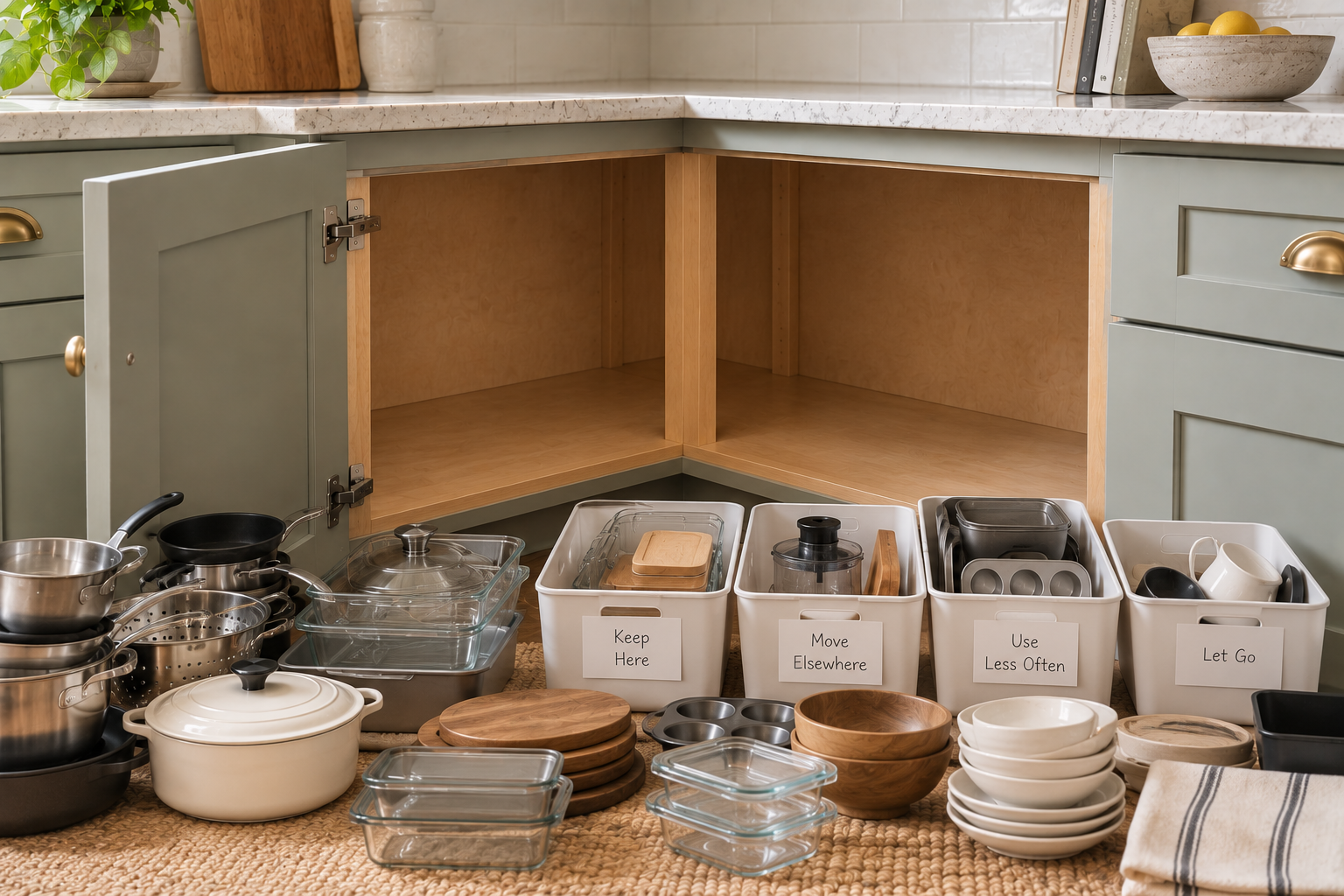
Empty the cabinet completely. Blind corners are difficult to evaluate when they are still full because the hidden area can make you underestimate how much space is actually usable.
Sort what you remove into four practical groups:
- Keep here: items that genuinely belong in this cabinet.
- Move elsewhere: items that would work better somewhere easier to access.
- Use less often: items that can tolerate deeper or less convenient storage.
- Let go: broken, duplicated, unwanted, or no-longer-useful items.
Do not organize around something simply because there is technically room for it. A difficult cabinet should earn its contents by making those items reasonably useful there.
Measure Before You Buy Anything
Measure the cabinet’s actual usable space before choosing storage. A product can appear to fit based on the advertised cabinet size and still fail because the opening, hinges, shelves, or movement path reduce the usable space.
- Opening width: measure the clear opening the organizer must pass through.
- Interior depth: measure how far usable storage extends into the cabinet.
- Usable height: check the vertical space available between shelves and obstructions.
- Door and hinge clearance: note anything that can interfere with movement.
- Left or right orientation: record which side contains the blind section.
- Movement path: consider the space needed if storage will rotate, pull out, or swing.
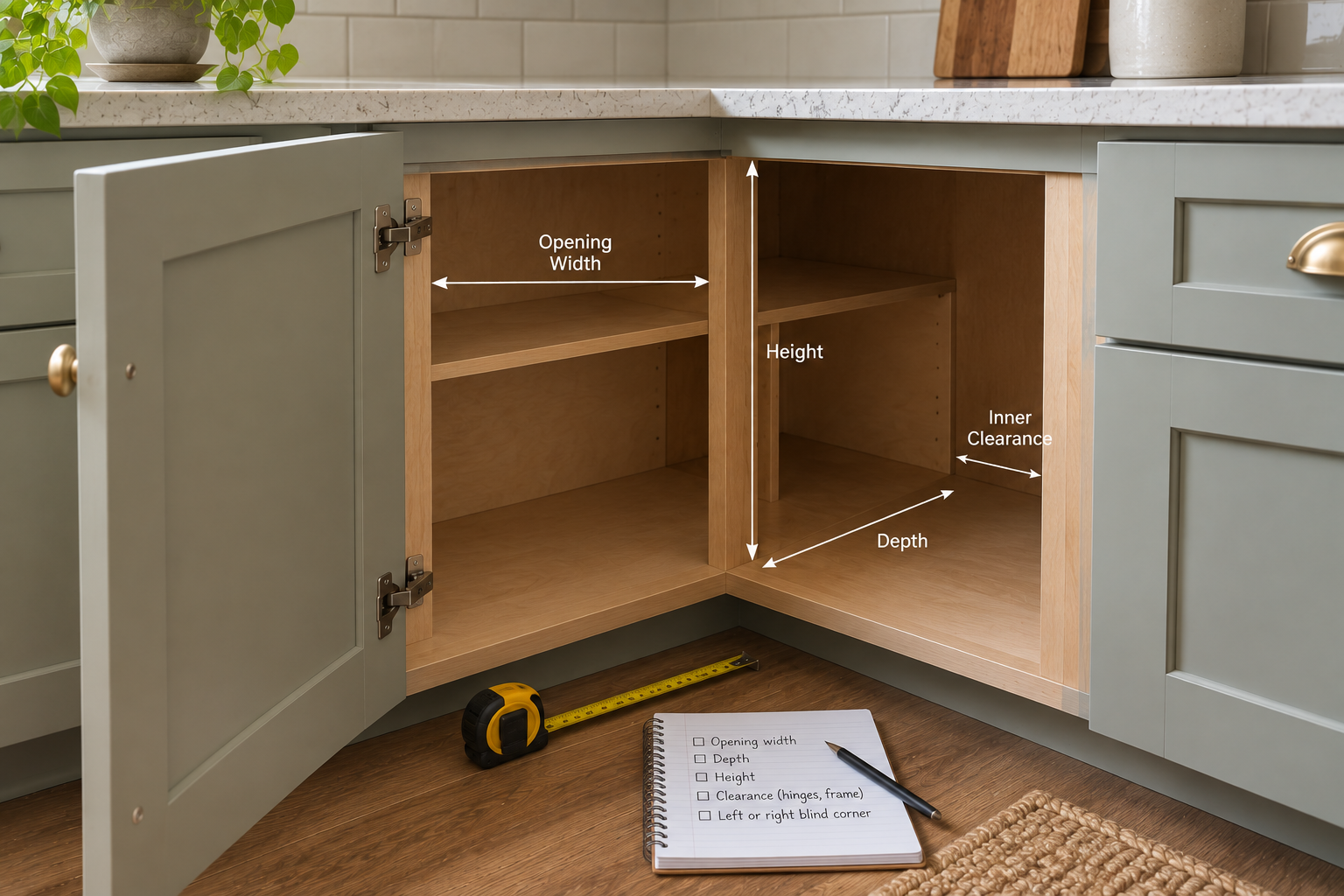
If an organizer needs to rotate, slide, or pass through the cabinet opening, make sure there is enough clearance for the complete movement.
Decide What Is Worth Storing in the Blind Corner
The deepest or least-accessible part of the cabinet should not automatically become the home for whatever happens to fit there.
Consider three things:
Frequency
Frequently used items deserve easier access. Items used only occasionally can tolerate a less convenient position.
Weight
Heavy cookware can be awkward to retrieve from a difficult corner. Think about how much lifting, bending, or reaching an item requires before placing it in the least accessible area.
Size
Large items may use the space efficiently, but only if they can still be removed without disturbing everything around them.
Your goal is not maximum capacity. It is reasonable retrieval effort.
Map the Cabinet by Access
Instead of treating the cabinet as one large storage area, divide it according to how difficult each part is to reach.
Easy-Access Zone
Keep items you use often where you can see and retrieve them with the least effort.
Secondary Zone
Use this area for items that are needed regularly but do not need the easiest possible access.
Blind Zone
Reserve the hardest-to-reach area for items that can tolerate deeper storage and occasional retrieval.
Retrieval Path
Keep the route between the opening and stored items clear enough that taking something out does not create a new mess.
Create a Front Zone and a Back Zone
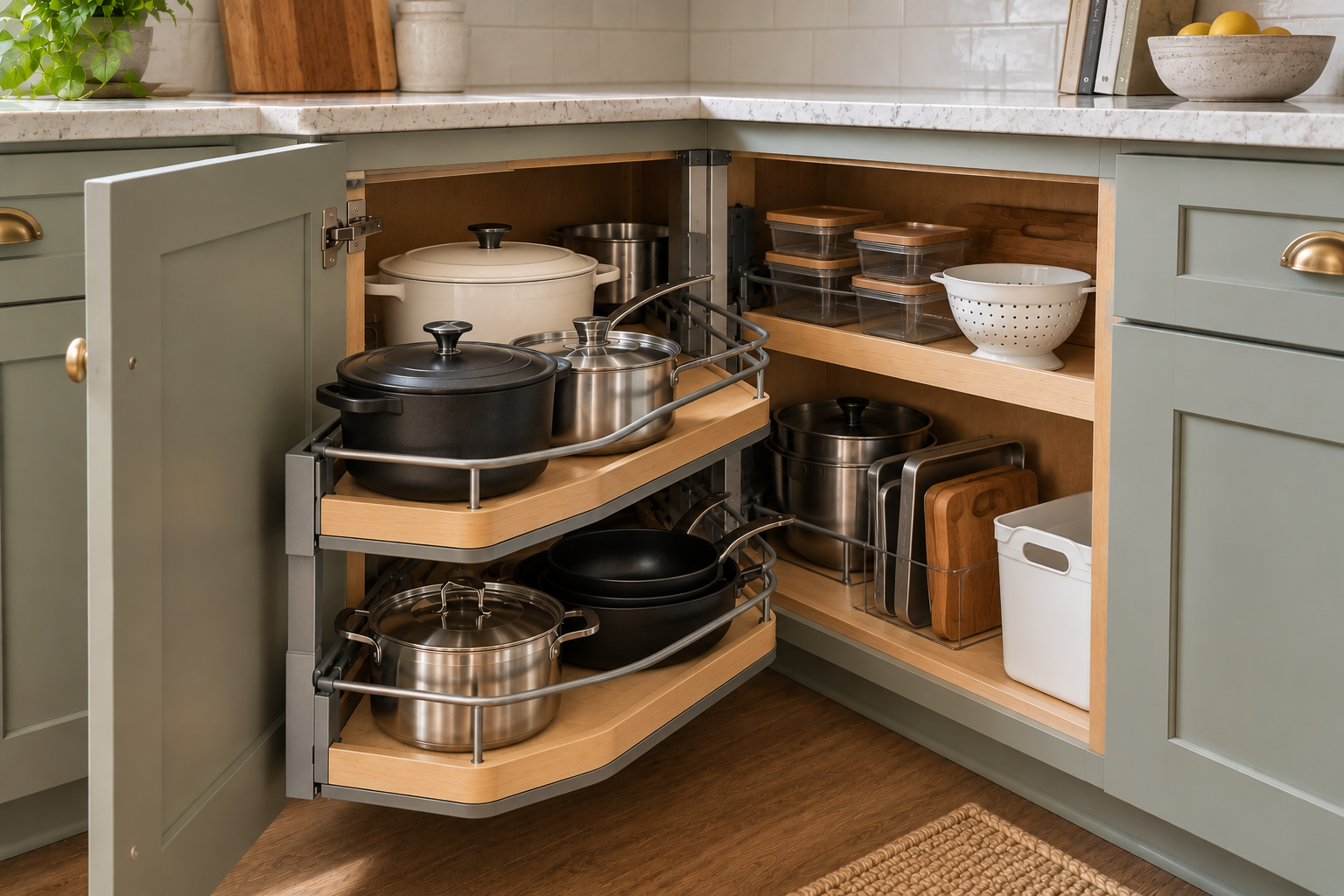
The front zone is the gateway to the rest of the cabinet, so avoid turning it into a wall of containers or stacked cookware.
Keep frequently used items near the opening and use the deeper area for items that do not need constant access.
When loading the cabinet, place the least-accessed items in the deeper zone first. Then build the easier-access zone around them.
Choose the Simplest Storage Solution That Fixes the Problem
Not every blind corner needs specialized hardware. Start with the simplest option that genuinely improves access.
| What is making the cabinet difficult? | Possible direction |
|---|---|
| The shelves already work, but the contents are mixed | Keep the shelves and improve categorization and zones |
| Small groups of items become scattered | Use removable bins that are easy to lift and return |
| Items are difficult to reach because they sit deep inside | Consider a pull-forward solution if the cabinet opening and hardware allow it |
| Rotation would make suitable items easier to retrieve | Consider rotating storage only when the cabinet provides enough clearance |
| The cabinet has a compatible swing-out configuration | Consider swing-out hardware designed for that cabinet type |
Keep the Existing Shelves When They Already Work
If you can see and retrieve the contents without much difficulty, you may not need new hardware. Simple zones and removable containers can be enough.
Use Removable Bins for Containment
Bins can help when related items need to stay together and can be removed as a group. Keep them small enough that they can be lifted through the cabinet opening without creating another access problem.
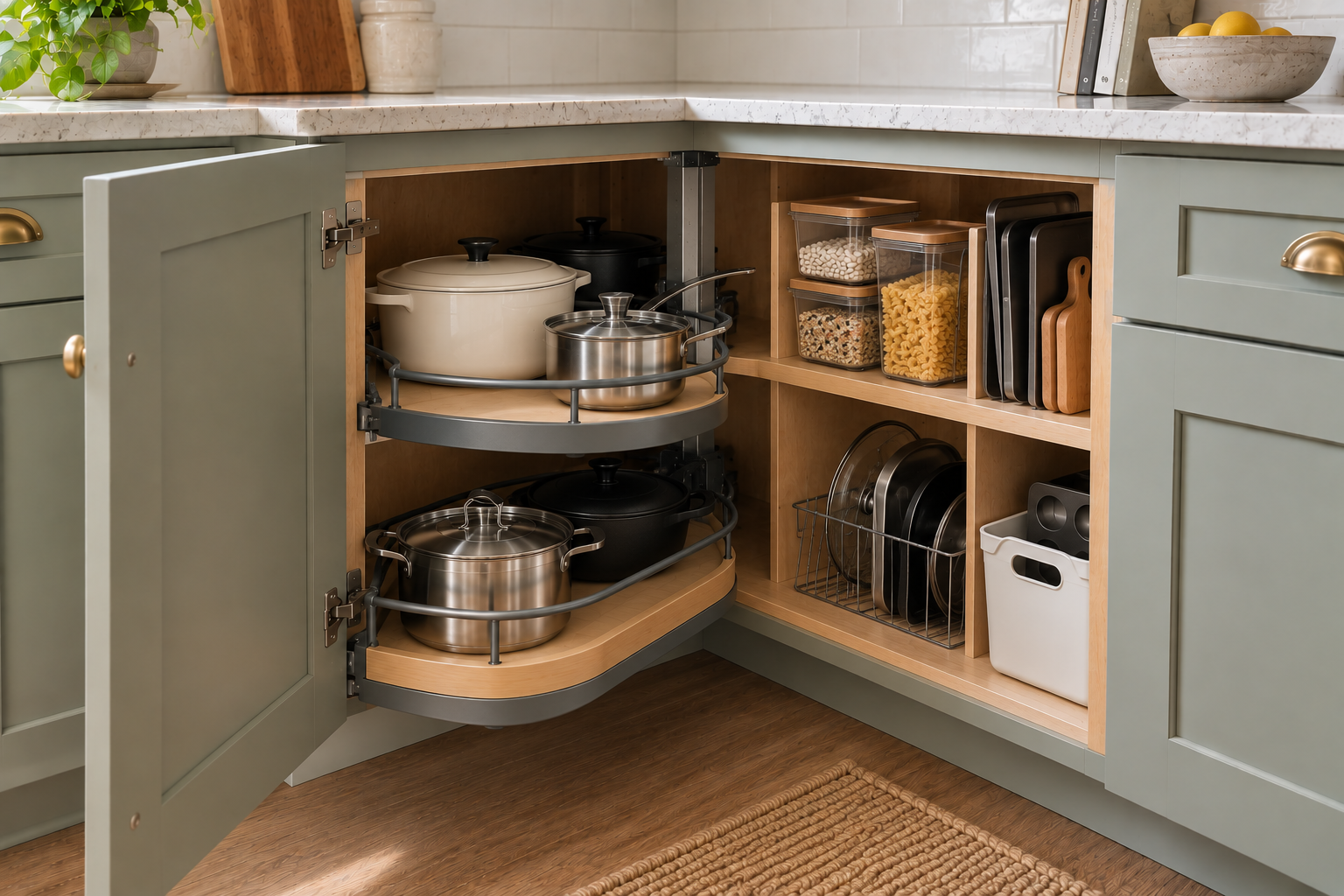
Consider Rotating Storage When Rotation Solves the Problem
Rotating storage can make suitable items easier to reach by bringing different sections toward the opening. But it is not automatically the best solution for every blind corner.
The cabinet needs enough clearance for the mechanism to operate, and the items stored there need to work with the available shape and movement.
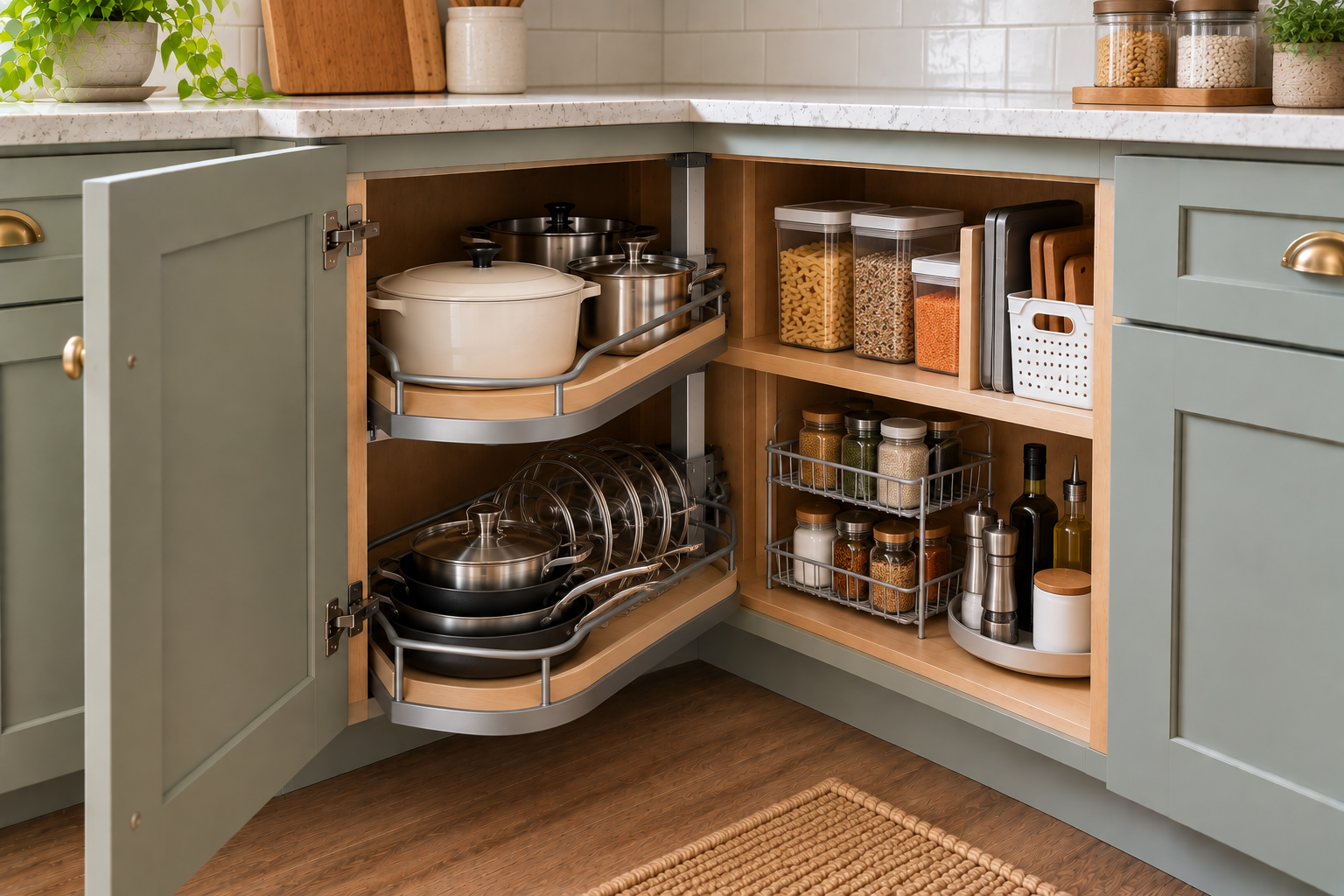
Consider Pull-Out or Swing-Out Storage When the Geometry Allows It
Pull-out and swing-out systems can bring hidden contents closer to the opening instead of requiring you to reach deep around the corner.
These systems can be useful, but their fit depends on the cabinet’s dimensions, opening, construction, orientation, and movement clearance. Follow the installation and load requirements of the specific system you choose.
Organize by Frequency, Weight, and Size
Once the storage approach is decided, place items according to how they behave in daily use.
- Most used: easiest access.
- Regularly used: convenient secondary access.
- Occasionally used: deeper or less convenient storage.
- Heavy items: locations where they can be lifted comfortably.
- Bulky items: positions where they can be removed without disturbing the surrounding zone.
This creates an access hierarchy rather than simply filling the available shelves.
Test the Retrieval Path Before You Finish
Do not judge the organization only by how tidy the cabinet looks. Actually use it.
- Open the door fully.
- Remove something you use frequently.
- Return it to its zone.
- Retrieve something from deeper storage.
- Check whether anything blocks the opening or movement path.
- Make sure containers can be removed and returned comfortably.
If a normal retrieval creates a new pile of items on the floor or counter, the system still needs adjustment.
Common Blind Corner Cabinet Organization Mistakes
Buying Before Measuring
A storage mechanism that looks suitable online may not fit the actual opening or have enough room to operate.
Treating Every Corner Cabinet the Same
Different cabinet configurations have different openings and movement requirements. Identify yours before choosing a solution.
Filling the Front Zone
The front is valuable because it is accessible. Blocking it with too many containers can make the deeper storage even harder to use.
Putting Everyday Items in the Blind Zone
If you use something frequently, making it difficult to reach creates unnecessary work every time you need it.
Using Oversized Containers
A container can solve a containment problem while creating a retrieval problem. Choose a size that can still be removed comfortably.
Maximizing Capacity Instead of Access
Empty space is not automatically wasted space. Sometimes leaving clearance is what makes the rest of the cabinet usable.
Organizing for Appearance Only
A cabinet that looks tidy but requires you to unload several items to reach one pan is not functioning well.
How to Maintain the System
A blind-corner cabinet does not need a complicated maintenance routine. Check it occasionally and correct small problems before they become another full reorganization.
- Return items to their assigned access zones.
- Move frequently used items forward if your routine has changed.
- Remove items that no longer belong in the cabinet.
- Check whether containers or hardware are still easy to use.
- Adjust the system when your cookware or kitchen habits change.
If something repeatedly becomes difficult to retrieve, do not simply put it back. Ask whether the storage location is wrong or whether the storage mechanism is wrong.
Blind Corner Kitchen Cabinet FAQ
What should I store in a blind corner kitchen cabinet?
Store items that can tolerate deeper or less convenient access. Consider frequency of use, weight, size, and how easily each item can be retrieved. Frequently used items are usually better placed closer to the easiest access point.
How do I organize a blind corner cabinet without buying an expensive organizer?
Start by emptying the cabinet, removing items that do not belong, and creating front and deeper access zones. If the existing shelves are usable, simple categorization and removable containers may be enough.
Is a Lazy Susan good for a blind corner cabinet?
A rotating organizer can work for some corner-cabinet configurations, but it is not a universal solution for every blind corner. Check the cabinet opening, available clearance, and movement path before choosing rotating storage.
How do I measure a blind corner cabinet for an organizer?
Measure the clear opening, usable interior depth, available height, door and hinge clearance, obstructions, and the space needed for the organizer to move. For rotating or pull-out systems, the movement path matters as much as the static cabinet dimensions.
What is the best way to make a blind corner cabinet easier to access?
Start by reducing unnecessary contents and moving frequently used items toward the easiest-access area. Then choose a storage mechanism only if it solves a specific retrieval problem and fits the cabinet’s geometry.
For a broader approach to organizing difficult kitchen storage, you can also see our small kitchen organization guide. It covers how to diagnose hard-to-reach storage problems across the kitchen before adding more storage.
Make the cabinet easier to use, not just fuller.
A blind corner does not need to become perfect. It needs to become predictable: you should know what belongs there, where it goes, and how to retrieve it without emptying half the cabinet.
IDENTIFY → MEASURE → CLEAR → CATEGORIZE → MAP ACCESS → ZONE → CHOOSE → TEST → MAINTAIN