
SMALL KITCHEN ORGANIZATION
When counter space is limited, the goal isn’t to fit more onto the counter. It’s to decide what deserves the surface and move everything else to a useful home.
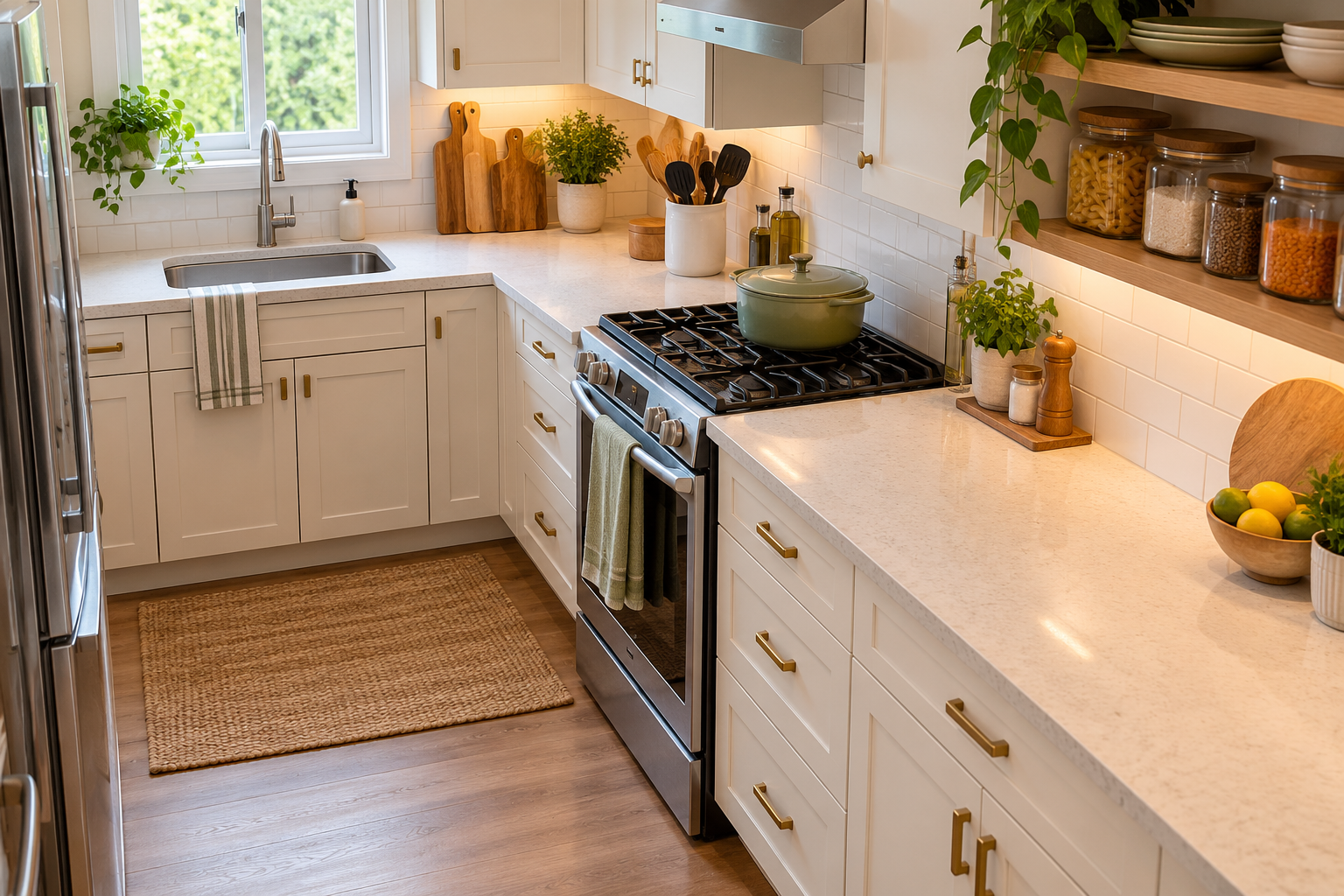
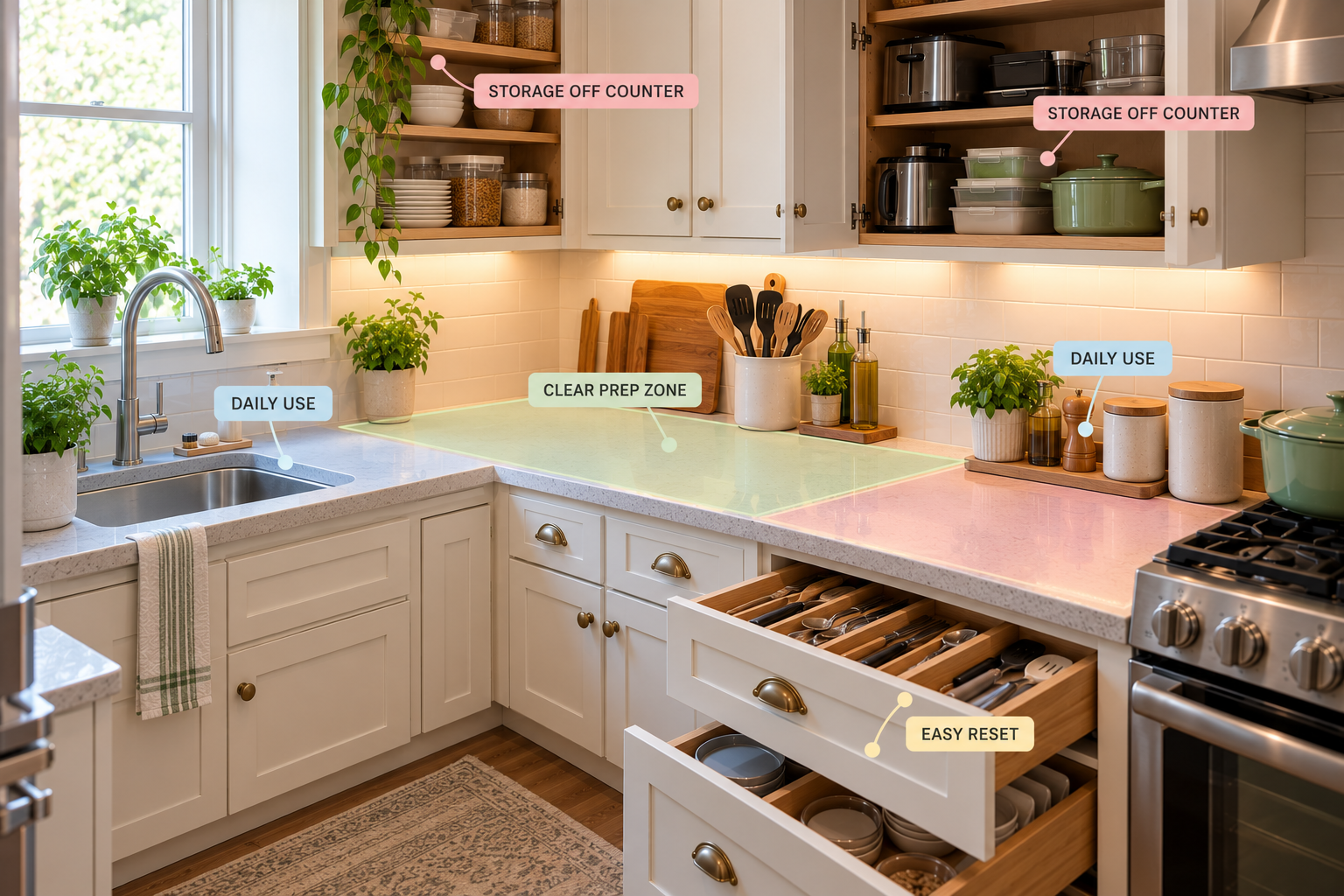
To organize a small kitchen with limited counter space, first protect one usable preparation area. Then decide which items genuinely deserve permanent counter space, move storage into cabinets or vertical areas, store appliances according to how often you use them, and create a temporary work surface when you need one.
The Simple System
A small kitchen can feel much smaller when the counter-top has to do too many jobs at once.
Appliances, utensils, food containers, cutting boards and everyday items can gradually take over the surface you actually need for preparing food.
The solution is not always another organizer. Often, the better solution is deciding which jobs belong on the counter and which jobs belong somewhere else.
Why Small Kitchens Run Out of Counter Space
Counter space disappears when the work surface becomes a storage surface.
This is especially common in small kitchens because there may be fewer cabinets, fewer drawers, and fewer places to store appliances and everyday supplies.
The result is a counter that has to function as storage, preparation space, appliance parking, and sometimes even a temporary drop zone.
Limited counter space is usually a space-allocation problem, not simply a lack-of-storage problem.
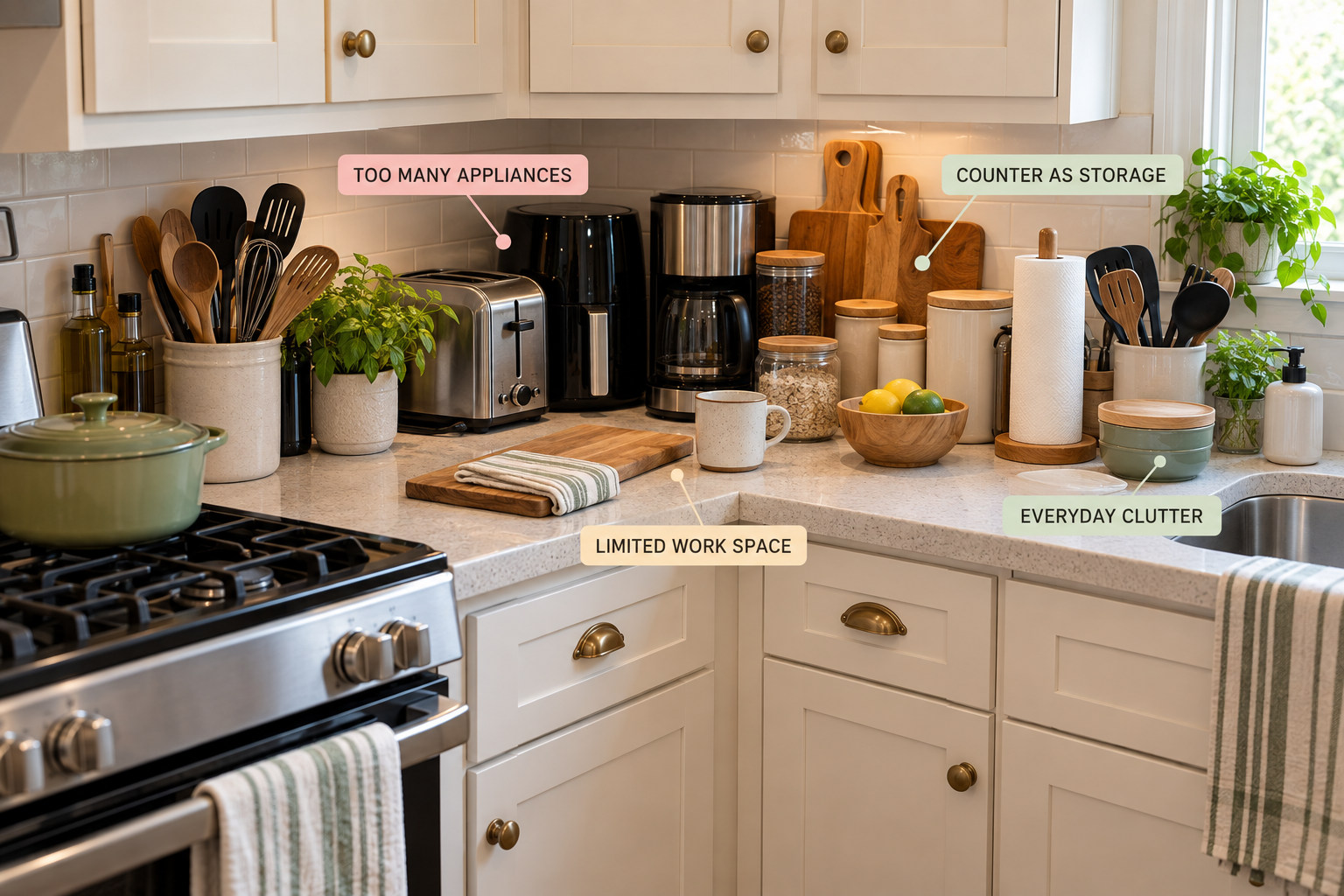
Protect One Usable Prep Zone
Start by protecting the part of the counter you actually need for preparing food.
It does not have to be the largest possible area. It needs to be a genuinely usable area that you can clear quickly and use without first moving several unrelated objects.
A completely empty kitchen is not the goal. A usable work surface is.
Look at your counter and identify the area where you most naturally prepare food. Protect that area from permanent storage whenever possible.
If the entire counter is currently occupied, begin by removing the items that do not need to live there.
Decide What Actually Deserves Counter Space
Not everything you use in the kitchen needs a permanent place on the counter.
A useful way to decide is to consider frequency of use and how difficult the item is to retrieve.
The Counter-Space Decision
Consider keeping genuinely frequent-use items accessible if they do not interfere with preparation.
Give these items an easy-to-reach home in a cabinet, drawer, shelf, or other nearby storage area.
These usually do not need to occupy valuable counter space permanently.
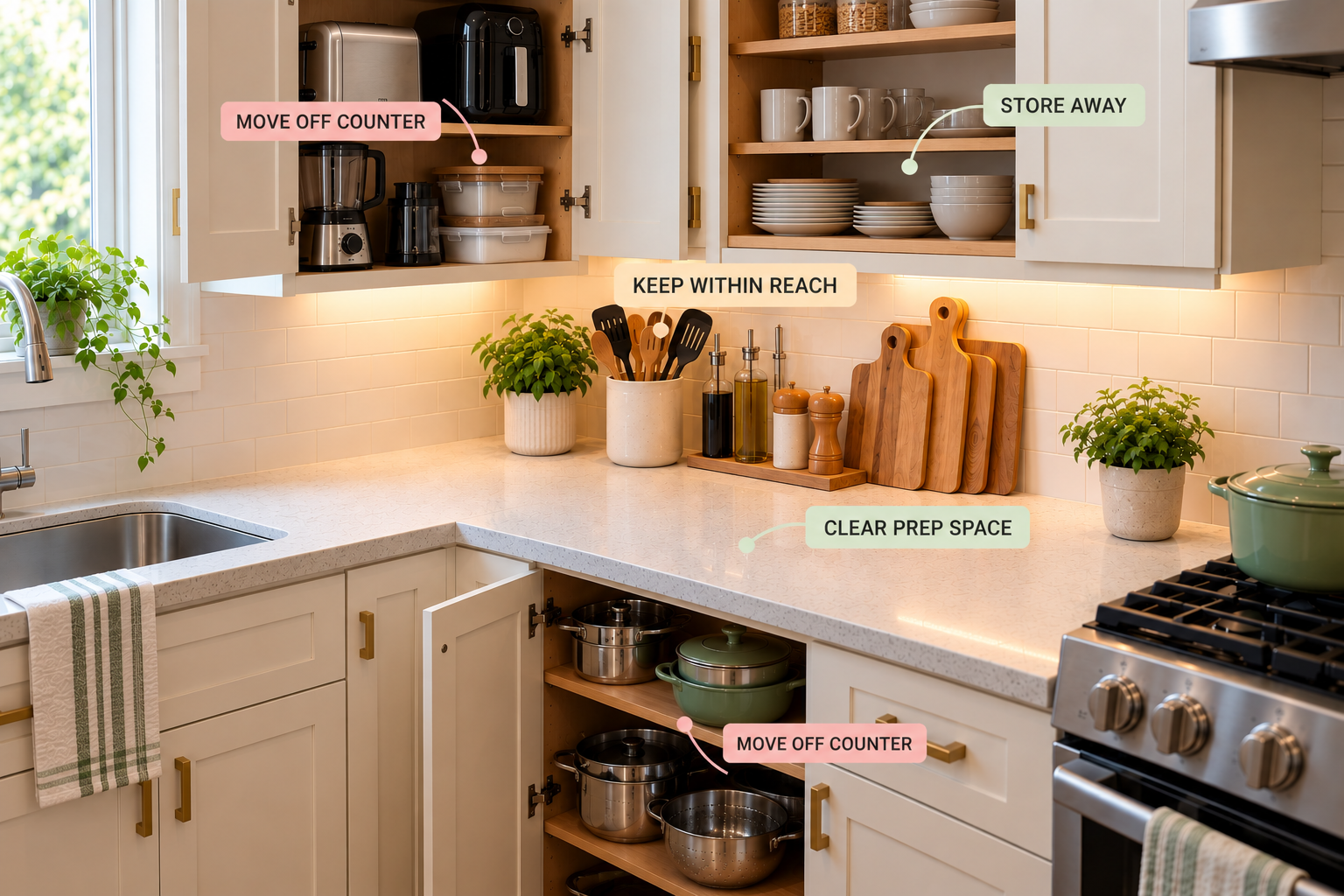
Move Storage Off the Counter
Once you know what deserves the counter, look for places where the remaining items can live.
Start with storage you already have before buying anything new.
Use Cabinets
Move items that do not need to stay visible into appropriate cabinet space.
Use Drawers
Small tools and frequently used utensils may belong in drawers rather than taking up counter space.
Use Vertical Space
Shelves, hooks, rails, and other vertical storage can move useful items away from the work surface.
The important distinction is that storage should remain practical. Moving an item somewhere technically available is not useful if retrieving it becomes unnecessarily difficult.
As an Amazon Associate I earn from qualifying purchases. Some links below are paid links, which means Simply Tidy Home may earn a commission if you purchase through them, at no additional cost to you.
FOR UNUSED VERTICAL SPACE
SONGMICS Cabinet Organizer Shelf, Set of 2
A shelf riser can create another accessible storage level when a cabinet has useful vertical clearance above the items already stored there.
This type of organizer makes the most sense when the cabinet has space that is currently difficult to use efficiently.
Best fit if: you have unused vertical cabinet space and want to move suitable items off the counter.
FOR ADDITIONAL STORAGE SPACE
Compact Storage Option
A separate compact storage solution can be useful when the kitchen has a narrow area that can hold supplies without taking over the main preparation surface.
Before buying, measure the available width, depth, and height and make sure the storage location does not interfere with doors, drawers, appliances, or normal movement through the kitchen.
Best fit if: you have a suitable unused area outside the main counter-top that can take on part of the storage load.
Store Small Appliances According to Frequency
Small appliances can consume a surprising amount of valuable work surface.
Instead of asking whether an appliance is useful, ask how often you actually use it.
Consider keeping it accessible if it does not significantly reduce your usable preparation space.
Give it an easy-to-reach storage location rather than automatically giving it permanent counter space.
Store it away from the primary work surface whenever practical.
Use Vertical Space Instead of More Counter Space
When the floor and counter are both limited, look upward.
Depending on the kitchen, useful vertical storage may include cabinet shelf risers, wall shelves, hooks, rails, or other appropriately fitted storage.
The important point is not to add vertical storage simply because there is an empty wall. The storage should solve a specific problem.
Create Temporary Workspace When You Need It
A small kitchen does not necessarily need a larger permanent counter-top.
Sometimes the better solution is a temporary work surface that appears only when you need it.
Depending on the layout, this could include an appropriately fitted over-sink work surface, a movable cart, or another temporary preparation area.
Any temporary work surface should be appropriate for the space, stable during normal use, and stored safely when it is not needed.
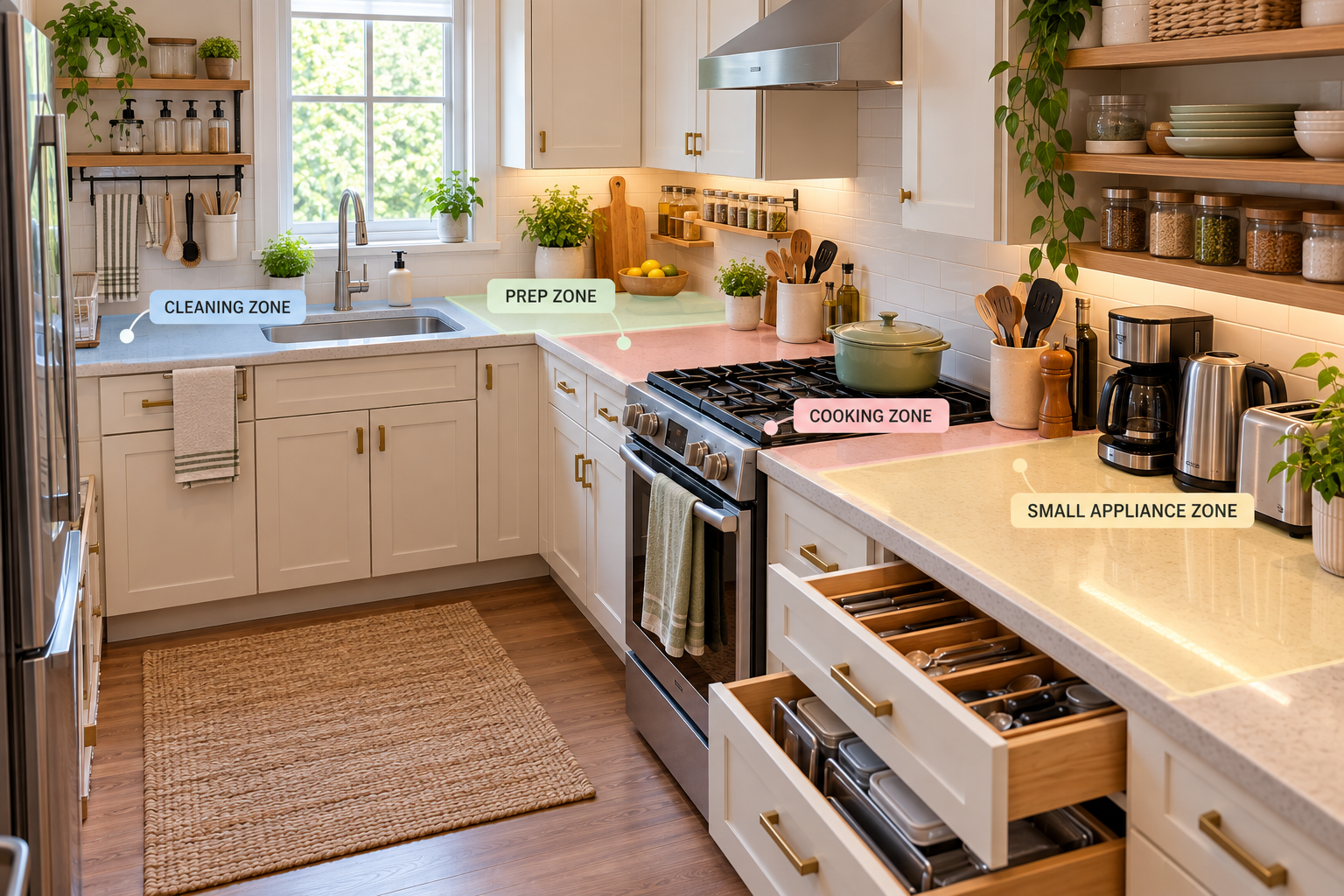
Build Kitchen Zones Around Workflow
Organization becomes easier when storage follows the way you actually use the kitchen.
Think about the basic movement of work:
Kitchen Workflow
Your kitchen does not need four perfectly separated physical areas. The idea is simply to keep related tools and supplies close to the part of the kitchen where they are actually used.
What Not to Do
Avoid these common mistakes:
- Do not use the entire counter-top as permanent storage.
- Do not keep every small appliance within sight simply because it is useful.
- Do not buy organizers before measuring the space they will occupy.
- Do not add storage that blocks cabinet doors, drawers, appliances, or normal kitchen movement.
- Do not sacrifice the only useful preparation area just to make storage look more organized.
- Do not assume a product that works in one small kitchen will automatically fit another.
Before You Buy an Organizer
Measure first. Then decide whether the product solves the actual problem.
MEASURE
Check the available width, depth, and height.
ASSIGN
Decide exactly what the organizer will store.
COMPARE
Check whether the organizer improves access rather than simply adding capacity.
CHOOSE
Buy only when the product fits the space and the storage job.
How to Keep the Counter Clear
The organization system needs a simple reset routine.
At the end of normal kitchen use, return items to their assigned homes rather than allowing the counter to become the default storage location again.
DAILY RESET
Return appliances, utensils, containers, and other items that do not belong on the work surface.
WEEKLY CHECK
Notice which items repeatedly remain on the counter and decide whether their storage location is actually convenient.
WHEN SOMETHING CHANGES
Reassign storage when your appliances, routines, or kitchen needs change.
Find the Next Kitchen Organization Guide
Key Takeaways
- Protect at least one genuinely usable preparation area.
- Decide what actually deserves permanent counter space.
- Move storage into cabinets, drawers, and vertical areas where practical.
- Store appliances according to frequency of use.
- Consider temporary workspace instead of adding permanent counter-top clutter.
- Measure before buying any organizer.
- Give every item a realistic home and maintain the system with a simple reset.
Frequently Asked Questions
How do you organize a small kitchen with very little counter space?
Protect one usable preparation area, decide which items deserve permanent counter space, move other storage into cabinets or vertical areas, and use temporary workspace when needed.
What should stay on a kitchen counter?
Items that you use frequently may deserve accessible counter space if they do not interfere with food preparation. Less frequently used items can usually be stored elsewhere.
How do I make more counter space in a small kitchen?
Start by removing storage from the counter. Move suitable items into cabinets, drawers, vertical storage, or another appropriate storage area. A temporary work surface can also help when additional preparation space is needed.
Where should small appliances go?
Store appliances according to frequency of use. Daily-use appliances may remain accessible when they do not consume too much useful work surface. Appliances used less often can be stored in appropriate cabinets or other storage areas.
How can I use vertical space in a small kitchen?
Depending on the kitchen, you can use cabinet shelf risers, shelves, hooks, rails, or other appropriately fitted storage to move suitable items away from the counter-top.
Can I create temporary counter space?
Yes. Depending on the layout, an appropriately fitted over-sink work surface, movable cart, or other temporary preparation surface can provide additional workspace when needed.
How do I keep a small kitchen counter clear?
Give items realistic homes outside the counter, return them after use, and regularly review the items that repeatedly accumulate on the surface. If something always ends up on the counter, its assigned storage location may not be convenient enough.
What should not be stored on a kitchen counter?
Avoid using the counter as permanent storage for items that are rarely used or can be stored conveniently elsewhere, especially when they take away the preparation space you need every day.
A Small Kitchen Works Better When the Counter Has a Job
You do not necessarily need more counter space to make a small kitchen easier to use.
Start by giving the existing counter a clear job: provide usable space for preparing food and handling everyday kitchen tasks.
Then move storage elsewhere, organize around your workflow, and choose products only when they solve a measured problem.
The goal is not an empty kitchen. The goal is a kitchen where the space you have is easy to use.