
Under-bed space can be useful storage, but it is easy to turn it into a hidden dumping ground. The space is low, partly hidden, and often awkward to reach. A better approach is to give it a specific job and store only things that suit that location.
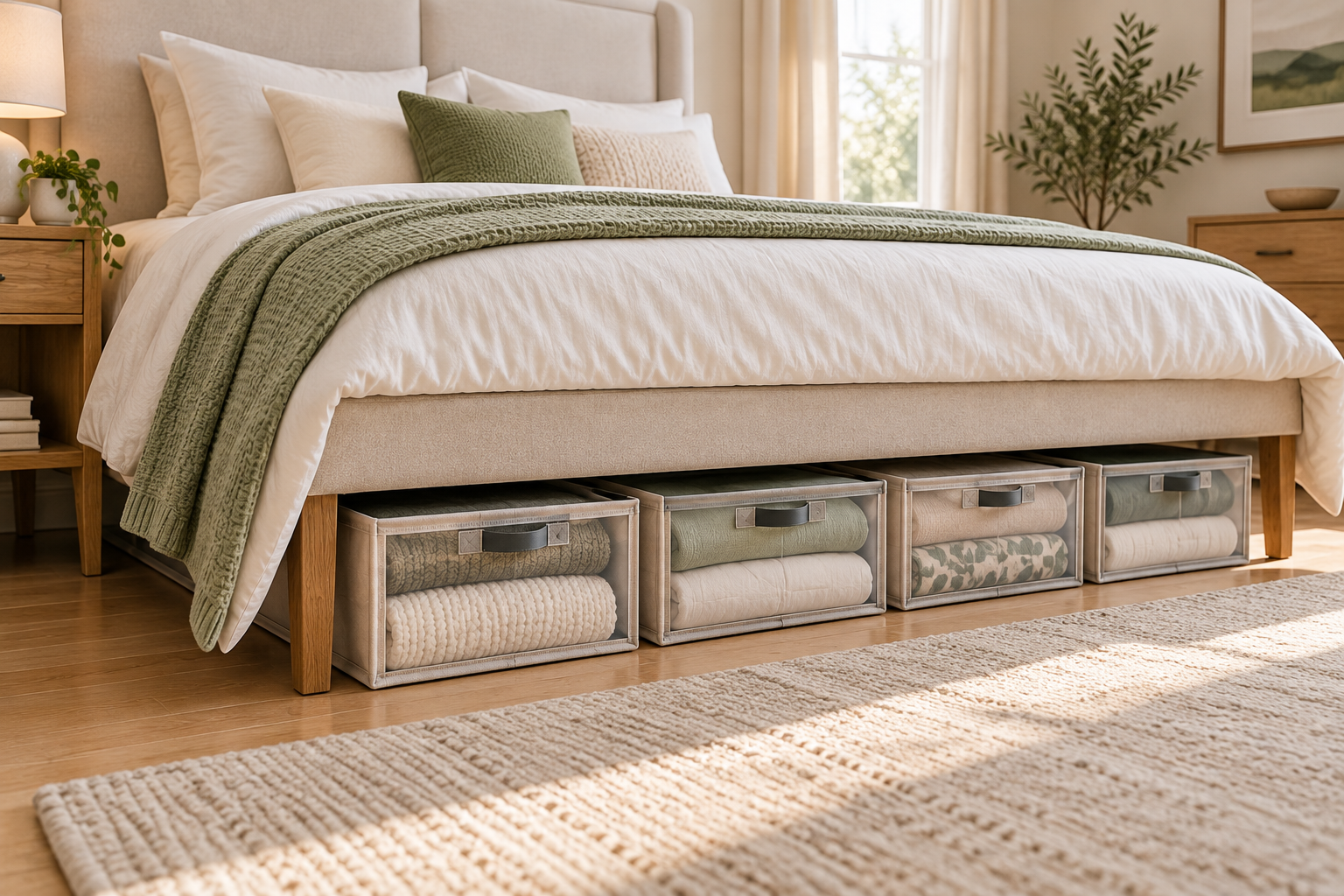
Start by emptying the space under the bed and deciding what actually belongs there. Measure the usable height, width, depth, and any obstructions before choosing storage. Prioritize items that are used occasionally, group similar items together, and choose storage that fits the available clearance without making retrieval difficult. Label hidden storage so you can find things without opening every container, then test the system during a normal retrieval and return routine. Review the contents periodically so the space does not become a dumping ground.
Why Under-Bed Storage Often Becomes a Problem
The space under a bed can look like free storage, but it has unusual constraints. It is low, partly hidden, and often difficult to reach without moving around the bed.
When belongings are pushed underneath simply because there is room, categories quickly become mixed. Containers can block one another, useful items can disappear from view, and the space can become difficult to clean.
The problem is usually not that the space is too small. It is that the space has no defined job.
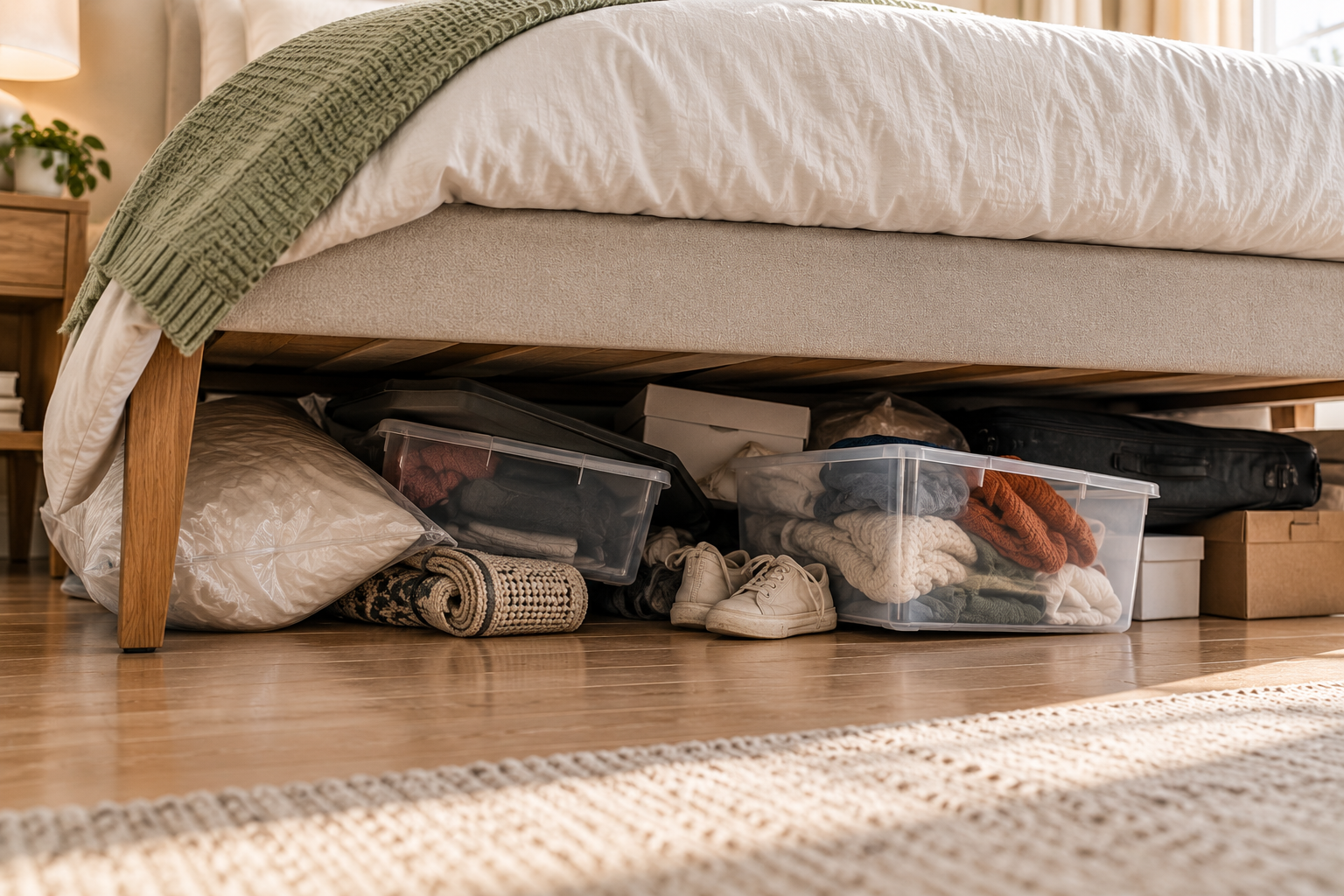
Start by Emptying the Space
Before choosing containers or rearranging what is already underneath the bed, remove the contents so you can see the whole storage area.
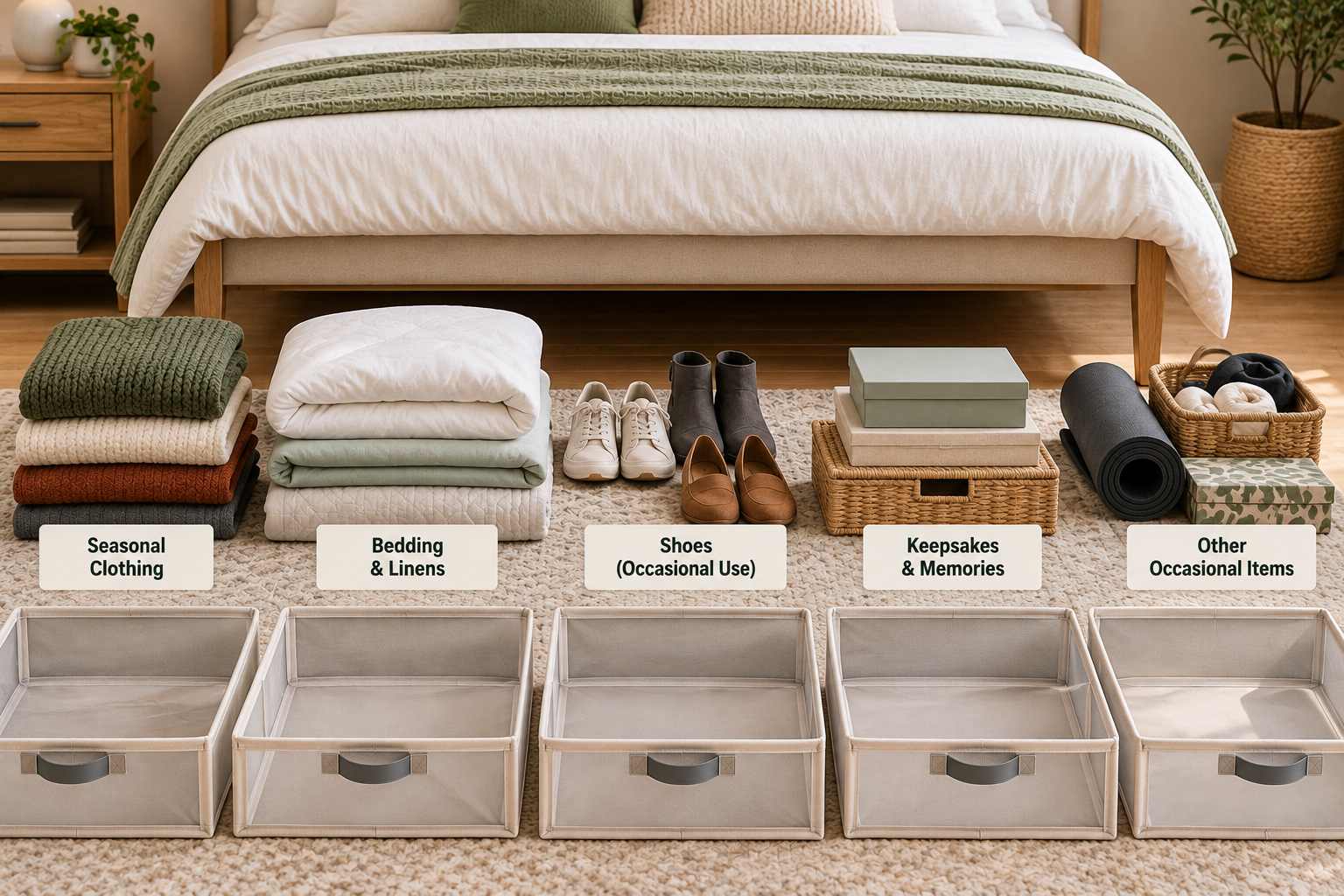
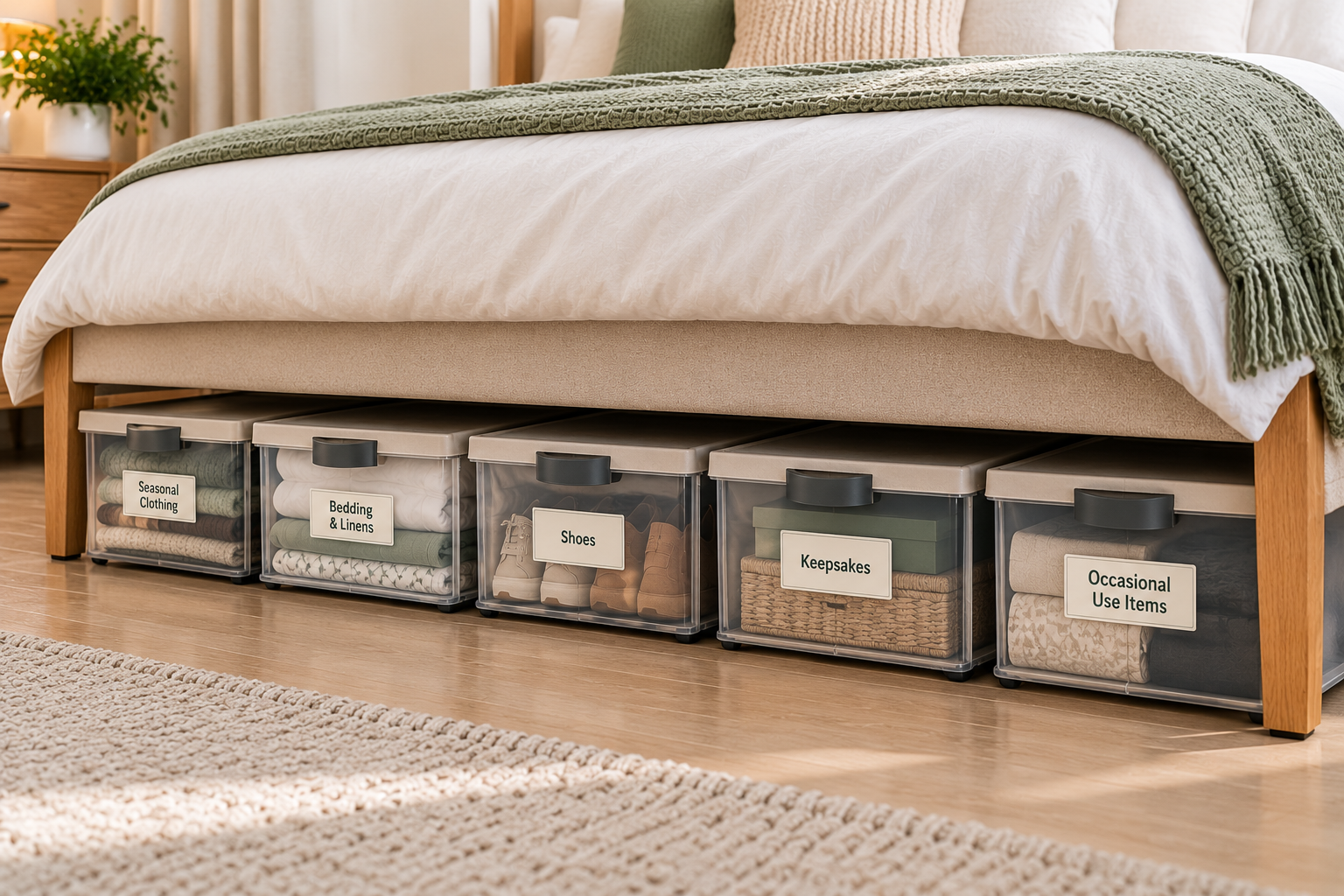
Make broad groups such as seasonal clothing, bedding, shoes, keepsakes, occasional-use household items, and anything that does not clearly belong.
- Keep: items that genuinely suit under-bed storage.
- Move: items that belong in a more accessible or more suitable location.
- Remove: items you no longer need.
- Review: anything that has become a miscellaneous category.
Ask one useful question before returning something to the space:
If the answer is no, do not automatically put it back. The goal is to build a storage system deliberately rather than preserve an existing pile.
Measure the Usable Under-Bed Space
Measure before buying storage. The dimensions of the bed do not tell you how much storage space you can actually use.
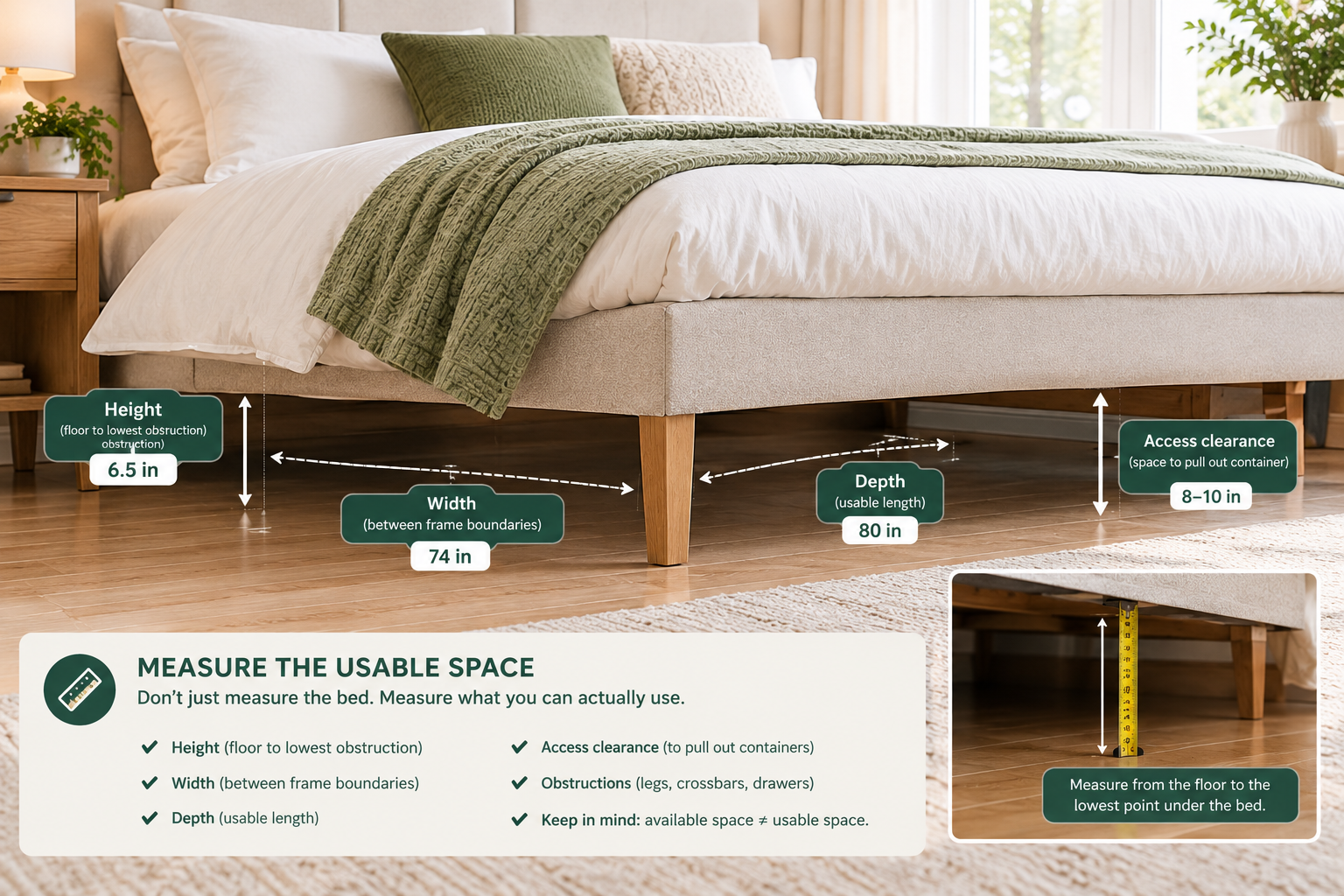
- Height: floor to the lowest obstruction.
- Width: the usable distance between frame boundaries or other obstructions.
- Depth: how far storage can extend while remaining retrievable.
- Access clearance: the space needed to pull a container out.
- Obstructions: legs, supports, crossbars, nearby furniture, drawers, or other features.
Measure the storage movement as well as the storage space. A container can fit underneath the bed and still be a poor choice if it cannot be pulled out without moving other things.
Also measure the largest items that need to remain accessible. The usable storage area is determined by both the physical opening and the way you need to retrieve what is inside.
Decide What Actually Belongs Under the Bed
Not everything that fits underneath the bed belongs there. Under-bed storage is usually more useful for belongings that do not need constant access and can be stored appropriately in that environment.
How often will you need the item?
Is the item practical to retrieve from floor level?
Does the location suit the item’s requirements?
Can the item be moved comfortably?
Does the item justify the storage space it uses?
What Should You Store Under the Bed?
Suitable categories depend on your belongings and the conditions under the bed, but lower-frequency items are often a better fit than things you use every day.
- Seasonal clothing: items that are rotated rather than worn every week.
- Extra bedding: spare linens and bedding that are used occasionally.
- Selected shoes: footwear that is appropriate for protected storage and not needed frequently.
- Keepsakes: suitable personal items that do not need regular access.
- Occasional-use household items: belongings that are appropriate for the available storage conditions.
These are examples, not universal rules. The right category depends on the item, your household, the available space, and any storage requirements that apply.
What Should You Not Store Under the Bed?
An item may be a poor candidate when the location creates more problems than it solves.
- Items you need to access frequently.
- Heavy or awkward items that are difficult to pull out safely.
- Items that require storage conditions the space cannot provide.
- Items that are vulnerable to dust or unsuitable exposure.
- Oversized items that block other storage or cannot be retrieved easily.
- Items that create a household safety or access problem.
The question is not simply whether an item can fit. It is whether under-bed storage is a sensible location for that item.
Create Categories Before Choosing Containers
Define the categories before you buy or assign containers. Otherwise, the container can start dictating the organization instead of solving a real storage problem.
Use categories that match how you will actually search for the contents. For example, “Winter Bedding” is easier to act on than a broad “Blankets” category if the items are used together.
Match the Storage Method to the Space
Once you know what belongs under the bed and how much space is available, match the storage method to the actual problem.
| Actual problem | Possible response | Check first |
|---|---|---|
| Very low clearance | Use shallower storage that fits the measured opening. | External height, including any lid or handle. |
| Frequent retrieval | Use an easier-access storage method or move the category elsewhere. | Pull-out clearance and retrieval frequency. |
| Dust exposure is a concern | Use more protective enclosed storage where appropriate. | Whether the container suits the contents. |
| Soft textiles need grouping | Use a suitable textile-oriented storage method. | Compression, moisture, and access requirements. |
| Awkward or irregular space | Reduce the category size or reconsider whether the space is worth using. | Whether the storage can still be retrieved easily. |
Do not try to fill every available gap. Leaving some clearance can make the system easier to inspect, clean, and use.
Make Under-Bed Storage Easy to Access
Hidden storage is only useful when you can retrieve what you need without creating another mess.
Keep the most frequently accessed categories closer to the easiest access point. Less-used items can occupy less convenient areas when they can still be retrieved safely.
Pay attention to container weight, pull-out clearance, and whether one container blocks another. If you have to remove several unrelated containers to reach one item, the system is not working as intended.
Choose one item you realistically expect to retrieve. Pull it out, find the item, and return everything to its place. If that simple sequence is frustrating, change the arrangement before adding more storage.
Label Hidden Storage
Labels become especially useful when storage is hidden. A container that cannot be seen clearly should still be easy to identify.
Use short category labels that match the contents:
- Winter Bedding
- Seasonal Clothing
- Guest Linens
- Keepsakes
- Occasional Shoes
Avoid turning every label into an inventory list. The purpose is to identify the category quickly, not document every item inside.
How to Organize Under-Bed Storage in a Small Bedroom
Under-bed storage can be particularly useful when a small bedroom has limited closet or dresser capacity. The key is to reserve easier-to-reach storage for things you use more often and use the space beneath the bed for suitable lower-frequency categories.
This approach works alongside the broader room system described in How to Organize a Small Bedroom. The under-bed area should support that system rather than become a separate place where everything without a home gets hidden.
If the bedroom also lacks a closet, the storage decision becomes more important because several categories may be competing for limited space. How to Organize a Small Bedroom Without a Closet covers the wider room-level problem.
How to Handle Deep or Difficult-to-Reach Space
A deep under-bed area can create the illusion of abundant storage while making retrieval difficult.
Avoid creating a second row of containers that blocks the first row unless the items in the back are genuinely low-frequency and the arrangement remains manageable.
If the space is difficult to reach, consider using fewer categories, reducing the amount stored there, or moving some belongings to a more accessible location.
You do not have to use every inch of available space. Sometimes leaving part of the area open is what makes the rest of the storage practical.
Before Buying Under-Bed Storage
- What exact problem am I trying to solve?
- What are the actual height, width, and depth measurements?
- How often will I retrieve the contents?
- Does the storage fit without wasting usable space?
- Can I pull it out without moving unrelated items?
- Does it suit the contents and their storage requirements?
- Can I identify what is inside?
- Will it make the system easier to maintain?
If you cannot identify the problem, measure the space, or explain how the storage will improve access, wait before buying it.
Test the System
A storage system is not finished when the containers are full. It is finished when you can use the system during a normal routine.
Store
Place each category in its assigned location.
Retrieve
Take out an item you would realistically need.
Return
Put the item back without reorganizing everything else.
Adjust
Change the arrangement if any part of the process is awkward.
Failure Signals
Watch for repeated problems rather than assuming you need more storage.
- Containers cannot be pulled out easily.
- Categories become mixed together.
- Items are forgotten because the labels or categories are unclear.
- One container becomes a miscellaneous box.
- Retrieving one item requires moving several unrelated items.
- The space becomes difficult to clean or inspect.
- The under-bed area gradually becomes a dumping ground.
- Storage containers consume so much clearance that access becomes difficult.
These are signals to change the system, not automatic reasons to buy another organizer.
Under-Bed Storage Reset Routine
A short review keeps hidden storage from becoming forgotten storage.
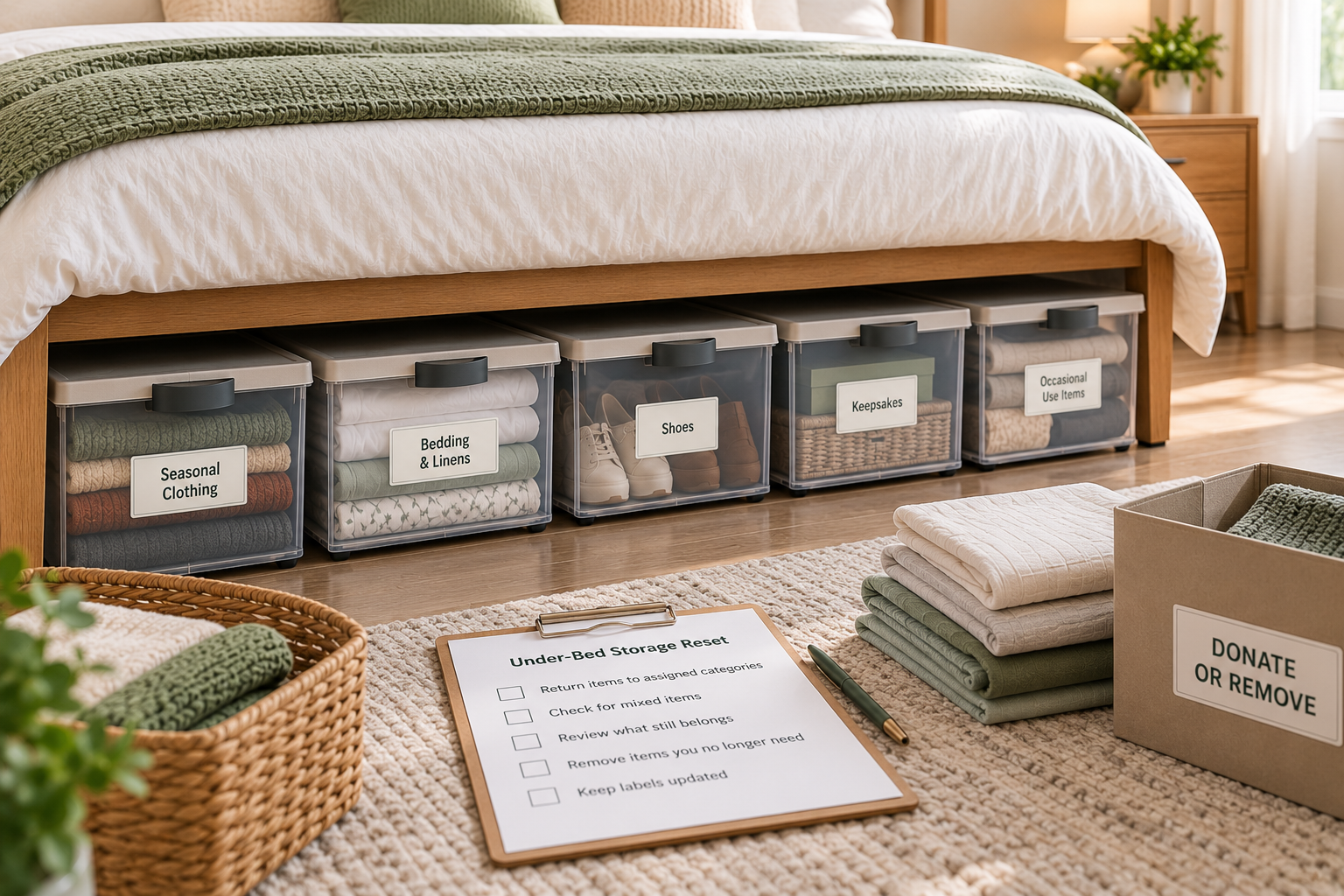
Put items back into their assigned categories.
Look for mixed categories, crowding, or misplaced items.
Ask whether each category still deserves the space.
Take out anything that no longer belongs in the system.
Keep the reset simple. If maintaining the space requires a major reorganization every time, the underlying system is probably too complicated.
Common Questions About Under-Bed Storage
How do I organize under-bed storage?
Empty the space, measure the usable clearance, decide what belongs there, group similar items, choose storage that fits, label the contents, and test retrieval before considering the system finished.
What should I store under the bed?
Lower-frequency belongings such as suitable seasonal clothing, spare bedding, selected shoes, keepsakes, and other appropriate occasional-use items can work well. The item and the storage conditions should determine whether it belongs there.
What should I not store under the bed?
Avoid using the space for items that need frequent access, are too heavy or awkward to retrieve, require storage conditions the location cannot provide, or create a safety or access problem.
How do I measure under-bed storage space?
Measure the usable height from the floor to the lowest obstruction, the usable width, the depth available for storage, and the clearance needed to pull a container out. Also check legs, supports, crossbars, nearby furniture, and other obstructions.
What is the best way to organize under-bed storage?
Start with the contents and the available space rather than a storage product. Decide what belongs there, create useful categories, choose storage that fits those categories, label hidden contents, and test retrieval.
How do I organize under-bed storage in a small bedroom?
Reserve easy-to-reach bedroom storage for frequent-use belongings and use the under-bed area for suitable lower-frequency categories. Keep the system limited to items that genuinely benefit from that location.
How do I keep under-bed storage from becoming cluttered?
Give each category a defined home, label hidden containers, avoid miscellaneous storage, and use a short reset routine. Periodically remove items that no longer deserve the space.
How do I organize deep under-bed storage?
Keep the easiest-to-reach area for categories you access more often and use deeper space for lower-frequency items. Avoid stacking or arranging containers so that retrieving one item requires unloading several others.
Do I need containers for under-bed storage?
Not necessarily. A container is useful when it solves a specific problem such as grouping, protection, identification, or access. Start with the category and measurements before deciding whether a container is needed.
How often should I review under-bed storage?
Review it whenever a category becomes difficult to access, mixed, or overcrowded, and periodically as part of normal household organization. The goal is to prevent hidden storage from becoming forgotten storage.
Related Guides
The Bottom Line
Under-bed storage works best when it has a defined job. Do not use the space simply because it is empty.
AUDIT → MEASURE → DECIDE → CATEGORIZE → CONTAIN → ACCESS → LABEL → REVIEW
Start with what you already own. Measure the space you can actually use. Choose categories that make sense for your household, then match the storage method to the contents and the available clearance.
Finally, test the system during real retrieval and return. When hidden storage is easy to identify, access, and reset, the space beneath the bed becomes useful storage instead of a place where clutter disappears.