
A small bedroom can become difficult to use even when you do not own an extreme amount of stuff.
The problem may be the furniture footprint. It may be clothing that no longer fits comfortably into the closet. It may be floor clutter, poorly placed storage, unused space under the bed, or everyday items that never seem to have a proper home.
That is why the best place to start is not with storage products.
Start by finding the problem.
A small bedroom does not need more storage everywhere. It needs a system that protects usable space, gives everyday items a home, and makes the storage you already have work harder.
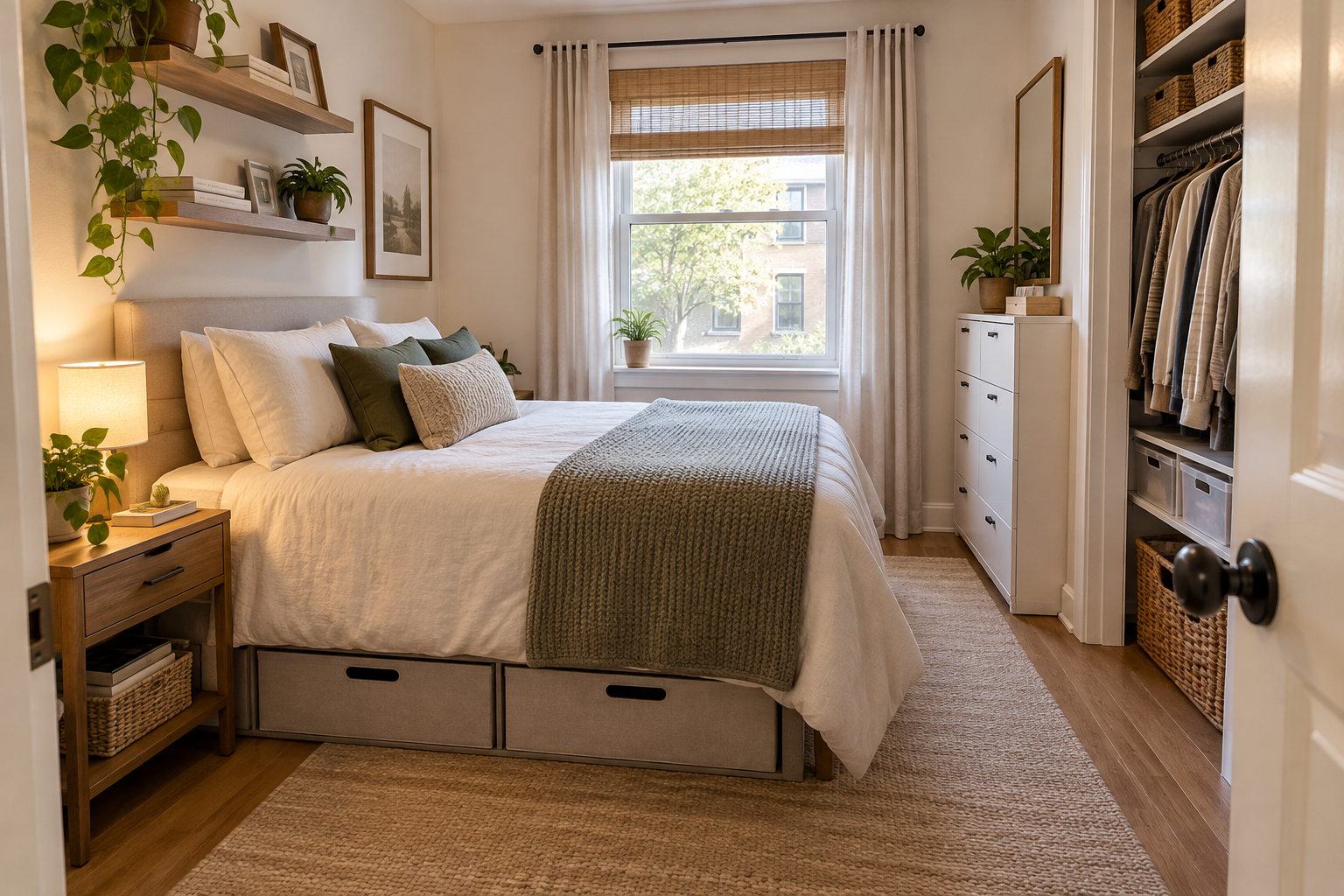
1. Find Your Bedroom’s Biggest Bottleneck First
Before organizing the room, identify what is actually making it difficult to use.
Look around the bedroom and ask:
- Is the floor becoming a dumping ground?
- Is clothing overflowing from the closet or dresser?
- Is the bedside area collecting too many items?
- Are storage areas full while other spaces remain unused?
- Is furniture taking up more room than the storage it provides?
- Are you keeping more belongings in the bedroom than the room can comfortably hold?
These problems require different solutions.
A clothing problem may need better closet allocation.
A floor-space problem may require moving items into existing storage.
A furniture problem may require changing the layout or removing a piece.
An inventory problem may require reducing what the bedroom is being asked to store.
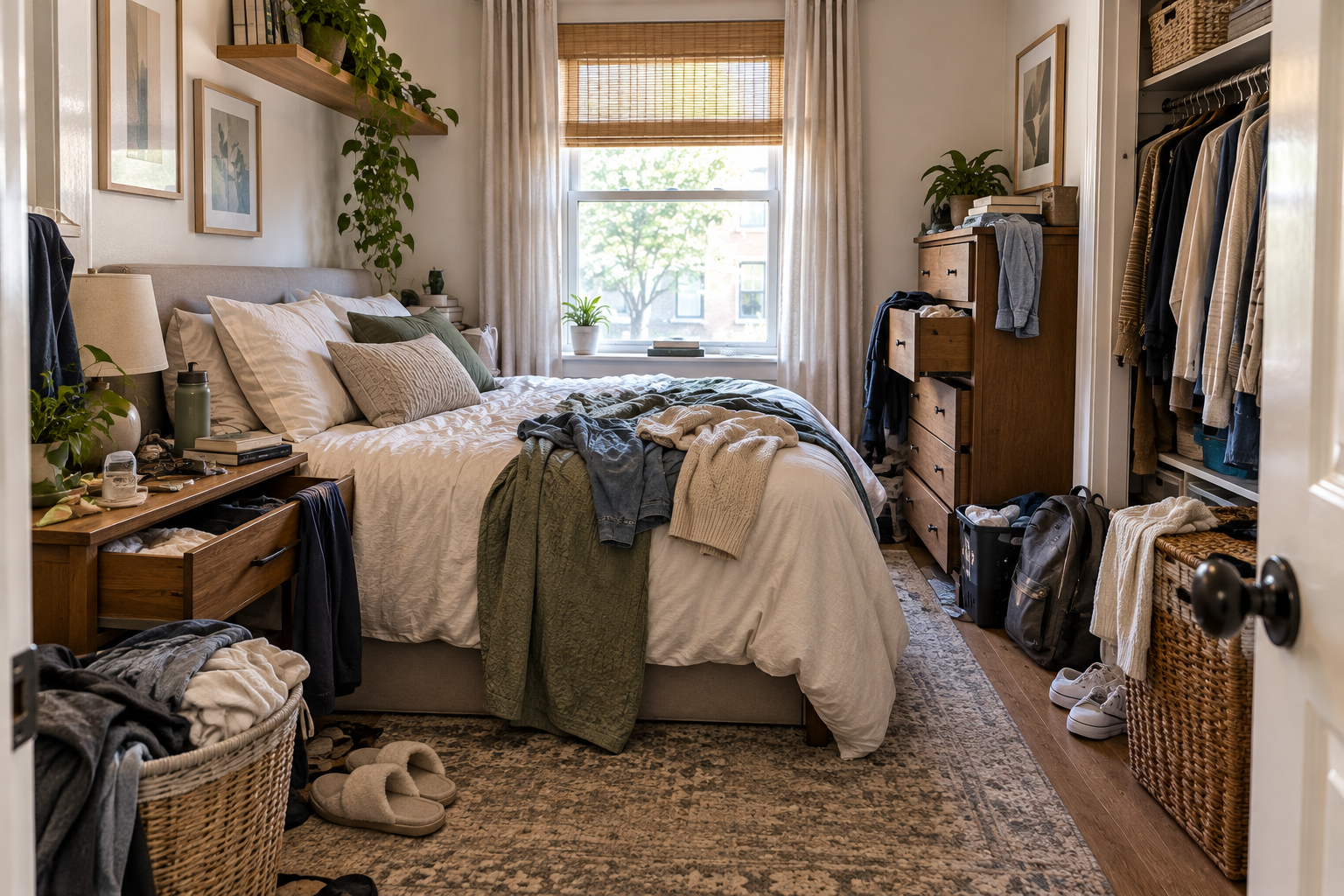
2. Clear Out What Does Not Need to Stay
Once you know the main problem, remove anything that does not need to live in the bedroom.
Keep Here
Things you use regularly in the bedroom.
Move Elsewhere
Items that belong in another room.
Seasonal or Occasional
Things you need but rarely access.
Remove
Items you no longer need, use, or want.
The important distinction is this:
A small bedroom should not automatically become storage for every category of belongings you own.
For example, seasonal items may be better stored in a lower-access location. Extra household supplies may belong elsewhere. Items used only occasionally may not deserve prime bedroom storage.
Clear the room before deciding how much storage it needs.
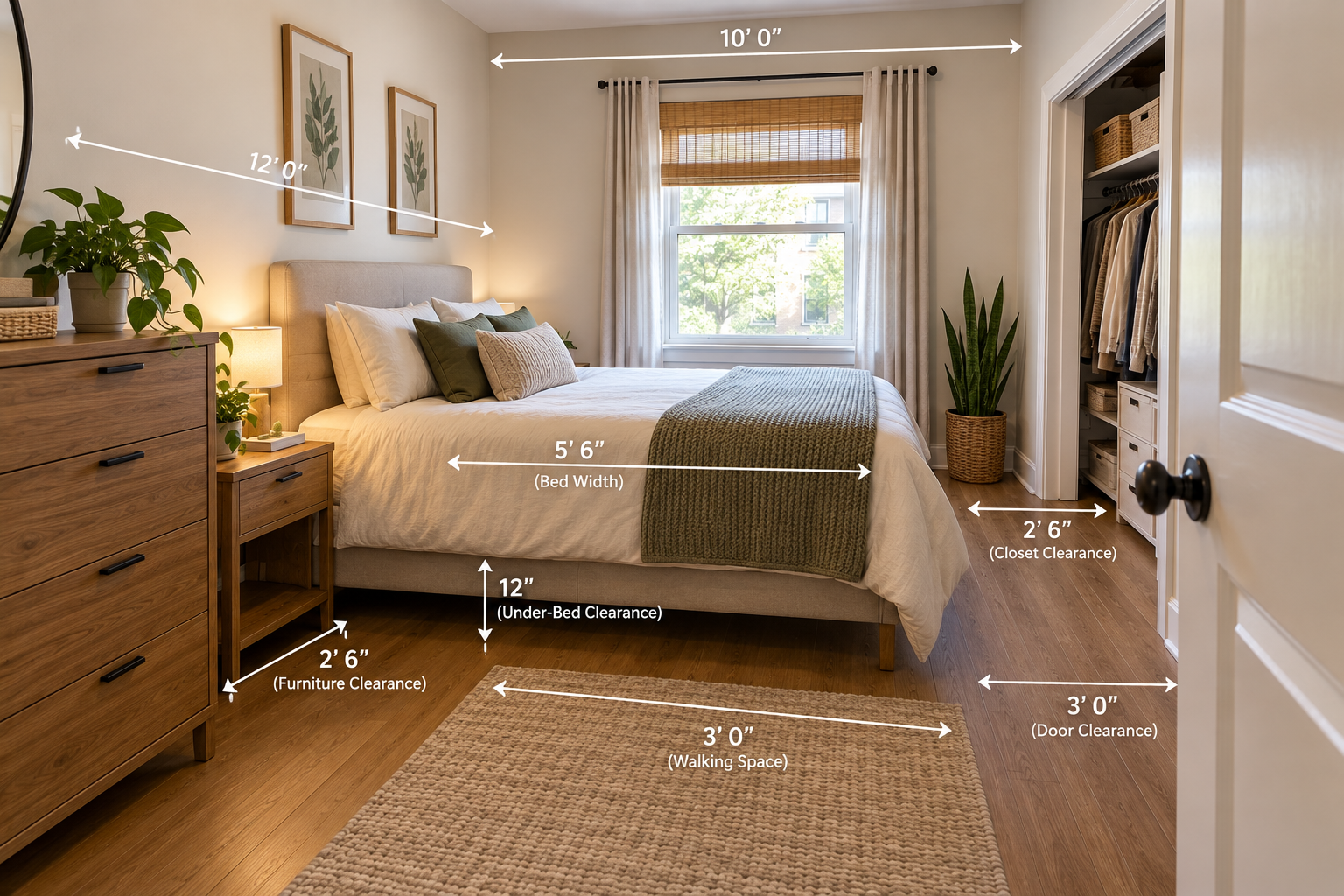
3. Measure the Room and Its Usable Storage
Small rooms leave less room for guesswork.
Before moving furniture around, measure the space you actually need to use.
Measure:
- Room length
- Room width
- Bed footprint
- Furniture footprints
- Closet opening
- Door swing
- Drawer and cabinet clearance
- Window locations
- Usable wall space
- Under-bed clearance
- Available walking space
Do not measure only the furniture.
Measure the clearances around it too.
A dresser may physically fit beside a bed, but that does not mean the drawers can open comfortably. A storage unit may fit against a wall but block the path to the closet. A bed may fit into a corner but make the room difficult to enter and move around.
4. Categorize What the Bedroom Actually Needs to Hold
After clearing the room, make a simple inventory of the categories that genuinely need bedroom storage.
Common categories include:
- Everyday clothing
- Shoes
- Bedding
- Bedside essentials
- Laundry
- Books
- Personal-care items
- Charging and technology
- Seasonal clothing
- Occasional belongings
Then ask one important question:
This prevents a common mistake: buying organizers before understanding what they are supposed to organize.
For example, if the bedroom contains clothing, books, electronics, paperwork, hobby supplies, bags, and household items, adding more containers may only make the problem harder to see.
Categorize first.
Contain later.
5. Assign Each Category to the Right Storage Area
Once you know what needs to stay, give each category a logical storage location.
Think about both frequency of use and ease of retrieval.
Everyday clothing should be easy to reach.
Seasonal clothing can use lower-access storage.
Bedding can go into appropriate under-bed or secondary storage when practical.
Bedside essentials should stay close to the bed.
Laundry should have a defined place rather than a permanent place on the floor.
Books can have a dedicated shelf or bedside location.
Chargers and frequently used technology can have a defined charging zone.
The goal is not to fill every drawer.
The goal is to make the room predictable.
When you know where a category belongs, putting something away becomes a simple action instead of another organizing decision.
6. Protect the Walking Space Before Adding Storage
In a small bedroom, open floor space is valuable.
Before adding another shelf, cabinet, basket, or storage unit, protect the routes you use every day.
Check the path:
Then check whether you can comfortably:
- Walk around the bed
- Open closet doors
- Open drawers
- Enter and leave the room
- Reach frequently used items
- Access the window
- Stand where you need to stand
A room can technically contain more storage while becoming less functional.
The objective is not maximum storage volume. It is maximum useful storage without sacrificing the space needed to live in the room.
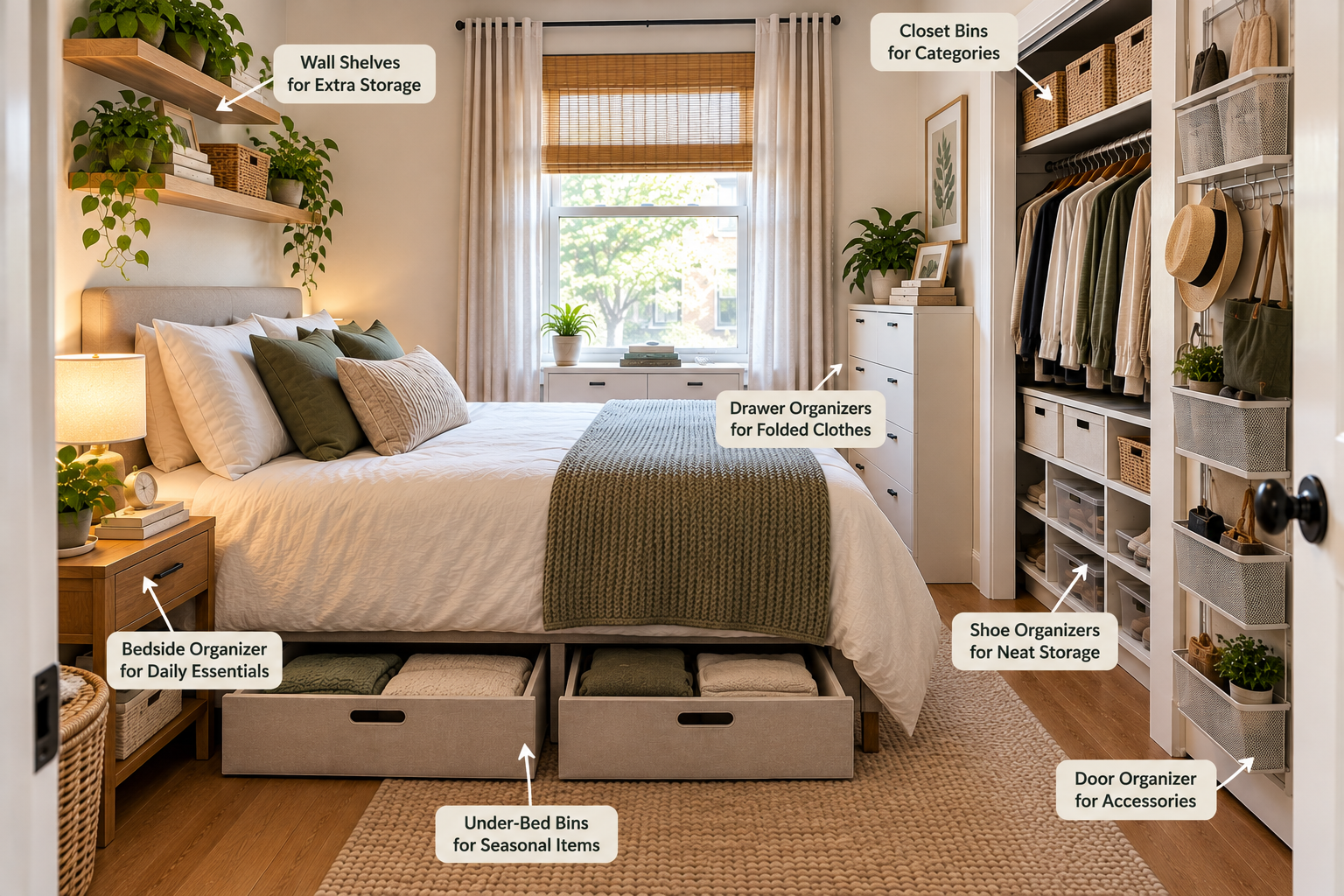
7. Use Existing and Vertical Storage Before Adding Furniture
Look carefully at the storage you already have.
Your bedroom may already contain useful capacity in:
- The closet
- Dresser drawers
- Bedside furniture
- Shelves
- Under-bed space
- The back of the door
- Unused wall space
Use these areas deliberately before assuming another piece of furniture is necessary.
Vertical storage can help when appropriate because it uses wall height instead of additional floor area.
But “go vertical” is not a universal answer.
A shelf that is difficult to reach may not improve everyday storage. A wall filled with visible containers may make the room feel more crowded. A door organizer may be useful for lightweight, frequently accessed categories but unnecessary for items that are better stored elsewhere.
Use the space that fits the category and the way you actually retrieve it.
If you have usable under-bed clearance, a low-profile storage container can help move seasonal or occasional items away from prime floor and closet space. Before buying, measure the available height and check how easily the container can be accessed.
See the under-bed storage option
For drawers that hold smaller categories, organizers can help keep items separated instead of allowing one drawer to become a mixed pile.
See the drawer organizer option
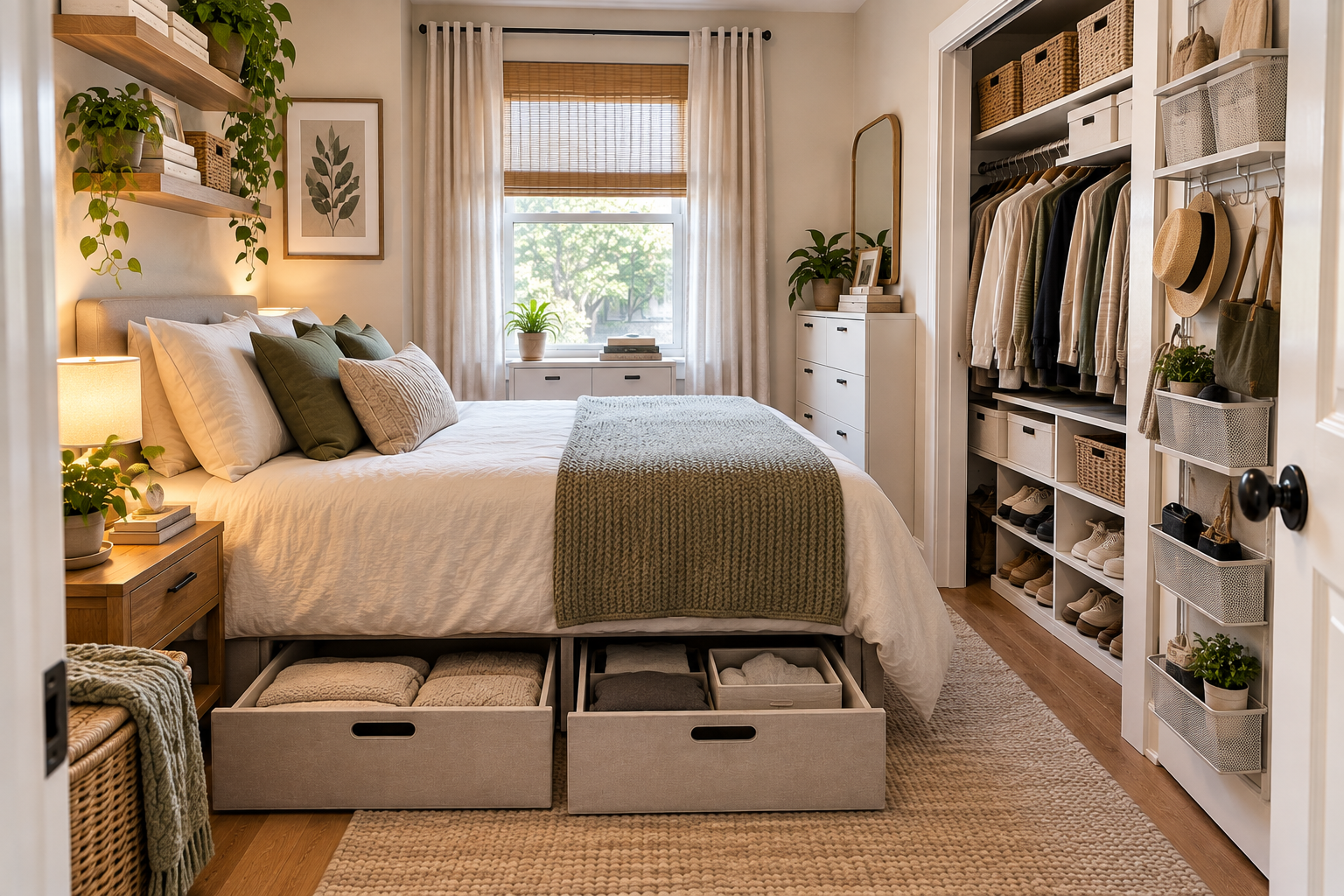
8. Match the Storage to the Actual Problem
This is where many bedroom organization projects go wrong.
They start with a product instead of a problem.
Instead, work backwards from the bottleneck.
| Problem | Storage direction |
|---|---|
| Floor clutter | Move suitable items into existing storage or use appropriately placed storage |
| Clothing overflow | Improve closet or dresser allocation |
| Bedside clutter | Create a defined bedside landing zone |
| Seasonal items | Use lower-access or secondary storage |
| Shoes and bags | Create a dedicated category zone |
| Miscellaneous items | Categorize before containing |
| Furniture crowding | Remove, relocate, or reconsider the furniture footprint |
| Unused wall space | Consider suitable vertical storage |
A storage product is useful only when it solves a clearly identified problem and fits the available space.
If closet space is the problem, a stackable bin can help contain a defined category after you have measured the shelf and confirmed that the bin fits.
If the back of the bedroom door is genuinely suitable for storage, an over-door organizer can use otherwise unused vertical space. Check the door, clearance, and the weight of the items before choosing this approach.
See the over-door organizer option
9. Make Every Piece of Furniture Earn Its Footprint
Furniture takes up some of the most valuable space in a small bedroom: floor space.
So every piece should have a reason to be there.
Ask:
- Does it solve a real problem?
- Does it support something I actually do?
- Does it provide useful storage?
- Does it make another area easier to use?
- Is the amount of floor space it occupies justified?
This does not mean every piece of furniture needs multiple functions.
A simple nightstand can be valuable if it provides the right amount of bedside storage without consuming unnecessary floor space.
A dresser can be valuable if it stores clothing efficiently and remains easy to access.
The question is not whether furniture is multifunctional.
The question is whether its footprint earns its place.
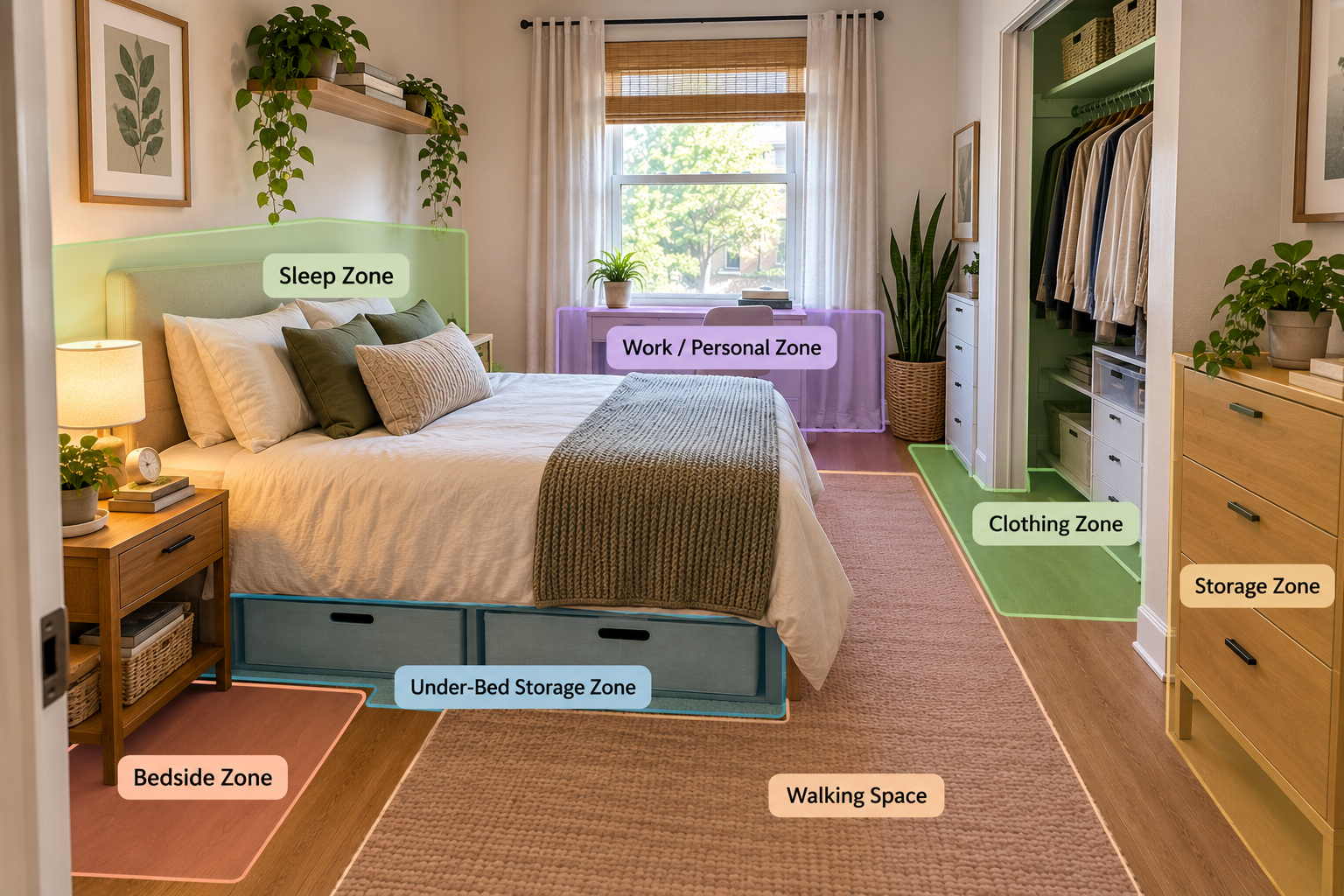
10. Organize for Everyday Access
A bedroom should follow the way you use it.
Create practical zones around real activities.
Sleep Zone
Keep the area around the bed calm and easy to access.
Clothing Zone
Keep everyday clothing where it can be reached without creating unnecessary steps.
Getting-Ready Zone
Group the items you regularly use when getting dressed or ready.
Bedside Zone
Keep only the essentials that genuinely need to be within reach of the bed.
Personal-Care Zone
Give frequently used personal-care items a defined location.
Work or Study Zone
If applicable, give work or study items their own boundary.
Seasonal Storage Zone
Keep occasional belongings out of prime-access storage whenever practical.
The best organization system follows behavior.
If an item is constantly used, its home should not require unnecessary effort to retrieve or return it.
11. Test the Layout Before Buying More
Do not assume the first arrangement is the final arrangement.
Live with the layout for a short period and look for friction.
Notice:
- Blocked paths
- Awkward drawer openings
- Difficult closet access
- Items accumulating on the floor
- Surfaces that repeatedly become cluttered
- Storage that is annoying to use
- Categories that still do not have homes
These are signals.
If clothing keeps landing on a chair, the problem may not be discipline. The closet or hamper may simply be inconvenient.
If items repeatedly collect beside the bed, the bedside zone may need adjustment.
If a storage unit makes the room difficult to walk through, the unit may be solving the wrong problem.
Change what creates friction.
12. Give Every Category a Home
Once the layout works, assign a permanent home to each category.
- Clothing → closet or dresser
- Shoes → designated shoe area
- Laundry → hamper
- Books → shelf or bedside storage
- Chargers → charging zone
- Seasonal items → secondary storage
- Accessories → appropriate drawer, shelf, or door storage
- Miscellaneous belongings → a clearly defined category
Avoid creating a large “miscellaneous” container that becomes a permanent hiding place for decisions you have not made.
If a category repeatedly escapes its assigned home, stop and diagnose why.
The storage location may be inconvenient.
The category may be too large.
The items may not actually belong in the bedroom.
Or the container may simply be the wrong size or shape.
Organization works when the system matches the behavior.
13. Reset the Room With a Simple Maintenance System
A small bedroom does not need a complicated maintenance routine.
Keep it simple.
Daily
Return displaced items to their homes and keep the main walking path clear.
Weekly
Correct category drift before misplaced items become the new normal.
Seasonally
Review clothing and other bedroom storage and move seasonal items when appropriate.
The goal is not perfection.
The goal is making the organized state easy to return to.
14. What If the Bedroom Is Still Too Full?
If you have organized the room and it still feels crowded, ask a more important question:
That distinction matters.
You can improve a system, but you cannot create unlimited floor space.
If the room remains overloaded, consider whether:
- Seasonal belongings can move elsewhere
- Excess clothing can be reduced
- Rarely used items can be relocated
- Another storage area can take some categories
- Furniture can be removed or relocated
- Belongings can be reduced before additional storage is purchased
More containers are not always the answer.
Sometimes the system needs less inventory.
15. Small Bedroom Organization: The System in One View
Audit — Find the main bottleneck instead of trying to fix everything simultaneously.
Measure — Understand the room, furniture footprints, clearances, storage capacity, and usable space.
Clear — Remove or relocate things that do not need to stay in the bedroom.
Categorize — Group the belongings the bedroom genuinely needs to hold.
Assign — Give each category an appropriate storage location.
Zone — Organize the room around the activities and routines that actually happen there.
Match — Choose storage based on the problem, space, category, and access requirements.
Test — Live with the arrangement and identify friction.
Reset — Create a simple routine that keeps categories from drifting.
This sequence keeps the process focused on the room rather than on buying more storage.
Frequently Asked Questions
How do I organize a small bedroom with lots of stuff?
Start by identifying what actually needs to stay in the bedroom. Remove or relocate items that belong elsewhere, then categorize what remains. Assign each category to appropriate storage and protect the walking space before adding anything new.
How can I make a small bedroom feel less crowded?
Start with floor space. Reduce unnecessary furniture and belongings, keep walking routes clear, and use existing or suitable vertical storage where it genuinely improves capacity without making the room harder to use.
How do I organize a small bedroom without buying furniture?
You can often make significant improvements by editing what you keep, reallocating closet and dresser space, using under-bed storage, improving existing shelves and drawers, creating defined zones, and giving every category a home.
What should I store under the bed?
Under-bed space can work well for items that are needed less frequently, such as seasonal clothing, spare bedding, or other suitable belongings. Avoid using it as a place to hide frequently needed items if accessing them becomes inconvenient.
How do I maximize storage in a small bedroom?
Start by maximizing the usefulness of existing storage rather than immediately adding more. Review closet allocation, dresser drawers, under-bed space, shelves, and other suitable areas. Then match additional storage to a specific remaining problem.
How do I organize a small bedroom with little closet space?
Separate everyday clothing from seasonal or occasional items first. Use the available closet space for the categories that need the easiest access, then consider appropriate secondary storage for less frequently used belongings. The goal is to avoid forcing the entire clothing inventory into prime-access space.
Final Thought
A small bedroom becomes easier to organize when every part of the room has a job.
You do not need to fill every wall with storage or buy a new organizer for every category.
First understand the problem.
Then measure the space, clear what does not belong, categorize what remains, assign homes, create practical zones, match storage to the actual need, and test the system.
When the system works, putting things away becomes easier because the room already tells you where they belong.
If your bedroom also has a small or difficult closet, you can continue the same problem-first process with our guide to how to organize a small closet .