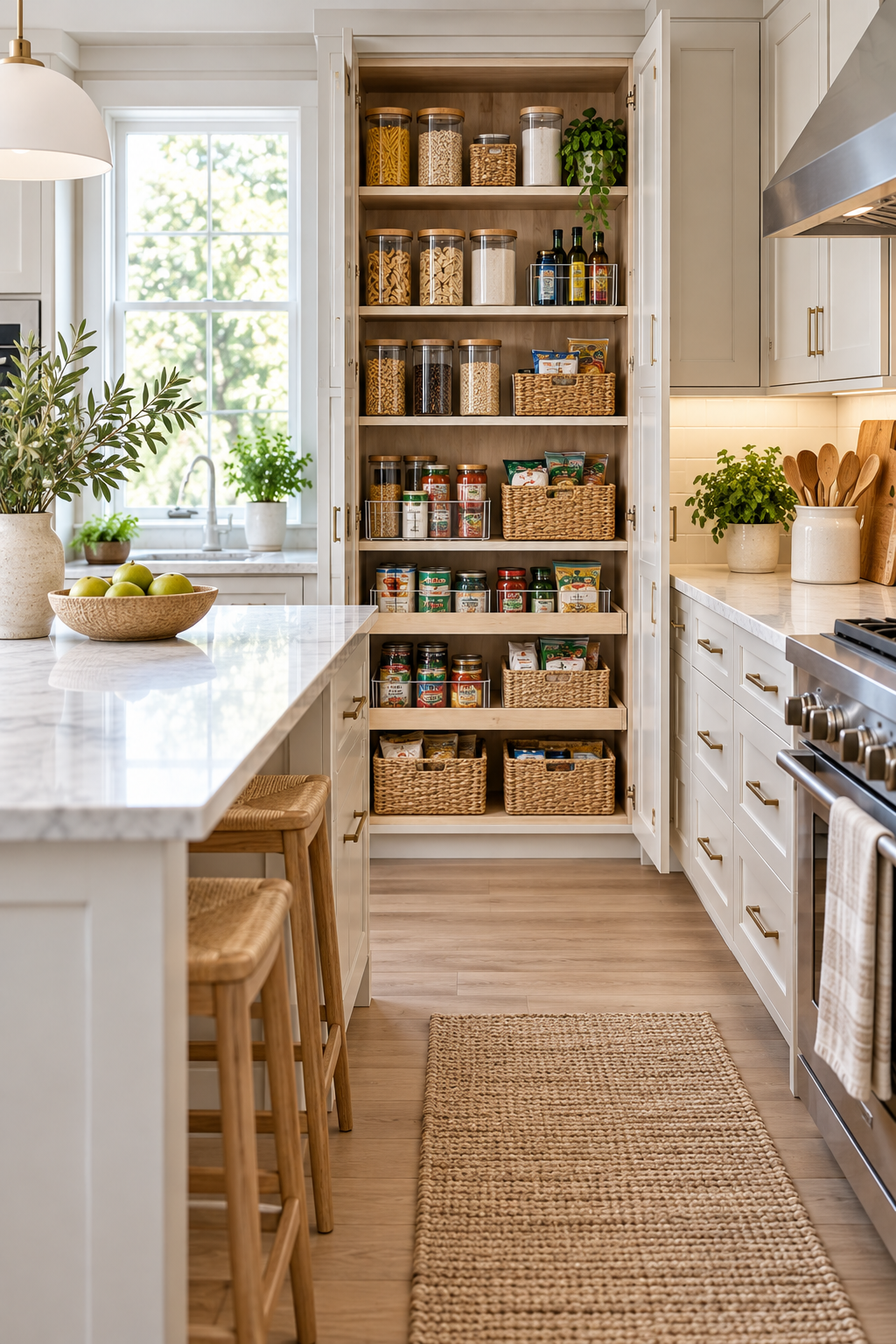
Not having a pantry can make kitchen organization feel harder than it needs to be.
Food may end up spread across several cabinets, drawers, countertops, or other storage areas simply because there isn’t one obvious place for it. Over time, that can make it harder to see what you have, find everyday ingredients, and put groceries away.
But you don’t necessarily need a dedicated pantry to create a useful food-storage system.
The better approach is to look at the storage you already have, decide which space can do the most useful work, and then organize it around the food your household actually keeps.
The goal isn’t to recreate a walk-in pantry. It’s to give your food a predictable home that fits your kitchen.
Start by Finding Where Your Food Already Lives
Before moving anything, take a quick look at where food is currently stored.
- kitchen cabinets
- drawers
- island storage
- shelves
- countertops
- refrigerator and freezer areas
- any other appropriate storage you already use
You may find that food has gradually spread into several different locations.
For example, breakfast foods might be in one cabinet, snacks in another, canned goods in a lower cabinet, and extra supplies somewhere else.
That isn’t necessarily wrong. The problem is when the arrangement makes food difficult to find, difficult to return, or easy to forget.
Make a quick inventory of the problem. You don’t need to create a detailed spreadsheet. Simply identify where food is currently stored, which areas are overcrowded, which items are difficult to reach, which categories are scattered, and where food regularly ends up outside its intended storage area.
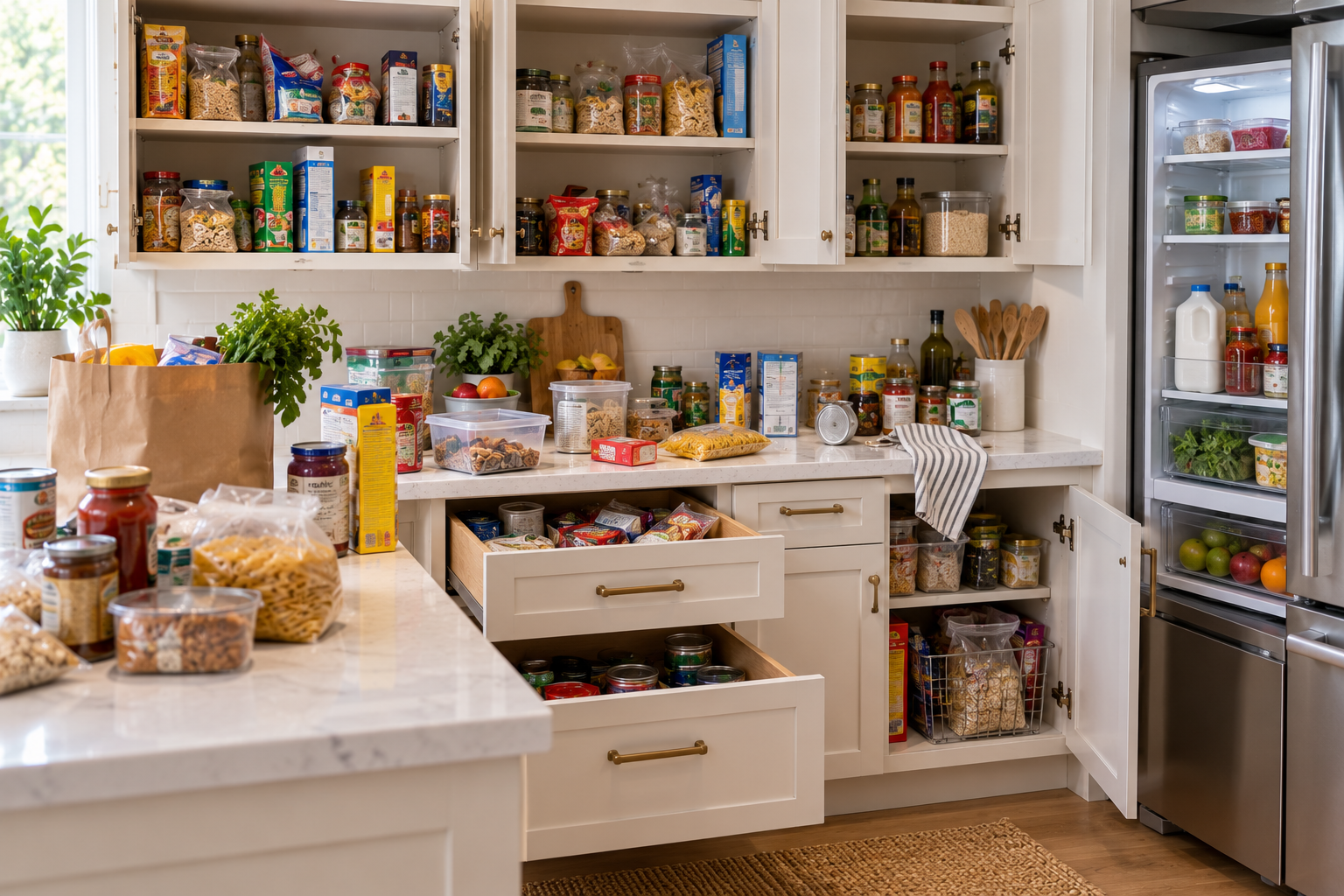
Clear the Space Before You Organize It
Once you’ve identified your existing storage, clear the areas that could potentially become part of your food-storage system.
Remove:
- expired food
- empty packages
- duplicate items you don’t need
- things that belong elsewhere
- kitchen items occupying useful food-storage space
Then group the remaining food loosely by type.
You might have groups such as:
- breakfast foods
- snacks
- pasta and grains
- canned and jarred foods
- baking ingredients
- cooking staples
- sauces and condiments
- backup supplies
Don’t buy containers yet.
The purpose of this stage is to understand what you actually need to store before deciding how the storage should work.
Create a Primary Food-Storage Zone
If your kitchen allows it, choose one main area to serve as your primary food-storage zone.
This might be:
- one tall cabinet
- several shelves within a cabinet
- a group of drawers
- part of a kitchen island
- a suitable freestanding cabinet
- another convenient storage area
The important part isn’t the type of furniture.
It’s the function.
Instead of letting food gradually occupy every available storage space, give the majority of your everyday food a clear home.
Your primary zone doesn’t have to hold everything.
Some kitchens simply don’t have enough suitable storage for every food category in one location. That’s fine.
Use a primary zone for the food you reach for most often, then create secondary storage for categories or backstock that genuinely need somewhere else.
If you’re using a cabinet as your main food-storage area, our guide to how to organize kitchen cabinets covers the broader cabinet system in more detail.
The objective is coordination, not forcing everything into one cabinet.
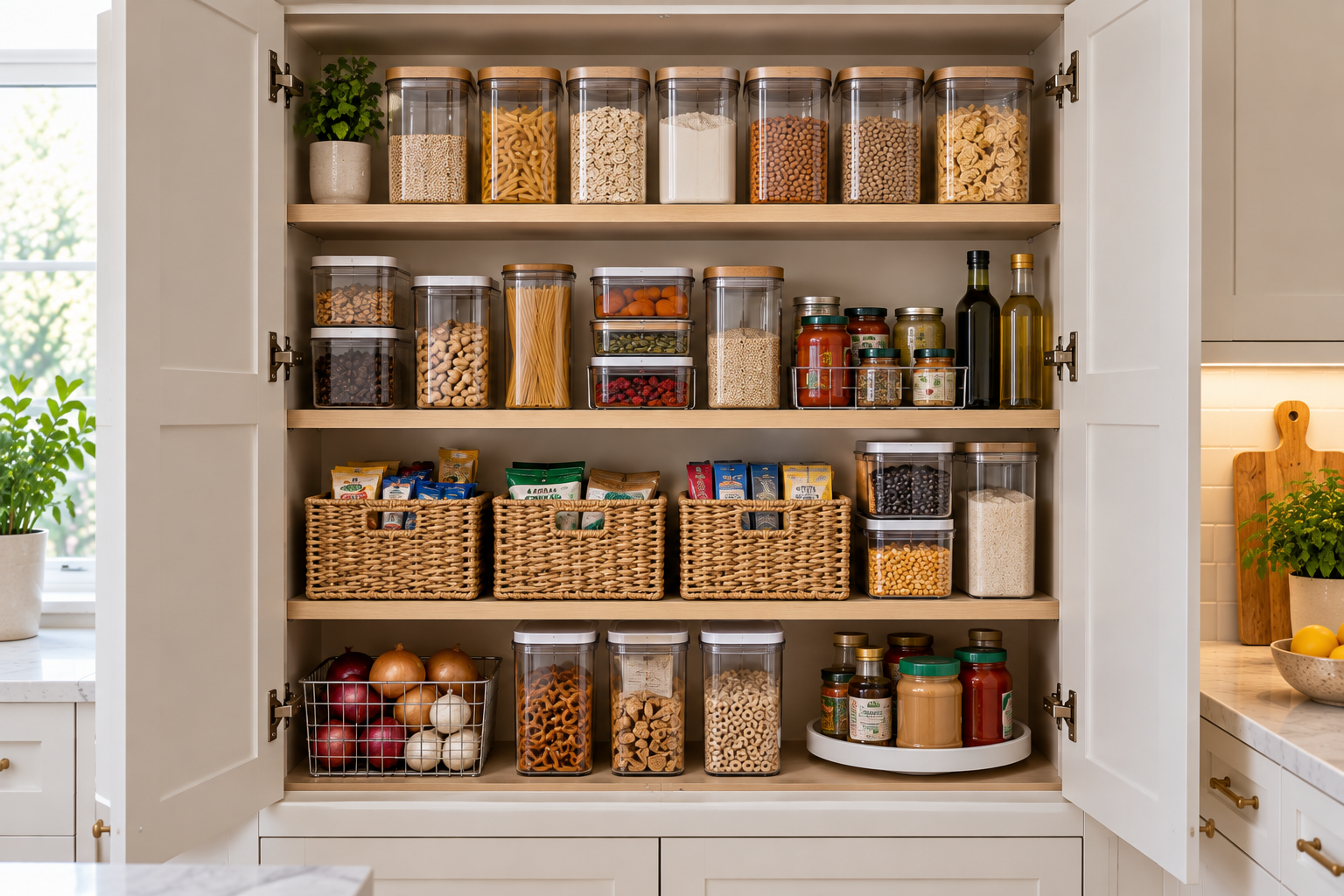
Choose the Best Storage Area
If you have several possible locations, don’t automatically choose the largest one.
Look at how the space actually works.
How much usable space does it provide?
A large cabinet isn’t necessarily useful if much of its depth becomes inaccessible.
Look at the space you can realistically use, not just its outside dimensions.
How easy is it to reach?
Everyday foods should generally be easier to access than items you use occasionally.
Can you see what you have?
Visibility matters.
If food disappears behind other packages, you may forget that you already own it.
How deep is the storage?
Deep cabinets can hold plenty of food while still being frustrating to use.
If you need to move several things before reaching the item behind them, the storage may need a better arrangement rather than simply more capacity.
Is it reasonably convenient?
Food used during cooking or meal preparation should not have to travel unnecessarily far if a more convenient storage location is available.
Can you maintain it?
A system that looks organized on the first day but is difficult to put away isn’t a very useful system.
The best storage area is therefore not simply the one with the most capacity. It is the one that balances capacity, access, visibility, convenience, and maintainability.
Organize the Food by Useful Categories
Once you’ve chosen your main food-storage area, group similar things together.
The exact categories should reflect your household rather than a universal organization template.
For example, you might create areas for:
- breakfast foods
- snacks
- pasta and grains
- canned foods
- baking supplies
- cooking ingredients
- sauces and condiments
- backstock
The point is to make categories easy to recognize.
You shouldn’t have to search through the entire cabinet to find one type of food.
Keep the categories practical
Don’t create a separate category for every small group of items.
If a category contains only one or two things, it may be simpler to keep them with a related group.
Good organization reduces searching.
It shouldn’t create another layer of decisions.
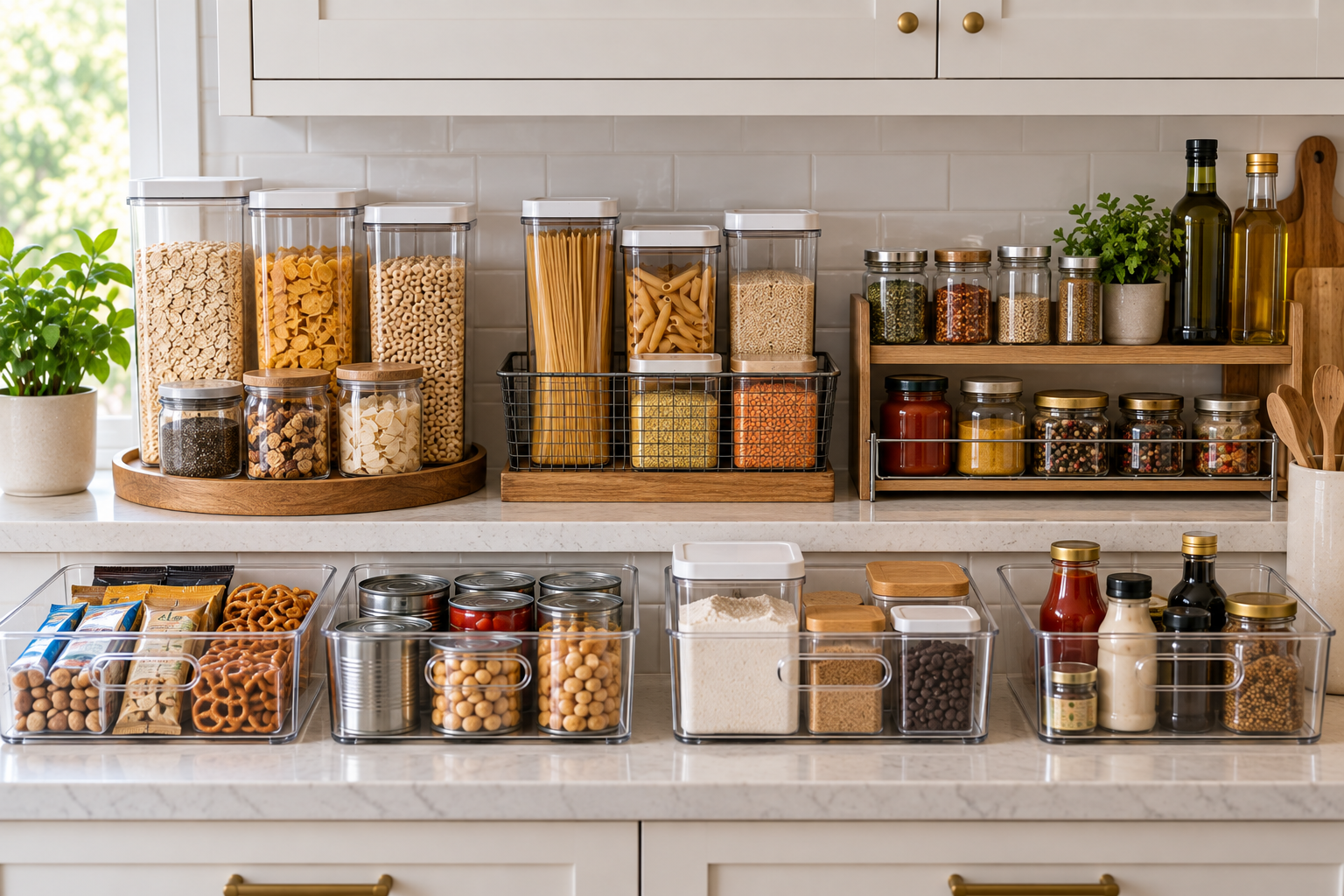
Make Deep Cabinets Easier to See and Reach
Deep storage can create a specific problem:
Capacity without visibility.
You may technically have enough room, but items pushed toward the back can become difficult to see and reach.
Before buying an organizer, identify what’s actually causing the problem.
Is the issue:
- too much inventory?
- mixed categories?
- excessive depth?
- poor visibility?
- small packages getting lost?
- items stacked behind one another?
Different problems call for different solutions.
Depending on the cabinet, useful options can include:
- shelf risers
- bins
- trays
- turntables
- pull-out organizers
These aren’t automatically necessary.
The right organizer is the one that solves the particular storage problem.
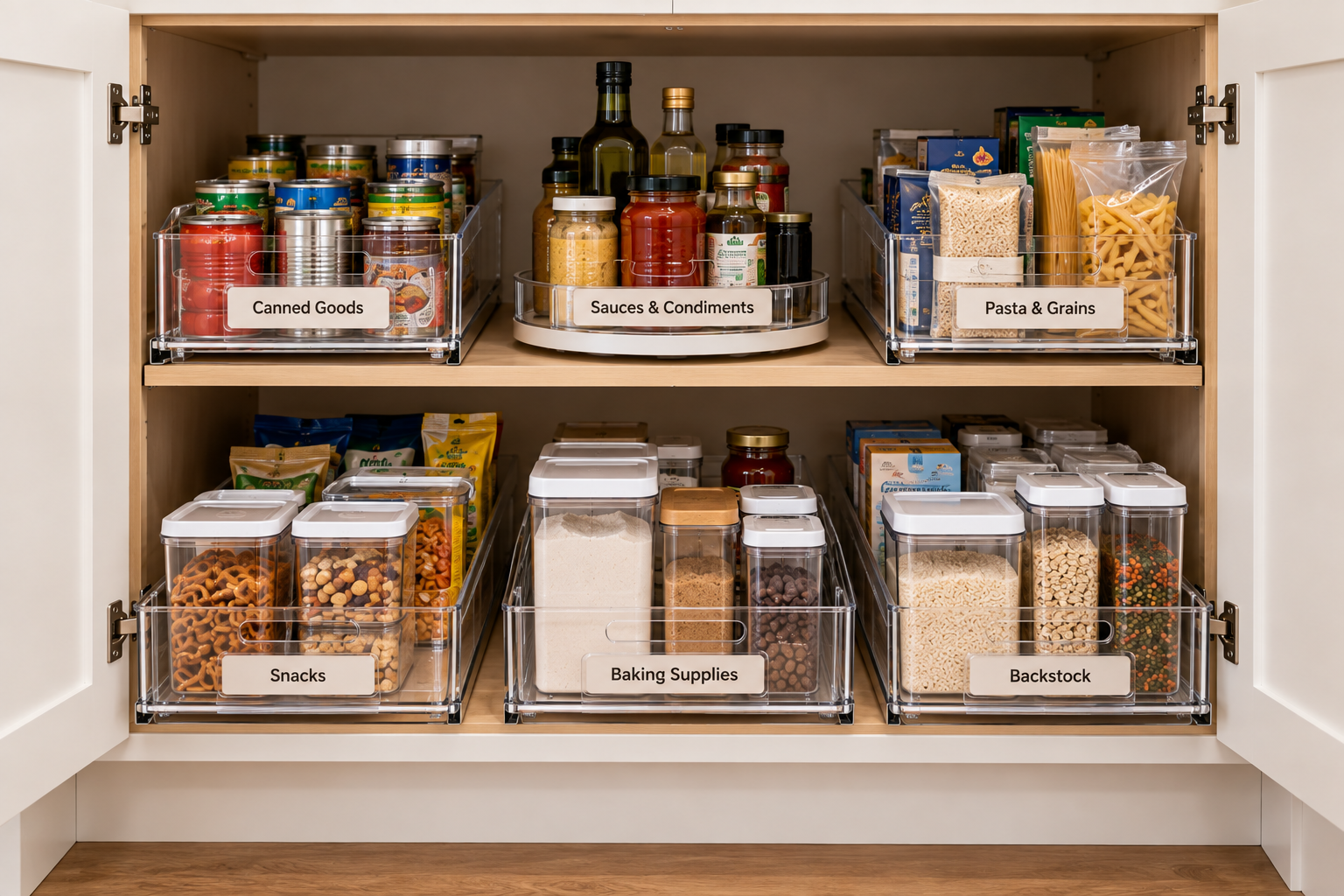
Use Drawers as Pantry Storage When They Make Sense
Drawers can be particularly useful for food because they can make the contents easier to see from above.
They can work well for categories such as:
- snacks
- packets
- breakfast foods
- baking supplies
- other smaller packaged foods
But don’t convert every drawer into food storage.
Consider what else your kitchen needs the drawers to hold and whether the location is convenient for the category.
If you’re reorganizing your kitchen drawers more broadly, see our guide to how to organize kitchen drawers.
Use Vertical and Overlooked Space Carefully
When a kitchen has limited storage, it can be tempting to use every empty wall, cabinet door, narrow gap, or open surface.
Some of these spaces can genuinely help.
They can work as pantry alternatives when they provide appropriate, accessible storage without creating a new clutter problem.
Depending on your kitchen, possibilities include:
- cabinet-door storage
- vertical shelving
- open shelving
- narrow storage
- freestanding furniture
- rolling carts
But there is an important limit:
Unused space isn’t automatically suitable food-storage space.
For shelf-stable foods, choose a cool, dry, appropriate storage area and follow the storage instructions on the package.
So first ask:
Does this space improve storage without creating a new problem?
If the answer is no, leave the space alone.
Handle Bulk Food and Backstock Separately
A pantry-free kitchen can become difficult to manage when everyday food and large quantities of backup food compete for the same limited space.
Start by separating:
Everyday stock
Food you regularly reach for and need to access easily.
Backstock
Extra supplies you don’t need to access every day.
If you have suitable secondary storage, backstock can live separately.
If you don’t, your shopping habits may need to reflect the storage capacity you actually have.
That doesn’t mean you can never buy in bulk.
It means the amount you keep should make sense for the space available.
Keep Food From Spreading Onto the Counter
If food continually ends up on the kitchen counter, don’t assume the answer is simply to clear the counter more often.
Look at why it’s happening.
Perhaps:
- the designated storage area is full
- the food category doesn’t have a clear home
- the cabinet is inconvenient
- items are difficult to see
- there’s too much backstock
- groceries don’t have an easy place to go
Solve that problem first.
Your counter should support kitchen work rather than become overflow storage.
If your countertop is becoming crowded, see our guide to how to organize kitchen counters for a separate system focused on protecting useful working space.
Don’t Buy Organizers Until You Know What You Need
This is one of the easiest mistakes to make.
You see an empty cabinet and immediately start looking for bins, risers, turntables, containers, or shelves.
But the organizer should come after the storage problem has been identified.
Use this sequence:
For example:
- Food is getting lost behind other food → improve visibility.
- Small packets are spreading everywhere → contain the category.
- A cabinet is too deep to use comfortably → improve access.
- Shelves have too much unused vertical space → consider a riser.
- Everything fits comfortably already → don’t add anything.
More storage products do not automatically create a better storage system.
Create a Simple Grocery-to-Storage Routine
An organized food-storage area still needs a routine.
When groceries come home, put them into their designated categories rather than creating temporary piles around the kitchen.
As you use food, return packages to their normal locations.
When you notice a category becoming low, add it to your shopping list.
And before buying large quantities, consider whether you have appropriate space to store them.
The exact routine will vary by household.
The important thing is that putting groceries away should be predictable rather than becoming another organization project every week.
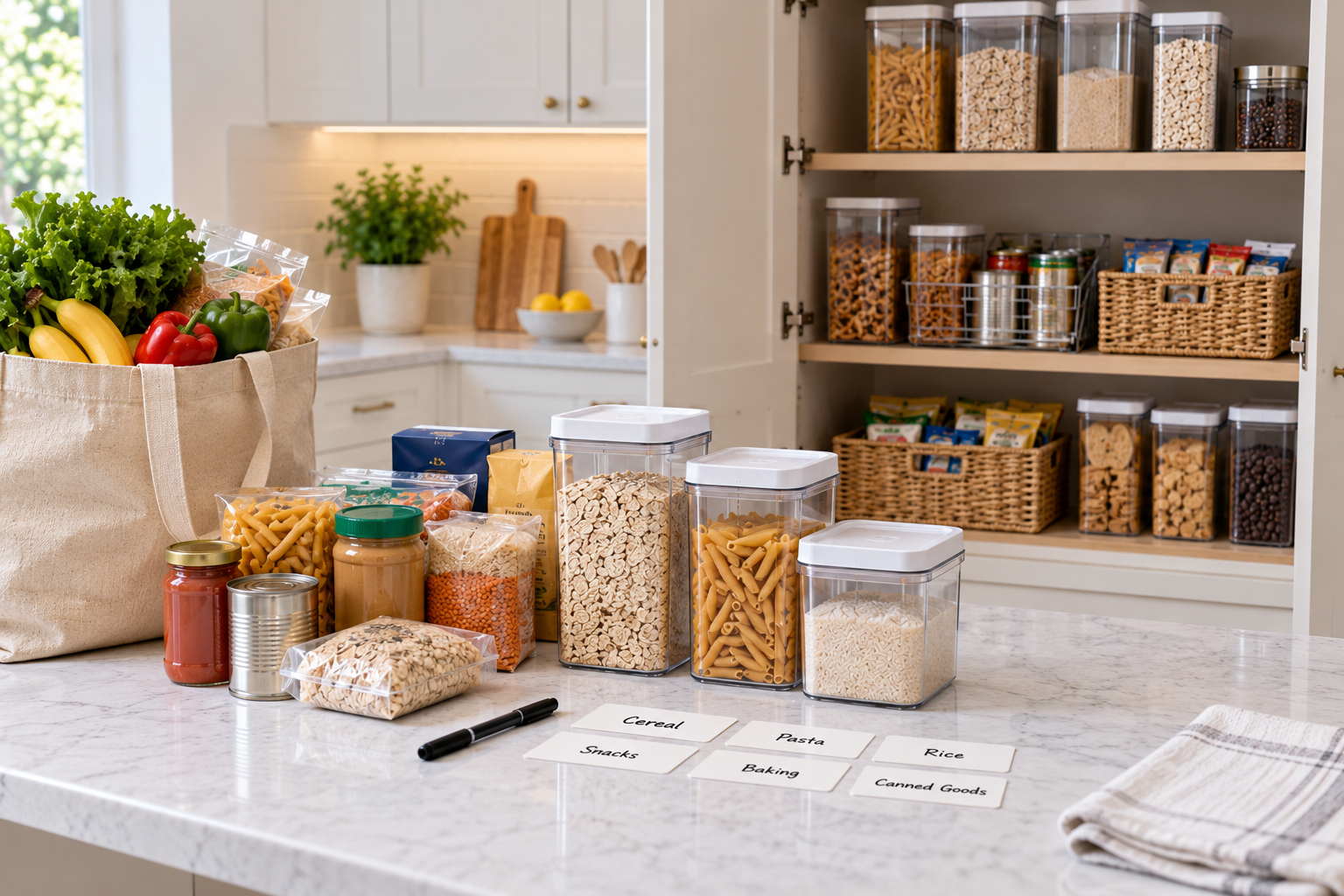
Common No-Pantry Organization Mistakes
Spreading Food Across Too Many Locations
If the same category appears in several unrelated places, finding what you need becomes harder.
Keep categories together where practical.
Organizing Before Clearing
Trying to fit unnecessary items into limited storage makes the problem harder.
Clear first.
Buying Containers First
Containers should solve a problem.
They shouldn’t determine the entire organization system.
Hiding Food Behind Other Food
If you can’t easily see what you own, storage capacity becomes less useful.
Using Every Empty Space
Not every gap, wall, or surface should become storage.
Mixing Everyday Food With Excessive Backstock
Everyday items need easier access than supplies you rarely use.
Ignoring the Conditions of the Storage Area
A convenient location isn’t useful if it isn’t appropriate for the food being stored.
Creating a Complicated System
If putting something away requires too many steps, the system may not survive normal kitchen use.
How to Keep a Kitchen Without a Pantry Organized
Once the system is working, maintenance should be simple.
Use this pattern:
When you finish using an item, return it to its designated category.
When groceries arrive, put them away in the same system.
Every so often, check for:
- expired food
- duplicates
- forgotten items
- categories that have become overcrowded
- food that keeps migrating elsewhere
If something repeatedly ends up outside its assigned home, don’t immediately blame yourself for not maintaining the system.
Ask whether the storage decision itself needs to change.
Sometimes the easiest way to maintain organization is to make the system better suited to the way you actually use the kitchen.
Kitchen Without a Pantry FAQ
Where should I store food if I don’t have a pantry?
Use the most suitable existing cabinet, drawer, shelf, island storage, or other appropriate area as your primary food-storage zone. Choose the location based on capacity, accessibility, visibility, convenience, and how easy it is to maintain.
How do I turn a kitchen cabinet into a pantry?
Start by clearing the cabinet, grouping your food into useful categories, and assigning each category a logical area. Then use an organizer only if it solves a specific problem such as poor visibility, wasted vertical space, or difficult access.
How do I organize a small kitchen without a pantry?
Protect your most useful working and storage areas first. Keep everyday food accessible, use storage efficiently, and avoid filling every available surface. For a broader small-kitchen system, see our guide to how to organize a small kitchen.
Can kitchen drawers replace a pantry?
They can serve as part of a pantry-style food-storage system when their size, location, and layout make sense. Drawers can be particularly useful for smaller packaged foods and categories that benefit from easy visibility.
Should I use containers for pantry food?
Only when containers solve a specific storage problem. They can help contain loose foods, improve visibility, or group small packages, but you don’t need matching containers simply to make the kitchen look organized.
How should I store bulk food without a pantry?
Separate everyday food from backstock where possible. Keep only the amount of backup food that fits comfortably into appropriate storage, and consider your available capacity when deciding how much to buy.
How do I keep a kitchen without a pantry organized?
Give food predictable homes, keep categories together, return items after use, and periodically review overcrowded or inconvenient areas. If the same items repeatedly end up elsewhere, adjust the storage system rather than simply reorganizing them again.
You Don’t Need a Pantry to Have an Organized Food-Storage System
A kitchen without a pantry can still have a clear and practical food-storage system.
Start by looking at where your food currently lives. Clear the space, choose a primary food-storage zone, group food into useful categories, and improve visibility and access where necessary.
Then test the system in everyday use.
You may discover that a cabinet, drawer, shelf, or other existing storage area works better than you expected once it has a clear purpose.
The goal isn’t to recreate someone else’s pantry.
It’s to create a food-storage system that fits your kitchen, your space, and your routine.
A pantry is a function—not necessarily a room.