
A linen closet works better when every shelf has a clear job. Instead of filling it with baskets or building tall stacks that fall apart, organize it around what you use, how often you use it, and how easily you can retrieve it.
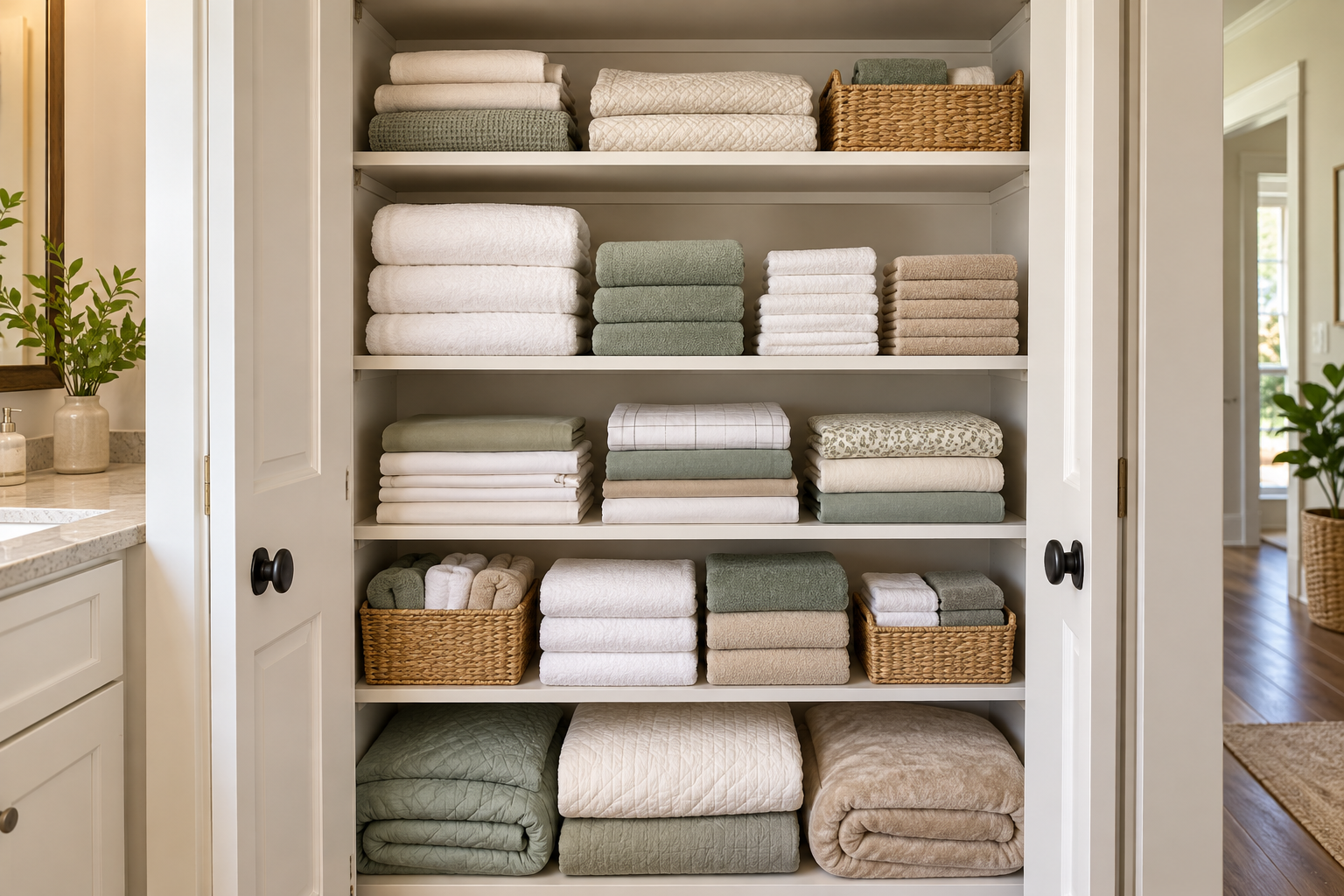
To organize a linen closet, empty it first, remove linens you no longer need, measure the shelves, group items by category, and assign each shelf a clear job. Keep everyday towels and current sheet sets easy to reach. Put less-used items higher and heavier bedding lower. Add bins or dividers only when they solve a specific storage problem.
The Linen Closet System at a Glance
Use this order
This order matters. If you buy organizers before you know what you are keeping or how much shelf space you have, you can easily create a closet that looks organized but is harder to use.
Empty the Entire Linen Closet
Start with a completely empty closet if possible. Remove towels, sheets, pillowcases, blankets, spare bedding, and anything else stored there.
Put everything somewhere you can see it. The goal is to understand the real inventory before deciding where anything belongs.
Do this first
Remove everything from the shelves so you can see how much you actually own.
Why it matters
Organizing around hidden excess usually creates crowded shelves instead of a useful system.
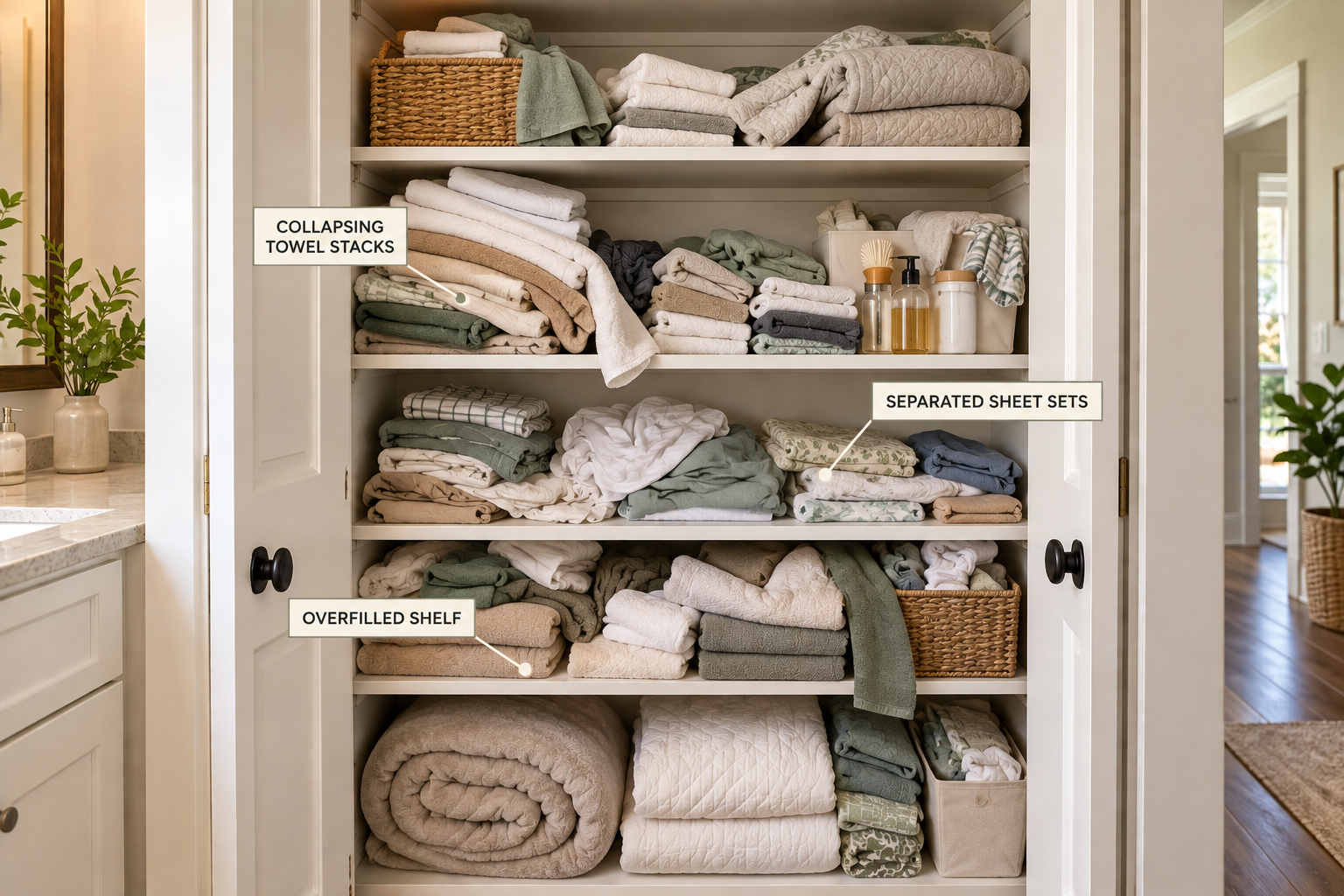
Edit Your Linen Inventory
Once everything is out, sort the linens before putting anything back.
Remove items that are worn out, badly stained, mismatched, uncomfortable to use, or simply no longer needed. Keep realistic quantities based on your household, laundry routine, beds, and guest needs.
You do not need to follow a universal rule such as keeping exactly two sets of sheets or a fixed number of towels. Your useful quantity depends on how your household actually operates.
- Useful to your household.
- In good enough condition to use.
- Part of a complete or intentionally useful set.
- Needed for your normal laundry cycle or realistic guest needs.
Measure the Shelves Before Choosing Organizers
Do not choose bins, baskets, dividers, or shelf risers based only on how they look online. Measure the space first.
Measure these areas
- Shelf width: the usable side-to-side space.
- Shelf depth: how far an organizer or stack can extend without making the back difficult to reach.
- Shelf height: the vertical clearance available for folded linens or containers.
- Door clearance: especially important if the closet has door-mounted storage.
- Awkward areas: corners, deep shelves, or spaces that are difficult to access.
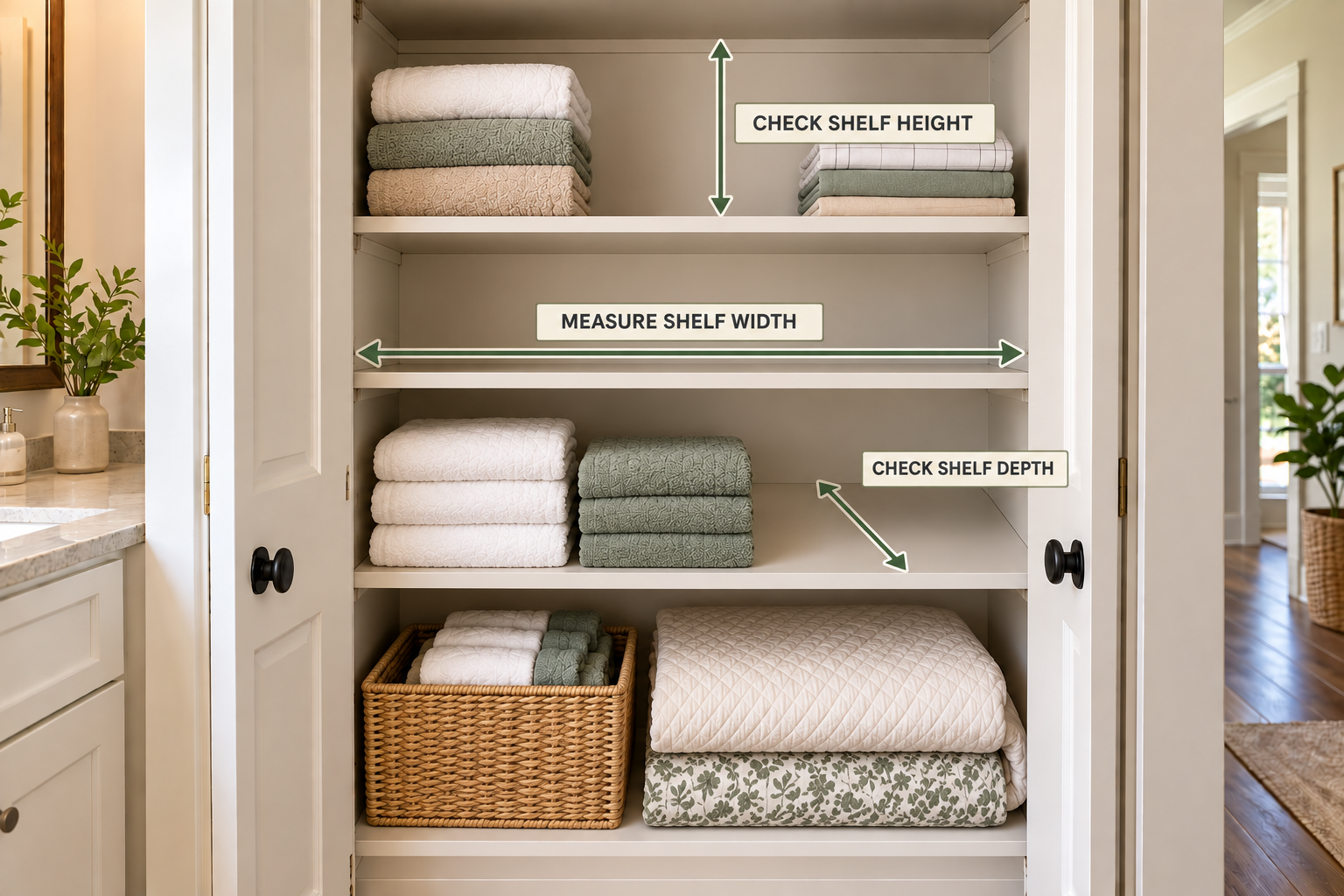
The right organizer is the one that fits the shelf and solves the actual problem. A container that wastes usable space is not an improvement.
Group Linens by Category
After editing, group similar items together. The categories do not need to be complicated.
- Bath towels
- Hand towels
- Washcloths
- Sheet sets
- Pillowcases
- Blankets and heavier bedding
- Guest or seasonal linens
The goal is not to create as many categories as possible. Create categories that make retrieval easier.
Keep Complete Sheet Sets Together
Sheet sets are much easier to use when the pieces stay together. A fitted sheet, flat sheet, and pillowcases should not become separate piles that require searching.
One simple method is to fold the complete set and place the folded pieces inside one matching pillowcase. Another option is to dedicate a shelf area to complete sets and group them by bed size.
When you need a sheet set, you should be able to remove the complete set as one recognizable unit instead of searching through several piles.
Assign Shelves by Frequency and Weight
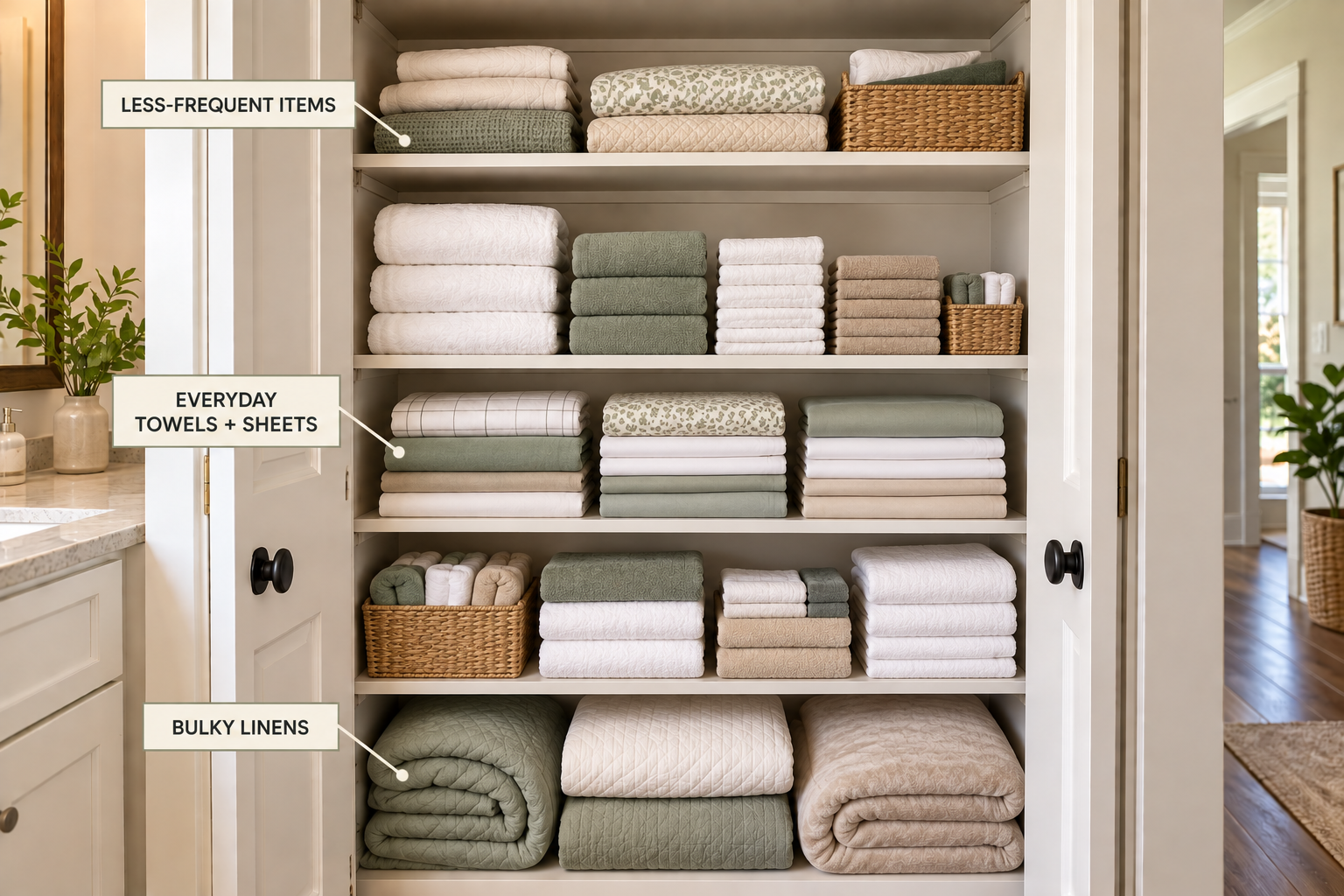
Not every shelf has the same value. The easiest-to-reach shelves should hold the things you use most often.
| Zone | Good fit | Why |
|---|---|---|
| Eye / waist level | Everyday towels and current sheet sets | These are the items you are most likely to retrieve regularly. |
| Upper shelves | Guest, seasonal, or less-used linens | Less frequent items do not need the prime access zone. |
| Lower shelves | Blankets and heavier bedding | Heavier items are easier to manage lower down. |
| Small contained zone | Washcloths or loose small linens | Small items can benefit from physical boundaries when they migrate. |
Fold Towels for the Shelf You Actually Have
There is no single towel-folding method that works for every linen closet.
The better question is whether the folded towel fits the shelf and can be removed without disturbing the rest of the stack.
For a shallow shelf, use a flatter fold. For a deeper shelf, you can create a deeper stack if it remains easy to reach. The important part is keeping the stack stable and visible.
Make Towels Easy to See and Remove
A tall towel stack can look impressive but still be difficult to use. If removing one towel causes the entire stack to lean, the stack is too tall or needs some separation.
Lower the stack before adding an organizer. If the problem continues, a divider can give the stack a physical boundary.
Before buying a divider
- Can you solve the problem by lowering the stack?
- Is the shelf too crowded?
- Are two categories sharing the same space?
- Does the stack actually need physical support?
Use Bins and Dividers Only When They Solve a Problem
Organizers are tools. They are not the organization system itself.
A stable towel stack does not need a divider simply because a divider exists. Likewise, a small category that already stays together may not need a bin.
Choose containment based on the problem
No organizer may be necessary.
Try a lower stack first. Add a shelf divider if the problem remains.
A basket or fabric bin can create a simple physical boundary.
Improve visibility and access before simply adding more containers.
Amazon Basics Collapsible Storage Bins
These fabric cube bins can be useful for a loose linen category that does not stack well or keeps spreading into neighboring shelf space. The photographed product is a 24-pack of 10.5 × 10.5 × 11-inch collapsible bins with handles.
HBlife Clear Shelf Dividers
These clear shelf dividers are useful when folded towel or linen stacks need a physical boundary to stop them from leaning or mixing with the next category. The photographed product is a 6-pack of clear vertical shelf dividers.
As an Amazon Associate I earn from qualifying purchases. Some links below are paid links, which means Simply Tidy Home may earn a commission if you purchase through them, at no additional cost to you.
What Should Not Live in the Linen Closet?
A linen closet can easily become a general household storage cabinet. That makes the space harder to navigate.
Remove items that do not belong to the closet’s main job unless there is a clear reason to keep them there.
If a miscellaneous item repeatedly gets in the way of towels and bedding, give it another storage location. The goal is not to maximize the number of things inside the closet. The goal is to make the useful things easy to find.
Handle Deep or Awkward Shelves Without Losing Visibility
Deep shelves create a common problem: items at the back disappear behind the items in front.
Start by keeping frequently used linens toward the front and avoiding unnecessary front-to-back layers. If an item is rarely used, it can occupy a less accessible position.
For a particularly deep shelf, consider whether a contained category can be pulled forward more easily. The solution should improve retrieval rather than simply use every inch of depth.
More storage volume is not automatically better storage. If you cannot see or reach what is behind the first layer, the usable capacity is lower than it appears.
Build a Linen Closet That Is Easy to Reset
The final test is not how the closet looks immediately after organizing it. The test is whether someone can put clean laundry away without having to think through the entire system again.
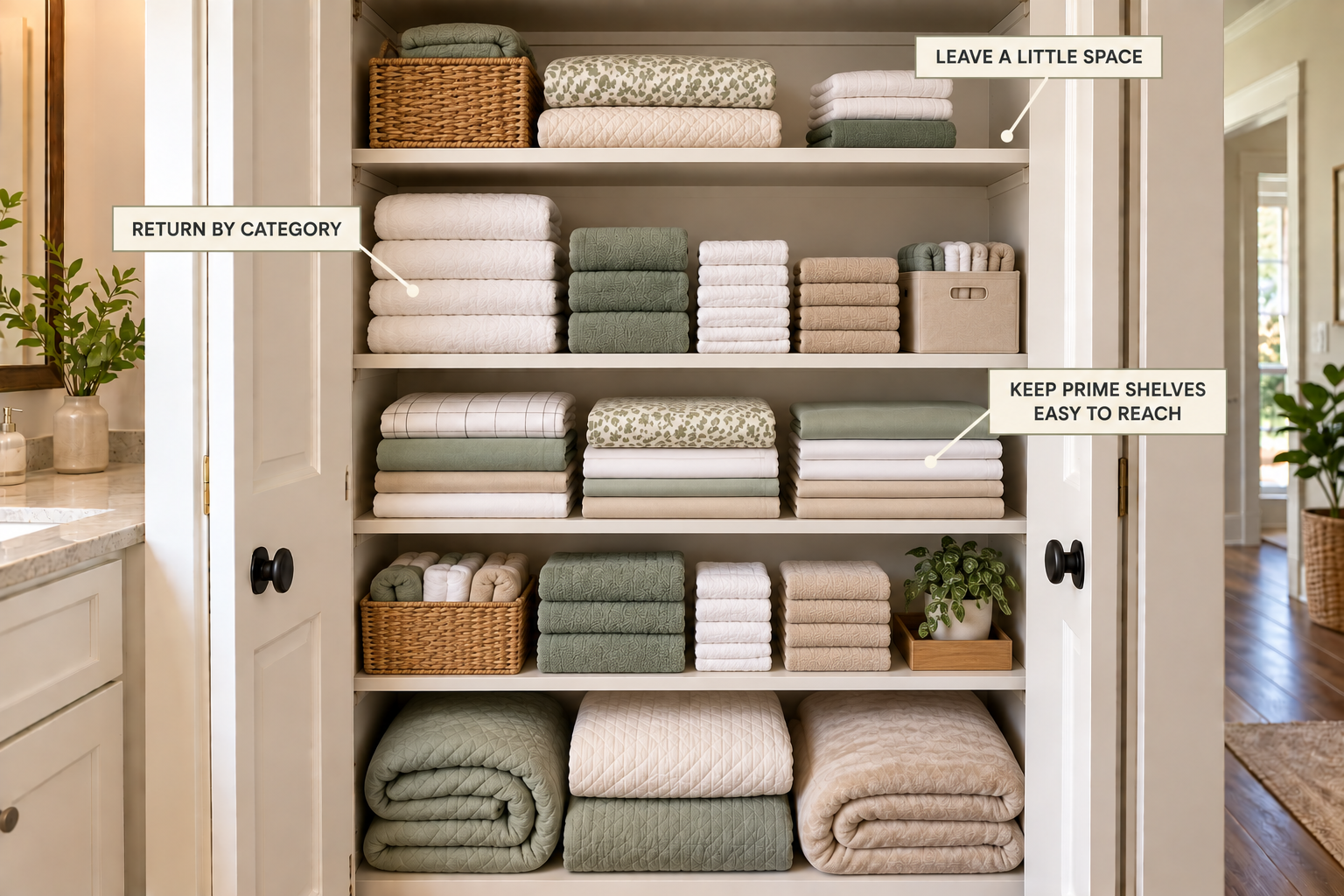
1. Return by category
Put towels, sheets, washcloths, and bedding back into their assigned zones.
2. Protect prime shelves
Keep everyday items in the easiest-to-reach areas instead of filling those shelves with rarely used linens.
3. Leave some space
A little breathing room makes it easier to remove and return items without rebuilding the stacks.
Common Linen Closet Organization Mistakes
-
Organizing before editing.
Adding storage to an overfilled closet rarely solves the underlying capacity problem.
-
Buying bins before measuring.
An attractive container is not useful if it wastes shelf space or blocks access.
-
Building very tall towel stacks.
If one towel destabilizes the whole stack, the system is difficult to maintain.
-
Separating sheet-set pieces.
Keep complete sets together so the next use does not require searching.
-
Giving prime shelves to rarely used items.
Use the easiest-access zones for the linens you reach for most often.
-
Filling every inch.
Some empty space makes retrieval and reset easier.
-
Putting heavy items too high.
Lower shelves are generally a better place for bulky blankets and heavier bedding.
-
Over-controlling the closet with containers.
Every bin or divider should solve a real problem. Otherwise it adds another thing to maintain.
-
Mixing unrelated household items into the linen zones.
A clear category system is easier to maintain when the closet has a defined purpose.
Linen Closet Decision Flow
Start with the problem
Lower the stack. If it still migrates, add a divider.
Bundle each complete set together.
Edit the inventory before adding storage products.
Improve visibility and front-to-back access.
Use a bin or basket to create a physical boundary.
Reassess shelf spacing and whether the current shelf assignment makes sense.
Frequently Asked Questions
How do I organize a linen closet?
Empty the closet, edit your linen inventory, measure the shelves, group items by category, and assign shelves according to frequency of use and item weight. Keep everyday towels and current sheet sets easy to reach, then use bins or dividers only where they solve a specific problem.
How should towels be stored in a linen closet?
Fold towels to suit the shelf depth and keep stacks low enough to remain stable. Store everyday towels in an easy-to-reach zone. If stacks repeatedly lean or migrate, reduce the stack or use a shelf divider.
How do you keep sheet sets together?
Fold the complete set together and place the folded pieces inside one matching pillowcase, or give complete sets a dedicated shelf area grouped by bed size. The goal is to make each set retrievable as one unit.
What should go on the top shelf of a linen closet?
The top shelf is generally better for lightweight, less frequently used items such as guest or seasonal linens. Keep everyday items in the easier-to-reach middle area.
What should go on the bottom shelf of a linen closet?
Lower shelves can work well for heavier or bulkier linens such as blankets and bedding. This keeps heavier items lower and can make them easier to handle.
Do I need bins in a linen closet?
Not necessarily. Use a bin when a category is loose, difficult to stack, or keeps spreading into neighboring shelf space. Stable folded linens may not need containers.
Do I need shelf dividers for towels?
Use a divider when towel stacks repeatedly lean, migrate, or mix with adjacent categories. If a stack stays stable on its own, a divider may not be necessary.
How do I organize a deep linen closet?
Keep frequently used linens where they are easiest to see and reach. Avoid unnecessary front-to-back layers, and use containment only when it improves access to items that would otherwise disappear at the back.
How many towels and sheets should I keep?
Keep enough for your household’s normal laundry cycle, beds, guests, and realistic needs. There is no single quantity that works for every household.
How do I keep a linen closet organized?
Give every category a defined zone, keep frequently used items accessible, avoid overfilling shelves, and make the return process simple enough to follow after laundry day.
Related Guides
A well-organized linen closet does not need to be packed with organizers.
Give each category a clear home, keep everyday linens easy to reach, and make the system simple enough to reset after laundry day.