
BEDROOM ORGANIZATION
Bedroom drawers work better when every drawer has a clear job. Instead of adding organizers first, start by emptying the drawer, measuring the usable space, sorting the contents, and choosing a folding or containment method that fits what you actually store.
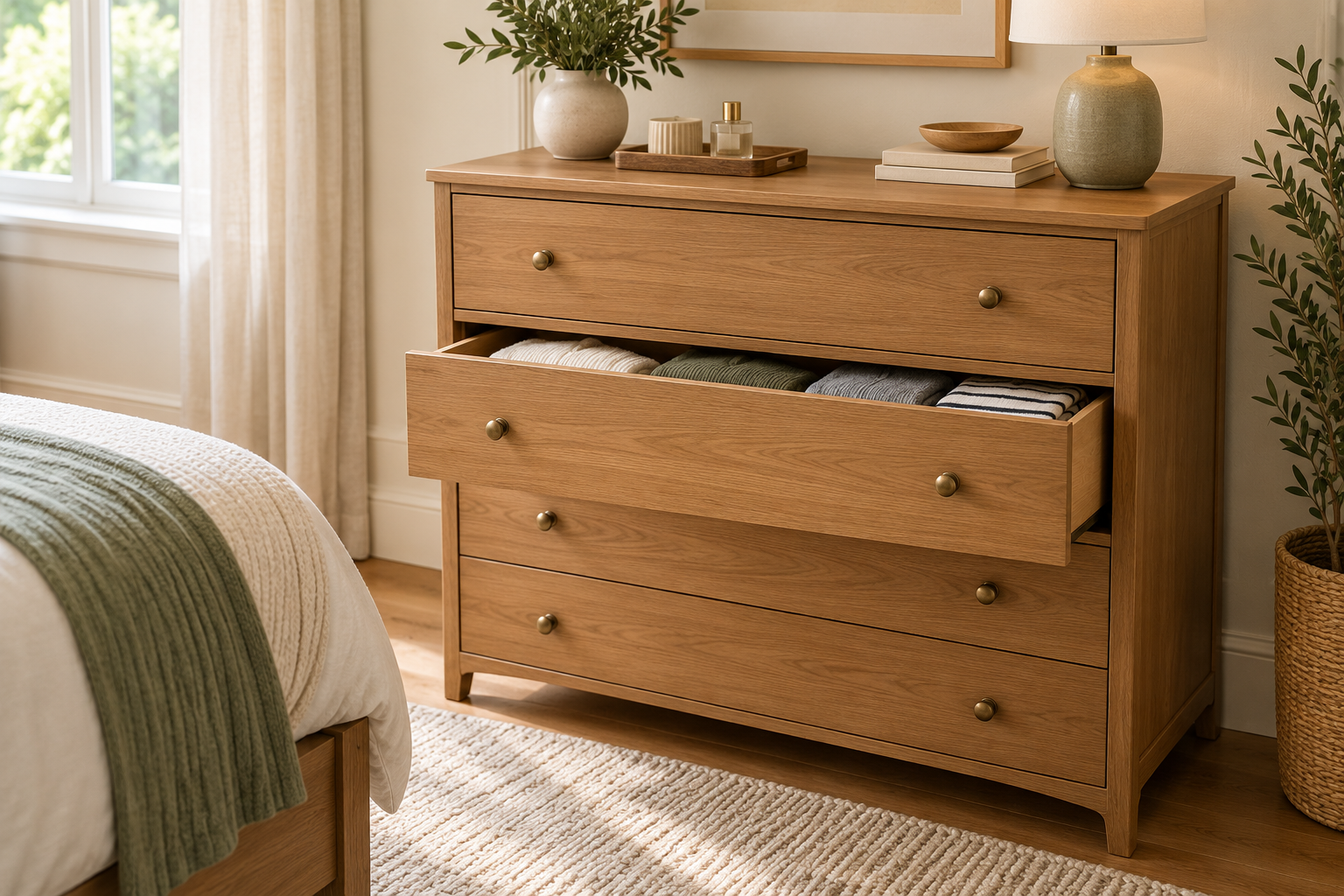
To organize bedroom drawers, empty them completely, measure the usable space, sort everything by category, give each drawer a primary job, match the folding method to the drawer depth, add containment only where items move, and use a simple reset routine.
The bedroom drawer system at a glance
1. Empty every drawer before organizing
Start with an empty drawer. Do not try to organize around the clothes already inside it.
Emptying the drawer lets you see how much space you actually have. It also makes it easier to spot categories that have become mixed together.
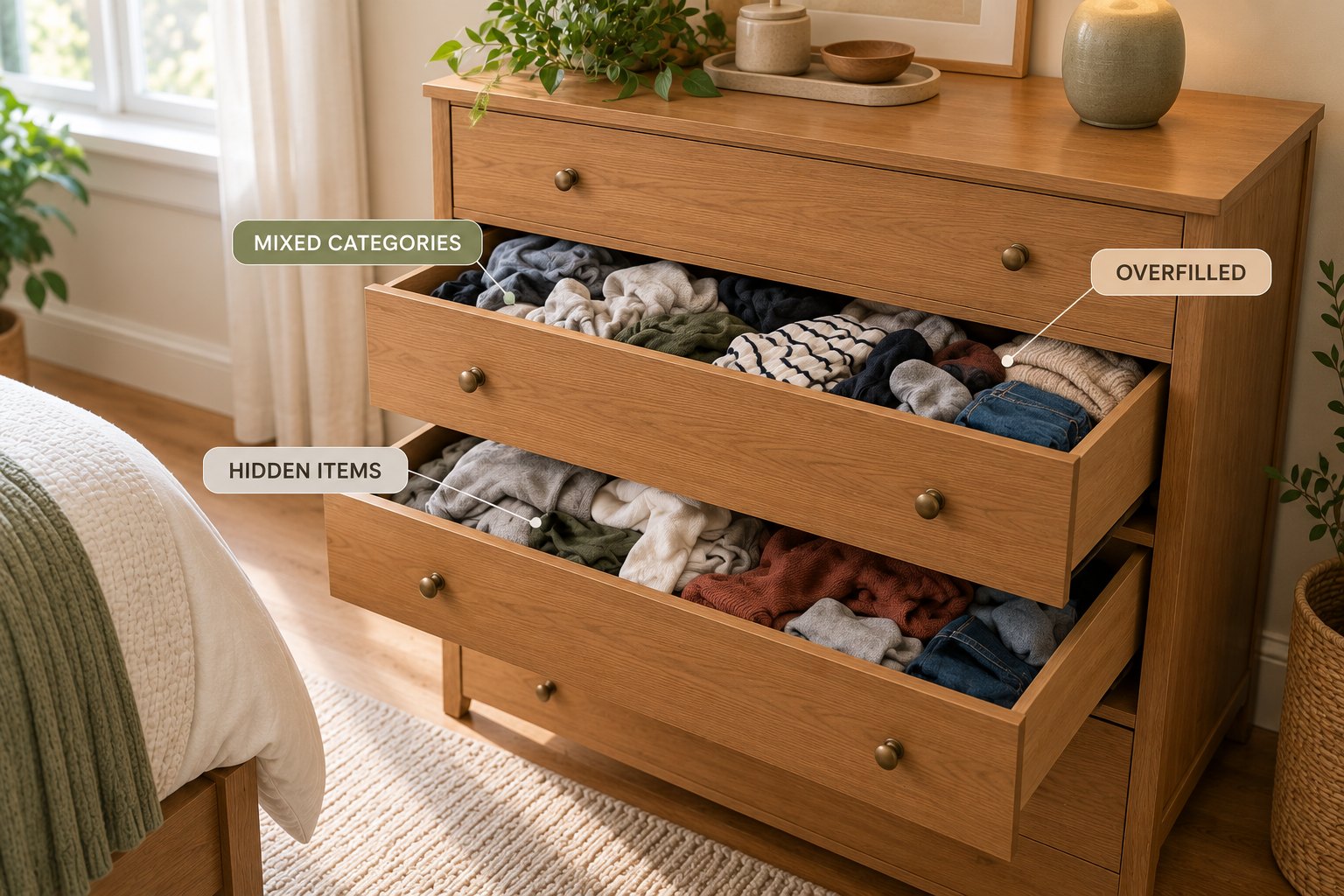
Do this
Remove everything from the drawer and place it where you can see it.
Why it matters
You cannot make a good drawer assignment when you cannot see the full category, quantity, or condition of the items competing for the space.
As you empty the drawer, set aside anything that clearly belongs somewhere else. The goal is not to create a perfect bedroom in one session. The goal is to understand what should actually live in each drawer.
2. Measure the drawer before choosing organizers
Measure the usable interior space before buying a divider or drawer organizer. The outside dimensions of a dresser do not tell you how much usable space is available inside each drawer.
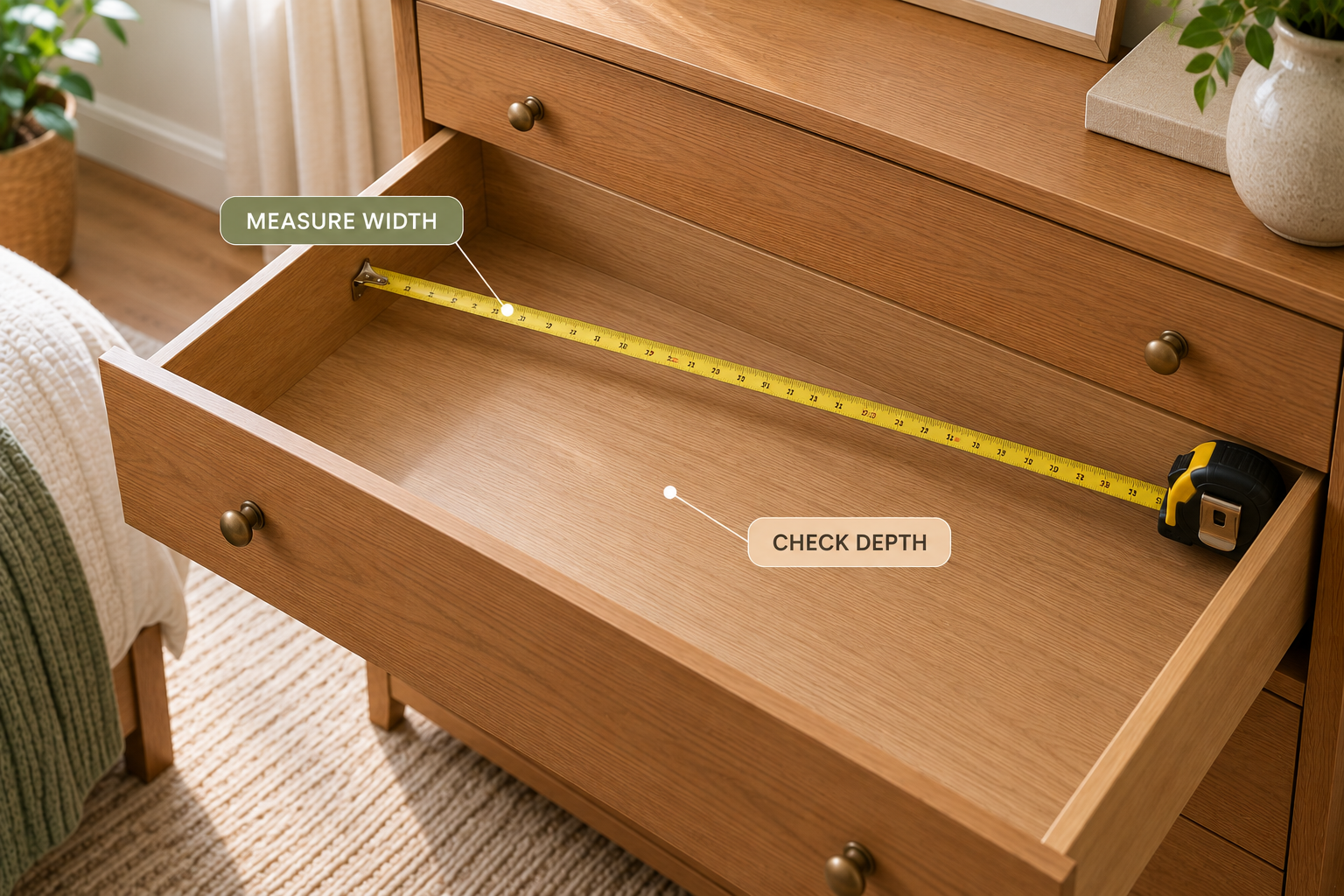
Measure these three things
- Width: measure from the usable inside edge of one drawer side to the other.
- Depth: measure from the front inside edge toward the back.
- Height: measure the usable vertical clearance from the drawer bottom to the lowest obstruction.
Measure the actual space where the organizer will sit. Also account for the drawer construction, hardware, and any features that reduce usable space.
This matters especially with tall dividers. An organizer that technically fits the drawer width can still be unsuitable if its height interferes with the drawer or the items you need to access.
3. Sort everything by category
Once the drawers are empty, sort the contents before putting anything back.
Keep categories simple. You might have everyday tops, sleepwear, underwear, socks, workout clothes, or other small clothing categories depending on your wardrobe.
A simple sorting decision
Same type? Keep similar items together.
Different use? Consider a separate category.
Too many categories? Combine closely related items instead of creating tiny drawer jobs.
Too much volume? Reduce the amount before adding containment.
The goal is not to give every type of clothing its own drawer. The goal is to create categories that are easy to find and realistic for the amount of space you have.
4. Give each drawer a primary job
After sorting, assign each drawer a primary job. A drawer should have a clear reason for existing.
For example, one drawer might hold underwear and socks, another everyday tops, and another sleepwear. The exact assignments depend on your wardrobe and drawer dimensions.
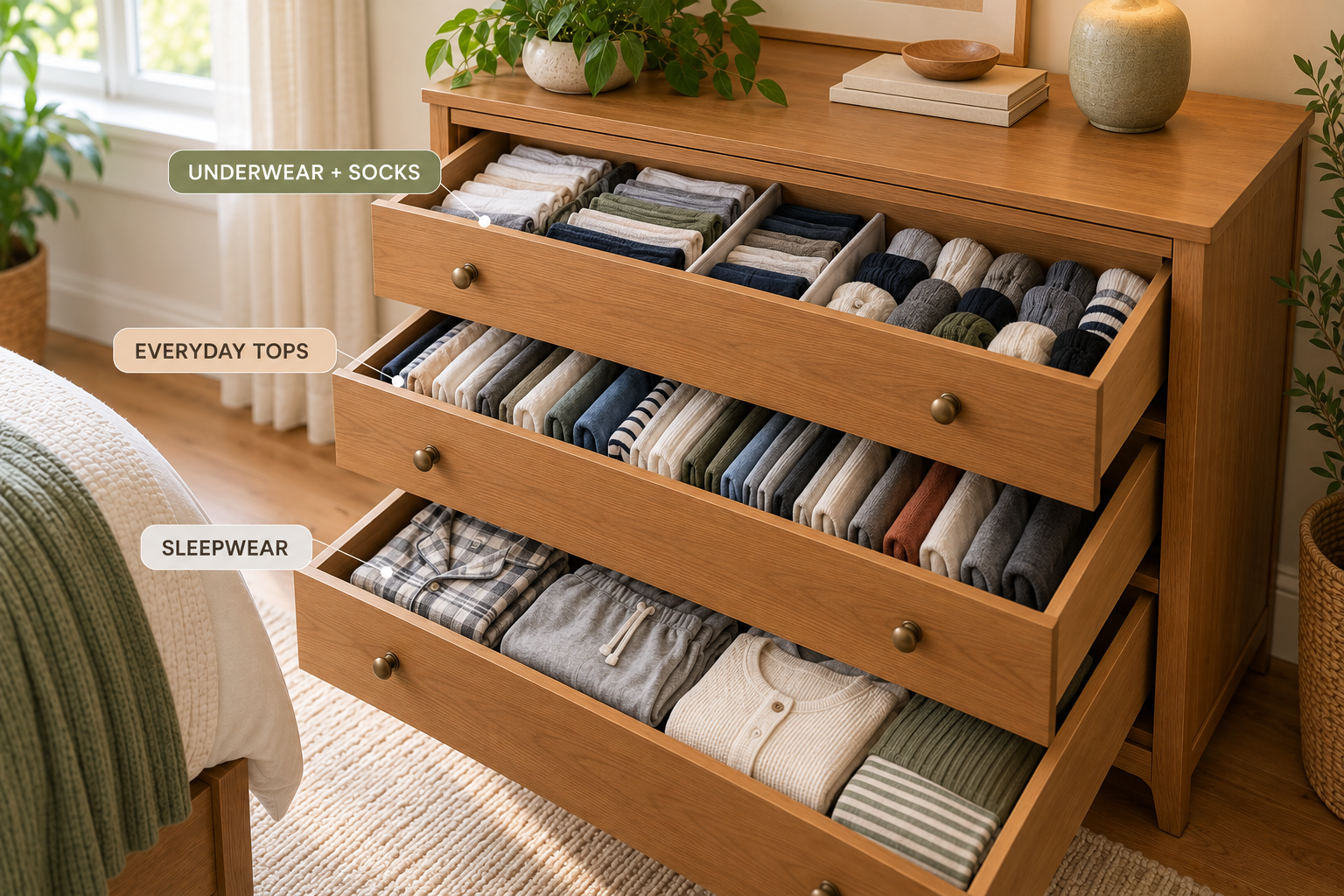
Think in terms of drawer → job → category. This is more useful than buying an organizer and then trying to make your clothing fit around it.
A useful rule
Keep the categories you reach for most often in the drawers that are easiest to access. Less frequently used categories can use less convenient space.
5. Match the folding method to drawer depth
Drawer depth should influence how you fold and position clothing.
A shallow drawer has less vertical space. A deeper drawer can often accommodate a different orientation and more substantial categories.
| Drawer situation | Useful approach | Watch for |
|---|---|---|
| Shallow drawer | Flatter folds and compact categories | Overfilling the limited height |
| Medium drawer | Visible rows and selective containment | Creating too many small sections |
| Deep drawer | Upright/file-folded clothing where suitable | Stacking items so high they become hidden |
| Small-item drawer | Compartments or dividers when categories migrate | Using a large organizer for too little inventory |
6. How to organize shallow bedroom drawers
Shallow drawers work best with categories that do not require much vertical stacking.
Use flatter folds and keep the category compact. Avoid building a tall pile that becomes difficult to see or remove.
If the drawer is already crowded, an organizer is unlikely to solve the underlying problem. Reduce the category first.
If the drawer catches on clothing when you open it, or the top layer prevents you from seeing what is underneath, the category or folding method needs attention before you add more containment.
7. How to organize deep bedroom drawers
Deep drawers give you more vertical space, but that does not mean they should become storage for everything.
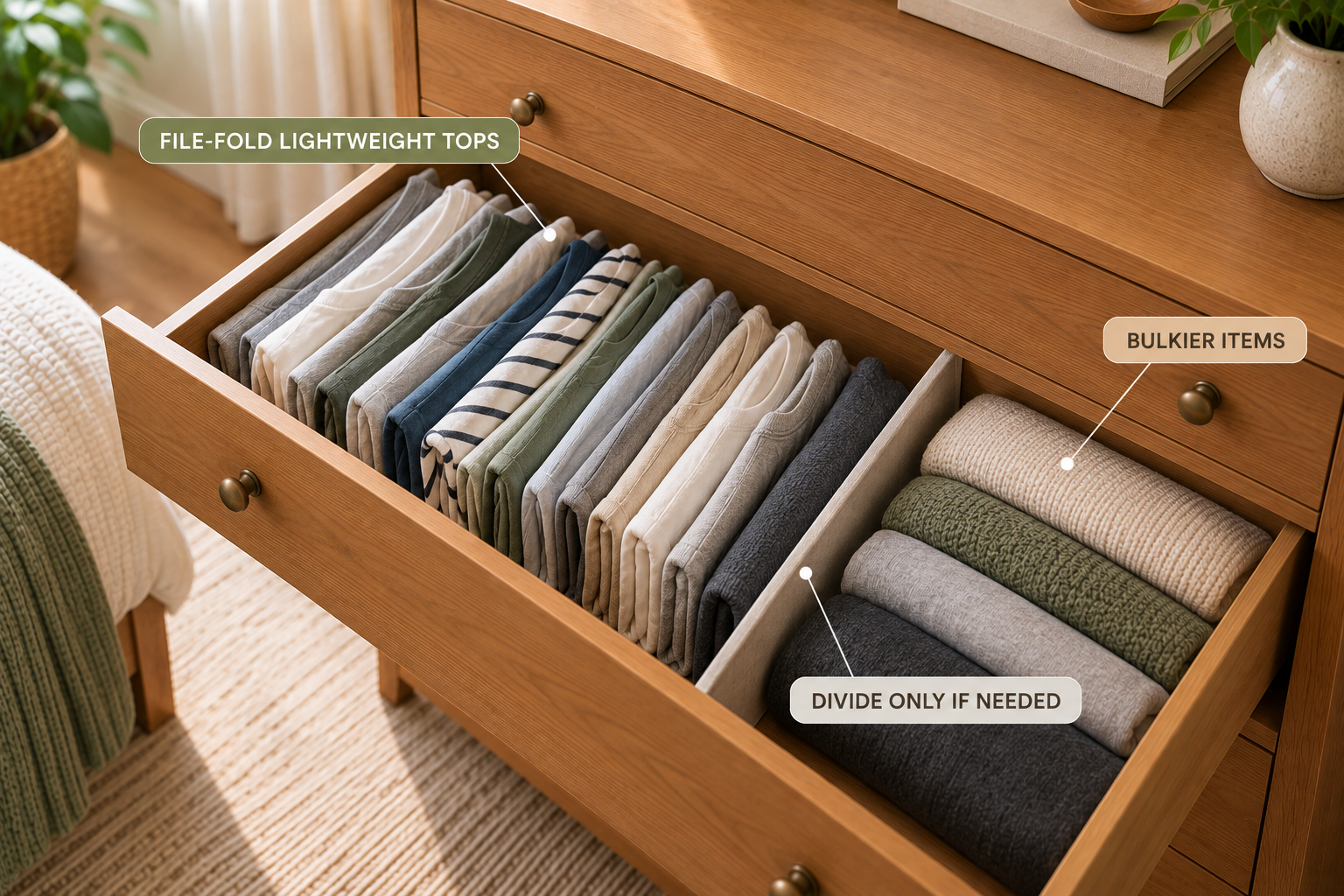
Upright or file-style folding can work well for lightweight tops because the garments can remain visible from above. This reduces the need to pull out a whole stack just to reach one item.
Bulkier clothing may need a more stable folded arrangement. Keep those items together rather than forcing every garment into exactly the same orientation.
Use vertical organization when
The drawer is deep enough and the garments are lightweight enough to stand upright without collapsing.
Use a stable folded section when
The garments are bulky, heavy, or difficult to keep upright.
8. How to organize socks, underwear, and small items
Small clothing categories can become difficult to control because individual pieces move around inside the drawer.
Start by grouping similar items. Then decide whether the category stays separated naturally. If it does, you may not need an organizer.
If socks, underwear, or other small pieces repeatedly migrate into one another, compartments can make the drawer easier to maintain.
Before you buy a small-item organizer
- Measure the drawer interior.
- Estimate how many categories actually need separation.
- Check the organizer height against the drawer height.
- Leave enough space to remove items comfortably.
- Do not buy more compartments than the drawer needs.
9. Use dividers where items actually move
Dividers are useful when categories repeatedly drift into each other. They are less useful when the drawer is already easy to maintain without them.
For deeper drawers, a taller divider can create a clear boundary between two clothing groups. Measure first, especially when choosing a tall divider.
As an Amazon Associate I earn from qualifying purchases. Some links below are paid links, which means Simply Tidy Home may earn a commission if you purchase through them, at no additional cost to you.
Lifewit 5″ Tall Bamboo Drawer Dividers
These adjustable bamboo dividers are designed to create physical boundaries inside drawers. The version reviewed for this guide is a six-pack with an adjustable 13–16.5-inch length and a 5-inch height.
They are most relevant when a deeper drawer contains two categories that repeatedly migrate into each other.
Best fit if: you have a suitable drawer height and need a physical boundary between clothing categories.
See the Lifewit bamboo drawer dividers on Amazon (paid link)
Simple Houseware Closet Underwear Organizer
This seven-piece organizer set is designed around small clothing categories such as underwear and socks. Its individual compartments can help keep small items separated inside a larger drawer.
It makes the most sense when small items repeatedly become mixed together and a simple category boundary is not enough.
Best fit if: your drawer has enough usable space for compartments and you regularly need to separate several small-item categories.
See the Simple Houseware underwear organizer on Amazon (paid link)
Neither type of organizer needs to go into every drawer. The right question is whether the drawer has a specific containment problem that the product solves.
10. What should not go in bedroom drawers
A drawer should not become a general-purpose storage box simply because it has empty space.
Avoid filling clothing drawers with unrelated items that make the primary category harder to access. If something has a better home elsewhere, keep it out of the drawer.
- Items you rarely use but can store elsewhere more appropriately.
- Large bulky objects that consume most of the usable drawer space.
- Mixed household items that make clothing categories harder to find.
- Overflow that does not fit comfortably in the assigned category.
If a drawer constantly overflows, solve the capacity problem before adding more organizers.
11. Create a drawer system that is easy to reset
A drawer is organized successfully when it is easy to put back together after laundry day or normal daily use.
The system should not depend on perfect folding every time. It should make the correct place for each category obvious.
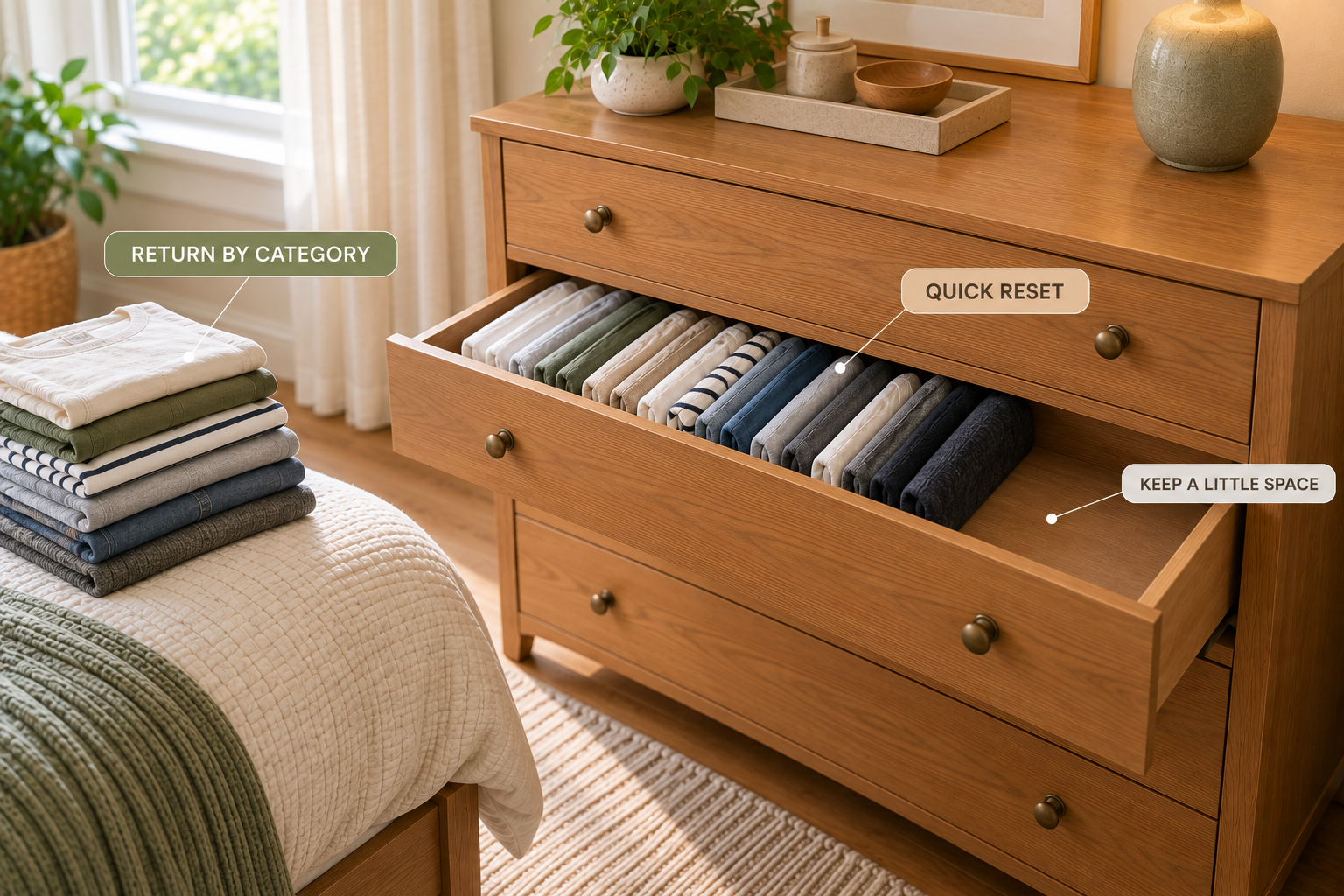
1. Return by category
Put each clothing group back into its assigned drawer instead of placing clean laundry wherever there is room.
2. Keep visibility
Maintain the orientation that lets you see and reach the items you use most often.
3. Leave breathing room
Do not refill the drawer until there is no usable space left. A little empty space makes the system easier to maintain.
12. Common bedroom drawer organization mistakes
Buying organizers first
An organizer cannot fix an unclear category, an overfilled drawer, or a poor drawer assignment.
Ignoring drawer depth
The same folding method does not work equally well in every drawer.
Creating too many categories
Tiny categories can make a drawer harder to use rather than easier.
Overfilling every drawer
A drawer that has no breathing room is difficult to maintain, even when everything technically has a place.
Using dividers everywhere
Dividers are most useful when items actually migrate. Stable categories may not need them.
Organizing without measuring
Even a well-designed organizer can be a poor fit if its dimensions do not match the usable drawer space.
13. A simple bedroom drawer decision flow
Fix the actual problem first
Too much stuff? Reduce the category before adding storage.
Mixed categories? Separate them into clearer drawer jobs.
Items are hidden? Change the folding orientation or reduce stacking.
Items migrate? Consider a divider or compartment.
Organizer does not fit? Measure the drawer again.
Drawer keeps overflowing? Solve the capacity problem rather than adding more containment.
14. Frequently asked questions
What is the best way to organize bedroom drawers?
Start by emptying each drawer, measuring the usable space, sorting clothing by category, assigning each drawer a primary job, and matching the folding method to the drawer depth. Add dividers or compartments only when they solve a specific containment problem.
Should clothes be folded or stored upright in drawers?
It depends on the drawer depth and the clothing. Upright or file-style folding can make lightweight tops easier to see in deeper drawers. Bulkier clothing may be more stable in compact folded sections.
Are drawer dividers worth using?
They can be useful when categories repeatedly move into each other. They are not necessary for every drawer. Measure the drawer first and use a divider only when a physical boundary solves a real problem.
How do I organize a deep bedroom drawer?
Give the drawer a clear category, then use an orientation that keeps the contents visible. Lightweight tops can often work well in upright rows, while bulkier garments may need stable folded sections. Avoid filling the drawer so tightly that items become difficult to remove.
How do I keep bedroom drawers organized after laundry?
Return clean clothing by category rather than putting items wherever there is room. Keep the existing folding orientation, preserve some breathing room, and reset categories as soon as you notice them starting to mix.
Related guides
Final thought
Good bedroom drawer organization is less about fitting more into a drawer and more about making the drawer predictable.
Empty it. Measure it. Sort the contents. Give the drawer a job. Match the folding method to the space. Add containment only where it solves a real problem. Then make the reset simple enough to repeat.
When every drawer has a clear purpose, putting things away becomes part of the system instead of another organizing project.