
ENTRYWAY ORGANIZATION
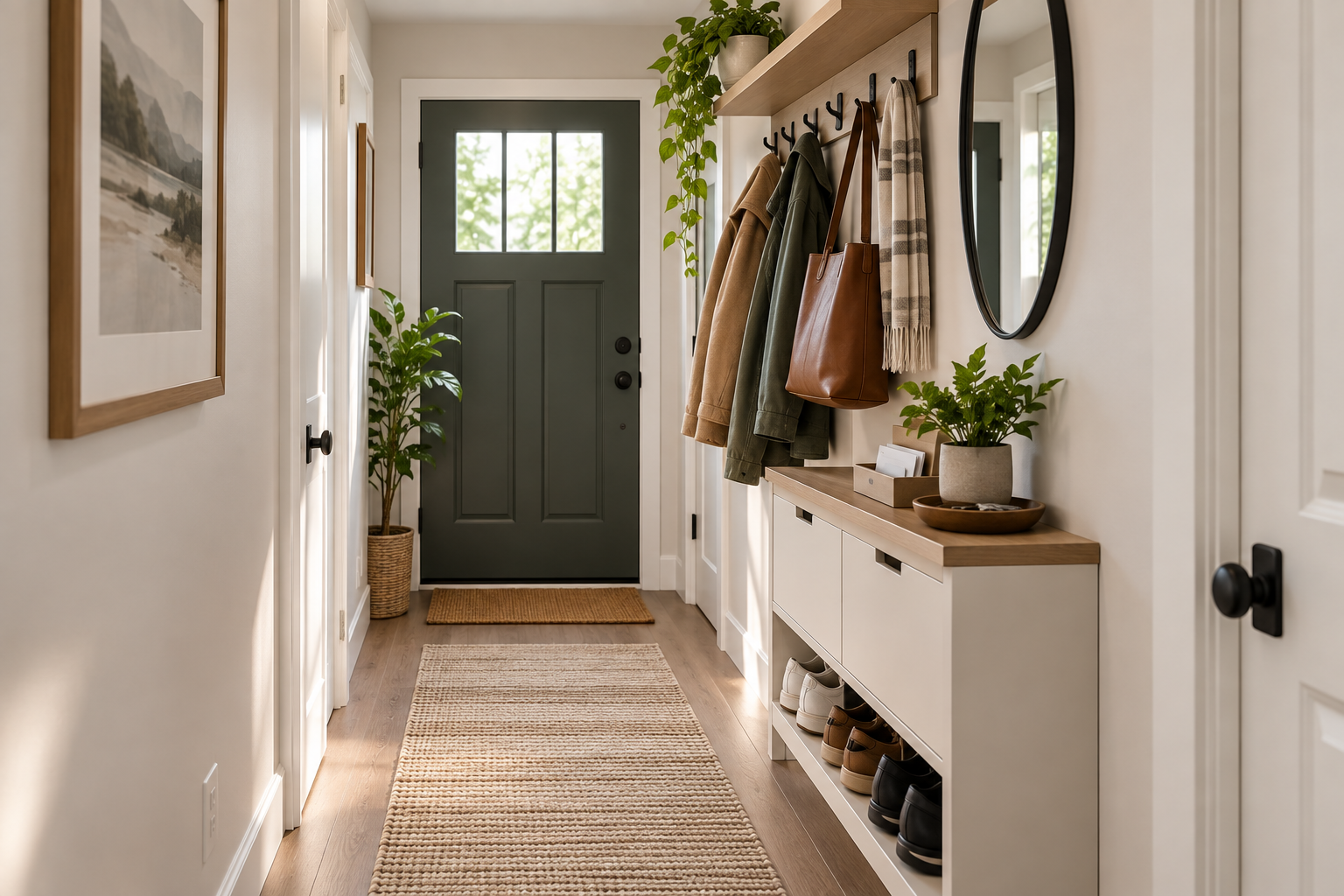
A narrow entryway works best when you protect the walking path first, then use the remaining space for only the storage your household actually needs. The goal is not to fit as much storage as possible. It is to make the entrance easy to use every day.
Quick Answer
To organize a narrow entryway, measure the actual walking route first. Then identify the narrowest point, account for door swings and storage depth, remove items that do not need to stay near the entrance, create only the zones you actually need, and choose shallow or vertical storage that does not interfere with movement. Finally, test the system while the entryway is being used normally.
THE KEY PRINCIPLE
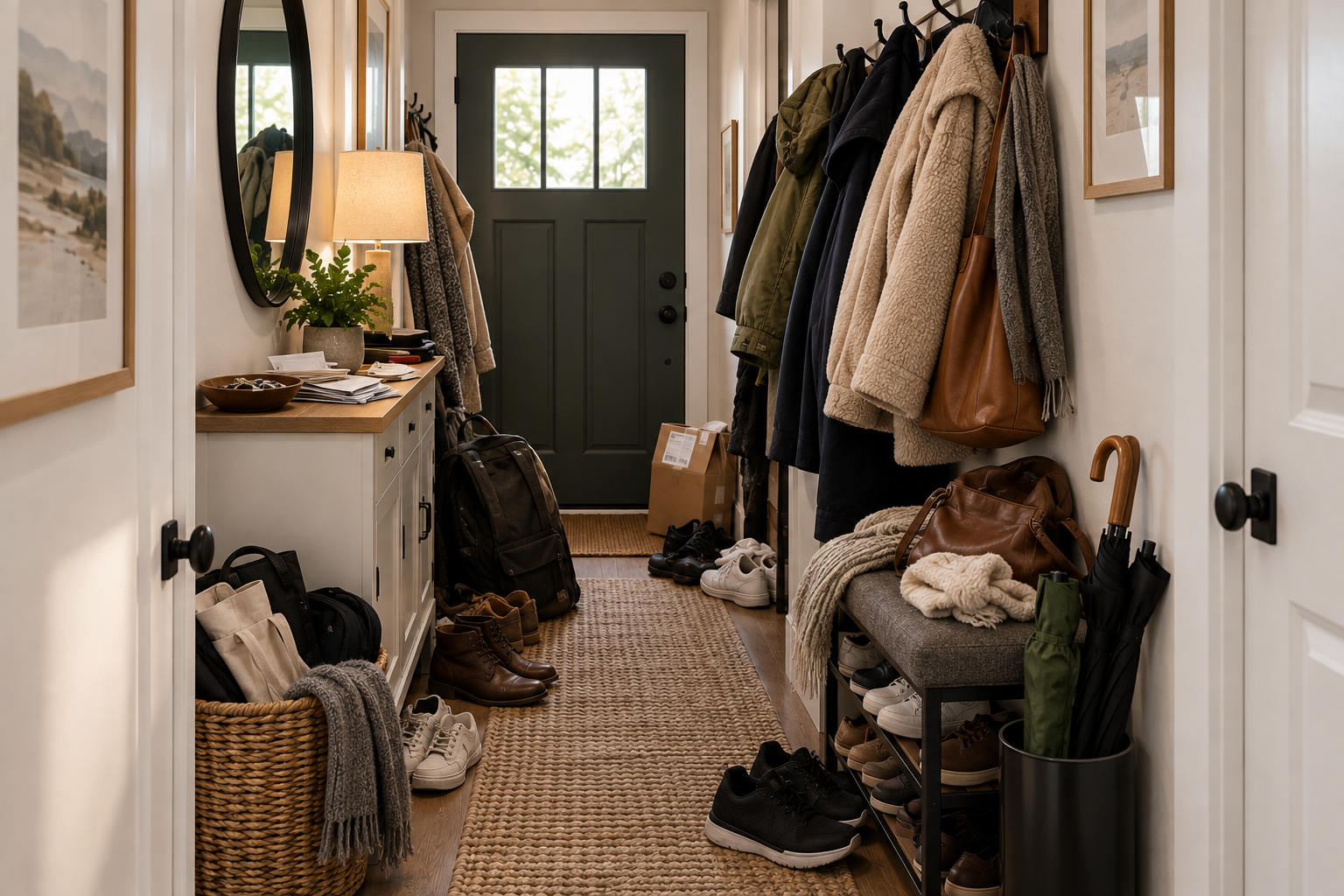
Organize the walking path first, then organize the storage.
A narrow entryway can have plenty of storage and still work badly if furniture, coats, bags, shoes, doors, or drawers interfere with the route.
Why Narrow Entryways Become Difficult to Organize
A narrow entryway is usually a combination of limited width, storage depth, movement, and too much active inventory.
The problem is not always a lack of storage. Sometimes the storage itself is creating the problem.
A cabinet may technically fit but block a door when it opens. A hook may take up almost no wall space but become much deeper when a coat and bag are hanging from it. A bench may provide useful seating but leave too little room for people to move comfortably.
This is why the first question should not be, “What organizer should I buy?”
Start With the Space
What part of this entryway can I use without making the route harder to move through?
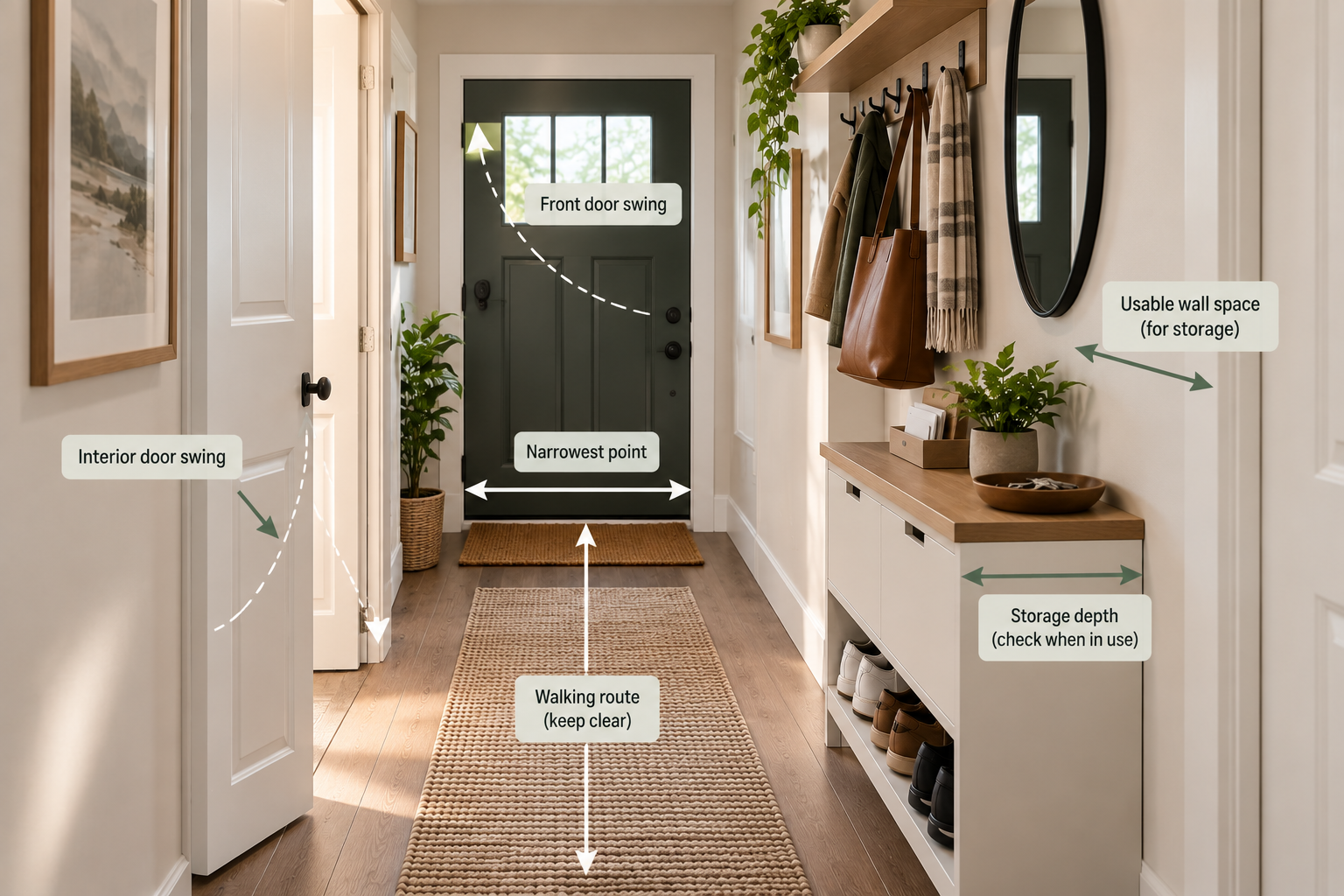
Step 1: Measure the Actual Walking Route
Start with the space people actually use, not the empty wall or the dimensions listed on a storage product.
Check:
- The narrowest point in the entryway
- Usable wall width
- Available storage depth
- Front-door swing
- Nearby interior-door swings
- Existing furniture
- Baseboards and other obstacles
- Outlets and switches
- Space required to open drawers and cabinets
- Vertical space available for storage
Find the Pinch Point
Do not rely on the average width of the hallway. Find the narrowest functional point.
It may be near a door, a corner, a staircase, existing furniture, or another object that projects into the route.
That point often determines how much storage the space can actually handle.
Measure Storage in Use
This is especially important in a narrow entryway.
A shelf may be shallow when empty but become deeper when loaded. A hook may take little space until a coat and bag are hanging from it. A cabinet may fit when closed but require additional operating space when its doors or drawers are open.
Think about the loaded depth of the system, not just the product’s empty dimensions.
Step 2: Clear What Does Not Need to Live There
The narrowest part of your home should not become the household’s overflow closet.
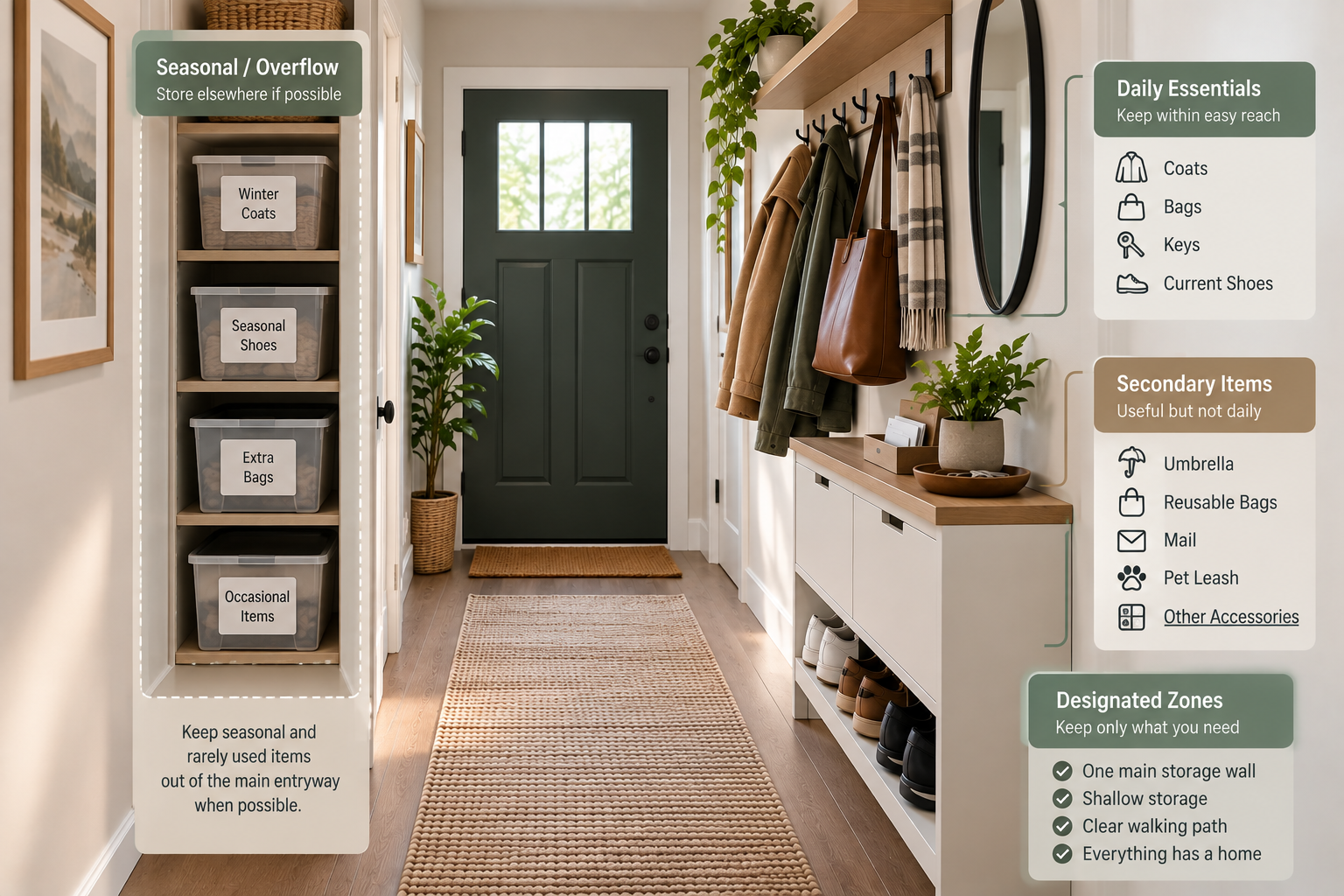
Before adding storage, divide the items near the entrance into three groups.
Daily
Keep current shoes, daily coats, everyday bags, keys, and other frequently used essentials close to the entrance.
Secondary
Umbrellas, reusable bags, mail, pet accessories, and other useful but less frequent items can stay nearby if the space allows.
Seasonal
Extra coats, seasonal shoes, occasional bags, and rarely used items should move elsewhere whenever practical.
Removing unnecessary inventory often creates more usable space than adding another organizer.
Step 3: Decide What Functions Actually Belong in the Entryway
A narrow entryway does not need to perform every possible storage function.
Prioritize the functions that support daily movement through the door.
- Safe entry and exit
- Daily shoes
- Daily coats and bags
- Keys and other small essentials
- Mail or outgoing items when needed
- Temporary wet-weather management
Seating and decorative storage should come later. They should not take priority over circulation.
Step 4: Choose One Primary Storage Wall
When the layout permits, concentrate the main storage functions on one wall.
Using both sides of a narrow hallway can make the passage feel like a storage tunnel. One stronger storage wall usually creates a simpler system and keeps the opposite side more open.
If you have only one usable wall, combine functions vertically. If there is no continuous wall, use smaller sections or continue the system around the corner where practical.
Step 5: Match Storage to the Constraint
There is no single best storage type for every narrow entryway. The useful choice depends on what is actually limiting the space.
| Your constraint | Storage direction |
|---|---|
| Almost no usable floor space | Wall-mounted storage |
| Very little available depth | Shallow or floating storage |
| Long usable wall | One-wall storage system |
| Shoes create most of the clutter | Slim shoe storage |
| Coats and bags create most of the clutter | Wall hooks or shallow hanging storage |
| Keys and mail are the main problem | Small landing shelf, tray, or organizer |
| Visible clutter is the main problem | Contained or closed storage |
| Wet footwear is common | Open or ventilated temporary zone |
| A door conflicts with storage | Move storage outside the door swing |
| Two walls face each other | Use one main storage wall |
| You cannot drill into the wall | Freestanding or removable storage |
| Seasonal items create overload | Move overflow elsewhere |
Step 6: Build the Daily Storage Zones
Once the physical constraint is clear, create only the zones that the household actually needs.
Coat Zone
Keep the number of active coats limited to what is normally used. Seasonal overflow does not need to compete for prime entryway space.
Bag Zone
Give daily bags an easy landing point. A hook can work well when it is positioned where the bag can be returned immediately.
Shoe Zone
Keep active footwear near the entrance while moving less-used pairs elsewhere. For the dedicated shoe system, see our guide to organizing shoes in a small entryway .
Small-Item Zone
Keys, wallets, sunglasses, and similar items need one obvious landing place. A small tray or shelf can be enough.
Paper and Outgoing Zone
If mail or outgoing items regularly accumulate near the door, give them a clearly defined temporary location instead of allowing them to spread across the entryway.
For a broader system focused on keys, bags, mail, everyday carry, and outgoing items, see our guide to creating an entryway drop zone .
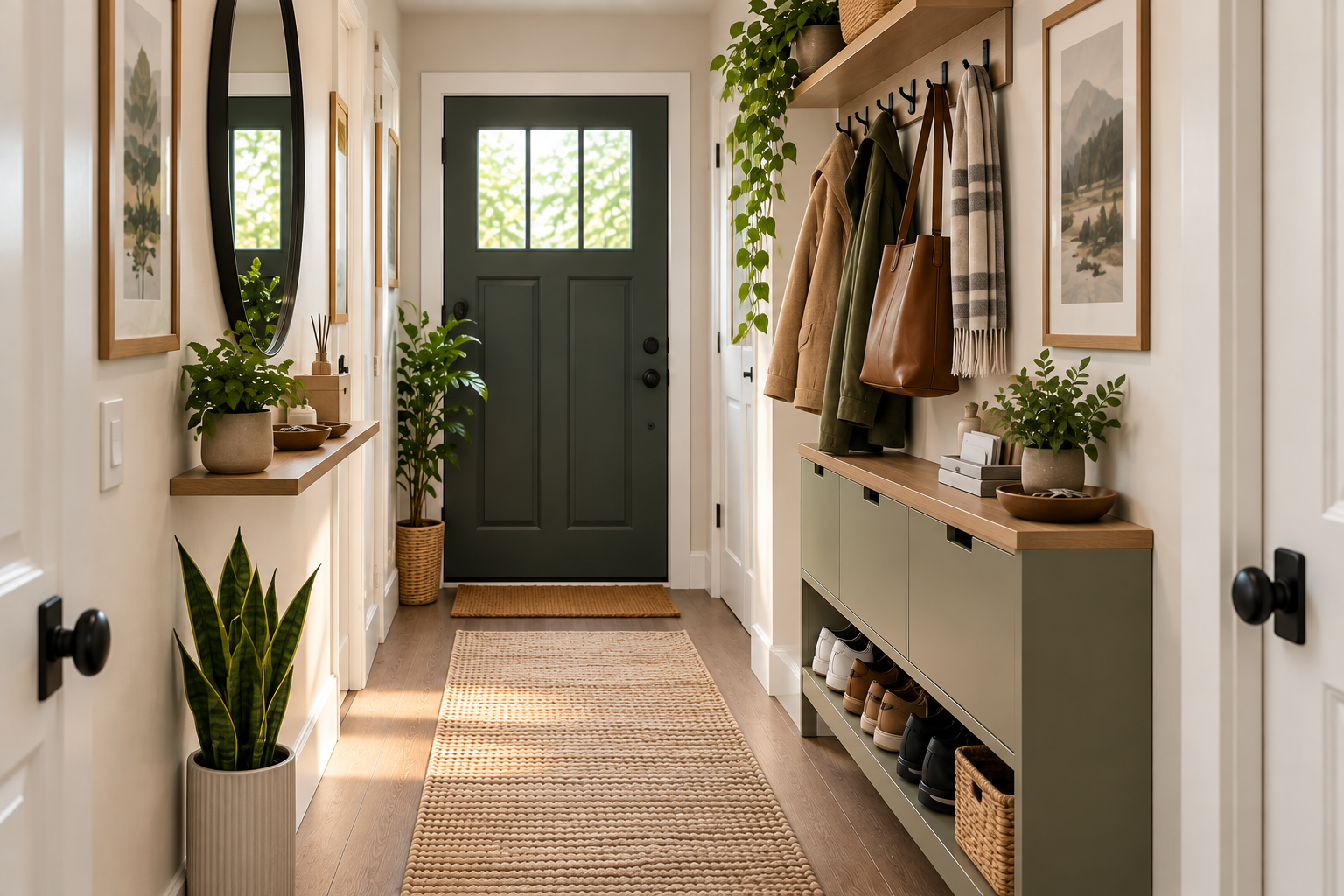
Step 7: Decide Whether a Bench Actually Fits
A bench can be useful in an entryway, but it should not be added simply because benches are common in entryway designs.
A bench can make sense when:
- Seating is genuinely useful
- The walking route remains comfortable
- The bench replaces another necessary function
- Doors can still open normally
- The bench does not become another dumping surface
If the entryway is already tight, a bench may take up valuable depth without solving the main storage problem.
Simple Decision Rule
Do not add seating if the seating makes the circulation system worse.
Step 8: Check the Storage While the Entryway Is Being Used
An organization system should work during normal activity, not just when the entryway is empty.
Test the space by:
- Opening the front door
- Walking through while carrying a bag
- Hanging a coat
- Removing and returning shoes
- Opening cabinets and drawers
- Picking up keys
- Putting down mail
- Carrying an outgoing package
The Real Test
If the organizer works only when the entryway is empty, it does not really work.
Entryway Organization Options
Products should come after the space has been diagnosed. Use them to solve a specific constraint rather than buying storage simply because the entryway looks unfinished.
Entryway Organization Option
Consider this option when you need a defined organization point for everyday entryway items and want to keep the system simple.
Entryway Storage Option
Consider this option when the entryway needs additional storage capacity while still keeping the main walking route open.
Affiliate note: Some links on this page are affiliate links. If you purchase through them, Simply Tidy Home may earn a commission at no additional cost to you.
Step 9: Make a Narrow Entryway Feel Less Crowded
Once the functional system works, you can improve the visual feel of the space.
- Keep the active inventory limited
- Concentrate storage on one wall when practical
- Keep the floor visually open
- Use consistent storage where possible
- Contain visual clutter when it becomes distracting
- Rotate seasonal items out of the main entryway
The goal is not to make the hallway look empty. It is to make the space feel intentional and easy to move through.
Step 10: Test the System for a Week
Do not decide that the organization system works simply because it looks good on the first day.
Use the entryway normally for a week and watch what repeatedly goes wrong.
Find the Escape
Notice which shoes, bags, coats, papers, or other items repeatedly end up outside their assigned homes.
Find the Reason
Ask whether the storage is too far away, difficult to access, too small, unclear, or poorly matched to the item.
Change One Thing
Adjust the location, capacity, category, or storage method instead of rebuilding the entire entryway.
Common Narrow Entryway Organization Mistakes
Measuring Only the Empty Furniture
A product can fit on paper and still become too deep when loaded or opened.
Ignoring Door Swings
Storage should not interfere with doors simply because everything fits when the doors are closed.
Using Both Walls Automatically
Two-sided storage can make a narrow passage feel even more constricted.
Buying a Bench Automatically
Seating is useful only when the available space can support it without harming circulation.
Keeping Every Shoe Near the Door
Active footwear needs easy access. The entire household’s shoe collection does not necessarily need to live in the entryway.
Keeping Seasonal Items in Prime Space
Narrow entryways should prioritize what is used now.
Adding Too Many Hooks
More hooks can simply create more visible accumulation if there is no capacity limit.
Choosing Storage Before Diagnosing the Constraint
A product should solve a demonstrated problem. It should not determine the organization system.
Adding Decoration Before Solving Circulation
A beautiful entryway that is difficult to walk through is still a poorly functioning entryway.
How to Maintain a Narrow Entryway
A narrow entryway stays functional when its active inventory changes with daily, weekly, and seasonal needs.
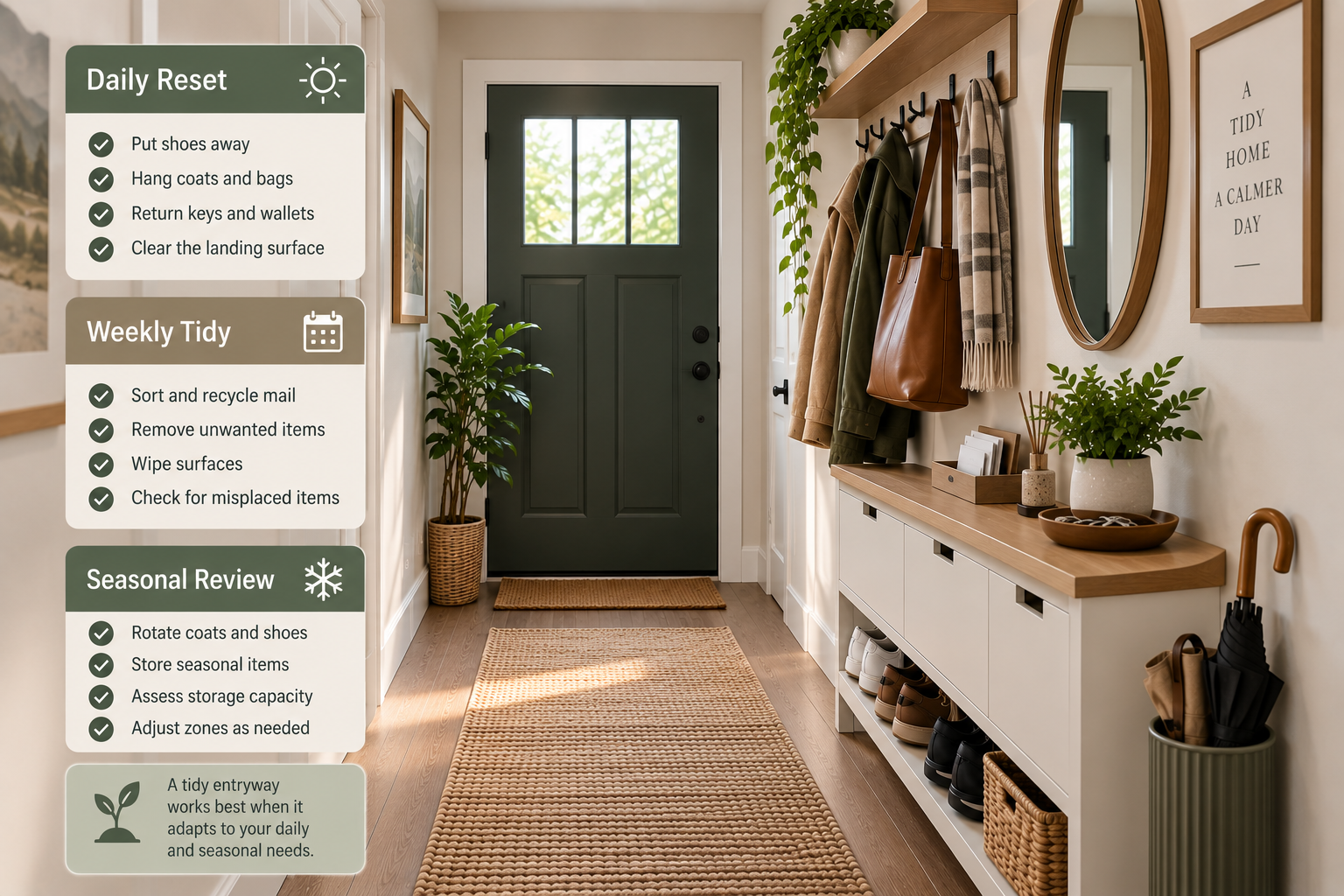
Daily
Return shoes, coats, bags, keys, and other everyday items to their assigned homes.
Weekly
Process mail, remove outgoing items, clear misplaced belongings, and reset the landing area.
Seasonal
Rotate coats and shoes, move seasonal items elsewhere, review storage capacity, and adjust the zones as needs change.
Quick Takeaways
- Protect the walking path before adding storage.
- Find the narrowest functional point rather than relying on average width.
- Measure storage while it is being used, not only when it is empty.
- Keep daily essentials near the entrance and move seasonal overflow elsewhere.
- Use one primary storage wall when the layout allows it.
- Match storage to the actual physical constraint.
- Do not add a bench if it makes circulation worse.
- Test doors, drawers, coats, bags, shoes, and normal movement before considering the system finished.
- Use a daily, weekly, and seasonal reset to keep the narrow entryway functional.
Narrow Entryway FAQ
How do you organize a very narrow entryway?
Protect the walking path first, then use shallow or vertical storage for only the functions that need to remain near the entrance. Remove seasonal and rarely used items from the narrowest part of the space.
What storage works best in a narrow entryway?
Storage that matches the available depth and does not interfere with normal movement or door operation works best. Wall-mounted, shallow, vertical, or carefully positioned storage can all work depending on the layout.
How do you organize a narrow entryway without a console?
Use wall-mounted hooks, a shallow shelf, a compact landing area, or narrow storage around the entrance. The system only needs enough capacity for the categories that actually occur there.
Can you put a bench in a narrow entryway?
Yes, if the bench does not interfere with circulation and provides a useful function. If the entryway is already tight, a bench may take up valuable depth without solving the main organization problem.
How do you store shoes in a narrow entryway?
Keep active footwear near the entrance and use storage whose loaded depth fits the available space. Less-used shoes can be stored elsewhere to preserve circulation.
How do you organize coats in a narrow hallway?
Use a limited number of accessible hooks or another shallow hanging solution for current coats. Move seasonal coats and rarely used outerwear elsewhere when possible.
How do you make a narrow entryway feel less crowded?
Reduce active inventory, control storage depth, concentrate storage on one wall when practical, and keep the walking route physically and visually open.
How do you organize a narrow entryway with no closet?
Create a small wall-based system for daily coats, bags, shoes, and small items, then store seasonal overflow elsewhere.
Where should storage go in a narrow hallway?
Place primary storage where it uses available wall space without interfering with the walking route, door swings, or the operation of nearby furniture.
How much storage should you keep in a narrow entryway?
Keep enough capacity for the household’s normal daily load rather than the maximum amount of belongings that could theoretically fit. Narrow spaces usually work better when seasonal and rarely used items are stored elsewhere.
The Simplest Way to Organize a Narrow Entryway
Measure → Clear → Zone → Match → Limit → Test → Maintain.
A narrow entryway does not need to store everything. It needs to support the things you actually do when entering and leaving your home while keeping the route clear.