
PANTRY ORGANIZATION • PRODUCT GUIDE
Best Can Organizers for Pantry: How to Choose the Right One
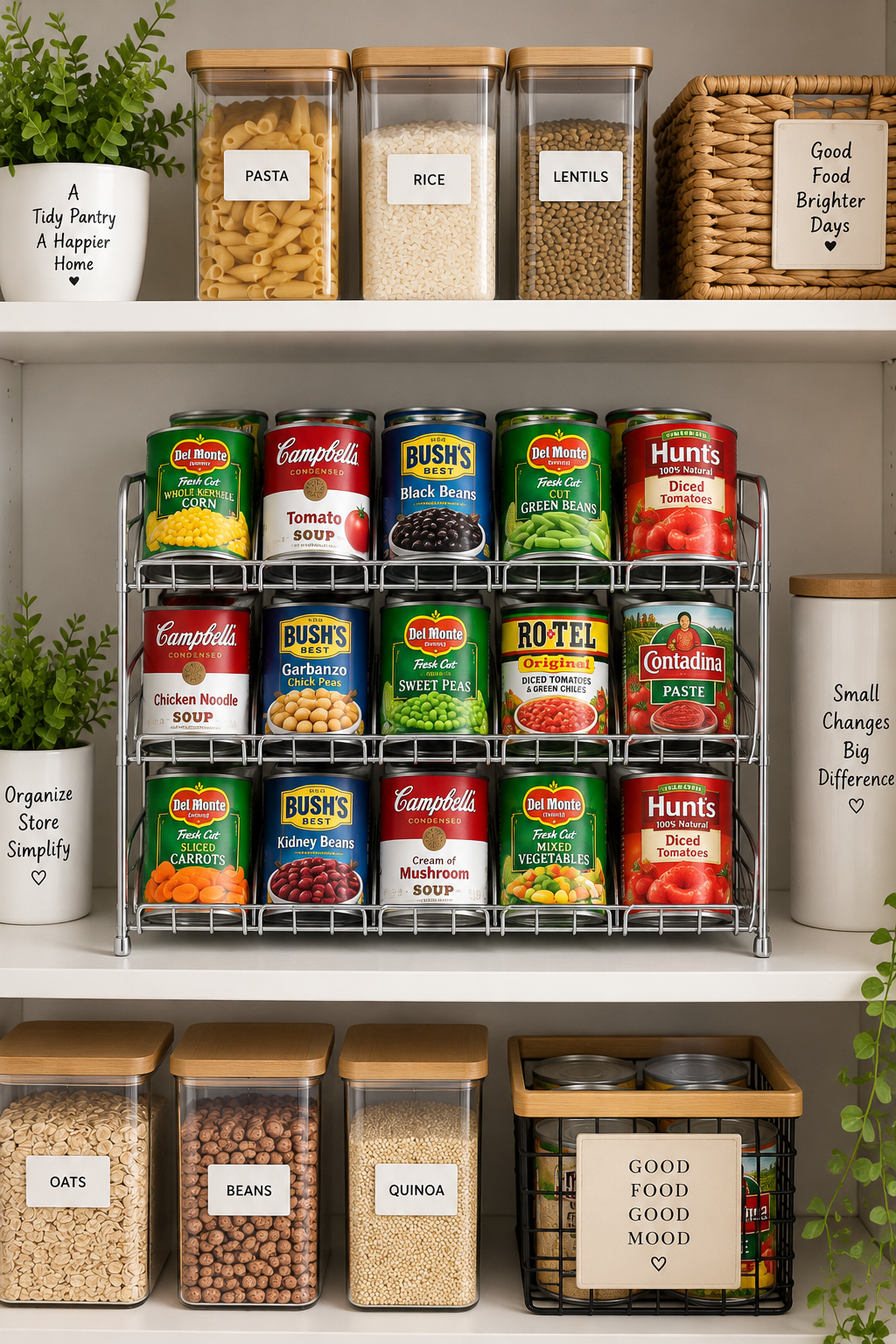
Canned food is easy to stack and surprisingly easy to lose track of. Once cans sit two or three rows deep, the back row becomes harder to see and reach.
The best can organizer for your pantry should solve that problem without creating another one. It needs to fit your shelf, work with the cans you actually store, and make everyday access easier.
That means the best choice is not necessarily the organizer with the biggest capacity or the most reviews.
What Makes a Good Pantry Can Organizer?
A can organizer is one part of a larger pantry system. If you want to work on the whole space first, see our guide to Pantry Organization Ideas.
A useful can organizer should improve at least four things:
- Visibility: You can see what you have.
- Access: You can reach cans without moving several others.
- Fit: The organizer actually fits your shelf and can sizes.
- Rotation: Older cans can be used before newer purchases when that makes sense.
Capacity matters too, but it should come after fit.
A large organizer that takes up more shelf space than you need can make a pantry harder to use. Likewise, a small rack may not solve the problem if you regularly keep a large supply of canned food.
The goal
Store cans in a way that makes them easier to see, reach, rotate, and restock.
The 3 Main Types of Pantry Can Organizers
There are three useful styles to consider.
1. Tiered Can Racks
A tiered rack raises the cans in the back so you can see more than one row at a time.
This is often the simplest solution when your main problem is visibility.
A tiered rack can work well when:
- You keep a moderate to large number of cans.
- Your pantry shelf has enough width and depth.
- You want labels to remain visible.
- You do not need a specialized dispensing system.
- You want a straightforward organization system.
Some tiered racks also allow cans to roll or move toward the front as cans are removed. The exact design varies by product, so check how the individual rack loads and releases cans.
2. FIFO or Gravity Can Organizers
FIFO means first in, first out.
The idea is that newer cans are loaded behind existing cans, while the older can moves toward the front for use.
This can be helpful if you buy canned food in larger quantities, keep a substantial pantry inventory, want a more deliberate rotation system, or regularly restock the same types of canned food.
FIFO is primarily an organization and stock-rotation method. It should not be treated as a food-safety guarantee.
USDA guidance recommends keeping commercially canned foods in a cool, clean, dry place and checking pantry stock regularly. Damaged cans, including leaking, bulging, heavily rusted, or deeply dented cans, should not be used.
3. Expandable Tiered Shelves
An expandable shelf is useful when the width of your pantry space is the main constraint.
Instead of having one fixed width, the organizer can expand or contract within a specified range.
This can be useful for unusually wide shelves, narrow pantry sections, mixed pantry storage, smaller cans or bottles, and situations where you want adjustable shelf width.
If you are organizing more than cans and need flexible storage for grouped pantry items, our guide to Best Pantry Storage Bins may also be useful.
But an expandable tiered shelf is not automatically a FIFO can dispenser.
That distinction matters when comparing products.
Our Picks: Best Can Organizers for Pantry
Rather than listing a dozen similar racks, we selected three options that solve different pantry problems.
| Organizer | Best for | Main strength | Main consideration |
|---|---|---|---|
| Simple Houseware 3-Tier | Standard pantry shelves | 36-can tiered storage | Needs adequate shelf space |
| Dial Industries Expandable | Adjustable shelf width | Expands 14–27 inches | Not a dedicated FIFO dispenser |
| FIFO Can Tracker 2-Pack | Stock rotation | Dedicated FIFO system | More specialized |
1. Simple Houseware 3-Tier Stackable Can Organizer
Best for standard pantry shelves
The Simple Houseware 3-Tier Stackable Can Organizer is a good fit when you want a dedicated can rack with multiple levels and a substantial capacity.
The verified listing is designed to hold 36 cans and measures approximately 11.5 inches deep × 17 inches wide × 13.75 inches high. It also has six adjustable dividers and a stackable design.
One measurement is particularly important before buying: the current listing recommends approximately 12 inches of depth × 17.5 inches of width × 16 inches of height for the best fit.
That means the organizer should be measured against your actual pantry space rather than judged only by its advertised dimensions.
Why choose it
This is the strongest choice of the three if your main problem is having a lot of cans on a normal pantry shelf and wanting them easier to see.
The three-tier layout raises cans above one another, while the dividers help separate different groups. Its angled, forward-moving design can also help bring cans toward the front as they are removed.
Best fit if you:
- Have sufficient shelf width and depth.
- Keep a larger collection of cans.
- Want a dedicated can rack.
- Prefer tiered visibility.
- Want adjustable dividers.
Before buying: Measure shelf width, shelf depth, and vertical clearance, then compare those measurements with the organizer’s required space.
View the Simple Houseware 3-Tier Can Organizer on Amazon (paid link)
2. Dial Industries 3 Tier Expandable Pantry Shelf Organizer
Best for adjustable shelf width
The Dial Industries organizer takes a different approach. Rather than being a dedicated can rack, it is an expandable three-tier pantry shelf.
The verified listing expands from approximately 14 to 27 inches wide and is about 4.25 inches high. The top shelf is approximately 3 inches deep, while the lower shelves are shallower.
That makes it particularly interesting when your pantry width is awkward or you want a flexible tiered shelf rather than a dedicated can-dispensing system.
Why choose it
Its biggest advantage is adjustability. Instead of trying to find a fixed-width organizer that exactly matches your shelf, you can adjust the shelf within its specified range.
The current listing also indicates that the top shelf can accommodate standard 16-ounce cans, while the shallower lower shelves are better suited to smaller cans, bottles, or jars.
Best fit if you:
- Have a variable-width pantry space.
- Want an expandable shelf.
- Store a mixture of cans and other pantry items.
- Do not specifically need FIFO dispensing.
- Want a relatively low-profile tiered system.
Important distinction: Don’t buy this expecting the same function as a dedicated FIFO can tracker. Its strength is adjustable tiered storage, not automatic can rotation.
View the Dial Industries Expandable Pantry Shelf on Amazon (paid link)
3. FIFO Can Tracker 2-Pack
Best for FIFO stock rotation
The FIFO Can Tracker is the most specialized option in this comparison.
The verified listing is a 2-pack of three-tier rotating food-can organizers designed to hold up to 54 cans across the system.
Its main purpose is not simply to raise cans for better visibility. It is designed around FIFO rotation.
As cans are removed from the front, the system is intended to move the next cans forward.
Why choose it
This makes the most sense when your pantry problem is: “I keep buying cans, and I want a system that helps me rotate the stock.”
It can be particularly useful for households that maintain larger canned-food inventories.
Best fit if you:
- Store many canned foods.
- Regularly buy multiple cans of the same products.
- Want a dedicated FIFO system.
- Care about systematic stock rotation.
- Have enough pantry space for a more specialized organizer.
Before buying: Pay particular attention to shelf width, shelf depth, vertical clearance, how the system loads, where cans enter and exit, and how much space the full system occupies.
View the FIFO Can Tracker 2-Pack on Amazon (paid link)
How to Choose the Right Can Organizer
Before buying any pantry can organizer, use this simple process:
This is the Pantry Can Organizer Fit Check.
Step 1: Measure Your Pantry Shelf
Start with the space, not the product.
Measure the usable width, depth, and vertical clearance of the shelf.
If limited space is the larger problem across your pantry, see How to Organize a Small Pantry for a broader approach to working with tight pantry constraints.
Don’t assume the shelf width printed in your cabinet specifications is the same as the usable space.
Step 2: Measure the Cans You Actually Store
Not every can in your pantry is the same size.
Before choosing an organizer, look at the cans you use most often.
Consider:
- Standard vegetable cans
- Soup cans
- Beans
- Tomatoes
- Sauces
- Larger cans
- Unusually tall or wide cans
The important question is not “Will it hold cans?”
It is “Will it hold the cans I actually buy?”
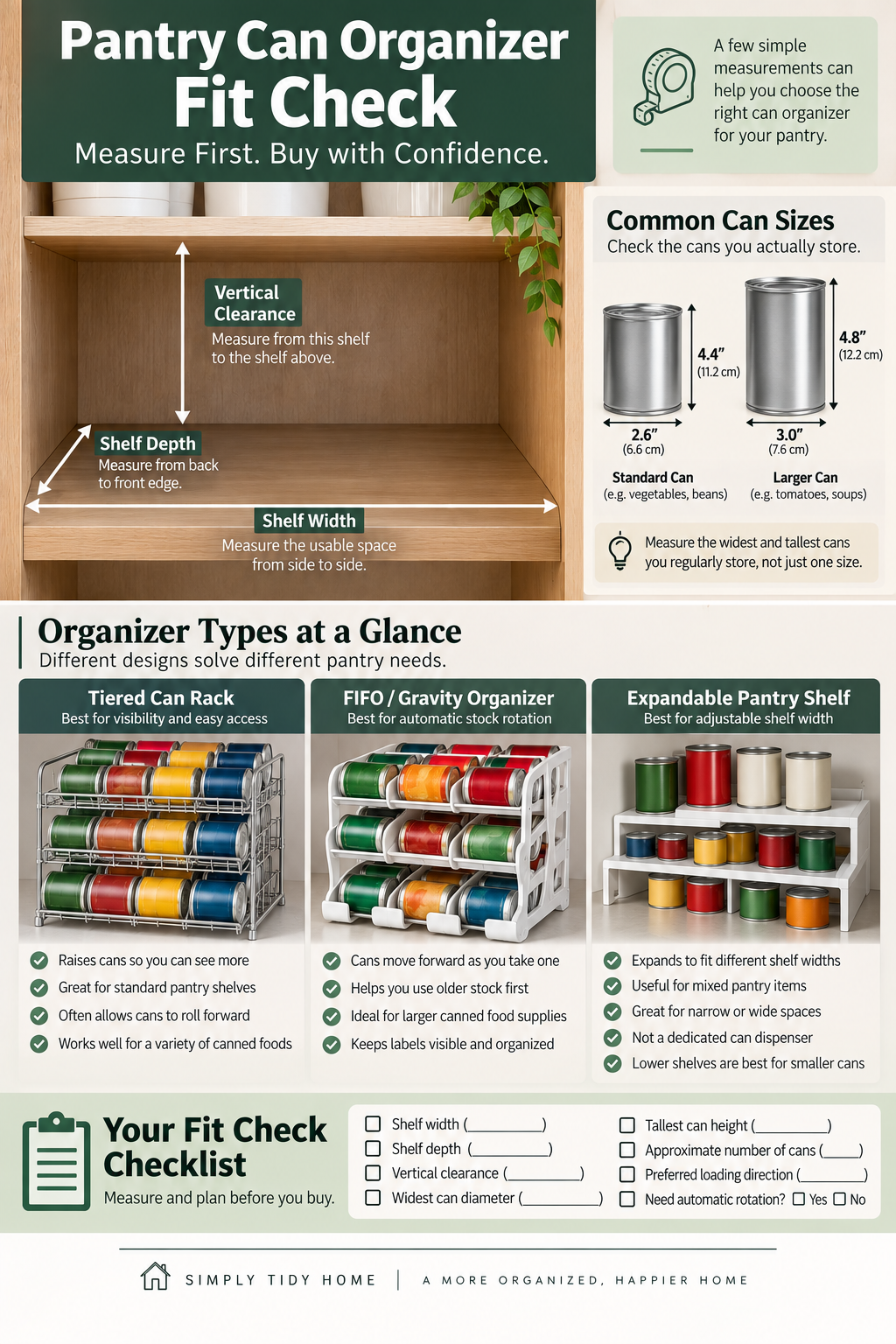
Measure your shelf and the cans you actually store before choosing a pantry can organizer.
Step 3: Decide What Problem You’re Solving
This is where the three organizer types become useful.
- If your problem is visibility: Choose a tiered rack.
- If your problem is stock rotation: Consider a FIFO organizer.
- If your problem is variable shelf width: Consider an expandable tiered shelf.
This simple decision can prevent you from buying a product that solves the wrong problem.
Step 4: Choose the Right Capacity
More capacity isn’t automatically better.
Ask yourself: How many cans do I normally keep?
If you regularly have 20–30 cans, a 36-can rack may be plenty. If you maintain a much larger canned-food inventory, a larger or multi-unit system may make more sense.
But don’t fill an organizer simply because it can hold more. Overloading storage can make cans harder to identify and remove.
Step 5: Check How the Cans Load
Look at the direction cans enter the organizer.
Some systems are designed for:
- Front loading
- Rear loading
- Top loading
- Gravity-fed movement
This affects how easy the system will be to restock. A good organizer should not require you to fight the system every time you bring home groceries.
Step 6: Think About Everyday Reach
The organizer should make the pantry easier to use every day, not just look better immediately after organizing.
Ask:
- Can I see the labels?
- Can I remove one can without moving several others?
- Can I put a replacement can back easily?
- Can I clean underneath it?
- Can everyone in the household understand where cans belong?
If the answer is yes, the organizer is doing its job.
Step 7: Build a Simple Restocking System
Once your organizer is installed, keep the system simple.
Group similar products together.
- Vegetables
- Beans
- Soups
- Tomatoes
- Sauces
- Fruit
For products you keep in larger quantities, use the organizer’s rotation system consistently.
When new cans arrive, don’t simply put them wherever there is an empty space. Place them according to the system you have chosen.
If you are also using rotating storage elsewhere in the pantry, see Best Lazy Susan Pantry Organizers for another way to improve visibility and access.
Tiered Rack vs. FIFO vs. Expandable Shelf
If you’re still unsure, use this quick decision guide.
| If your main problem is… | Start with… |
|---|---|
| Cans are hidden behind other cans | Tiered rack |
| You want labels easier to see | Tiered rack |
| You maintain a large canned-food inventory | FIFO system |
| You want automatic forward rotation | FIFO system |
| Your shelf width is unusual | Expandable shelf |
| You want flexible mixed pantry storage | Expandable shelf |
| You don’t know what you need yet | Measure first |
The important point is that these products are not interchangeable.
A product can be excellent at one pantry problem and unnecessary for another.
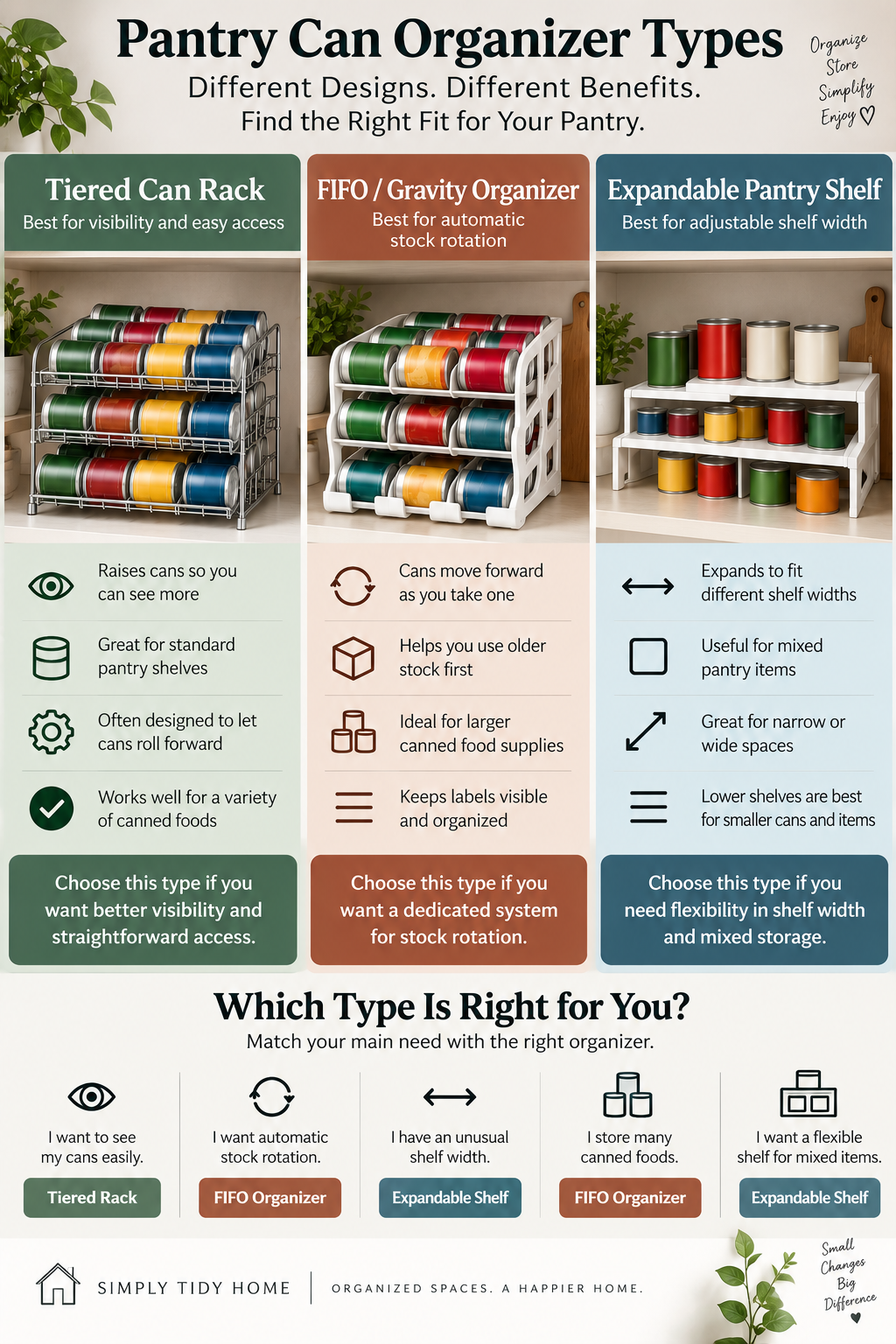
Different can organizer styles solve different pantry problems, from visibility and access to stock rotation and flexible shelf width.
A Simple Pantry Can Organization System
Once you have chosen your organizer, don’t stop at installing it.
Group
Keep similar canned foods together.
Face
Keep labels oriented so you can identify products quickly.
Rotate
Use older stock before newer stock where practical.
Reach
Put frequently used cans where they are easiest to access.
Reset
After grocery shopping, return new cans to their designated area instead of creating another stack.
This small reset is what keeps the system working after the initial cleanup.
What About Food Safety and Can Dates?
A can organizer is an organization tool, not a food-safety system.
USDA recommends storing commercially canned foods in a cool, clean, dry place and checking pantry stock regularly. It also advises against using cans that are leaking, bulging, badly rusted, or deeply dented.
USDA also distinguishes between food quality and the condition of the container. Properly stored commercially canned foods can retain good quality for long periods, but storage conditions and the condition of the can still matter.
So use a can organizer to make your pantry easier to inspect and rotate—but don’t rely on it to determine whether a particular can is safe to eat.
Before You Buy: The Pantry Can Organizer Fit Check
Before ordering, write down these eight measurements or decisions:
Shelf
- Width: ______
- Depth: ______
- Vertical clearance: ______
Cans
- Widest can: ______
- Tallest can: ______
Storage
- Approximate number of cans: ______
- Preferred loading direction: ______
- Need FIFO rotation? Yes / No
This takes only a few minutes and can prevent an otherwise good organizer from becoming another source of pantry clutter.
Frequently Asked Questions
What is the best way to organize canned goods in a pantry?
Start by grouping similar cans, improving visibility, and making frequently used products easy to reach. A tiered rack can help when cans are stacked behind one another, while a FIFO system can be useful when regular stock rotation is important.
Are FIFO can organizers worth it?
They can be worthwhile if you maintain a larger canned-food inventory or regularly buy multiple cans of the same products. If you use canned food quickly and mainly need better visibility, a simpler tiered rack may be enough.
How deep should a pantry shelf be for a can organizer?
There is no single ideal shelf depth because organizer dimensions vary. Measure your usable shelf depth and compare it with the organizer’s required depth before buying.
How do I choose a can organizer for different can sizes?
Measure the cans you actually store, especially the widest and tallest ones. Then check the organizer’s dimensions and loading design. If your pantry contains several can sizes, choose a system that accommodates your most common sizes rather than assuming every can is identical.
Do pantry can organizers save space?
They can make better use of vertical space and improve visibility, but the organizer itself also takes up space. The goal is not simply to add storage capacity; it is to make the existing shelf easier to use.
Should I choose a tiered rack or FIFO organizer?
Choose a tiered rack if visibility and straightforward access are your main concerns. Choose FIFO if systematic stock rotation is important. If shelf width is your biggest constraint, an expandable tiered shelf may be more appropriate.
Affiliate disclosure
As an Amazon Associate I earn from qualifying purchases. Some links below are paid links, which means Simply Tidy Home may earn a commission if you purchase through them, at no additional cost to you.
Product availability, pricing, dimensions, and options can change. Check the current Amazon listing and confirm the size and fit before purchasing.
Final Takeaway
The best can organizer for your pantry is the one that fits your shelf, your cans, and your routine.
If you want a dedicated tiered rack for a larger standard pantry shelf, the Simple Houseware 3-Tier is the strongest match from this comparison.
If your main constraint is shelf width and you want flexibility, the Dial Industries Expandable Shelf offers a different approach.
If you maintain a larger canned-food inventory and specifically want FIFO rotation, the FIFO Can Tracker 2-Pack is the specialized choice.
But whichever system you choose, start with the same rule: